An orchestral music for sleep workflow is the intentional, structured use of symphonic soundscapes to guide your nervous system from alertness into deep, restorative rest. This is not simply pressing play on a classical playlist and hoping for the best. The practice draws on specific compositional features, frequency science, and deliberate playlist architecture to support what sleep researchers call parasympathetic activation, the body’s “rest-and-digest” state. Composers such as Robert Emery and Moritz Schneider have built entire catalogues around this precise goal, blending live orchestral recordings with ambient textures and sleep-supportive frequencies. Get the workflow right, and orchestral music becomes one of the most reliable tools in your sleep toolkit.
What makes orchestral music for sleep workflow actually work?
The single most important concept in sleep-focused orchestral music is minimal friction. Minimal friction means a composition avoids sudden dynamic changes, complex melodic leaps, or abrupt shifts in instrumentation. Any of those elements can jolt the brain back into alertness, which is precisely what you are trying to avoid at 11 o’clock on a Tuesday.
Effective relaxing orchestral tracks share a recognisable set of features. Slow tempos, typically below 60 beats per minute, mirror the resting heart rate and encourage the body to follow. Soft dynamics, sustained string textures, and gradual harmonic movement all signal safety to the nervous system. Nervous system regulation is an active process, not a passive one. Music designed to calm the fight-or-flight response actively transitions the listener toward parasympathetic dominance, the physiological state that makes deep sleep possible.
Beyond tempo and dynamics, the most effective orchestral sleep sounds often incorporate ambient field recordings. Think gentle rain, distant wind, or soft water movement woven underneath string pads. BBC Radio 3 Unwind uses exactly this approach, blending classical orchestral music with ambient field recordings to aid nervous system downregulation. The result feels less like a concert hall and more like being wrapped in a very expensive duvet.
Frequency science adds another layer. Delta-frequency isochronic tones in the 0.5–4 Hz range, embedded within orchestral production, direct brainwaves toward deep sleep cycles more effectively than standard music alone. Producer and composer Robot Koch applies this principle directly in his work, combining orchestral instrumentation with delta frequency tones for sleep efficacy. Binaural beats work similarly, though they require headphones to function properly.
Robert Emery and Moritz Schneider, the composers behind Orchestralmeditations, take a comparable approach. Their work integrates organic orchestration recorded with live musicians, including sessions at Abbey Road Studios, with modern production techniques designed for nervous system regulation. The compositional intention is built into the music from the first bar, not added as an afterthought.
- Slow tempo: Below 60 bpm to mirror resting heart rate.
- Minimal friction: No sudden dynamic shifts or complex melodic changes.
- Ambient blending: Nature sounds or field recordings layered beneath orchestral textures.
- Frequency embedding: Delta-range isochronic or binaural tones for deep sleep support.
- Sustained dynamics: Soft, consistent volume without dramatic crescendos.
Pro Tip: Before selecting a track, check the production notes or song metadata. Platforms like Harmonic Egg publish detailed song notes listing instruments, tonal focus, and frequency intent. This lets you match the music to your actual physiological state on any given night, rather than guessing.
How to build a sleep music playlist that actually keeps you asleep
The most common mistake people make with a sleep music playlist is building it like a daytime listening queue. Short tracks, abrupt transitions, and looping repetitions are fine for background music at your desk. For sleep, they are a disaster. Short loops risk waking the brain due to abrupt silence or track changes, disrupting sleep cycles at precisely the wrong moment.
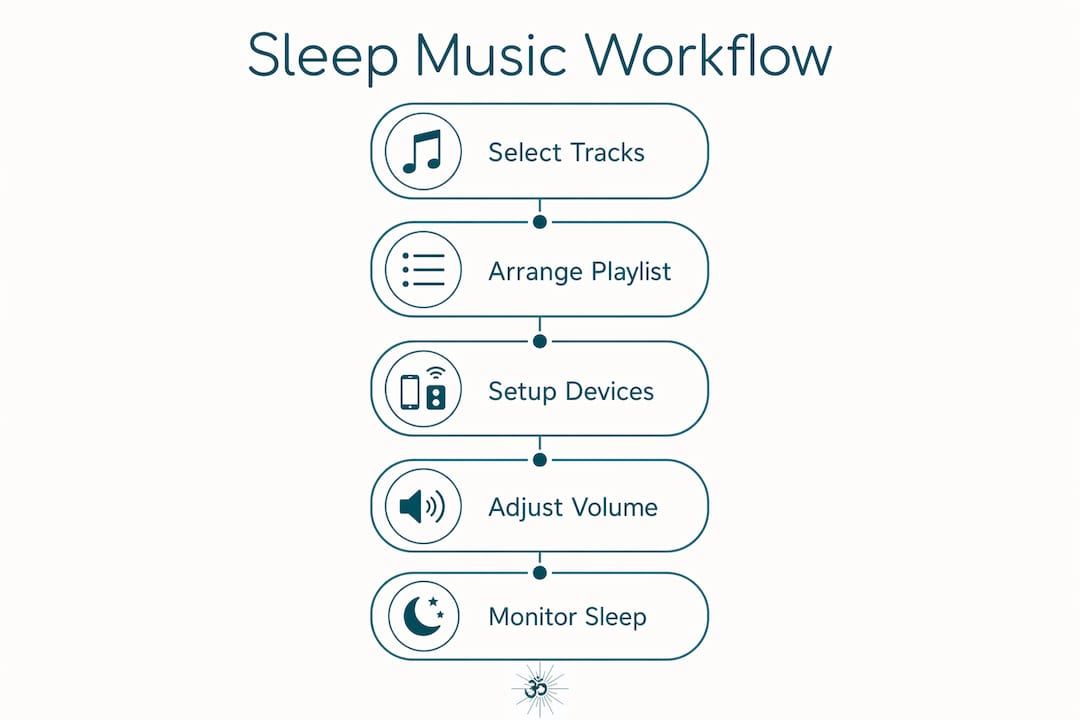
The solution is long-form continuous playback. Here is how to build a playlist that works through the night.
-
Start with a track of at least 60 minutes. Ideally, your opening piece runs 60–90 minutes to carry you through the initial sleep onset phase without any interruption. Robot Koch’s Soft Euphoria runs a full 3 hours and integrates ambient textures with delta frequencies, making it a strong anchor track for any sleep playlist.
-
Sequence from active to passive. Begin with slightly warmer, more melodically present orchestral music to meet your current mental state. Gradually move toward sparser, more ambient textures as the playlist progresses. Think of it as a sonic ramp down, not a cliff edge.
-
Avoid track gaps. Even a two-second silence between tracks can register as a threat signal to a lightly sleeping brain. Use a music player or app that supports gapless playback. Spotify supports this in settings; Apple Music does too.
-
Aim for a total runtime of at least 3 hours. BBC Radio 3 Unwind’s Sleep Tracks episodes typically last over 300 minutes, creating an uninterrupted audio environment for deep rest. That runtime is not accidental. It covers the full sleep architecture of most adults.
-
Mix orchestral and ambient elements intentionally. A track that blends strings with rain or forest sounds tends to hold the nervous system in a relaxed state longer than pure orchestral music alone. The natural sounds provide a grounding, familiar quality that the brain interprets as safe.
Pro Tip: Test your playlist on a weekend when a disrupted night matters less. Note the exact point where you wake, if you do. That is almost always where a track transition, loop restart, or volume spike occurs. Fix that one moment and your playlist improves dramatically.
How to integrate orchestral music into your nightly sleep routine
Choosing the right music is only half the job. How and when you use it matters just as much. A well-constructed orchestral sleep sounds library does very little if you start playing it while scrolling through your phone with the overhead light blazing.
The timing of playback is the first variable to get right. Start your orchestral music 20–30 minutes before you intend to sleep, not at the moment you turn the light off. This gives your nervous system time to begin the transition. Think of it as a warm-up in reverse. You are cooling down, and the music is the signal that the cool-down has begun.
Environment setup matters enormously. Consider these practical steps:
- Set volume to a conversational level or lower. Loud music, even beautiful music, keeps the auditory cortex engaged. Aim for a level where you can hear the music clearly but would not struggle to talk over it.
- Use a dedicated device. A phone that also receives notifications is a liability. A dedicated tablet, a smart speaker set to Do Not Disturb, or a purpose-built sleep sound device removes the risk of a notification cutting through a quiet string passage at 2 a.m.
- Darken the room completely. Light and sound work together. A dark room amplifies the calming effect of orchestral music for relaxation by removing competing sensory input.
- Match music intensity to your stress level. If you have had a genuinely difficult day, start with something slightly warmer and more melodically present. The works of Robert Emery and Moritz Schneider are designed with this kind of holistic wellness intent in mind, offering a range of emotional textures rather than a single sonic template.
- Use orchestral music at your workspace in the late afternoon. Preparing your nervous system before you even reach the bedroom makes the evening transition smoother. Playing gentle orchestral music for relaxation during the last hour of work reduces the cortisol spike that makes falling asleep difficult.
The use of appropriate devices and configured volume for immersive playback is one of the most consistently overlooked elements of an effective sleep workflow. Getting this right costs nothing and makes a measurable difference.
What are common mistakes when using orchestral music for sleep?
Even people who understand the theory get this wrong in practice. The gap between knowing what works and actually doing it is where most sleep music workflows fall apart.
The most frequent error is choosing music with high friction. A dramatic film score, a Romantic-era symphony with fortissimo climaxes, or a playlist that shuffles between genres will keep your brain alert rather than calm it. Minimal friction in orchestral scoring is the defining feature of effective sleep music. If the music would work well in a cinema trailer, it will not work well at bedtime.
Here are the most common pitfalls and how to fix them:
- Using short tracks or looping playlists. A 4-minute track that loops creates a predictable pattern the brain learns to anticipate. That anticipation is the opposite of sleep. Replace short loops with long-form continuous compositions.
- Ignoring your nervous system state. Playing very sparse, near-silent ambient music when you are genuinely anxious can feel unsettling rather than calming. Match the music’s energy to where you are, then let it guide you downward.
- Overlooking production metadata. Not all “sleep music” is produced with sleep in mind. Reading the song notes or production description tells you whether a composer has embedded frequency work or simply labelled a piano piece as relaxing.
- Noisy environments without compensation. If your environment is genuinely noisy, low-volume orchestral music will not mask the disruption. Either increase volume slightly (while staying below the alerting threshold) or add a layer of brown noise underneath the orchestral track.
- Switching tracks mid-night. Waking at 3 a.m. and reaching for your phone to change the music defeats the entire purpose. Choose a long enough track or playlist before you sleep and commit to it.
Pro Tip: Keep a simple note on your phone with two or three tracks that worked well for you and two or three that did not. After a fortnight, the pattern becomes obvious. Your personal sleep music profile is more useful than any generic “best music for sleep” list.
Key takeaways
An effective orchestral music sleep workflow depends on long-form, minimal-friction compositions, deliberate playlist architecture, and a consistent pre-sleep environment that gives your nervous system time to shift gears.
| Point | Details |
|---|---|
| Minimal friction is non-negotiable | Choose orchestral tracks with no sudden dynamic shifts, complex melodies, or abrupt instrumentation changes. |
| Long-form tracks prevent disruption | Aim for continuous playback of at least 3 hours to cover full sleep architecture without interruptions. |
| Start music before lights out | Begin playback 20–30 minutes before sleep to give the nervous system time to transition. |
| Match music to your stress state | Higher-stress evenings need warmer, more melodically present music before moving to sparser textures. |
| Read production metadata | Song notes and frequency details help you select tracks that match your physiological state on any given night. |
Why I think most people are using orchestral sleep music backwards
Here is the thing nobody tells you: most people treat orchestral sleep music as a last resort. They have already been lying in bed for 45 minutes, phone in hand, cortisol quietly humming, and then they press play on a string quartet and wonder why it is not working. That is like trying to stop a runaway train by placing a cushion on the tracks.
The composers who understand this best build the transition into the music itself. Robert Emery and Moritz Schneider, whose work I have spent considerable time with, approach composition with the listener’s physiological state as the starting point, not an afterthought. Their recordings, made with live musicians and produced with frequency-conscious techniques, are structured to meet you where you are and move you somewhere quieter. That is a fundamentally different creative intention from simply writing “calm” music. You can read more about the science behind sleep music if you want the research to back that up.
What I have found, both personally and from years of paying attention to how people actually use music for sleep, is that the workflow matters more than the specific track. A mediocre piece of orchestral music used consistently, at the right time, in the right environment, will outperform a masterpiece played at random on a noisy phone with notifications on. The music is the tool. The workflow is the skill. If you want to go deeper on the therapeutic side of this, the orchestral sound healing guide for 2026 is worth your time.
My honest recommendation: pick one long-form track or album from a composer who has stated their sleep or wellness intention clearly. Use it for two weeks without changing it. You will be surprised how quickly your nervous system learns to associate that sound with rest.
— ROBERT
Discover orchestral sleep music built for your nervous system
Orchestralmeditations produces orchestral meditation and sleep music recorded at Abbey Road Studios with the National Philharmonic, featuring compositions by Robert Emery and Moritz Schneider. Every track is crafted with nervous system regulation in mind, integrating binaural beats, theta frequencies, and 3D surround sound techniques. If you are ready to move beyond generic playlists, the English meditation music library offers a curated selection of long-form orchestral compositions designed specifically for deep relaxation and sleep. For a broader view of their top-rated recordings, the best meditation music collection is an excellent starting point for building your personal sleep workflow.
FAQ
What is an orchestral music sleep workflow?
An orchestral music sleep workflow is the structured, intentional use of orchestral compositions to guide the nervous system from alertness into deep, restorative sleep. It combines track selection, playlist architecture, timing, and environment to support parasympathetic activation.
How long should orchestral sleep music play for?
Orchestral sleep music should play for at least 3 hours without interruption. BBC Radio 3 Unwind’s Sleep Tracks run over 300 minutes, covering the full sleep architecture of most adults without disruptive track changes or loops.
Do binaural beats and delta frequencies actually help with sleep?
Yes. Isochronic tones and binaural beats in the 0.5–4 Hz delta range, embedded in orchestral production, direct brainwaves toward deep sleep cycles more effectively than standard music. Binaural beats require headphones to work correctly.
What makes orchestral music better for sleep than other genres?
Orchestral music offers sustained, layered textures at slow tempos that mirror resting physiological states. When composed with minimal friction and no abrupt dynamic shifts, it signals safety to the nervous system in a way that most other genres do not.
How do I choose the right orchestral sleep track for my stress level?
Read the production notes or song metadata before selecting a track. Composers like Robert Emery and Moritz Schneider publish details about their compositional intent and frequency use. On high-stress nights, choose warmer, more melodically present music and let the playlist guide you toward sparser textures as you settle.