If you are hunting for zenmix.io alternatives, here is the short answer sorted by what you actually need:
- Generative ambient players (Noisli, myNoise, Noizio, Blanket, Ambi, Moodist): best for personal focus, sleep, or casual relaxation. Free or low-cost, web and mobile, personal use only.
- Research-backed brainwave apps (Brain.fm): best for cognitive performance, focus sessions, or medically curious users who want science behind the sound.
- Professional royalty-free orchestral libraries (Orchestralmeditations): best for UK yoga instructors, therapists, app developers, and content creators who need explicit commercial licences and live-recorded, high-fidelity audio.
One-line verdict: if you are a casual listener, start with a generative ambient player; if you run classes, clinics, or produce wellness content, you need a professional library with a written commercial licence. Production credits — composers such as Robert Emery and Moritz Schneider — are meaningful trust signals when choosing a library for therapeutic use.
How do the main categories of alternatives compare?
Community aggregators consistently split the ambient and meditation audio space into three distinct tiers, each with a different licence shape and production depth.

| Category | Best for | Pricing / licence | Platforms | Offline | Audio production | Commercial licence |
|---|---|---|---|---|---|---|
| Generative ambient players | Personal focus, sleep, relaxation | Free to ~£5/month; personal use | Web, iOS, Android | Varies | Generative loops or mixed soundscapes | Rarely available |
| Research-backed brainwave apps | Cognitive focus, sleep science | Subscription; personal | Web, iOS, Android | Limited | Engineered binaural / neural audio | Not standard |
| Royalty-free orchestral libraries | Therapy, yoga, apps, wellness content | Per-track or subscription; personal + commercial | Web, download | Yes (download) | Live-recorded, 3D surround, binaural, frequency-engineered | Explicit, written |
A few things worth noting about where each tier falls short:
- Generative ambient players are excellent for personal use but lack commercial licences, making them unsuitable for UK studios or streamed wellness content.
- Research-backed brainwave apps are compelling for focus but rarely offer downloadable stems or explicit public-performance rights.
- Professional orchestral libraries cost more upfront, but the licence clarity and audio fidelity justify that for anyone producing content or running paid sessions.
Which specific tools should you actually try?
Aggregator directories list more than 40 apps in this space, which is both reassuring and slightly exhausting. Here is what each category actually contains and who it suits.
Generative ambient players
This is the largest group and the most varied. Tools like Noisli, myNoise, Noizio, Blanket, Ambi, and Moodist all let you mix ambient sounds (rain, café noise, white noise, nature) to build a personal soundscape. Most are free or freemium, with optional paid tiers for extra sounds or offline access.
- Noisli: web and mobile, clean interface, good for productivity playlists. Free tier available; paid plan adds offline and more sounds.
- myNoise: browser-based with an unusually deep library of engineered soundscapes. Donation-supported; no commercial licence.
- Noizio: macOS and iOS focused, minimal design, good for desk workers. One-time purchase.
- Blanket and Ambi: open-source Linux/desktop options for users who want local control and no subscription.
- Moodist: lightweight browser tool with mood-based presets. Free.
What unites them: personal use only, no production credits, and short looped files rather than generative or live-recorded content. For a 90-minute yoga class, that loop will repeat. Noticeably.
Pro Tip: Test any ambient player on a 30-minute loop before committing. If you can hear the seam where the file restarts, your clients will too.
Research-backed brainwave apps
Brain.fm sits in its own lane. It uses engineered neural audio designed to push the brain toward specific states — focus, relaxation, sleep — within 10–15 minutes of use. It is subscription-based, available on web, iOS, and Android, with limited offline capability.

The trade-off: Brain.fm is personal-use only and does not offer downloadable stems or commercial licences. It is genuinely useful for individual practitioners who want science-backed audio for their own sessions, but it cannot legally be played in a paid class or embedded in a client app.
| Tool | Trial available | File download | Commercial licence | UK licence clarity |
|---|---|---|---|---|
| Noisli | Yes (free tier) | No | No | Personal only |
| myNoise | Yes (free) | No | No | Personal only |
| Brain.fm | Yes (free trial) | No | No | Personal only |
| Noizio | Yes (free tier) | No | No | Personal only |
| Orchestralmeditations | Yes (samples) | Yes (high-bitrate) | Yes (explicit) | Written, UK-ready |
How do you choose the right alternative for your situation?
The honest answer is that most people pick the wrong tool because they skip the licence check. Here is a quick process that takes about 15 minutes and saves a lot of grief later.
- Define your use case first. Personal listening at your desk is a completely different requirement from streaming music during a paid therapy session or embedding tracks in a wellness app.
- Test the audio quality on good headphones. Synthetic loops and live orchestral recordings sound very different at volume. A short looped file that sounds fine on laptop speakers can feel thin and repetitive through studio monitors.
- Read the licence page, not the marketing copy. Look for explicit language covering public performance, streaming, and distribution. If the licence page says “personal use only” or says nothing at all, assume it means personal use only.
- Check the file format and bitrate. Professional use typically requires high-bitrate WAV or FLAC files, not compressed MP3s. Open-source apps often rely on user-supplied files to keep their app size small; professional libraries deliver high-bitrate downloadable stems.
- Contact support with a specific question. Ask: “Does your licence cover playing this track during a paid group meditation class in the UK?” A vague or slow answer is itself useful information.
Red flags to watch for:
- Licence wording that is ambiguous about commercial use or territory
- Only short looped files with no generative or live-recorded option
- No named composers, producers, or recording credits
- No refund or demo policy
Pro Tip: UK practitioners should ask for written confirmation that the licence covers public performance and distribution within client materials. A PDF or email reply is your evidence if a rights dispute ever arises.
When does a professional orchestral library make more sense?
Background noise apps and professional meditation music are genuinely different categories. The former is engineered for personal productivity; the latter is designed to produce specific physiological outcomes through layered live instrumentation and frequency engineering. That distinction matters enormously when you are working with clients.
Orchestralmeditations records with live musicians, including sessions at Abbey Road Studios with the National Philharmonic. The result is a harmonic richness and dynamic range that synthetic loops simply cannot replicate — and that richness reduces auditory fatigue during longer sessions, which is a real clinical consideration.
Robert Emery is a composer and producer with a background in orchestral scoring and sound design, whose work spans film, television, and therapeutic audio. Moritz Schneider brings a similar blend of classical training and studio production, with particular attention to how frequency layering affects listener state. Both bring a level of intentionality to the recording process that you simply do not get from a generative algorithm or a single developer’s ambient loop pack.
The library also includes binaural beat technology, theta frequencies, and Solfeggio-based tracks, each documented so practitioners can match the right track to the right session outcome. For UK-based wellness professionals, the commercial licence is explicit, written, and covers studio use, streaming, and client-facing distribution. That is not a minor detail — it is the difference between legal clarity and a copyright risk sitting quietly in your business.
- Live orchestral recording with 3D surround sound
- Binaural and theta frequency tracks with documented frequency content
- Explicit commercial licences covering public performance and distribution
- Named composers and producers as trust signals
- High-bitrate downloadable stems for therapeutic integration
Key takeaways
For UK wellness professionals, the single most important rule is this: never use a personal-use ambient app in a paid session or commercial content without a written commercial licence.
| Point | Details |
|---|---|
| Match tool to use case | Generative ambient players suit personal use; professional libraries suit commercial and clinical settings. |
| Licence check is non-negotiable | Many free ambient apps are personal-use only; UK practitioners need written confirmation covering public performance and distribution. |
| Audio quality affects outcomes | Live orchestral recordings reduce auditory fatigue in long sessions; short loops repeat noticeably and can disrupt immersion. |
| Production credits matter | Named composers such as Robert Emery and Moritz Schneider signal intentional, therapeutically considered production. |
| Orchestralmeditations for professionals | Offers explicit commercial licences, high-bitrate downloads, and live-recorded orchestral tracks suitable for UK studio and content use. |
Why the licence question matters more than the sound quality question
Here is something most “best ambient apps” articles quietly skip: the gap between what sounds good and what you are legally allowed to use in your work is enormous, and the consequences of getting it wrong are not abstract.
The ambient app space is full of genuinely lovely tools. Noisli is pleasant. myNoise has an almost absurd depth of soundscape options. Brain.fm is doing something genuinely interesting with neural audio research. None of that changes the fact that playing any of them during a paid class, embedding them in a client app, or using them as the soundtrack to a YouTube wellness video without a commercial licence is a copyright infringement.
What I have observed, working with practitioners who use orchestral soundscapes for mental wellness, is that the licence question tends to get asked only after something goes wrong. A YouTube Content ID claim. A venue asking for proof of music rights. A client asking whether the music in their guided audio download is cleared for redistribution.
The production quality argument is real too. Session musicians, studio mastering, and composers like Robert Emery who approach therapeutic audio as a craft rather than a side project — these things produce a different listening experience. Not just subjectively nicer, but functionally different in long sessions where a looping synthetic file starts to feel like a dripping tap.
For personal use, pick whatever sounds good to you. For professional use, get the licence in writing first.
Orchestralmeditations: royalty-free orchestral music for UK professionals
If you have read this far and realised that a personal-use ambient app is not going to cut it for your studio, clinic, or content library, Orchestralmeditations is built precisely for that gap.
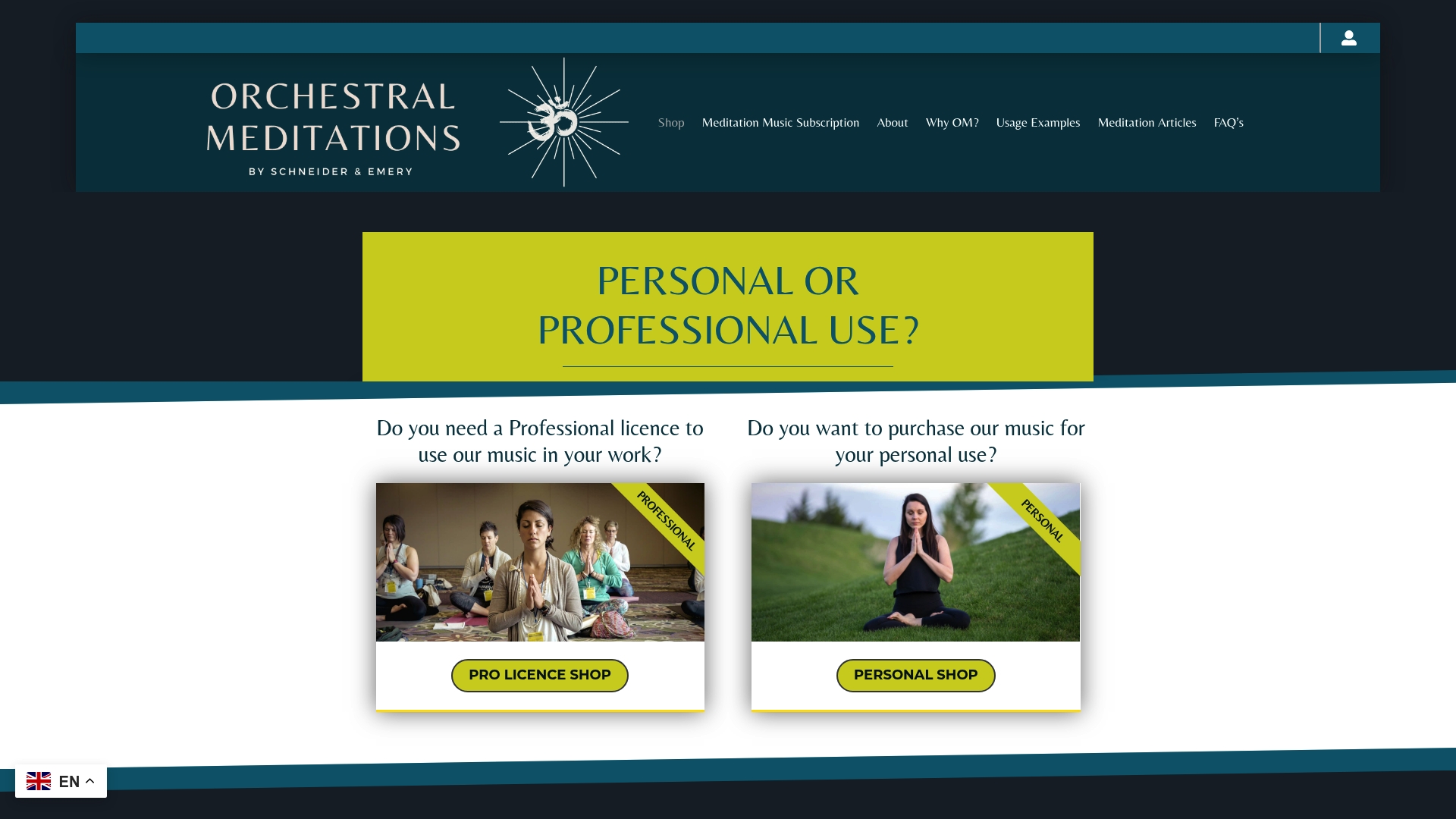
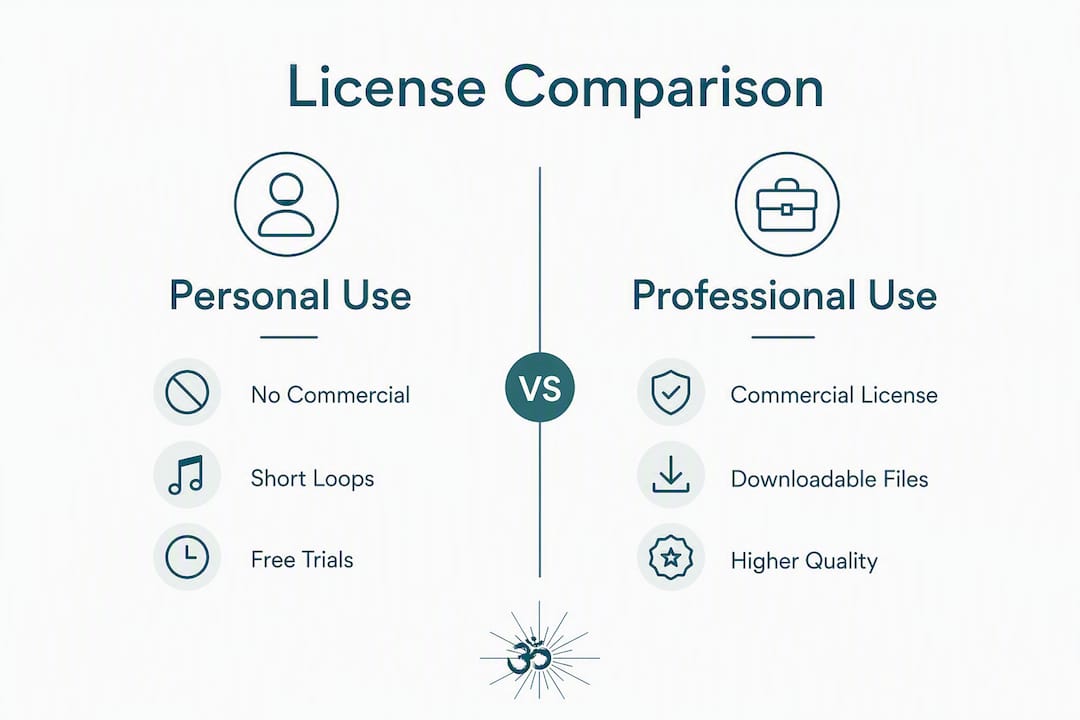
The library covers orchestral meditation tracks, binaural and theta frequency recordings, Solfeggio-based compositions, and guided audio, all recorded with live musicians. Personal and professional licences are both available, with the commercial licence explicitly covering studio use, streaming, and distribution within client materials — in writing, for UK buyers.
You can browse the full meditation music library and listen to samples before purchasing. Individual tracks and subscription options are both available, so you are not locked into a format that does not suit your workflow. For a clear breakdown of personal versus professional licence tiers, the best meditation music page is the right starting point.
Useful sources for testing alternatives and checking licences
Before committing to any platform, it is worth spending time with the primary sources rather than relying on aggregator summaries alone.
Orchestralmeditations resources for practitioners:
- Royalty-free music for hypnotherapy: licence guidance and examples for clinicians
- Relaxation music checklist: practical selection criteria for wellness professionals
- Binaural beat guide for meditation: session design and technical notes
- Orchestra music for meditation: deep dive on orchestral arrangements
External discovery and aggregator sources:
| Source | What it covers | Useful for |
|---|---|---|
| AlternativeTo | Community-voted alternatives with feature tags | Initial discovery of ambient tool options |
| SaaSHub | Verified product listings with competitor comparisons | Checking which tools are actively maintained |
| Product Hunt | User reviews and upvotes for ambient/meditation apps | Gauging community sentiment before trialling |
Always verify licence territories and file formats directly with the provider before purchase. Aggregator listings do not always reflect the most current licence terms, and a tool’s “free” tier may have changed since the listing was last updated.
FAQ
What are the best free zenmix.io alternatives?
Noisli, myNoise, and Moodist are the most widely used free options, offering ambient sound mixing for personal focus and relaxation. All are personal-use only and do not provide commercial licences.
Can I use ambient sound apps commercially in my UK yoga or therapy practice?
Most free ambient apps are personal-use only, meaning playing them in paid sessions or embedding them in client content is a licence infringement. UK practitioners need an explicit commercial licence, such as those offered by Orchestralmeditations.
What makes Brain.fm different from other ambient sound tools?
Brain.fm uses engineered neural audio designed to guide the brain toward specific states within 10–15 minutes, rather than simply masking noise. It is subscription-based and personal-use only.
Why do production credits matter when choosing meditation music?
Named composers and producers signal that the music was created with therapeutic intent and consistent quality standards. Producers such as Robert Emery and Moritz Schneider bring orchestral and frequency-engineering expertise that generative or single-developer tools cannot replicate.
How do I verify that a meditation music licence covers UK commercial use?
Read the licence page carefully for explicit language about public performance, streaming, and distribution territory. Then contact the provider directly and ask for written confirmation that your specific use case — studio, class, app, or client audio — is covered.