For UK practitioners who need licensable, live-recorded orchestral and binaural meditation music, Orchestralmeditations is the recommended alternative. Three reasons settle it quickly:
- Licence clarity: professional and commercial licences explicitly covering public performance, in-app streaming, and paid sessions in the UK, with no PPL/PRS overhead when you use rights-inclusive tracks.
- Live orchestral quality: real musicians, real rooms, real emotional weight — not a synthesiser approximating a string section.
- Studio provenance: recordings made at Abbey Road Studios with the National Philharmonic, giving you credits you can actually show a client or an app store reviewer.
If you run yoga classes, therapy sessions, or a wellness app and you need music that holds up legally and artistically, that is your short answer. Everything below explains how to verify it, implement it, and avoid the traps along the way.
Why does live orchestral music matter more than you might think?
Synthetic libraries are cheap and plentiful. They are also, to a trained ear (and sometimes an untrained one), a bit like a photograph of a fire: technically accurate, but missing the warmth entirely.
Research published in PNAS found that live, adaptive musical performance increased amygdala activity and synchronised physiological responses more reliably than recorded playback. In plain terms: live-recorded orchestral music reaches the limbic system — the part of the brain that governs emotion and stress response — more consistently than its synthetic equivalent. For therapists and yoga teachers, that is not a trivial distinction. It is the difference between a client who relaxes and a client who merely sits quietly.
Binaural and 3D formats compound this effect. When tracks are engineered with binaural beats and spatial audio, headphone listeners experience a measurable shift in brainwave entrainment. Pair that with orchestral soundscapes built for mental wellness and you have something that genuinely supports a therapeutic outcome, not just a pleasant background hum.
What do UK practitioners actually need to know about PPL/PRS?
Here is the short version: GOV.UK guidance states that businesses playing recorded music in public must hold a licence — but explicitly notes that royalty-free music is exempt from that requirement, provided the licence genuinely covers public performance.
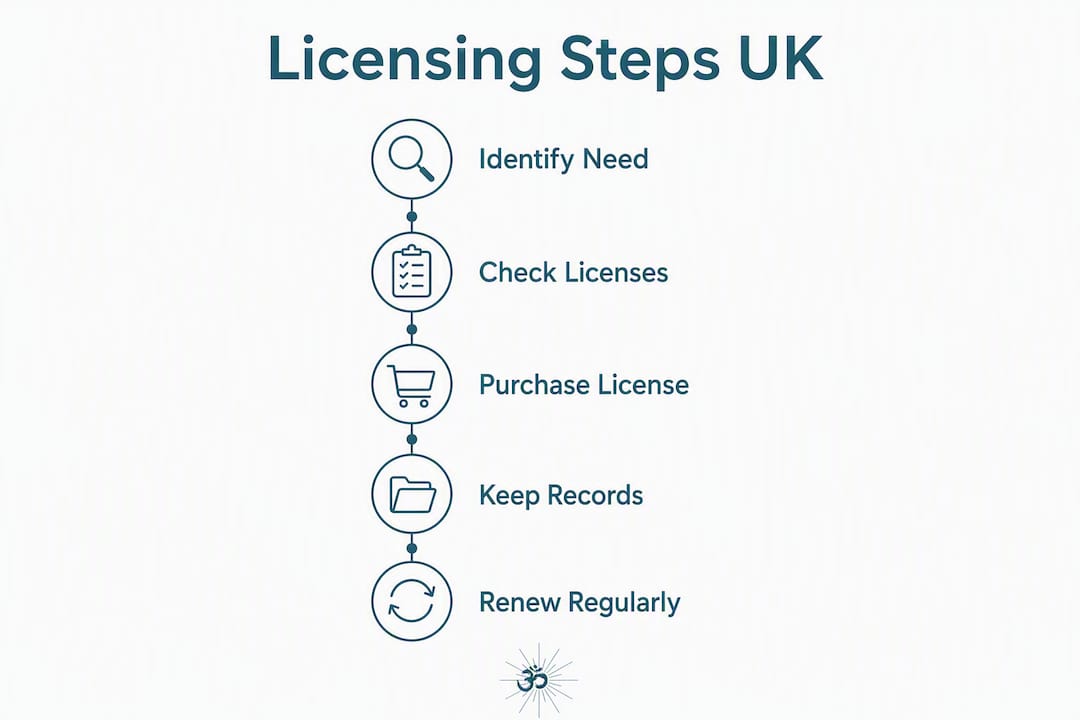
TheMusicLicence from PPL PRS consolidates both PPL and PRS rights for most commercial uses, including fitness and yoga classes. If you use standard commercial tracks — even from a streaming service — you need it. If you use rights-inclusive royalty-free music with explicit public performance coverage, you do not.
Practically, this means:
- UK invoiceability: — you want a receipt or licence certificate you can produce if a PPL PRS inspector asks.
Pro Tip: Keep a dedicated folder — digital or physical — containing the licence certificate, purchase receipt, and permitted-use summary for every track you use commercially. If you ever face a query from PPL PRS or a venue, you can resolve it in under two minutes.
How do you choose the right source? A checklist for UK professionals
Before you spend a penny, run through these questions on any vendor’s licence page:
- Does the licence explicitly name public performance as a permitted use?
- Does it cover in-app streaming and redistribution if you are building a wellness app?
- Is the licence one-time (perpetual) or does it expire with a subscription?
- Are composer and producer credits listed and verifiable?
- Can you download WAV files or stems for professional integration?
- Is there a full-length preview before purchase?
- Does the vendor provide a licence certificate or receipt suitable for UK compliance records?
- Is UK pricing in GBP available, or at minimum a clear invoiceable transaction?
Red flags to walk away from:
- Vague wording like “personal and commercial use” with no definition of what “commercial” covers.
- No named composer or producer — anonymous tracks are harder to defend in a licensing dispute.
- Preview clips under 30 seconds (you cannot assess therapeutic fit from a snippet).
- No refund or satisfaction policy.
- Pricing in a foreign currency with no GBP equivalent and no UK-addressable invoice.
How does Orchestralmeditations compare to other ways to source meditation music?
| Solution type | Best for | Licensing & commercial terms | Pricing model | Audio quality | UK suitability | Ease of integration | Guarantees/previews |
|---|---|---|---|---|---|---|---|
| Royalty-free orchestral libraries (e.g. Orchestralmeditations) | Practitioners, therapists, app developers needing named credits and professional licences | Explicit public performance, in-app, and commercial use; licence certificate provided | One-off purchase or subscription | Live-recorded, binaural/3D, studio-credited | GBP pricing, UK-compliant receipts | WAV, stems, metadata-ready | Full previews, refund policy |
| Synthetic stock libraries | Budget-conscious creators needing volume | Varies widely; often excludes public performance | Subscription | Programmatic, no live musicians | Licence terms often vague for UK public use | Easy download | Limited previews |
| Marketplace licences | One-off projects, video producers | Per-track sync licences; rarely covers live performance | Per-track fee | Mixed; depends on contributor | Often US-centric terms; UK public performance unclear | Standard formats | Preview available; refunds rare |
| Bespoke composer commissions | High-budget productions needing unique IP | Full rights transfer possible; negotiated | Project fee (high) | Highest possible | Fully customisable | Stems and masters delivered | Contractual guarantee |

Orchestralmeditations sits in the first row for a reason. For most UK wellness professionals, the combination of live-recorded quality, explicit commercial licensing, and named studio credits makes it the practical choice. Bespoke commissions offer more creative control but at a cost that most independent practitioners cannot justify. Synthetic libraries are fine for background content where no one is paying close attention — which is rarely the case in a professional therapy room.
Seven steps to licence and implement tracks legally in the UK
A clear process removes the guesswork entirely. Follow this for every track you use commercially:
- Choose your licence type — personal (private listening) or professional/commercial (classes, apps, paid sessions). Select the professional licence if any revenue is involved.
- Confirm public performance rights — read the licence wording; the phrase “public performance” must appear explicitly.
- Obtain your invoice and licence certificate — download and store both immediately after purchase.
- Download the correct file format — WAV at 24-bit/48kHz for professional use; request stems if you plan to layer tracks under voiceover.
- Embed metadata — add track title, composer, licence reference, and purchase date to the file’s metadata fields before integrating into any app or session playlist.
- Test in a live session — play the full track in context (headphones for binaural, room speakers for group settings) before committing it to a programme.
- Retain licence documentation — store certificates alongside session records; review annually if using a subscription model to confirm renewal.
Pro Tip: If you edit a track — trimming an intro, looping a section — save the edited version under a new filename that includes the original track name and your edit date. Version control sounds tedious until you need to prove which licensed version you used in a recorded session.
Ongoing compliance checklist:
- Renew subscription licences before expiry and re-download updated certificates.
- Check licence terms before repurposing a track for a new medium (e.g. moving from in-person classes to a podcast).
- Confirm in-app streaming rights separately if you distribute via a third-party platform.
Should you test tracks before committing?
Yes, and here is how to do it properly rather than just pressing play and hoping for the best.
- Full-length preview first: never assess a track from a 30-second clip. A meditation track that opens beautifully can shift key or tempo in ways that disrupt a guided session. Listen end-to-end.
- Binaural test on headphones: binaural tracks only work correctly on headphones. Play the track binaurally and check for the characteristic spatial widening effect; if it sounds flat, the encoding may be off.
- Layer under voice: play the track at session volume while speaking a guided meditation script aloud. Check that the orchestral dynamics do not compete with or overwhelm your voice.
- A/B test across two sessions: use Track A in one class, Track B in the next, and collect brief qualitative feedback from participants. Even three or four comments will tell you which track created deeper engagement.
- Check the refund policy: a reputable provider will offer either a satisfaction guarantee or a clear returns process. If neither exists, treat that as a red flag.
You can explore techniques for enhancing meditation with sound to sharpen your ear for what works in a live group context before you test.
Who made the music? Robert Emery, Moritz Schneider, and why credits matter
Named composer and producer credits are not just a nice-to-have. They are a licensing transparency signal — and in a dispute, they are evidence.
Robert Emery is a British composer and conductor whose career spans orchestral film scoring, live concert work, and therapeutic music production. His credits include conducting and arranging for major UK orchestral ensembles, and his approach to meditation music draws on classical compositional structure to create pieces that sustain emotional coherence across long listening sessions — precisely what a 45-minute yoga class demands.
Moritz Schneider brings a production background rooted in psychoacoustic engineering. His work on binaural and 3D surround formats for Orchestralmeditations reflects a technical understanding of how spatial audio affects brainwave entrainment, particularly in the theta frequency range (4–8 Hz) associated with deep meditative states. That is not marketing language; it is the reason the tracks feel different on headphones.
Together, their work on Orchestralmeditations recordings made at Abbey Road Studios with the National Philharmonic gives the catalogue a provenance that synthetic libraries simply cannot replicate.
For app developers, named credits also simplify metadata compliance and reduce the risk of content ID disputes on streaming platforms.
Key takeaways
For UK wellness professionals, the single most important decision is choosing music with an explicit commercial licence that covers your specific use case — everything else follows from that.
| Point | Details |
|---|---|
| Licence wording is everything | Confirm “public performance” and “in-app streaming” appear explicitly before purchasing any track for professional use. |
| Live orchestral recordings outperform synthetic | PNAS research shows live-recorded music produces stronger limbic responses — a measurable therapeutic advantage. |
| PPL/PRS can be avoided legally | Rights-inclusive royalty-free licences remove PPL/PRS obligations, per GOV.UK guidance, provided public performance is explicitly covered. |
| Named credits protect you | Composer and producer credits (Robert Emery, Moritz Schneider) provide auditable provenance and reduce licensing dispute risk. |
| Orchestralmeditations is the recommended pick | Abbey Road/National Philharmonic provenance, explicit professional licences, and binaural/3D formats make it the strongest option for UK practitioners. |
Why a licence-first, live-orchestral approach is the only sensible recommendation
My reasoning here is not complicated, but it is firm. The wellness professionals I know who have run into licensing trouble were not careless people — they simply assumed that “royalty-free” meant “use anywhere, forever, for anything.” It does not. The licence wording is the product, as much as the music itself.
What convinced me that Orchestralmeditations is the right recommendation is the combination of factors that rarely appear together: Abbey Road provenance, named credits for Robert Emery and Moritz Schneider, explicit professional licensing language, and binaural/3D formats that actually hold up in a therapy room. Most sources offer one or two of those things. This one offers all of them.
For practitioners who want to go deeper on the therapeutic mechanisms, the orchestral sound healing guide is worth an hour of your time.
What Orchestralmeditations offers UK practitioners
If you have read this far, you already know what to look for. Orchestralmeditations delivers it in one place: a curated library of live-recorded orchestral meditation music with professional commercial licences, WAV downloads, binaural and 3D surround formats, and named credits from Robert Emery and Moritz Schneider — all recorded at Abbey Road Studios with the National Philharmonic.
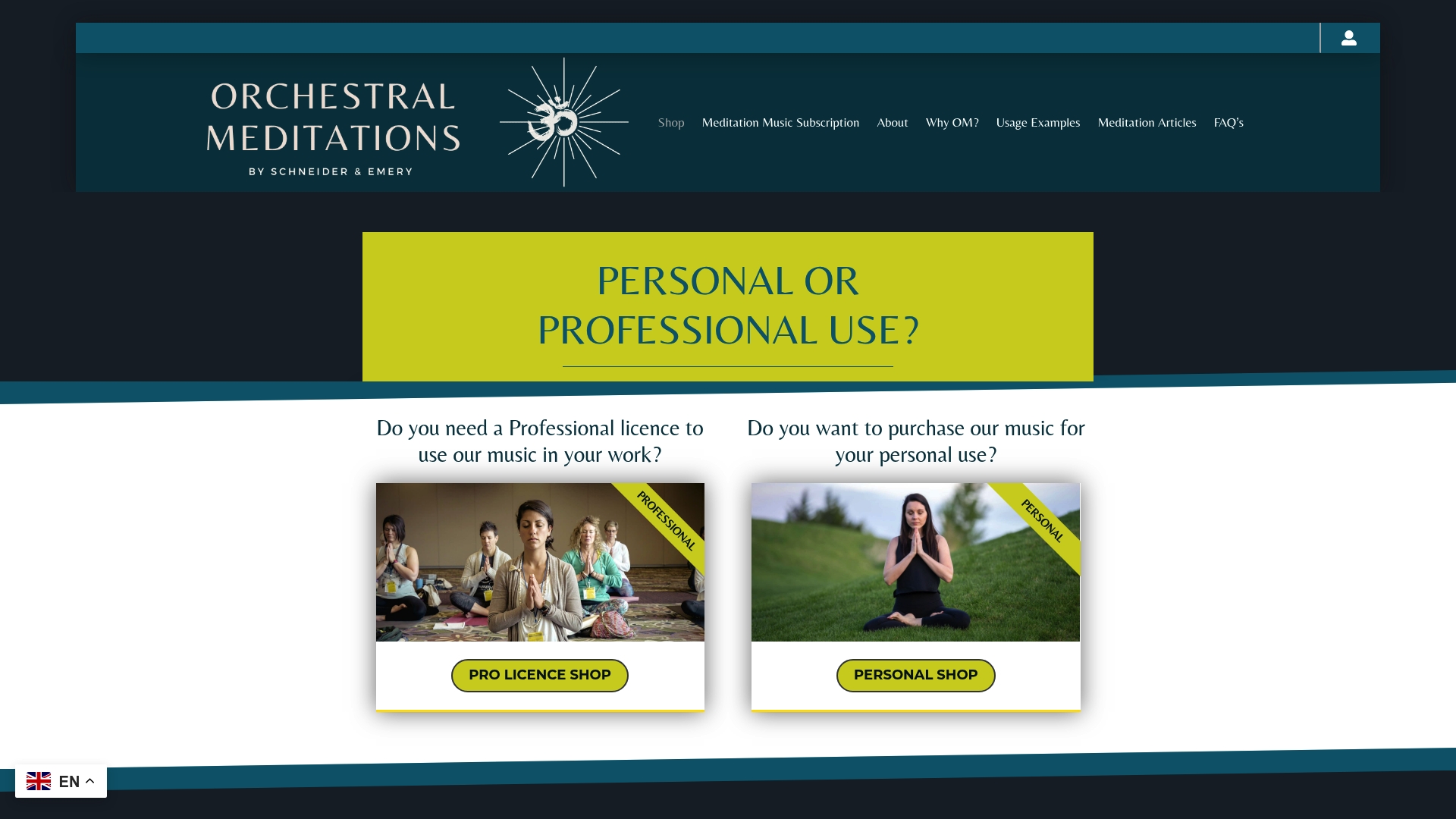
Licence options cover personal listening, professional practice (classes, therapy, retreats), and in-app commercial use. Tracks are available as one-off purchases or via subscription, with full-length previews before you commit and licence certificates issued with every professional purchase. For practitioners who also work with guided meditation content, the platform pairs well with partners like Paul Stebles’s guided meditation library for combined music-and-guidance productions.
Browse the catalogue, preview in full, and download your licence certificate on the same day at Orchestralmeditations.
Useful sources and further reading
- Get a licence to play live or recorded music — GOV.UK: the primary UK government source on when a music licence is required and when royalty-free music is exempt. Referenced in the UK licensing section.
- TheMusicLicence — PPL PRS (Fitness, Exercise and Dance Classes): official PPL PRS guidance for yoga and fitness class operators. Use this to confirm your obligations before switching to royalty-free.
- Live music stimulates the affective brain — PNAS: peer-reviewed study on limbic responses to live versus recorded music. Cited in the value proposition section.
- Musician presence and physiological well-being — Scientific Reports: open-access research on audience responses to live versus remote performance. Supports the therapeutic quality argument.
- Royalty-free professional meditation music — Orchestralmeditations: the platform’s own licensing guidance page, detailing permitted uses for therapy, apps, and classes.
- Your orchestral sound healing guide for 2026 — Orchestralmeditations: technical coverage of binaural, theta, and Solfeggio formats with practical session guidance.
FAQ
Do I need TheMusicLicence if I use royalty-free tracks in my yoga class?
No — GOV.UK guidance states that royalty-free music is exempt from the licensing requirement, provided the track’s licence explicitly covers public performance. Always verify the wording before use.
What file formats should I request for professional meditation music?
WAV at 24-bit/48kHz is the standard for professional use; request stems if you plan to layer music under voiceover or mix for an app. Orchestralmeditations provides WAV downloads with professional licence purchases.
Who are Robert Emery and Moritz Schneider?
Robert Emery is a British composer and conductor with orchestral film and therapeutic music credits; Moritz Schneider is a producer specialising in binaural and 3D surround formats. Both are credited on Orchestralmeditations recordings made at Abbey Road Studios with the National Philharmonic.
Can I use Orchestralmeditations tracks inside a commercial wellness app?
Yes, provided you purchase the professional/commercial licence, which explicitly covers in-app streaming and redistribution. Check the professional licence page for the full permitted-use summary before integrating tracks.
How do I verify that a royalty-free licence is genuine and UK-compliant?
Confirm that the licence document names public performance, commercial use, and your specific medium (in-app, broadcast, live class) as permitted uses. Obtain a dated licence certificate and store it alongside your purchase receipt — this is your evidence if PPL PRS ever queries your use.