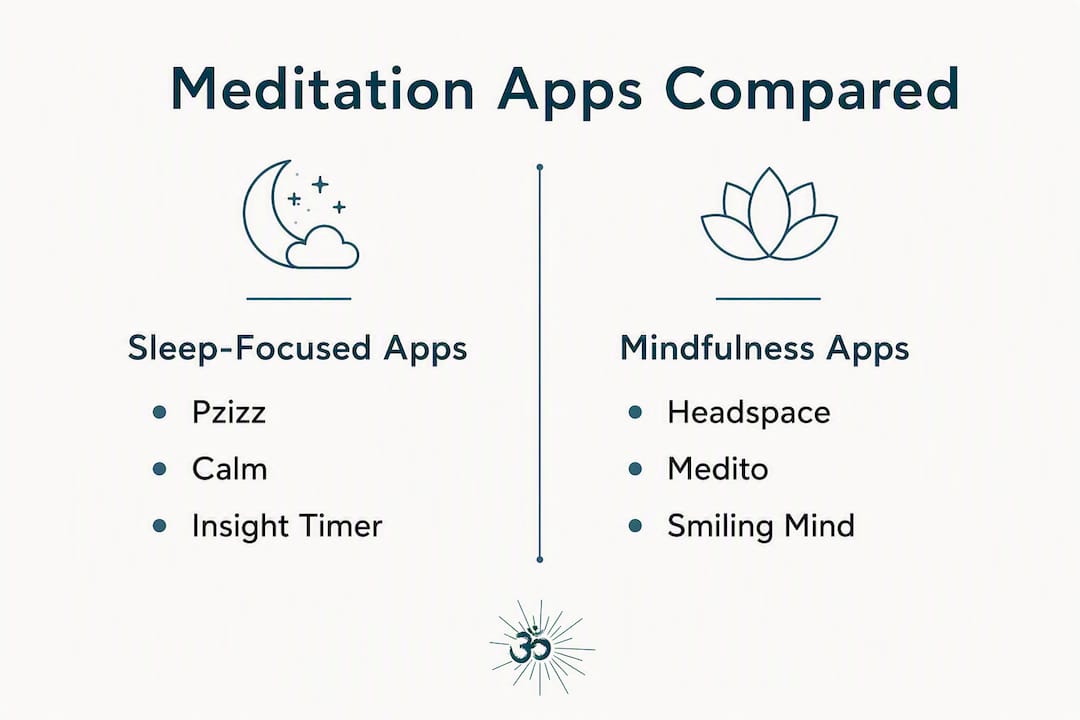
If you are looking for the best Calm.com alternatives right now, here is the short version: Insight Timer is the strongest all-round free option, Headspace leads on structured courses and clinical backing, Pzizz is the one to try if sleep is your main goal, Medito is completely free with no ads, Smiling Mind is the pick for younger users and families, and Orchestralmeditations is the standout choice when audio fidelity and professional licensing matter.
- Insight Timer — best overall free library, with thousands of teacher-led sessions and a generous free tier
- Headspace — best for structured, evidence-informed courses with a clean interface
- Pzizz — best for sleep engineering, using layered binaural audio and dynamic narration
- Medito — best if you want zero cost and zero ads, full stop
- Smiling Mind — best free app for families, schools, and younger adults
- Orchestralmeditations — best for studio-quality orchestral and binaural audio, with royalty-free licensing for professionals; tracks composed by Robert Emery and produced by Moritz Schneider, recorded with the National Philharmonic at Abbey Road Studios
TL;DR: If you want one free app to replace Calm today, start with Insight Timer. If sleep is the problem, try Pzizz. If you need licensed, high-fidelity audio for professional or therapeutic use, Orchestralmeditations is in a different category entirely.
How do these Calm alternatives compare at a glance?
| App | Best for | Price / free tier | Core features | Audio quality | Platforms & offline | UK payment | Licensing |
|---|---|---|---|---|---|---|---|
| Insight Timer | Free library, community | Free tier (extensive); Premium subscription | Guided meditations, courses, music, timers | Good (varies by teacher) | iOS, Android, Web; offline on premium | Yes, Apple/Google/card | Personal only |
| Headspace | Structured courses, clinical backing | Free trial; annual subscription | Guided meditations, sleep, courses, movement | Polished, consistent | iOS, Android, Web; offline on paid | Yes | Personal only |
| Pzizz | Sleep and naps | Free tier (limited); annual subscription | Sleep stories, binaural audio, dynamic narration, nap mode | Engineered for sleep | iOS, Android; offline | Yes | Personal only |
| Medito | Zero-cost, no ads | Completely free | Guided meditations, sleep, breathing, courses | Decent, improving | iOS, Android; offline | N/A | Personal only |
| Smiling Mind | Families, schools, younger adults | Completely free | Guided meditations, programmes by age group, wellbeing tools | Clear, accessible | iOS, Android, Web; offline | N/A | Personal only |
| Orchestralmeditations | Studio audio, professional licensing | Per-track purchase or subscription | Orchestral meditations, binaural/3D audio, theta and Solfeggio tracks | Abbey Road, live orchestra | Web, download; offline | Yes, card/PayPal | Personal and commercial |
A few quick notes worth flagging. Calm itself has a strong content catalogue, celebrity sleep stories, and a revenue lead among meditation apps, which is precisely why users look for alternatives that specialise more narrowly. None of the apps above try to replicate Calm wholesale. Each carves out a lane.
Also worth knowing: multiple reviewers recommend combining apps rather than hunting for a single perfect replacement. One app for sleep, another for daytime mindfulness, is a perfectly sensible setup.
Short reviews: what each alternative actually delivers
Insight Timer
Wirecutter tested 19 apps with expert input and named Insight Timer the best overall meditation app in 2026. The reason is simple: the free library is genuinely enormous, with thousands of guided sessions from independent teachers, live events, and a community that keeps content fresh without a subscription fee. The premium tier adds offline downloads and structured courses, but many users never feel the need to upgrade.
Pros:
- Massive free library, updated constantly by the teacher community
- Live events and group meditations add a social dimension Calm lacks
- Courses from credentialled teachers, including clinicians
Cons:
- Quality varies between teachers; some sessions are excellent, others less so
- Interface can feel cluttered when you first open it
- Premium pricing is reasonable but the free tier is so good it can feel odd to pay
UK billing works through Apple, Google, or direct card payment. No commercial licensing is offered.

Headspace
Headspace is the most structured option on this list. Its courses follow a deliberate progression, which suits beginners who want to build a practice rather than dip in and out. The clinical backing is genuine: Headspace has published peer-reviewed research on its programmes, and its content is authored by meditation teachers and psychologists rather than assembled from a marketplace.
Pros:
- Structured beginner-to-advanced courses with clear progression
- Consistent production quality across all content
- Sleep content (Sleepcasts, wind-down exercises) is well designed
Cons:
- Smaller free tier than Insight Timer; most content sits behind a paywall
- Less flexibility for experienced meditators who want to explore freely
- Annual subscription is comparable to Calm in price
Available on iOS, Android, and web. UK billing via Apple, Google, or card. No commercial licensing.

Pzizz
Pzizz does one thing and does it with unusual focus: it helps you fall asleep and nap. The app uses a combination of dynamic narration, music, and binaural audio that changes each session so your brain does not habituate to a fixed track. That is a genuinely clever piece of sleep engineering, and it is the reason Pzizz consistently appears in sleep-focused roundups rather than general mindfulness ones.
Pros:
- Dynamic audio means each session sounds different, preventing habituation
- Binaural elements are built into the sleep and nap modules
- Nap mode with customisable duration is a practical feature most apps skip
Cons:
- Daytime mindfulness content is thin compared to Insight Timer or Headspace
- Free tier is limited; the full experience requires a subscription
- Not the right tool if you want guided meditation beyond sleep
UK billing via Apple or Google. Offline downloads available on the paid plan. No commercial licensing.
Medito
Medito is the rare app that is entirely free, carries no advertising, and does not push you towards a premium tier because there is no premium tier. It is a non-profit project, which explains the model. The Guardian highlighted it as a strong ad-free option, and for anyone whose main objection to Calm is the cost, Medito is the obvious answer.
Pros:
- Completely free, no ads, no upsells
- Offline downloads available for all content
- Covers guided meditation, sleep, breathing exercises, and short courses
Cons:
- Smaller content library than Insight Timer or Headspace
- Content update cadence is slower than commercial apps
- No community or live events
No payment required. Available on iOS and Android. No commercial licensing.
Smiling Mind
Smiling Mind was built by an Australian non-profit with a specific focus on younger users, schools, and families. The Guardian named it the best free meditation app for this audience. The programmes are structured by age group, which makes it genuinely useful for parents who want something appropriate for children rather than a scaled-down adult app.
Pros:
- Age-grouped programmes from children through to adults
- Completely free, no in-app purchases
- Web access alongside mobile, which suits classroom use
Cons:
- Adult content is less deep than Headspace or Insight Timer
- Interface is functional rather than polished
- Limited sleep-specific content for adults
No payment required. Available on iOS, Android, and web. No commercial licensing.
Orchestralmeditations
Orchestralmeditations occupies a different position to every other option on this list. Rather than a subscription app with a library of voice-led sessions, it is a platform for professionally produced orchestral meditation music, recorded with live musicians and available for personal or commercial licensing. Tracks are composed by Robert Emery and produced by Moritz Schneider, and the catalogue includes binaural, 3D surround, theta frequency, and Solfeggio-based recordings.
Pros:
- Abbey Road recording quality, live orchestra; a genuinely different listening experience
- Binaural and 3D surround mixes for deep immersion
- Commercial licensing available for therapists, app developers, and content creators
- One-off purchases or subscription; no lock-in
Cons:
- No voice-guided meditation sessions; purely music and soundscapes
- Not an app in the traditional sense; primarily web and download
- Higher per-track cost than a general subscription app
UK card and PayPal payment accepted. Commercial licensing is a core part of the offering, which sets it apart from every other option here.
Pro Tip: If you use Orchestralmeditations tracks in a professional setting, such as a therapy practice or yoga class, check the commercial licence terms before your first session. The licensing page is clear about what each tier covers, which saves an awkward conversation later.
How do you pick the right Calm alternative for your goals?
The honest answer is that the “best” app depends entirely on what you were actually using Calm for. Here is a practical way to narrow it down.
Start with these four questions:
- Is your primary goal sleep, daytime mindfulness, or stress relief?
- Are you willing to pay, or do you need a free option?
- Do you want guided voice sessions, music, or both?
- Are you using this personally or professionally (therapy, classes, content)?
Once you have answered those, the decision largely makes itself. Sleep-first users should look at Pzizz before anything else. Budget-first users should go straight to Medito or Smiling Mind. Anyone who wants structured, evidence-informed courses should try Headspace. Professionals who need licensed audio for client work or content creation should look at Orchestralmeditations.
Red flags to watch for when evaluating any app:
- No clear privacy policy, or one that mentions selling data to third parties
- Opaque billing with no obvious cancellation route
- No UK payment option (some apps only accept US cards or dollar billing)
- Free trial that requires card details with no reminder before it converts
- No offline download option on a paid plan
A practical decision flow:
- Sleep is the main goal → try Pzizz first
- Need completely free → Medito or Smiling Mind
- Want structured courses with clinical backing → Headspace
- Want the largest free library → Insight Timer
- Need professional/commercial audio licensing → Orchestralmeditations
- Not sure → start with Insight Timer’s free tier; it costs nothing and covers most bases
One more thing worth saying: you do not have to pick just one. Combining a sleep app with a daytime mindfulness app is a common and sensible approach, and it often works out cheaper than a single premium subscription that tries to do everything.
What does switching actually cost? Pricing, free tiers and UK trials explained
Calm’s annual subscription sits in the mid-range price tier for premium meditation apps in the UK. Here is how the alternatives stack up.
| App | Free tier | Trial | Typical UK annual price | Monthly option |
|---|---|---|---|---|
| Insight Timer | Extensive (thousands of sessions) | N/A (free tier is generous) | Premium tier with annual and monthly options | |
| Headspace | Limited (select sessions) | Free trial available | Annual and monthly subscription available | |
| Pzizz | Limited (basic sleep/nap) | Free trial available | Annual and monthly subscription available | |
| Medito | Full app, no paywall | N/A | Free | Free |
| Smiling Mind | Full app, no paywall | N/A | Free | Free |
| Orchestralmeditations | Sample tracks available | N/A | Subscription or per-track | Varies by licence |
UK billing notes worth knowing:
- Apps purchased through the Apple App Store or Google Play are billed in GBP and subject to UK VAT at 20%. The price you see in the store is the price you pay.
- Apps billed directly (outside the app stores) may show prices exclusive of VAT; check the checkout total before confirming.
- Apple and Google both offer refund windows, though these are discretionary. For direct purchases, check the app’s own refund policy before subscribing.
- Cancellation should always be possible before the next billing date. If an app makes cancellation difficult to find, treat that as a red flag.
The free tier versus trial distinction matters more than it might seem. A free tier gives you ongoing access to a subset of content with no time limit. A trial gives you full access for a fixed period, after which you are charged unless you cancel. Medito and Smiling Mind have no trial because there is nothing to trial: the whole app is free. Insight Timer’s free tier is so substantial that many users never convert to premium.
Why audio quality and content type matter more than you might think
Not all meditation audio is the same, and the difference is not just aesthetic. The type of content and the quality of its production have a real effect on whether a session actually works for you.
Content types and what they are good for:
| Content type | Best for | What to listen for |
|---|---|---|
| Guided voice meditation | Beginners, structured practice, anxiety | Clear narration, pacing, teacher credentials |
| Sleep stories | Sleep onset, winding down | Soft voice, gentle pacing, no abrupt endings |
| Music tracks (ambient/orchestral) | Background focus, deep relaxation, professional use | Production quality, dynamic range, no compression artefacts |
| Binaural / 3D audio | Deep meditation, sleep, immersive relaxation | Requires headphones; check for true stereo phase, not just panning |
| Timers with bells | Experienced meditators, silent practice | Minimal; just the bell quality and interval accuracy |
Production quality shapes immersion in ways that are easy to underestimate. A voice recorded in a home studio with background noise, or a music track that has been over-compressed for streaming, pulls you out of a meditative state in the same way a dripping tap does. You notice it without knowing why you are noticing it.
Studio-level orchestral recordings combined with binaural mixing produce a different immersion profile than app-spoken-guidance tracks. This is not snobbery; it is physics. A live orchestra recorded with multi-microphone arrays and rendered binaurally in mastering creates spatial depth that a single voice track simply cannot replicate.
Pro Tip: For binaural audio to work properly, you need headphones, not speakers. Over-ear headphones give the best result because they maintain consistent stereo separation. In-ear buds work too, but make sure they fit snugly. Binaural played through speakers loses the spatial effect almost entirely.
A quick audio checklist before you commit to an app or track:
- Does the app offer a demo or sample before purchase?
- Is binaural audio labelled clearly, or is it just marketing language for stereo panning?
- Can you download for offline use, or does it require a constant connection?
- Is the content updated regularly, or is the library static?
Why professional orchestral recordings can genuinely change your practice
There is a meaningful difference between meditation music assembled from stock loops and music composed specifically for meditative states, recorded live, and mixed with spatial audio techniques. Orchestralmeditations sits firmly in the second category.
Tracks are recorded with the National Philharmonic at Abbey Road Studios, using multi-microphone arrays and 3D surround and binaural mixing techniques that require stereo-phase work and binaural rendering at the mastering stage, resulting in a recording that places the listener inside the sound rather than in front of it. a recording that places the listener inside the sound rather than in front of it.
The composer and producer credits on Orchestralmeditations tracks are Robert Emery (composer) and Moritz Schneider (producer). Robert Emery is a composer whose work spans orchestral and film music, bringing a structural understanding of how melody and harmonic movement guide emotional states. Moritz Schneider’s production background means the technical execution matches the compositional intent: the binaural rendering is not an afterthought bolted on at the end, but a design choice built into the session from the start. In professional licensing contexts, such as therapy practice credits or app metadata, these named credits are often a contractual requirement.
This matters practically for several groups of people:
- Therapists and counsellors who play background music during sessions need tracks that are consistent, non-distracting, and licensed for commercial use. A personal Spotify playlist does not cover that.
- Yoga and meditation instructors who teach classes need music that holds up on a room speaker system. Tracks mixed for spatial depth tend to translate better to larger playback environments than those mixed for earbuds.
- App developers and content creators who want to include meditation music in their own products need clear licensing terms, delivery stems, and named credits. Orchestralmeditations offers one-off royalty-free purchases and subscription licensing with both personal and commercial tiers.
The testimonials on Orchestralmeditations’ own pages describe the kind of deep relaxation response that is hard to achieve with lower-fidelity recordings. That is consistent with what the production approach would predict.
What should you check in a meditation app’s privacy policy?
UK users are protected by UK GDPR, which gives you specific rights around how your personal data is collected, stored, and used. Wellness apps collect more sensitive data than most people realise: meditation frequency, sleep patterns, mood logs, and sometimes location. Here is what to look for.
GDPR checklist for UK users:
- Lawful basis: The app must state why it is collecting your data (consent, legitimate interest, contract). “We use your data to improve the service” is not a lawful basis on its own.
- Data minimisation: Does the app collect only what it needs? An app that asks for your date of birth to serve you a breathing exercise is collecting more than necessary.
- Retention period: How long does the app keep your data after you delete your account? Thirty days is reasonable; indefinite retention is not.
- International transfers: If the app is US-based, your data may be transferred outside the UK. Check whether it uses Standard Contractual Clauses or an equivalent safeguard.
- Right to erasure: You have the right to request deletion of your data. The app must make this process findable, not buried in a support ticket queue.
- Third-party sharing: Check whether the app shares data with advertising networks. Some wellness apps use analytics SDKs that pass behavioural data to third parties.
Consumer rights for UK users:
If you purchase a subscription and it does not work as described, you have rights under the Consumer Rights Act 2015. For digital subscriptions, the service must be of satisfactory quality and fit for purpose. Complaints about data handling can be directed to the Information Commissioner’s Office (ICO) at ico.org.uk.
Red flags in a privacy policy:
- No mention of UK GDPR or a UK representative
- Vague language about “partners” who may receive your data
- No clear deletion process
- Policy last updated several years ago with no review date
How we selected and evaluated these alternatives
The shortlist was built around five criteria: fit for purpose (does the app actually solve the problem it claims to solve), audio quality, UK availability and payment, pricing transparency, and evidence or clinical backing where claimed.
- Each app was checked against independent reviews, including Wirecutter’s 2026 testing and The Guardian’s recommendations
- Pricing was verified against UK App Store and Google Play listings
- Privacy policies were reviewed for GDPR compliance indicators
- Orchestralmeditations’ production notes and licensing pages were consulted directly
- The list was last checked in 2026; prices and features can change, so verify before subscribing
No app paid for inclusion. Orchestralmeditations is the publisher of this article; that relationship is disclosed in the promo section below.
Key takeaways
The strongest single replacement for Calm depends on what you used Calm for: Insight Timer covers the most ground for free, while Orchestralmeditations is the only option with professional commercial licensing and Abbey Road production quality.
| Point | Details |
|---|---|
| Best free overall | Insight Timer offers thousands of sessions at no cost, confirmed by Wirecutter’s 2026 testing. |
| Best for sleep | Pzizz uses dynamic binaural audio and narration specifically engineered for sleep onset. |
| Completely free, no ads | Medito and Smiling Mind cost nothing and carry no advertising or upsells. |
| Professional licensing | Orchestralmeditations is the only option here offering commercial licensing for therapists, instructors, and app developers. |
| Combining apps works | Using one app for sleep and another for daytime mindfulness often covers more ground than a single subscription. |
When studio-recorded meditation music is the right choice
Most people reaching for a Calm alternative are looking for a guided voice app, and the options above serve that well. But there is a subset of users for whom the app model is the wrong tool entirely, and I think it is worth saying plainly.
If you are a therapist, a yoga teacher, or someone building a meditation app or wellness product, the music you play matters in ways that go beyond personal preference. A track recorded live at Abbey Road with a full orchestra and mixed binaurally is not just “nicer” than a stock loop. It behaves differently in a room, it holds attention differently over a 45-minute session, and it carries named composer and producer credits that professional licensing often requires.
The conventional wisdom in the wellness app space is that content volume wins: more sessions, more teachers, more variety. That is true for personal use. For professional use, the calculus shifts. One track that genuinely works in a clinical setting is worth more than a hundred that are merely adequate.
Orchestralmeditations is not trying to be Calm. It is doing something more specific, and for the right user, that specificity is exactly the point. Practitioners and content creators who have been using royalty-free stock music because it was the easiest option available should at least listen to the demo tracks before deciding that is good enough.
Orchestralmeditations: studio-quality meditation music with professional licensing
If you have read this far and your priority is audio quality or professional use, Orchestralmeditations offers something none of the apps above can match: royalty-free orchestral meditation music recorded with live musicians at Abbey Road Studios, available for personal listening or commercial licensing.
Tracks composed by Robert Emery and produced by Moritz Schneider cover binaural, 3D surround, theta frequency, and Solfeggio-based recordings. You can purchase individual tracks or take a subscription that covers ongoing commercial use for therapy, yoga, app development, or wellness content. The licensing terms are clear, the credits are named, and the production quality is verifiable from the sample tracks on the site.
Disclosure: this article is published by Orchestralmeditations. The app recommendations above are based on independent reviews and are not sponsored.
Sample the catalogue or check personal and commercial licensing options to find the right fit for your practice or project.
Where we checked facts
- Wirecutter: The 3 Best Meditation Apps of 2026
- The Guardian: The best meditation apps to quit doomscrolling and find peace instead
- CarePaths: 7 Calm App Alternatives (2026)
- App Vulture: Calm Competitors 2026
- Music Biz: Spotify Partners with Calm
- Orchestralmeditations: production notes and licensing
All sources last checked 2026. If you spot an error or a price that has changed, contact Orchestralmeditations via the website.
FAQ
Is there a free app that works like Calm?
Yes. Medito is completely free with no ads and no paywall, covering guided meditations, sleep content, and breathing exercises. Smiling Mind is also free and particularly strong for families and younger adults.
What is the closest direct alternative to Calm?
Headspace is the closest in structure and content scope, with guided courses, sleep content, and consistent production quality. Insight Timer covers more ground for free but has a less curated feel.
Is Headspace or Calm better?
It depends on what you want. Headspace is stronger for structured, progressive courses with clinical backing. Calm has a broader content range and more celebrity-led sleep stories. Neither is objectively better; the right choice depends on your goal.
Is Calm owned by Spotify?
No. Calm is an independent company. Spotify has a content partnership with Calm to distribute relaxation content through the streaming service, but that is a distribution deal, not an acquisition.
Which app is best for professional or commercial use?
Orchestralmeditations is the only option on this list that offers commercial licensing for therapists, yoga instructors, app developers, and content creators. The other apps listed here are licensed for personal use only.