
For UK-based wellness professionals, Orchestralmeditations is the standout alternative to Enlightened Audio: orchestral recordings made with live musicians, explicit commercial licences, and 3D surround sound that consumer streaming platforms simply cannot match.
Here is the short shortlist, if you need to move quickly:
- Orchestralmeditations — best for orchestral, commercially licensed meditation music with professional and personal licence options
- AudioJungle / Envato Market — best for per-track purchases with broad genre choice; licence clarity varies by seller
- Epidemic Sound — subscription model with clear commercial terms; strong for content creators, lighter on orchestral depth
- PremiumBeat (Shutterstock) — curated, rights-cleared tracks; good for video and app use, limited meditation-specific depth
- Pond5 — large library, per-track or subscription; useful for sourcing niche soundscapes
- Insight Timer — consumer streaming only; no commercial licence for class or app use
One licensing note worth pinning to your screen: consumer streaming services are almost always unsuitable for commercial use. Check the licence before you play a single track in a class or embed it in an app.
How do these alternatives compare at a glance?
| Dimension | Orchestralmeditations | AudioJungle | Epidemic Sound | PremiumBeat | Pond5 | Insight Timer |
|---|---|---|---|---|---|---|
| Best for | Wellness pros, app devs, therapists | Broad creative projects | Content creators, video | Video, apps | Niche soundscapes | Personal listening |
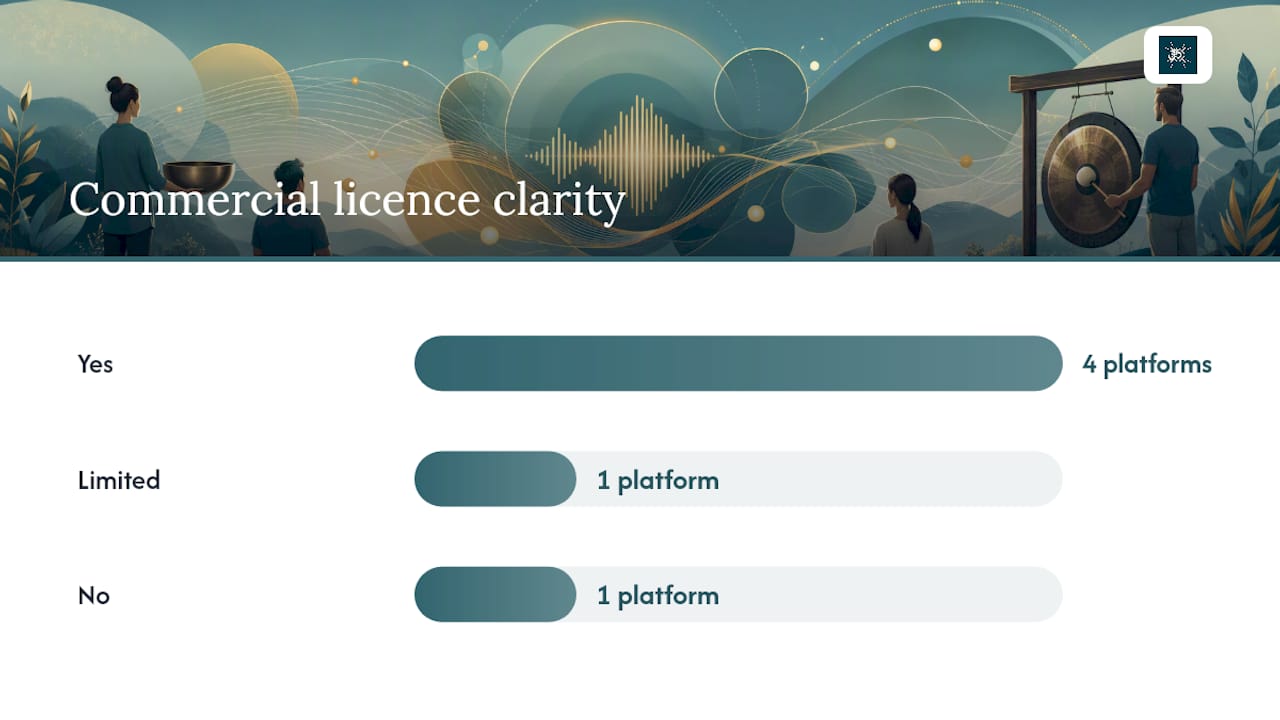
| Commercial licence clarity | Yes (explicit PDF) | Limited (seller-dependent) | Yes (subscription terms) | Yes | Yes (per-track) | No |
| Audio features | Orchestral, binaural, 3D, theta, Solfeggio | Mixed genres, varied quality | Produced tracks, no orchestral focus | Curated, produced | Large mixed library | Streaming only |
| Pricing model | One-off purchase or subscription | Per-track purchase | Monthly/annual subscription | Per-track purchase | Per-track or subscription | Free / subscription |
| Royalty status | Royalty-free with commercial licence | Royalty-free (check seller) | Royalty-free | Royalty-free | Royalty-free | Rights-managed / personal |
| UK suitability | Fully available | Fully available | Fully available | Fully available | Fully available | Personal use only |
A quick licence glossary:
- Royalty-free means you pay once and use the track without ongoing royalty payments (it does not mean free of charge).
- Rights-managed means each use requires a separate licence negotiation.
- Per-use means a fee applies every time the track is played commercially.
- Commercial licence covers use in classes, apps, therapy sessions, or published content.
- Public performance covers playing music to an audience, which in the UK may also require a PRS for Music or PPL licence.
What does each shortlisted option actually offer?
Orchestralmeditations records with live orchestral musicians and produces tracks using 3D surround sound, binaural beats, theta frequencies, and Solfeggio-based compositions. Composer and producer Robert Emery brings a background in orchestral scoring and sound healing, while Moritz Schneider contributes production expertise that shapes the immersive, frequency-specific character of the library. Professional and personal licences are available as explicit downloadable documents, which is genuinely rare in this space. Tracks are available as WAV downloads, and the library covers guided and unguided meditation, sound healing, and deep relaxation.
- Pros: explicit commercial licence PDF, orchestral live-musician recordings, binaural and 3D masters, UK-accessible
- Cons: specialist catalogue rather than a broad-genre library
AudioJungle / Envato Market hosts thousands of tracks from independent composers. Licence terms are set per seller, so quality and clarity vary considerably. Good for budget buyers who need a specific mood quickly, less reliable for practitioners who need airtight commercial terms.
- Pros: large catalogue, competitive pricing, per-track model
- Cons: licence terms differ by seller; orchestral meditation tracks are sparse
Epidemic Sound offers a subscription with clear commercial terms that cover YouTube, social media, and podcast use. The library leans heavily towards produced, modern sounds rather than orchestral or frequency-specific meditation music.
- Pros: clean commercial terms, subscription flexibility
- Cons: limited orchestral or binaural depth; not designed for wellness-specific use
PremiumBeat (Shutterstock) is a curated library with rights-cleared tracks and straightforward per-track licensing. Solid for video production and app soundtracks, but the meditation-specific catalogue is thin.
Pond5 is a large marketplace with per-track and subscription options. Useful for sourcing unusual soundscapes, though the royalty-free meditation music quality varies widely and orchestral depth is limited.
Insight Timer is a consumer app for personal meditation listening. It has no commercial licence pathway for class or app use, so it belongs firmly in the personal-use column.
Pro Tip: Before purchasing from any marketplace, search the seller’s individual licence page rather than the platform’s general terms. Seller-level terms can override platform defaults and may restrict commercial use entirely.
How do you choose the right alternative for your needs?
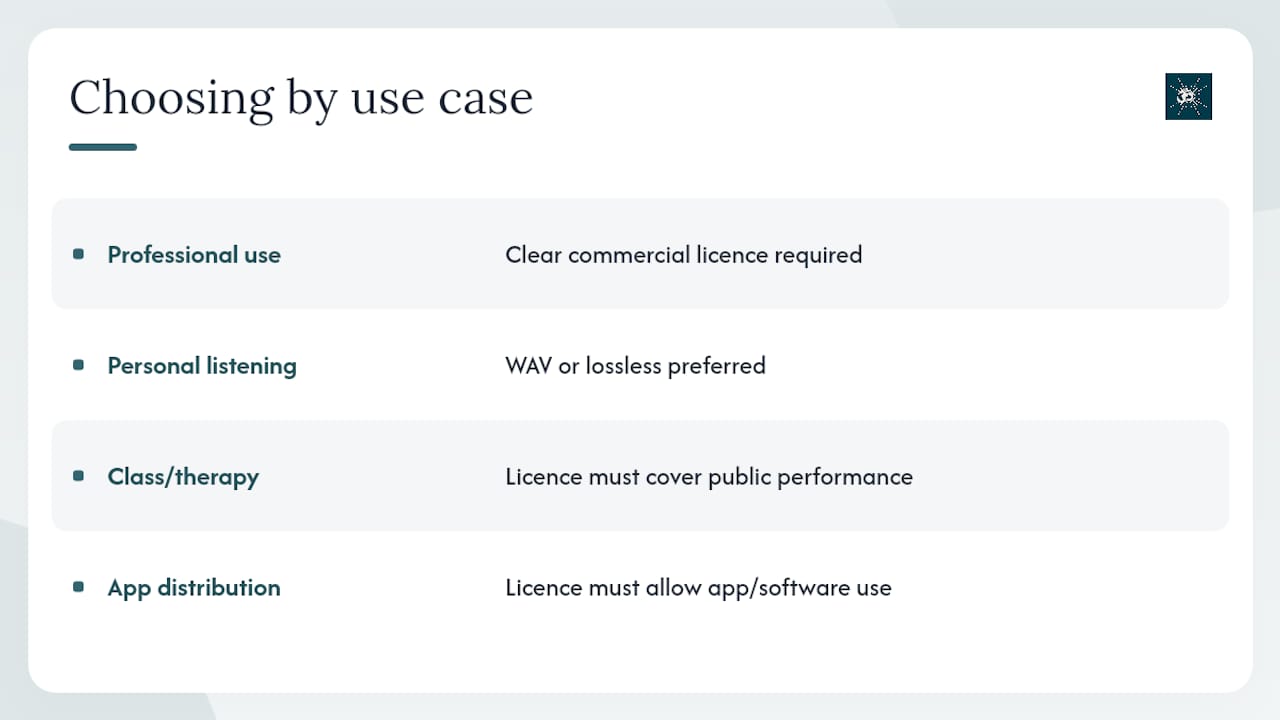
The single most decisive factor is this: if you use music professionally, commercial licence clarity comes first. Audio quality matters enormously, but a beautiful track with ambiguous licence terms is a legal liability, not an asset.
For personal listening, audio immersion is the priority. Binaural beats and 3D masters genuinely change the depth of a meditative state when listened to on headphones. MP3 previews are fine for sampling, but you want WAV or lossless files for the actual listening experience.
For in-class or therapy use, you need a licence that explicitly covers public performance. In the UK, playing music to a group may also require a PRS for Music licence depending on your venue and context. A track described as “royalty-free” does not automatically cover public performance.
For app distribution, the licence must explicitly name app or software use. Many standard royalty-free licences exclude this. Ask the provider in writing before you build a track into a product.
Here is a sample email you can adapt:
Red flags to watch for: a provider who cannot send a licence PDF on request, terms that say “personal use only” buried in the small print, no named composer or production credit (which can complicate copyright clearance), and platforms that list dozens of alternatives without distinguishing consumer services from commercial libraries.
What should UK wellness businesses verify before using a track?
- Confirm the licence document explicitly states “commercial use” and names your intended use case (class, app, download product).
- Check whether public performance rights are included or whether you need a separate PRS for Music or PPL licence for your venue.
- Verify app distribution rights are explicitly covered if you are embedding tracks in software.
- Confirm the territory scope covers the UK and any other markets you operate in.
- Check for exclusivity clauses — some licences restrict how widely you can distribute.
- Confirm the indemnity position: does the provider indemnify you if a copyright claim arises?
- Ask about refund or licence cancellation terms before purchasing.
For UK public performance obligations, check PRS for Music and PPL directly. Both organisations publish clear guidance on when a licence is required.
Pro Tip: Save your licence PDF, purchase receipt, and any written confirmation emails in a dedicated folder labelled by track name and purchase date. If a copyright dispute arises months later, that paper trail is your first line of defence.
Does audio format actually matter for meditation?
Yes, but not always in the way you might expect. Here is what genuinely changes outcomes:
- WAV / lossless files preserve the full frequency range, which matters most for binaural beats and theta frequencies where precise Hz accuracy affects the entrainment effect.
- Sample rate and bit depth (ideally 24-bit / 48kHz or higher) affect headroom and dynamic range, particularly in orchestral recordings where the contrast between quiet and loud passages carries emotional weight.
- Binaural and 3D masters require headphone listening to work as intended; they lose their spatial effect on room speakers.
- Stems vs mixed-down files matter if you are producing guided audio and need to layer narration over music without frequency clashes.
- Normalisation and headroom affect how a track sits in a mix; over-normalised tracks can sound harsh in a quiet meditation context.
For personal listening, a high-quality MP3 preview is sufficient to judge whether a track suits your practice. For professional production, always request the WAV master. And when you do your listening test, run it in a quiet room on headphones first, then on room speakers, then at low volume. A track that sounds lush at full volume but thin at low volume will not serve a late-night relaxation session.
Pro Tip: Test a short loop of around 60–90 seconds at the volume you actually use in sessions. Many tracks reveal loop points, frequency harshness, or dynamic issues that are invisible in a quick preview listen.
Why does Orchestralmeditations stand out from the crowd?
The core reason is straightforward: orchestral recordings with live musicians, explicit professional licences, and frequency-specific production techniques in a single library. That combination is genuinely uncommon.
Robert Emery, composer and producer at Orchestralmeditations, brings a background in orchestral composition and sound healing. Moritz Schneider contributes production expertise in frequency-based audio, including binaural and Solfeggio-frequency work. The result is music that is not just pleasant background sound but is designed with specific meditative outcomes in mind, from theta brainwave entrainment to deep parasympathetic relaxation.
The recording sessions at Abbey Road Studios level, using the National Philharmonic, give the library a sonic depth that synthesised or library-produced tracks rarely achieve. That matters in a meditation context because the natural resonance of live strings and brass carries a warmth that digital production tends to flatten.
For UK wellness professionals, the explicit commercial licence PDF is the practical differentiator. You can download it, read it, and confirm your use case is covered before spending a penny.
How do you test samples before committing to a purchase?
- Download or stream the highest-quality preview available; never judge a track from a 30-second compressed clip alone.
- Request the licence PDF before purchasing and confirm your specific use case is named.
- Run a listening test on headphones in a quiet room, then on room speakers, then at low volume.
- Test the track as a loop: check for audible loop points or abrupt transitions that would disrupt a class or session.
- If you are producing guided audio, layer a spoken narration test over the track to check for frequency clashes in the mid-range.
- Confirm the refund or licence cancellation policy in writing before purchasing.
What does good customer support look like in this space?
Honestly, it varies more than you would hope. The larger marketplace platforms tend to route queries through ticket systems with multi-day response times, which is fine for general questions but frustrating when you need a licence clarification before a class on Thursday.
Orchestralmeditations offers direct contact for professional licence enquiries, which means you can get a written confirmation of your use case rather than a generic FAQ link. For practitioners who need that paper trail, responsive human support is not a nice extra; it is part of the licence verification process.
When evaluating any provider, send a licence query before you buy. The speed and specificity of the response tells you a great deal about how the relationship will work if a problem arises later.
How big and diverse are the libraries you are comparing?
Community-curated directories list numerous sites similar to Enlightened Audio, and some aggregators surface many alternatives. Quantity, though, is not the point. Most of those sites are either consumer streaming services or small royalty-free libraries with limited meditation-specific depth.
For meditation and soundscape use specifically, the relevant dimensions are: orchestral vs produced tracks, binaural and frequency-specific options, guided vs unguided formats, and genre diversity within the wellness space (sleep, anxiety, deep focus, sound healing). Orchestralmeditations covers all of these within a curated library. The larger marketplaces offer broader genre choice but require more curation effort on your part to find tracks that meet both quality and licence standards.
Which platforms and formats work best for integration?
WAV downloads work across every professional audio workflow: DAWs, guided audio production, app development, and class playlist software. Streaming-only platforms are incompatible with most professional production workflows by design.
Orchestralmeditations provides WAV downloads, which integrate directly into tools like Logic Pro, Adobe Audition, GarageBand, and any standard DAW. For app developers, the downloadable format means you can embed tracks in your product without relying on a third-party streaming dependency. Consumer streaming platforms like Spotify or Deezer, while excellent for personal listening, do not supply files for integration and do not offer commercial licences for app or class use.
What do users and practitioners actually say?
Reputation in this space is built slowly and lost quickly. Practitioners who use music in a professional context tend to be vocal about licence problems, audio quality issues, and support responsiveness because the stakes are real: a copyright claim on a published app or a class recording is not a minor inconvenience.
Orchestralmeditations has built its reputation among wellness professionals on the combination of orchestral quality and licence clarity. The composer credits for Robert Emery and Moritz Schneider add a layer of accountability that anonymous marketplace tracks cannot offer: you know who made the music, which simplifies copyright clearance and adds credibility when clients ask about the production behind your sessions.
For the larger marketplaces, user reviews tend to highlight catalogue breadth and pricing positively, with licence ambiguity and inconsistent quality as recurring concerns. For consumer streaming platforms, reviews focus on convenience and catalogue size, with commercial use not being a relevant dimension for their typical user.
Key takeaways
For UK wellness professionals, the licence comes before the listen: confirm commercial terms in writing, then evaluate audio quality.
| Point | Details |
|---|---|
| Top recommended pick | Orchestralmeditations offers orchestral recordings, explicit commercial licences, and binaural/3D formats in one library. |
| Licence first rule | Always obtain a written licence PDF confirming your specific use case before purchasing or using any track professionally. |
| Audio quality check | Request WAV or lossless files for professional use; MP3 previews are sufficient only for initial sampling. |
| UK performance obligations | Check PRS for Music and PPL before playing any music to a live audience in the UK, even with a royalty-free licence. |
| Composer accountability | Orchestralmeditations credits Robert Emery and Moritz Schneider, giving you named composers for copyright clearance and client credibility. |
Why licensed, orchestral music is worth the extra step
There is a version of this decision that goes: “I’ll just use a Spotify playlist in my class — nobody will notice.” And honestly, for a while, nobody might. But the moment you publish a recording of that class, embed it in an app, or a client asks for the music details, the absence of a proper licence becomes a real problem rather than a theoretical one.
What I find genuinely underappreciated in the wellness space is that the quality of the music is not separable from the quality of the experience you are delivering. A synthesised loop from an anonymous marketplace track and a live orchestral recording produced with binaural precision are not interchangeable, even if they both technically “do the job.” Practitioners who have switched to properly produced, frequency-specific music consistently report that their clients notice the difference, even when they cannot articulate why.
The licence piece is the boring but necessary foundation. The orchestral quality is what actually elevates the work.
Orchestralmeditations: samples, licences, and next steps
If you have been searching for an Enlightened Audio substitute that holds up under professional scrutiny, Orchestralmeditations is worth a proper look before you commit to anything else.
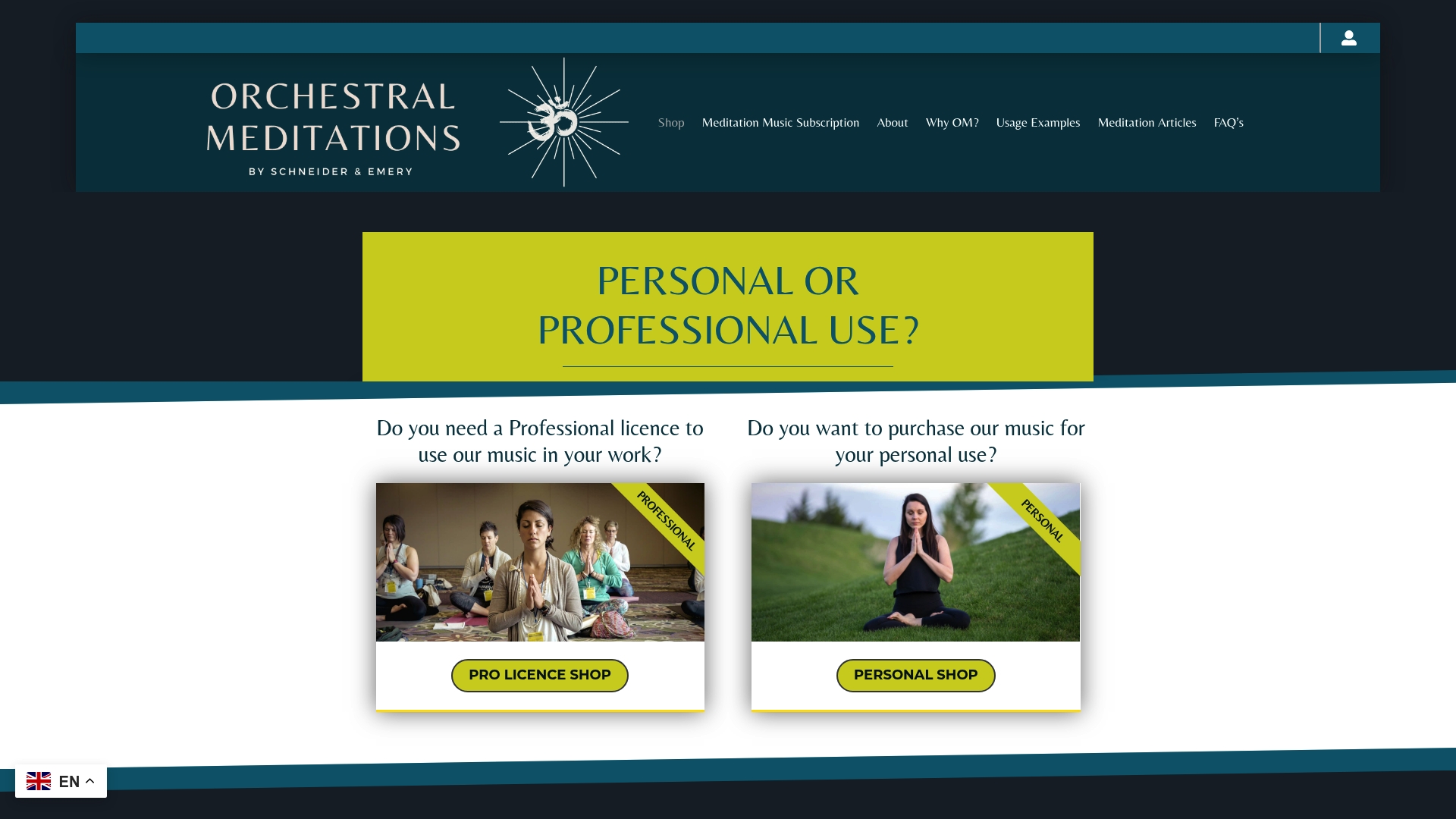
The meditation music library includes orchestral tracks produced by Robert Emery and Moritz Schneider, recorded with live musicians and engineered for binaural and 3D listening. Personal and professional licence options are available as downloadable PDFs, so you can confirm your use case is covered before purchasing. For app developers or practitioners with specific distribution needs, direct contact for licence queries is available through the site.
Browse the professional royalty-free library and download a sample licence to compare it against your current provider’s terms. That comparison alone tends to make the decision fairly straightforward.
Further reading and authoritative checks for UK buyers
Use these links to verify licence and public performance claims directly:
- PRS for Music — the UK’s performing rights organisation; check whether your venue or use case requires a public performance licence.
- PPL UK — covers recorded music performance rights; relevant for any setting where recorded music is played to an audience.
- What Hi-Fi? streaming services guide — useful for understanding the consumer streaming landscape and its limitations for professional use.
- Orchestralmeditations royalty-free library — resource for practitioners needing explicit royalty-free downloads with commercial licence clarity.
- Relaxation music selection checklist — a practical checklist for wellness practitioners assessing any meditation music supplier.
Keep copies of all licence PDFs, purchase receipts, and written confirmations from providers. If a copyright query arises during an audit or a platform review, that documentation is your evidence.
FAQ
What is the best Enlightened Audio alternative for UK professionals?
Orchestralmeditations is the top choice for UK wellness professionals, offering orchestral recordings with explicit commercial licences, binaural and 3D audio, and downloadable WAV files.
Can I use Spotify or Insight Timer music in my meditation classes?
No. Consumer streaming platforms like Spotify and Insight Timer do not supply commercial licences for class or app use; their terms typically restrict music to personal listening only.
Do I need a PRS for Music licence even if I buy royalty-free tracks?
Possibly, yes. In the UK, playing music to a live audience may require a PRS for Music or PPL licence regardless of whether the track is royalty-free. Check both organisations’ guidance for your specific venue and context.
Who are the composers behind Orchestralmeditations?
Robert Emery and Moritz Schneider are the composers and producers behind the Orchestralmeditations library, bringing orchestral composition and frequency-based production expertise to the recordings.
How do I confirm a licence covers app distribution?
Ask the provider in writing before purchasing, specifying that you intend to embed the track in a software application. Request a licence PDF that explicitly names app or software distribution as a permitted use.