
Binaural sound technology is defined as the method of recording and reproducing audio that tricks the brain into perceiving three-dimensional sound through headphones, creating immersive spatial experiences used widely in meditation, relaxation, and cognitive wellness. Unlike ordinary stereo, which simply pans sound left and right, binaural audio mimics the way your ears naturally receive sound from the world around you. The result, when done well, is genuinely uncanny. You put on your headphones and suddenly the music feels like it exists around you rather than inside your skull. Composers and producers like Robert Emery and Moritz Schneider, both of whom have worked with Orchestralmeditations to craft therapeutic orchestral soundscapes, have built entire creative practices around harnessing this technology for mental wellness.
How does binaural sound technology create immersive 3D audio?
Binaural sound technology works by capturing or synthesising audio from two microphone positions that replicate the spacing and shape of human ears. The physics here are genuinely clever. When sound reaches your left ear a fraction of a millisecond before your right, your brain uses that tiny delay to calculate where the sound is coming from. Binaural recording techniques exploit this by placing two microphones inside a dummy head (or sometimes a real person’s ears), capturing the subtle differences in timing, volume, and tonal colouration that real ears experience.
The technical term for those tonal differences is Head-Related Transfer Functions, or HRTFs. Your outer ear, skull shape, and even your shoulders all colour incoming sound in ways unique to your physiology. Accurate binaural experience relies on HRTFs tailored to the listener’s physiology. When there is a mismatch between the HRTFs used in the recording and your own ears, the sound collapses back into your head rather than floating around you. That is the difference between a genuinely immersive experience and one that just sounds like slightly odd stereo.

Head tracking adds another layer of realism. In natural hearing, when you turn your head, the sound sources stay fixed in space. Without head tracking, binaural audio rotates with your head, which the brain immediately recognises as unnatural. Research shows that head tracking restores natural dynamic cues and reduces cognitive load, making the listening experience feel far less effortful over time.
The head-above-torso orientation, known as HATO, matters too. Factoring in the angle and position of your torso relative to your head during binaural rendering reduces localisation errors by 19.5%–23.6% and cuts front-back confusion by up to 42%. That is a substantial improvement in perceived naturalness.
Here is what most listeners overlook when setting up their binaural listening experience:
- Headphone type matters enormously. Open-back headphones with a flat, neutral frequency response reproduce binaural audio most faithfully. Headphones with heavy bass boost or V-shaped EQ curves distort the spatial cues baked into the recording.
- Head tracking hardware is not just for gamers. Devices like the Waves NX head tracker or built-in sensors in headphones such as the Sony WH-1000XM5 can transform a static binaural mix into a genuinely dynamic spatial experience.
- Room acoustics still matter. Even through headphones, room simulation software adds the sense of physical space that makes binaural audio feel externalised rather than trapped inside your head.
Pro Tip: If you are new to binaural audio and your first listen feels oddly “in-head,” try a different pair of headphones before assuming the recording is poor. HRTF mismatch is the most common culprit, and a more neutral headphone often resolves it immediately.
What are binaural beats and how do they differ from binaural audio?
Binaural beats and binaural audio are two entirely different things, and conflating them causes no end of confusion. Binaural audio, as described above, is a spatial recording and playback technology. Binaural beats, by contrast, are a psychoacoustic illusion. Play a 200 Hz tone in your left ear and a 210 Hz tone in your right, and your brain perceives a third, pulsating tone at 10 Hz. That phantom rhythm is a binaural beat. It does not exist in the audio file. Your brain creates it.
Binaural beats are auditory illusions where the brain perceives a third pulsating sound from two different tones. The therapeutic effects, according to expert commentary from Cedars-Sinai, are tied more to the meditative practice surrounding the listening than to the frequency physics alone. That is a nuanced but important point. The beats may not be doing the heavy lifting on their own.
The most common applications for binaural beats in wellness settings follow a loose frequency guide:
- Delta (0.5–4 Hz): Associated with deep sleep and physical restoration.
- Theta (4–8 Hz): Linked to deep meditation, creativity, and the hypnagogic state between waking and sleep. Orchestralmeditations produces dedicated theta frequency recordings specifically for this purpose.
- Alpha (8–13 Hz): Connected to relaxed alertness and stress reduction.
- Beta (13–30 Hz): Associated with focused concentration and active cognition.
- Gamma (30+ Hz): Linked to heightened perception and cognitive processing.
“The brain is not a passive receiver of sound. It actively constructs the experience, which is precisely why the listener’s mindset, expectations, and musical background shape the outcome as much as the frequencies themselves.”
This matters practically. Listening to binaural beat music is more effective when the musical style aligns with listener expectation. Ambient or minimally structured music suits the experience far better than conventional melodic structures with strong rhythmic patterns competing for attention. If you have ever tried a binaural beats track buried under a thumping orchestral climax and wondered why it felt more stressful than relaxing, that is likely why.
The key distinction to hold onto is this: binaural audio creates spatial realism through recording and playback engineering. Binaural beats create psychoacoustic illusions through frequency mathematics. Both can support meditation and relaxation, but they work through entirely different mechanisms.
What does the science say about therapeutic benefits of binaural sound?
The honest answer is: the evidence is promising but genuinely mixed, and anyone selling you certainty is oversimplifying. A systematic review of 14 studies found that only 5 of 14 studies support binaural beats as effective brainwave entrainment tools, with 8 contradicting the claim and 1 producing mixed results. That is not a ringing endorsement for the frequency physics argument. It does, however, leave the door open for binaural beats as a personal wellness tool rather than a clinical intervention.
More recent research offers a warmer picture. A 2026 study with 19 British and Chinese participants found a significant increase in subjective well-being after one week of listening to binaural beats music. The catch? Effectiveness depended heavily on musical background and listener expectations. The 88% British cohort in the study responded differently from the Chinese participants, suggesting that cultural context shapes how we receive and process these sounds.
| Research finding | What it means for you |
|---|---|
| 5 of 14 studies support brainwave entrainment | Binaural beats may help, but treat them as a wellness complement, not a cure |
| Subjective well-being improved after one week | Short-term consistent listening shows real, measurable benefit |
| Effectiveness varies by musical background | Choose music that fits your taste, not just the “correct” frequency |
| HATO reduces localisation errors by 19.5%–23.6% | Better spatial rendering means a more natural, less fatiguing listen |
Cultural preferences influence binaural audio reception, with East Asian listeners prioritising spatial quality and North American listeners balancing timbral and spatial factors. This finding has real implications for how platforms like Orchestralmeditations might tailor their offerings for different audiences globally.
The physiological modelling side of the technology, particularly personalised HRTFs and head tracking, has stronger and more consistent scientific support than the binaural beats frequency claims. True transparent binaural audio requires room acoustics, personalised HRTFs, and head tracking to create externalised, speaker-like audio. When those elements align, the immersive quality of the listening experience is not a placebo. It is physics.
How to use binaural sound effectively for meditation and relaxation
Getting the most from binaural audio applications in your wellness routine requires a bit more thought than simply pressing play. The technology rewards deliberate setup and consistent practice.
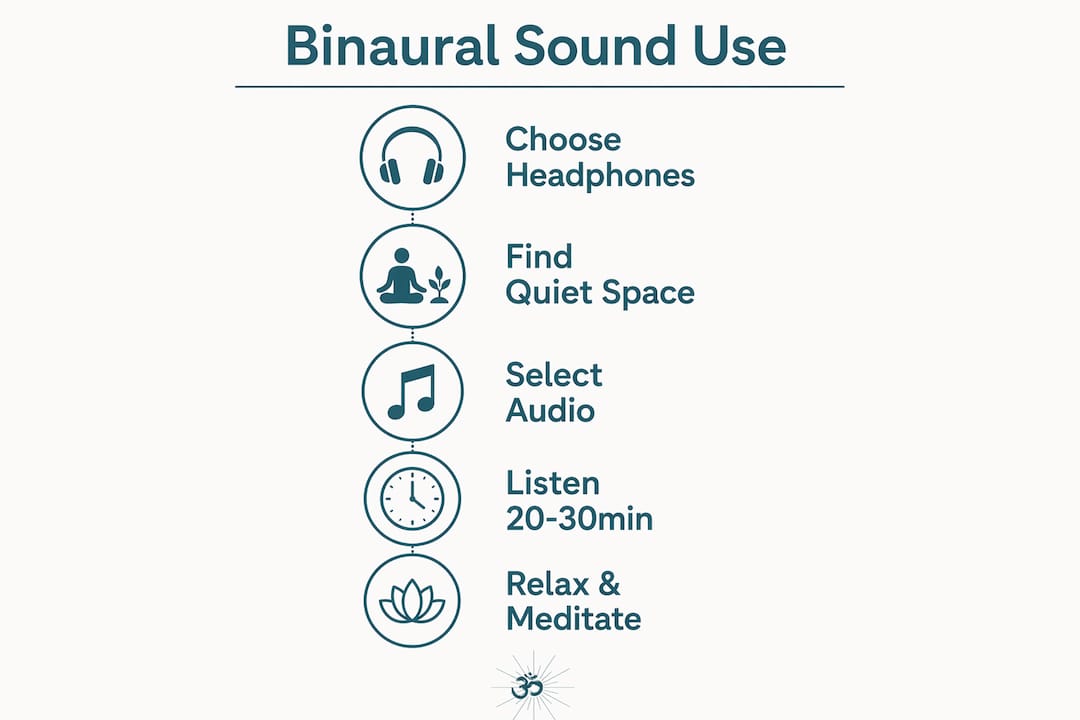
Start with your hardware. Open-back headphones with a neutral frequency response, such as the Sennheiser HD 600 or the Beyerdynamic DT 990 Pro, reproduce spatial cues far more accurately than consumer-grade headphones tuned for bass impact. If you are using closed-back headphones for privacy, look for models with a relatively flat response curve. Without head tracking, binaural audio can feel ‘fixed’ and cause listener fatigue, so if your headphones support motion sensing, enable it.
Next, consider your musical preferences honestly. Research confirms that ambient or minimal music suits binaural beats better than conventional melodic structures. Orchestralmeditations takes a thoughtful approach here, weaving orchestral textures that feel spacious and unhurried rather than melodically demanding. Robert Emery, whose compositional work spans film scoring and therapeutic music, brings a particular sensitivity to dynamic restraint. Moritz Schneider, whose production background includes work with live orchestras, understands how to place instruments in a spatial field so that the binaural effects feel natural rather than gimmicky.
Here is a practical framework for building binaural listening into your daily routine:
- Set a consistent time. Morning sessions before the day’s noise accumulates, or evening sessions as a wind-down ritual, tend to produce more consistent results than ad hoc listening.
- Create a dedicated listening environment. Dim lighting, a comfortable seated or reclined position, and minimal external interruption all reduce competing sensory input and let the spatial audio do its work.
- Start with shorter sessions. Ten to fifteen minutes of focused binaural listening is more effective than an hour of distracted background play. Build duration gradually as your brain adapts to the spatial cues.
- Match frequency to intention. Use theta-range binaural beats for deep meditation, alpha-range for relaxed focus, and delta-range for sleep preparation. Orchestralmeditations offers a detailed binaural beats Hz guide if you want to explore the frequency landscape more systematically.
Pro Tip: If you find binaural audio tracks feel oddly fatiguing after twenty minutes, the culprit is almost certainly static spatial cues without head tracking. Either enable head tracking on your device or try a different recording that uses more natural room simulation. Your brain is working overtime to reconcile the fixed soundstage with your natural head movements.
For a broader view of how sound frequencies support relaxation at a physiological level, the Orchestralmeditations article on how sound frequencies drive relaxation is worth reading alongside this one.
Key takeaways
Binaural sound technology works best when spatial engineering, personalised HRTFs, head tracking, and musically appropriate content combine to support the listener’s meditative practice.
| Point | Details |
|---|---|
| Binaural audio vs binaural beats | These are distinct technologies; spatial audio uses HRTFs, beats use psychoacoustic frequency illusions. |
| Scientific evidence is mixed | Only 5 of 14 studies support brainwave entrainment; treat binaural beats as a wellness tool, not a medical fix. |
| Hardware shapes the experience | Open-back, neutral headphones with head tracking deliver the most natural and least fatiguing binaural sound. |
| Musical style matters | Ambient and minimally structured music improves engagement with binaural beats over conventional melodic tracks. |
| Consistent practice amplifies benefit | One week of regular listening produced measurable well-being improvements in a 2026 study. |
Why I think we are only scratching the surface of binaural sound in wellness
I have spent a good portion of my career watching audio technology promise the world and deliver a postcard. Binaural sound is different, and I say that with the caution of someone who has been burned by overhyped audio trends before (spatial audio for television, anyone?).
What strikes me about the current state of binaural sound for wellness is that the technology has finally caught up with the ambition. Head tracking, personalised HRTFs, and room simulation are no longer the exclusive preserve of research labs. They are available in consumer headphones and streaming platforms. The gap now is not technical. It is compositional.
This is where composers like Robert Emery and Moritz Schneider matter more than most people realise. Emery’s background in orchestral scoring means he understands how to build music that breathes, that creates space rather than filling every frequency band with competing information. Schneider’s production sensibility, shaped by years of working with live orchestral musicians, means the spatial placement of instruments in a binaural mix feels organic rather than engineered. Together, their work for Orchestralmeditations represents what I think is the right approach: treating binaural technology as a compositional tool rather than a technical trick layered on top of ordinary music.
My honest recommendation? Do not get too attached to the frequency numbers. The research on brainwave entrainment is genuinely uncertain. What is not uncertain is that a beautifully produced, spatially immersive piece of music, listened to with good headphones in a quiet space, creates a qualitatively different meditative experience than anything coming through a laptop speaker. Start there. The science will catch up.
For those curious about how isochronic tones compare to binaural beats as wellness tools, that comparison is worth exploring once you have a feel for binaural audio on its own terms.
— ROBERT
Experience binaural sound technology with Orchestralmeditations

Orchestralmeditations produces a curated library of meditation music that puts binaural sound technology to genuinely therapeutic use. Every track is recorded with live musicians, including sessions at Abbey Road Studios with the National Philharmonic, and produced by composers Robert Emery and Moritz Schneider with spatial immersion as a core design principle rather than an afterthought. Whether you are looking for deep sleep support, focused meditation, or simply a more immersive relaxation experience, the meditation music collection offers something built with both the science and the artistry in mind. Browse the full library and find the sound that works for you.
FAQ
What is binaural sound technology?
Binaural sound technology is a method of recording or synthesising audio that replicates the way human ears naturally receive spatial sound, creating a three-dimensional listening experience through headphones. It uses two audio channels processed with Head-Related Transfer Functions to simulate the position of sounds in space around the listener.
How do binaural beats work in meditation?
Binaural beats work by playing two slightly different frequencies in each ear, causing the brain to perceive a third pulsating tone at the difference frequency. This perceived rhythm is thought to encourage brainwave states associated with relaxation or focus, though scientific evidence remains mixed across 14 reviewed studies.
Do you need special headphones for binaural audio?
Open-back headphones with a neutral frequency response, such as the Sennheiser HD 600 or Beyerdynamic DT 990 Pro, produce the most accurate binaural experience. Headphones with heavy bass colouration distort the spatial cues that make binaural audio feel three-dimensional.
What is the difference between binaural audio and binaural beats?
Binaural audio is a spatial recording technology that creates immersive 3D sound through HRTFs and head tracking. Binaural beats are a psychoacoustic illusion created by playing two different tones, one in each ear, with no spatial engineering involved. The two technologies are entirely distinct in both mechanism and application.
How long should I listen to binaural sound for wellness benefits?
A 2026 study found measurable improvements in subjective well-being after just one week of consistent listening. Starting with ten to fifteen minutes per session and building gradually is more effective than long, infrequent sessions, particularly while your brain adapts to spatial audio cues.