
Not all calming audio is created equal, and modern research is finally catching up to what many of us have sensed during practice but never quite been able to articulate. While plenty of people assume that any gentle background sound will ease them into a meditative state, sound interventions actually reduce measurable stress markers like cortisol, blood pressure, and heart rate variability in ways that vary enormously depending on what you play. The distinction matters enormously if you are trying to build a genuinely effective mindfulness practice rather than simply creating a pleasant ambience while you sit cross-legged on the floor thinking about what to have for dinner.
Key Takeaways
| Point | Details |
|---|---|
| Pick evidence-based sounds | Nature soundscapes and orchestral music are most supported by recent research for mindfulness and relaxation. |
| Personalise your practice | Adapt your choice of sound based on your unique goals and individual response. |
| Balance evidence with experience | Combine scientific insights with your own experimentation for best results. |
| Quality matters | High-quality or live musical experiences have greater benefits than generic background audio. |
| Stay curious | Continue exploring various sound environments to refine and deepen your mindfulness journey. |
Why sound matters in mindfulness
Let’s begin by understanding the scientific basis for using sound in mindful practices, because “it feels nice” is not quite the robust foundation we are looking for here. The connection between sound and the nervous system runs far deeper than most of us realise, and once you understand what is actually happening in your body when you hear music, you start to appreciate why choosing the right soundscape is so much more than personal preference.
Sound interacts with the body through several distinct biological pathways, and each of them deserves a moment of attention. The first is mechanotransduction, which is essentially your body’s ability to convert sound vibrations into cellular signals. Think of it as your cells picking up on the music in a very literal, physical way, not just metaphorically. The second pathway involves the vagus nerve, a remarkable wandering nerve that connects your brain to your heart, lungs, and digestive system. Certain frequencies and rhythms engage this nerve through auditory pathways, pushing the body towards parasympathetic dominance, which is the “rest and digest” mode rather than the rather exhausting “fight or flight” default many of us seem to live in. The third mechanism is brainwave entrainment, where the brain’s electrical activity begins to synchronise with the rhythms it hears. These sound therapy mechanisms working together create a genuinely powerful physiological response, not just a subjective sense of calm.

Why does all of this matter for mindfulness specifically? Because mindfulness is, at its core, an exercise in present-moment awareness, and sound is one of the most immediate sensory channels we have. A soundscape that supports relaxation and reduces the nervous system’s background hum of anxiety actually makes it physiologically easier to stay present. You are not fighting against your own cortisol levels.
The evidence backs this up in some rather impressive ways:
- Heart rate variability (HRV) increases with music mindfulness programmes, indicating improved nervous system regulation.
- EEG modulation suggests measurable shifts in brainwave patterns during music-assisted meditation.
- Participants in classical music meditation programmes show reductions in stress, anxiety, and depression alongside improvements in metacognitive awareness.
- Empathy scores improve with music-assisted mindfulness, which is a rather beautiful side effect nobody talks about enough.
“The relationship between sound and consciousness is not poetic licence. It is measurable, reproducible, and increasingly well-documented in peer-reviewed literature. What was once called ‘music therapy’ is becoming one of the more rigorous fields in applied neuroscience.”
Mindfulness practitioners who understand the scientific approach to meditation music are, in our experience, the ones who build durable, transformative practices rather than inconsistent ones. There is something genuinely useful about knowing why a piece of music moves you into stillness, rather than simply hoping it will.
Scientific evidence: How soundscapes and music influence mind and body
With a foundation in the mechanisms, it’s crucial to evaluate what recent research actually shows, because the science here is both exciting and, let’s be honest, occasionally humbling in its limitations.
The headline finding from recent meta-analyses and systematic reviews is that sound interventions reduce stress markers across both physiological and psychological dimensions. That means measurable changes in blood pressure, cortisol, self-reported anxiety, and mood. This is not trivial. But the devil, as always, is in the detail.
| Sound type | Psychological effects | Physiological effects | Evidence quality |
|---|---|---|---|
| Nature soundscapes (forest) | Strong: mood, restoration, cognition | Limited: minimal physiological change | Moderate |
| Orchestral music | Strong: emotional openness, loving-kindness | Moderate: HRV, dopamine | Emerging |
| Tibetan singing bowls | Moderate: anxiety, well-being | Moderate: HRV, brainwave shifts | Growing |
| Urban/industrial sounds | Negative: mood reduction, cognitive fatigue | Neutral to negative | Consistent |
| Generic digital ambient | Mild: some relaxation | Minimal measurable change | Limited |
One of the more striking recent findings concerns forest soundscapes, which significantly improve mood, cognitive restoration, and subjective well-being compared to industrial soundscapes, but do not appear to shift physiological stress markers or immunity measures in the same robust way. This is a genuinely important nuance. You might feel calmer listening to birdsong and rain, but your cortisol may not have budged particularly. That is not a failure of the research; it is a useful clarification of where nature sounds excel and where they fall short.
A few key statistics worth knowing:
- Loving-kindness meditation paired with orchestral music produces measurably greater self-transcendence than the same meditation without it.
- Tibetan singing bowls produced a 24% increase in psychological health in one study of PTSD-affected refugees. That is not a small number.
- Music-based mindfulness interventions consistently outperform control conditions for mood regulation across multiple study designs.
The honest caveat, and credit to the researchers who say this plainly, is that evidence for sound therapy remains promising but mixed. Many studies involve small sample sizes, variable methodology, and modest controls. The evidence is strongest for mood and psychological outcomes, somewhat weaker for direct physiological change, and the field would genuinely benefit from more rigorous randomised controlled trials. We say this not to dampen enthusiasm but because you deserve an honest picture.
What the orchestral music calming power research does confirm is that the emotional architecture of orchestral composition, with its dynamic range, harmonic complexity, and live performance energy, creates conditions for neurological responses that simpler audio formats cannot easily replicate. Similarly, the music and stress relief science is clear enough to act on, even while acknowledging the research is still maturing.
Comparing sound types: What works best for mindfulness?
Given the diversity of sound approaches, how do specific types stack up for mindfulness effectiveness? This is where things get genuinely interesting, partly because the answers are more nuanced than most “best meditation music” lists would have you believe.
Nature soundscapes are the comfort food of the mindfulness world. Everybody feels they should work, and for psychological restoration and mood lifting, they genuinely do. Forest soundscapes, in particular, boost mood, cognition, and restoration in measurable ways. If your mindfulness goal for the day is to simply decompress, clear mental fog, and feel better than you did twenty minutes ago, then birdsong and rustling leaves are a legitimate and well-evidenced choice.
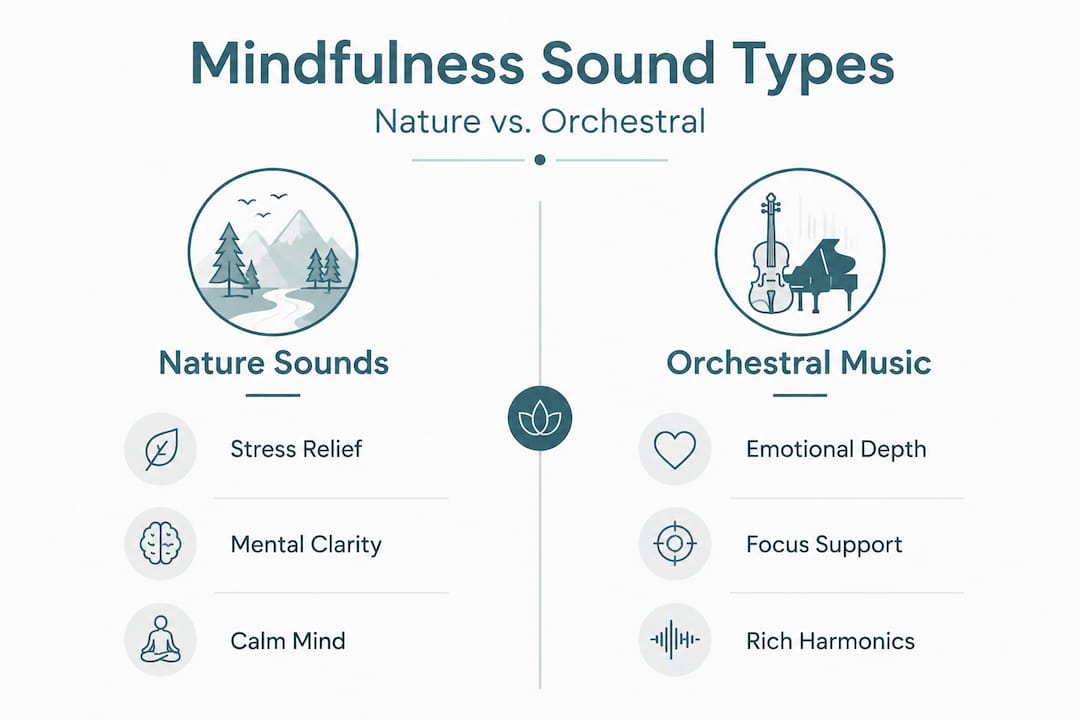
Orchestral music is, and we say this with complete conviction and only a modest amount of professional bias, the most emotionally sophisticated tool available for deep mindfulness work. Research specifically looking at chills-inducing orchestral music found that it augments loving-kindness meditation by enhancing self-transcendence, emotional breakthrough, psychological insight, and positive mood through dopamine release and limbic system activation. The limbic system, for context, is the brain’s emotional processing centre. When orchestral music activates it during a loving-kindness practice, you are not just relaxing. You are changing the emotional texture of your inner experience in a measurable, meaningful way.
Tibetan singing bowls deserve more credit than they typically receive outside of specialist wellness circles. Studies show they reduce anxiety and depression and, in one particularly compelling study, produced meaningful improvements in well-being for PTSD-affected individuals. The mechanism appears to involve shifts in HRV and brainwave activity that support deep relaxation without requiring active engagement from the listener. They are, in a sense, physiologically persuasive rather than emotionally evocative.
Industrial and urban soundscapes are, unsurprisingly, the least effective option for mindfulness. Research consistently shows they impair mood and increase cognitive fatigue rather than relieving it. If you have ever tried meditating near a busy road and felt vaguely irritable rather than serene, there is good science behind that experience.
Here is a quick comparison to make this practical:
| Mindfulness goal | Best sound type | Why |
|---|---|---|
| Emotional depth and insight | Orchestral music | Dopamine, limbic activation, self-transcendence |
| Cognitive restoration and mood | Nature soundscapes | Proven mood and cognition benefits |
| Deep physical relaxation | Tibetan singing bowls | HRV improvement, brainwave entrainment |
| General stress relief | Classical or orchestral music | HRV, anxiety reduction, metacognition |
| Focus and presence | Binaural beats, theta frequencies | Brainwave entrainment for attention |
Key takeaways from the comparisons:
- No single sound type is best for every purpose. The idea of a universal “perfect meditation track” is a fantasy worth letting go.
- Live or orchestral sound for meditation offers benefits that generic digital productions cannot consistently replicate.
- The emotional response to orchestral music is not just subjective preference. It is neurological, and the research on orchestral vs digital music makes this increasingly clear.
Pro Tip: Match your soundscape to your mindfulness intention for that specific session. Orchestral music for emotional exploration and loving-kindness work, nature sounds for restoration and mental clarity, Tibetan bowls for deep physical unwinding. Treat sound as a tool you choose deliberately, not background decoration.
Personalising and integrating sound science into your practice
Knowing which sounds are effective, here’s how to integrate them wisely into your daily mindfulness sessions, because theory only becomes valuable when it lands in actual practice.
The good news is that the evidence base is now robust enough to give you a genuinely useful framework. The better news is that this framework is flexible enough to honour the fact that you are a human being with your own nervous system, not a laboratory subject.
-
Define your intention before you press play. Are you sitting down to process emotions, restore mental clarity, achieve physical relaxation, or build compassionate awareness? Your answer should directly inform your sound choice. This single habit shifts your relationship with meditation music from passive to active, and classical music meditation programmes that build in this kind of intentional framing show notably better outcomes for HRV and emotional regulation.
-
Build a varied sound library across session types. You want orchestral compositions available for your deeper, more emotionally oriented sessions. You want nature soundscapes for the days when your mind is simply frazzled and needs restoring. You want something grounding like singing bowl recordings for the evenings when your body carries the stress your mind has not yet consciously registered. Variety is not inconsistency; it is intelligence.
-
Learn to use deep relaxation music correctly. There is actually a technique involved, particularly with orchestral and frequency-based recordings. Listening through headphones supports binaural processing. Listening in a quiet room with eyes closed and a settled posture allows the vibroacoustic effects to do their work. Pressing play while simultaneously scrolling through emails is, we regret to report, not the method the researchers had in mind.
-
Explore holistic orchestral soundscapes that integrate multiple therapeutic approaches. Some of the most effective recordings layer orchestral composition with theta frequencies, binaural beats, or Solfeggio frequencies, creating a genuinely layered sonic experience that engages multiple neurological pathways simultaneously.
-
Track your results honestly. Before each session, give yourself a quick mental score: how tense do I feel, how present do I feel, what is my mood? After the session, do the same. Over two or three weeks, patterns will emerge. You will notice which soundscapes consistently shift your state and which feel pleasant but leave you largely unchanged. This is your personal data, and it is more valuable than any generic recommendation.
-
Follow a step-by-step mindfulness guide that incorporates sound intentionally, rather than treating music as an afterthought tacked onto a breathing exercise. The research shows that sound and mindfulness technique work synergistically when they are designed together rather than assembled casually.
Pro Tip: Always use high-quality recordings from live musicians when possible. The acoustic richness of a recording made with real instruments in a real acoustic space, rather than digitally synthesised approximations, carries a physical and emotional authenticity that shows up in your experience even if you cannot immediately articulate why. Your nervous system notices the difference even when your conscious mind does not.
Beyond the research: What most guides won’t tell you about sound and mindfulness
Here is something the research-heavy articles rarely admit: the science is genuinely useful, and also not the whole story. Not by a long way.
We have seen this repeatedly. Someone follows every evidence-based recommendation to the letter. They choose forest soundscapes for cognitive restoration, orchestral music for loving-kindness practice, singing bowls for physical relaxation. They use headphones, sit correctly, and track their results diligently. And then they find a piece of music nobody would classify as “therapeutic” and have the most profound session of their year. Because it meant something to them personally. Because it caught them off guard. Because it arrived at exactly the right moment.
The research itself hints at this. Natural soundscapes boost psychological benefits without corresponding physiological changes. Vibroacoustic interventions do not consistently outperform guided mindfulness alone. Effects vary substantially by individual traits like absorption, interoception, and, we would add, the simple and underrated variable of whether someone actually loves the music they are listening to.
Absorption, for those unfamiliar with the term, refers to how deeply a person can become immersed in an experience. High absorbers get lost in music, in stories, in landscapes, in a way that low absorbers simply do not, regardless of what the music technically is. Interoception is the capacity to sense your own body’s internal signals, and it shapes how you respond to sound-based therapies. These are not small variables. They can determine whether a given soundscape transforms your practice or simply serves as a reasonably pleasant background noise.
What this means practically is that your mindfulness sound practice needs to include both scientific literacy and genuine self-curiosity. Use the research as your map, absolutely. It will save you from wasting months on urban soundscapes while wondering why you feel vaguely hostile. Consult the symphonic stillness guide for the deeper orchestral options. But then give yourself permission to experiment, to follow what genuinely moves you, and to notice when a combination of sound types produces something greater than the sum of its evidenced parts.
The most transformative mindfulness sessions we are aware of rarely come from following a protocol. They come from the synergy between clear intention, receptive attention, and a sound environment that has been chosen with both intelligence and curiosity. The science tells you where to start. Your own practice tells you where to go next.
Experience science-backed orchestral mindfulness music
Ready to put research into practice? Exploring curated orchestral soundscapes is one of the most direct ways to move from understanding the science to actually experiencing its benefits.
At Orchestral Meditations, every recording is informed by the latest research in sound therapy, mindfulness, and neurological response. Our library, recorded at Abbey Road Studios with the National Philharmonic, layers orchestral richness with theta frequencies, binaural beats, and 3D surround sound to create something your nervous system will recognise immediately as different from generic digital offerings. Whether you are exploring orchestral meditation music for the first time or looking to refine an existing practice, our curated selections are designed to support every kind of mindfulness goal, from emotional breakthrough to deep physical restoration. Discover what the best meditation music actually sounds like when it is built from both science and genuine artistry.
Frequently asked questions
Which type of sound is best for mindfulness meditation?
Both orchestral music and nature soundscapes offer strong evidence for supporting mindfulness. Forest soundscapes improve mood and cognition, while orchestral music augments loving-kindness meditation through emotional and neurological engagement. The best choice depends on your specific mindfulness goal for that session.
Does sound therapy really work for stress?
Yes, with some important nuance. Sound interventions reduce both physiological and psychological stress markers including cortisol and self-reported anxiety, though the evidence base remains promising but mixed, with stronger results for mood than for direct physiological change.
Are digital soundscapes as effective as live or orchestral ones?
Research suggests they are not equivalent. Orchestral music enhances loving-kindness meditation through dopamine release and limbic activation in ways that generic digital productions tend not to replicate. The acoustic complexity of live recordings appears to carry distinct neurological value.
How can I tell if a soundscape improves my mindfulness?
Rate your mental state, level of presence, and physical tension before and after each session on a simple one to ten scale. After a few weeks of consistent tracking across different sound types, you will have a clear and genuinely personalised picture of which soundscapes move the needle for you.