If you’ve ever sat on your cushion, closed your eyes, and felt precisely nothing except mild irritation at your own wandering thoughts, welcome to the club. Breaking through meditation plateaus is one of the most common frustrations practitioners face in 2026, and the good news is that sound and music are genuinely transforming how we reach deeper states of awareness. From crystal singing bowls to orchestral compositions recorded at legendary studios, the auditory toolkit available to us right now is extraordinary. The challenge, of course, is knowing what actually works and what is simply expensive noise.
Key Takeaways
| Point | Details |
|---|---|
| Personalise your practice | Tailor every sound and frequency choice to your unique intentions and comfort for best results. |
| Sound modalities matter | Research backs live instruments, binaural beats, and orchestral music for deeper relaxation and focus. |
| Combine science and self-awareness | Use evidence-based methods but always adjust based on your own experiences and preferences. |
| Consistency enhances benefits | The more regularly you engage with sound-enhanced meditation, the more profound the effects. |
Key criteria for choosing meditation enhancement techniques
With the context set, let’s clarify how to choose what will actually work for your unique meditation needs. Because here’s the thing: not every approach suits every person, and throwing random frequencies at your ears like you’re feeding ducks in a park is not a strategy.
Before you invest time or money into any sound-based technique, think carefully about these key factors:
- Your primary goal. Are you chasing deep relaxation, sharper focus, emotional processing, or spiritual expansion? Each goal favours different auditory tools.
- The type of sound you respond to. Some people find the resonance of live instruments almost viscerally moving. Others prefer the clean precision of digitally engineered tones. Neither preference is wrong; they’re just different entry points.
- Delivery method. Headphones offer a more immersive, inward experience, which matters especially for binaural beats. Speakers, by contrast, allow sound to wash over the whole body, which is closer to a traditional sound bath.
- Cultural background and personal sensitivity. Certain timbres and frequencies carry cultural weight or personal associations. What feels sacred to one practitioner might feel uncomfortable to another.
- The evidence base. It is worth noting that not all frequencies work equally for everyone; for example, 15 Hz was shown to improve working memory accuracy, while some individuals experience discomfort or simply drift to sleep with certain tones. Personalisation is not optional; it is the whole game.
A useful starting framework when reading our meditation frequency guide is to match your state to your intention. Theta frequencies (4 to 8 Hz) tend to support deep relaxation and creative dreaming. Alpha frequencies (8 to 12 Hz) are brilliant for calm, focused awareness. Exploring healing frequency techniques can give you an even richer map of the territory.
Pro Tip: Keep it simple at first. Start with theta for deep relaxation sessions and alpha for focused mindfulness practice. Build your framework outward from there rather than diving straight into complex multi-frequency stacks.
Sound baths and live instruments: Deep relaxation made immersive
Once you know what matters for your meditation, it’s time to explore leading enhancement options, starting with immersive sound baths. And honestly, if you have never experienced a proper sound bath, you are missing something that sits somewhere between a warm hug and a minor religious experience.
Sound baths work through a process called brainwave entrainment, which is essentially your brain’s tendency to synchronise its electrical activity with external rhythmic stimuli. When you immerse yourself in the resonant hum of crystal singing bowls, gongs, and chimes, your brain doesn’t just passively listen; it shifts from beta states (alert and active) down into alpha, theta, and sometimes delta states associated with deep relaxation and even sleep. This is brainwave entrainment in action, and it is a genuinely elegant mechanism.
The instruments commonly used in sound baths each carry distinct qualities:
- Crystal singing bowls produce long, sustaining tones that seem to vibrate in the chest cavity. They are typically tuned to specific frequencies and are particularly effective at inducing theta states.
- Gongs offer wide-spectrum sound that can feel almost overwhelming at first but creates remarkable stillness in many practitioners after a few minutes of exposure.
- Chimes and tingsha bells provide sharper, shorter tones that are often used at the beginning or end of sessions to orient awareness.
The research supporting sound baths is genuinely compelling. Sound meditation reduces tension, anger, fatigue, and depressed mood (Goldsby et al., 2017), and a randomised trial using 528 Hz solfeggio frequencies alongside singing bowls demonstrated measurable reductions in stress, anxiety, cortisol levels, and even blood pressure. That is not a minor result; that is your nervous system being demonstrably calmed by sound.
“Sound meditation doesn’t just feel relaxing; it produces measurable physiological changes, including reduced cortisol and blood pressure, that rival what we see in established mindfulness interventions.” (Philips et al., 2019)
Here is a quick look at how the outcomes from key sound bath studies stack up:
| Outcome measured | Improvement observed | Instrument / frequency used |
|---|---|---|
| Perceived stress | Significant reduction | 528 Hz solfeggio, singing bowls |
| Anxiety levels | Marked decrease | Crystal singing bowls |
| Cortisol (stress hormone) | Measurable reduction | Randomised singing bowl trial |
| Blood pressure | Lowered systolic and diastolic | Combined sound meditation |
| Mood (tension, anger, fatigue) | All significantly improved | Gongs, bowls, chimes |
| Depressed mood | Reduction noted | Multi-instrument sound bath |
Who benefits most from live sound? Broadly, anyone who finds purely mental meditation techniques like breath-counting frustrating. The sensory input gives your mind something tangible to track, which is enormously helpful if you are the sort of person whose inner monologue tends to hijack your practice within thirty seconds (again, you know who you are). The 3D sound meditation benefits extend this further by spatialising sound around the listener, creating an environment in which stillness feels genuinely natural rather than forced.
Harnessing binaural beats for deeper focus and mindfulness
For those drawn to digital sound, binaural beats offer another proven enhancement to consider. And no, they do not sound like someone tapping a wrench against a radiator. At their best, they are subtle, almost imperceptible, and quietly effective.
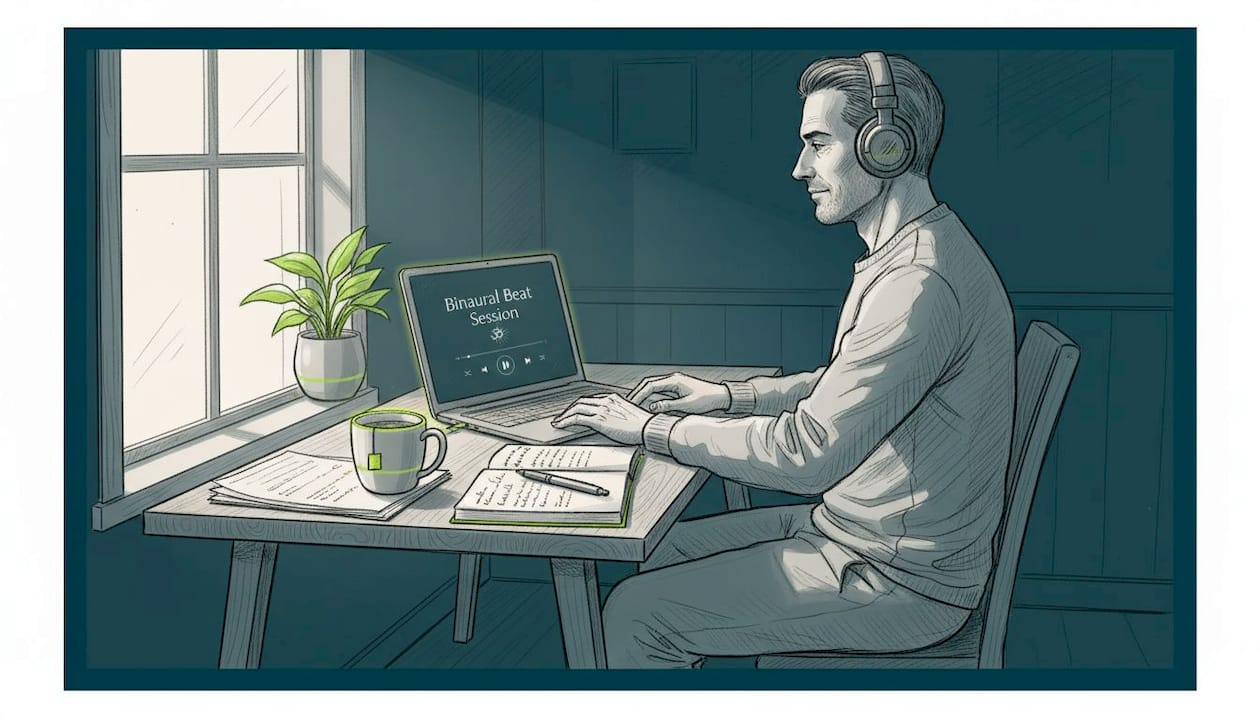
Here is the basic science: binaural beats occur when you play two slightly different frequencies simultaneously, one in each ear via headphones. Your brain perceives an illusory beat equal to the mathematical difference between the two tones. So if your left ear hears 200 Hz and your right hears 206 Hz, your brain generates a 6 Hz beat, which sits squarely in the theta range. The brain then tends to entrain to this frequency, nudging you toward a meditative state.
The research in 2026 is increasingly robust. Self-administered 6 Hz theta binaural beats demonstrate enhanced calmness and focus with an effect size (g) greater than 0.84, which in research terms is considered a large effect. That is significant. EEG studies further confirm that rhythmic sound meditation alters brain activity, with entrainment confirmed via power spectrum density analysis, and the effect is even stronger when white noise is used as a background for gamma binaural beats.
Here is a practical comparison to help you choose between the most commonly used binaural beat frequencies:
| Frequency range | Hz range | Primary benefit | Best used for | Potential downside |
|---|---|---|---|---|
| Delta | 0.5 to 4 Hz | Deep sleep, restorative states | Sleep induction | May cause excessive drowsiness |
| Theta | 4 to 8 Hz | Deep meditation, creativity | Relaxation, inner journeying | Can trigger vivid imagery (not always welcome) |
| Alpha | 8 to 12 Hz | Calm focus, gentle awareness | Mindfulness sessions, light meditation | Less immersive than theta for deep states |
| Beta | 12 to 30 Hz | Alertness, concentration | Pre-study focus sessions | Not ideal for traditional meditation |
| Gamma | 30 Hz and above | Heightened perception, insight | Advanced practice, cognitive enhancement | Requires white noise background for best effect |
A few practical points that make a real difference in delivery:
- Always use headphones. Binaural beats literally do not work without them, because the two-frequency separation across both ears is the entire mechanism.
- Reduce external noise. A quiet room or gentle background noise helps the brain lock onto the entrainment frequency more readily.
- Choose your track intentionally. Our guide to best binaural healing beats walks you through the key practices, and the binaural beats Hz guide is a brilliant companion for frequency selection.
If you are particularly interested in theta work, the theta binaural beats download options are worth exploring, as is the specific 428 Hz meditation guide for those curious about solfeggio-adjacent work.
Pro Tip: Match your frequency to your intention before each session rather than using the same track on autopilot. Spending sixty seconds consciously setting your goal before pressing play makes the whole experience more coherent and dramatically more effective.
Orchestral and digital compositions: Elevating the meditation experience
To complete your toolkit, orchestral and advanced digital compositions offer highly customisable enhancement for any meditation setting. And this is where it gets genuinely exciting, especially if you are someone who finds that music bypasses your mental chatter more efficiently than any other tool.
Orchestral compositions for meditation are not simply classical music played quietly. They are carefully constructed soundscapes in which instrumentation, harmony, dynamics, and pacing are all calibrated to support specific meditative intentions. The difference between listening to a well-crafted orchestral meditation track and simply putting on background music is a bit like the difference between a proper massage and someone patting you on the shoulder. Both are pleasant. One is transformative.
Here is how to integrate orchestral and digital compositions effectively into your sessions:
- Define your emotional starting point. Are you arriving frazzled and tense, or relatively calm and simply wanting to deepen your practice? Choose a track that meets you where you are rather than where you want to be. The music does some of the transitional work for you.
- Set your listening environment. Whether you use headphones or a high-quality speaker system, audio quality matters more than most people realise. Compressed audio files lose the harmonic subtlety that makes orchestral recordings powerful.
- Use the composition as an anchor. Rather than trying to meditate through the music, allow the music to anchor your attention. When thoughts arise, return to a specific instrument or melodic line as you would return to the breath.
- Explore frequency-embedded compositions. Many modern orchestral meditation tracks embed solfeggio frequencies or healing meditation hertz soundscapes within the arrangement itself, so you receive entrainment benefits alongside the richness of live instrumentation.
- Reflect afterwards. Give yourself two to three minutes after the session to sit quietly before moving on. The compositional journey often continues to settle in the nervous system even after the sound ends.
The statistical case for music in meditation is compelling. Studies on music and anxiety consistently show reductions of 60 to 65% in self-reported anxiety scores after structured musical listening interventions. That is a remarkable number. The spiritual growth through music literature also suggests that intentionally crafted compositions can support longer-term shifts in emotional resilience and self-awareness, not just momentary relaxation.
Orchestral recordings are particularly effective at creating immersion because a full ensemble produces a richness of harmonic overtones that digital synthesis struggles to replicate. The way a live cello section breathes and resonates, or the way a French horn phrase hangs in a real acoustic space, contains acoustic information that your nervous system processes on levels you are not consciously aware of. If you are curious about how sound architecture influences outcomes, brainwave entrainment in beta-to-theta shifts applies equally to live instrumental recordings as it does to purpose-built sound baths. And choosing the best frequency for wellness within an orchestral context is a genuinely rewarding area of exploration.
How to personalise your meditation for maximum results
After reviewing all options, the real breakthrough comes from experimenting and adapting to get the best results for you. No framework, however beautifully researched, can substitute for paying honest attention to your own experience.
Here is a step-by-step approach to personalising your sound meditation practice:
- Set a clear intention before each session. Write it down if you can. “I want to release the tension from today’s work stress” is more actionable than “I want to relax.” The specificity helps you evaluate what actually worked afterwards.
- Assess your current sensitivity. Note your baseline state: anxious, flat, restless, or already somewhat settled. This shapes which frequency range or instrument type you should start with.
- Select your tool or track accordingly. Use your meditation frequency guide as a reference and cross-check with how you felt in previous sessions using similar tracks.
- Run a short test before committing. Listen to the first two or three minutes of a new track or attend the opening of a sound bath with genuine attention. Does your body soften? Does your breathing shift? If you feel resistance or discomfort, that is useful information, not failure.
- Observe and record your response. Immediately after your session, jot down what you noticed physically, emotionally, and mentally. Even three sentences is enough. Over weeks, patterns emerge that are genuinely revelatory.
- Adapt and refine. Swap frequencies, try a different instrument type, shift your listening environment. Individual personalisation matters enormously, and some people experience discomfort from specific frequencies or find that certain tones cause them to drift to sleep rather than meditate. Both responses tell you something valuable.
Common troubleshooting scenarios worth knowing about: if you feel spacey or disoriented after a session, you may have gone too deep into delta territory without adequate grounding time afterwards. If you feel restless and unable to settle, your frequency choice may be too high, or your environment too stimulating. And if you consistently fall asleep during theta tracks, that is not necessarily a problem unless you wanted to stay conscious for the session.
Pro Tip: Keep a sound-meditation journal for at least four weeks. It sounds faintly obsessive, I know. But the ability to look back and see that “Tuesday’s orchestral theta session always leaves me clearer-headed by evening” is the kind of self-knowledge that no algorithm can generate for you.
Why your meditation experience is more than just the right frequency
Here is where I want to offer an opinion that might ruffle a few feathers in the quantified-wellness world: the science is genuinely valuable, and I love a well-designed study as much as the next person, but the risk of over-engineering your meditation practice is real and slightly ridiculous.
I have spoken to practitioners who spend more time optimising their audio setup than actually meditating. They read about frequency meditation insights obsessively, stack frequencies, invest in acoustic panels, and then sit down to meditate feeling so pressured to achieve an optimal state that the whole exercise becomes anxious rather than relaxing. The irony is quite spectacular.
The science provides a brilliant foundation. Binaural beats demonstrably alter brain states. Orchestral compositions provoke genuine physiological relaxation. Sound baths have measurable effects on cortisol. These are real phenomena and worth taking seriously. But here is the uncomfortable truth: personal variation is so enormous that the “correct” frequency for one practitioner is mildly irritating for another, and no study average can tell you what your specific nervous system needs on a grey Wednesday morning in February.
What consistently makes the biggest difference, in my experience and in the accounts of seasoned practitioners, is an open, investigative mindset. The willingness to say “I wonder what happens if I try this” rather than “I must achieve state X using protocol Y.” Combining approaches, such as beginning with a sound bath to drop into a relaxed state and then using binaural beats to deepen focus, can deliver more than either technique alone. But the person who notices that for them, specifically, a ten-minute orchestral track works better than forty minutes of theta binaural beats is practising genuine self-knowledge.
Technology enables. Curiosity and honest self-observation are what make the enabling count.
Enhance your practice with premium meditation music
Making sound-based meditation genuinely effective means having access to tracks that are crafted with intention, recorded with precision, and designed to support real transformation rather than just fill auditory space.
At Orchestral Meditations, we have built a curated library of orchestral and frequency-based recordings that spans deep relaxation, focused mindfulness, emotional healing, and spiritual exploration. Every track in our collection is purposefully designed and refined, so you spend less time searching and more time actually meditating. Whether you are new to sound-enhanced practice or a seasoned practitioner refining your toolkit, our best meditation music selections are tailored to personal need rather than generic listening. And if you have ever wondered about the practical difference in outcomes, our exploration of orchestral vs digital music is a great next step.
Frequently asked questions
Are sound baths or binaural beats better for deep relaxation?
Both are effective, but crystal bowls and gongs offer whole-body sensory immersion through brainwave entrainment, while binaural beats use headphone-delivered tones for subtler, inward entrainment. Your best choice depends on whether you respond more to environmental sound or personal audio.
How do I know which frequency is best for my meditation?
Match frequency to your goal: use theta for relaxation and alpha for focused awareness, and personalise by response rather than following a fixed protocol, since individual sensitivity varies considerably.
Is there scientific proof that these sound techniques reduce stress?
Yes, robustly so. Randomised trials show significant reductions in stress, anxiety, cortisol, and blood pressure following structured sound meditation with solfeggio frequencies and singing bowls.
Can I combine orchestral music and binaural beats in a single session?
Absolutely. Many practitioners find that layering orchestral compositions beneath binaural beat tracks creates a richer entrainment environment and makes the session feel more immersive and emotionally engaging.
What if I feel discomfort when using these sound techniques?
Stop, reset, and experiment with a different frequency range or instrument type. As research confirms, some individuals experience discomfort from specific frequencies, and that response is useful information guiding you toward what genuinely supports your practice.