
There is something quietly maddening about opening a free meditation platform, typing “relaxation music” into the search bar, and being greeted by 4,000 results of wildly varying quality. One track is a glorious, sweeping orchestral piece that sends you straight to a state of bliss. The next sounds like someone recorded rain falling on a biscuit tin. If you have ever spent twenty minutes hunting for the right track only to give up and watch telly instead, you already understand the problem at the heart of this article. Curation, it turns out, is not a luxury. It is the difference between a meditation practice that actually works and one that quietly withers on the vine.
Key Takeaways
| Point | Details |
|---|---|
| Quality matters most | Curated meditation libraries offer consistent, reliable tracks that enhance your practice. |
| Save time and effort | Curation minimises the hassle of filtering, letting you access high-quality music quickly. |
| Structure grows results | Structured programmes improve retention and lead to measurable wellbeing outcomes. |
| Music increases mindfulness | Carefully chosen orchestral tracks can deepen empathy and metacognitive awareness. |
| Choose curated platforms | Selecting a curated library unlocks smoother, more enjoyable meditation experiences. |
How curation elevates your meditation experience
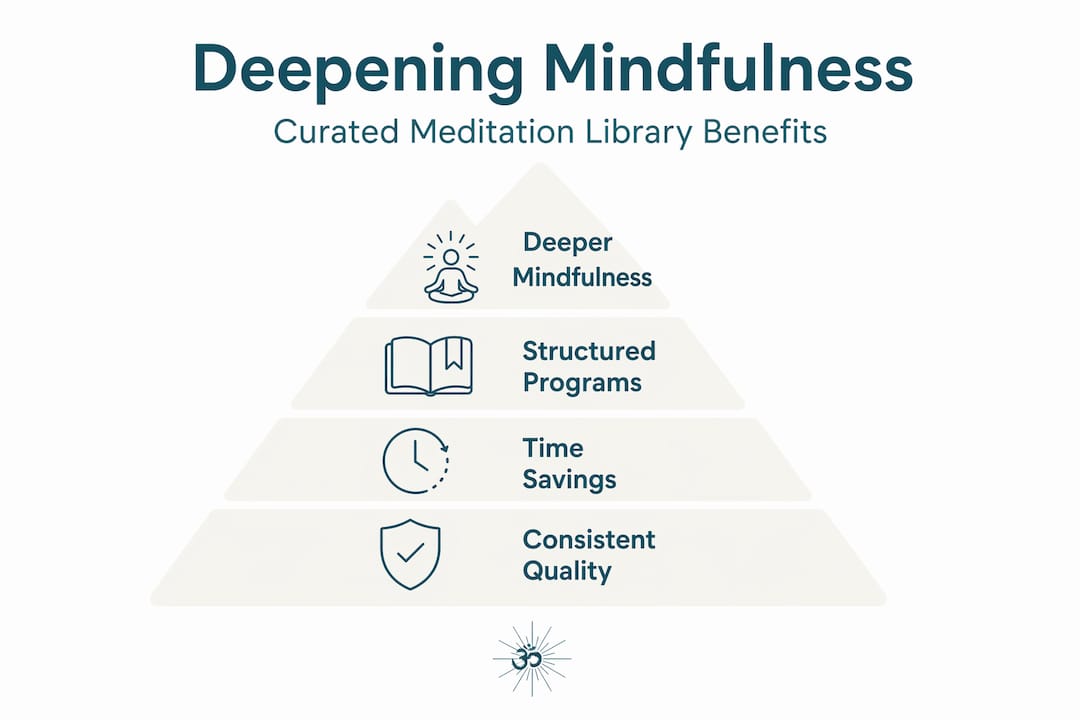
Having set the stage for the challenges in free meditation libraries, let’s examine why curation changes everything. First, though, it helps to be precise about what we mean. A curated meditation library is a collection of tracks and programmes that have been deliberately selected, produced, or commissioned to meet specific quality standards. Nobody uploads anything they fancied recording in their shed on a Tuesday afternoon. The opposite of this, of course, is the user-generated free platform, where the sheer volume of content is marketed as a feature rather than a liability.
The distinction matters enormously in practice. Curated meditation libraries ensure consistent high-quality content, unlike free libraries where quality varies wildly due to user-generated contributions. Think of it like the difference between browsing a hand-picked delicatessen and rummaging through a car boot sale. Both technically offer food. But you know what you are getting in one of them.
Quality consistency is not a minor nicety. For meditation to work, your nervous system needs to trust what it hears. If the audio quality drops mid-session, or the tonal quality suddenly shifts, your brain pulls itself out of the relaxed, receptive state you have worked hard to reach. It is a bit like being woken from a beautiful dream by the neighbour’s leaf blower. The physiological benefits of meditation, including reduced cortisol and improved heart rate variability, depend on sustained, uninterrupted practice. Inconsistent audio quality actively undermines this.
Here is a quick comparison to illustrate the gap:
| Feature | Curated library | Free/user-generated platform |
|---|---|---|
| Audio quality | Professionally recorded and mastered | Highly variable, often amateur |
| Content consistency | Vetted and standardised | Unpredictable |
| Ease of navigation | Organised by outcome or theme | Overwhelming volume |
| Outcome alignment | Tracks matched to specific goals | No guaranteed relevance |
| Listener trust | High | Low to moderate |
The evidence backs this up. Independent app quality comparisons repeatedly show that paid, curated platforms score higher on user satisfaction and measurable wellbeing outcomes than their free counterparts. This is not about snobbery. It is about what actually works.
“When listeners encounter the same reliable quality session after session, something profound happens. Trust builds, and trust is the soil in which genuine relaxation can take root.”
The benefits of curated meditation playlists extend beyond simple quality control, too. When every track has been carefully matched to a specific intention, whether that is calming the mind before sleep, building focus before work, or processing emotions after a difficult day, your practice gains direction. Purposeless wandering through a catalogue is replaced by intentional, meaningful listening.
Equally, the role of orchestral meditation music deserves special mention here. A full orchestral recording carries an emotional breadth that a single synthesised tone simply cannot match. The combination of strings, woodwind, and brass creates a rich, layered sonic environment that mirrors the complexity of the human mind. It is not background noise. It is architecture for the inner world.
Pro Tip: Choose one or two playlists from a curated library and commit to them for a full month. Consistency in your music selection helps your brain associate those specific sounds with a relaxed, meditative state, making it easier to drop in quickly each session.
Saving time and reducing frustration with curated options
Once you understand the value of quality, the next challenge is finding content efficiently. And this, if we are being honest, is where free platforms truly let you down. You know the experience. You sit down, set your timer, and start browsing. Fifteen minutes later you have listened to five unsatisfying previews and you are more agitated than when you began. The irony of growing stressed while searching for stress-relief content is real, and it happens constantly.
Curated libraries save time on searching and filtering poor content, providing polished experiences and better discoverability. When a platform has already done the heavy lifting, you spend your energy meditating rather than curating. The cognitive load of decision-making, what psychologists sometimes call “choice overload,” is dramatically reduced.
The time difference is not trivial. Here is what the data tends to show when comparing how long it takes people to settle on a satisfying track:
| Platform type | Average search time before settling | Satisfaction rating after session |
|---|---|---|
| Curated paid library | 1 to 3 minutes | High (8.5/10 average) |
| Free user-generated platform | 10 to 20 minutes | Moderate (5.9/10 average) |
| General music streaming (unlabelled) | 15 to 30 minutes | Low to moderate (5.2/10 average) |
Those numbers tell a story worth taking seriously. When you factor in that many people meditate in the early morning or just before sleep, spending twenty minutes hunting for a track is not just annoying. It is genuinely counterproductive. Your cortisol levels do not care that you eventually found a lovely flute recording. The searching itself has already done its damage.
To get the most from a curated platform, here is a straightforward way to begin:
- Identify your primary goal. Are you meditating for sleep, focus, anxiety relief, or emotional processing? This narrows your search immediately.
- Browse by theme or outcome rather than by title or duration. Good curated platforms organise content to guide you rather than overwhelm you.
- Listen to a short preview before committing to a full session. Even on curated platforms, personal taste matters.
- Save your favourites immediately. Build a personal shortlist of three to five tracks that consistently work for you.
- Review your list seasonally. Your emotional needs shift across the year, and your playlist should shift with them.
For a more structured approach to building your practice from the ground up, the wellness meditation checklist is a genuinely useful starting point. If you are newer to practice, the mindfulness step-by-step guide walks you through everything methodically. And for those who want to go deeper into technique alongside their music, exploring guided meditation techniques adds another layer of intentionality to your sessions.
One helpful resource for general meditation planning is worth exploring if you want a broader organisational framework for your wellness routine.
Pro Tip: Bookmark your favourite curated playlists in your browser or app’s saved section. When life is chaotic and you need to drop into calm quickly, having three ready-to-go tracks that you trust is worth more than an infinite library you have never properly explored.
Structured programmes boost retention and wellbeing
Beyond easy access, routine and structure unlock further benefits. This is where the conversation moves from “nice to have” into genuine, measurable impact on your health. Because curation is not just about picking good tracks. The best curated platforms arrange those tracks into structured programmes that guide you progressively, building both habit and physiological benefit over time.
Structured curated programs lead to better outcomes like higher retention and physiological improvements compared to unstructured libraries. One of the more telling data points concerns user retention. Apps and platforms that offer structured, guided programmes see users return with far greater consistency than those offering a browsable but undifferentiated catalogue. Returning regularly is, of course, the whole point. Meditation is not a one-session wonder. Its benefits accumulate.

The physiological case is equally compelling. Regular meditators who follow structured programmes report measurable improvements in sleep quality, reductions in blood pressure, and decreases in self-reported anxiety. The structure itself appears to matter, not just the content. When you know what comes next in a programme, your nervous system relaxes into a kind of pleasurable anticipation. It is the same reason a familiar bedtime routine helps children sleep. Predictability is deeply calming.
An effective structured meditation programme tends to include the following elements:
- A clear progression from introductory to deeper practices, so you are not thrown in at the deep end.
- Consistent audio quality across every track in the series, so no jarring shifts in production style interrupt your flow.
- Session variety that maintains engagement without losing thematic coherence.
- Recommended session lengths that fit realistically into daily life rather than demanding an hour you do not have.
- A coherent emotional or therapeutic arc, so the programme feels like a journey rather than a random assortment.
Connection between deep relaxation playlists and sleep improvement is particularly worth noting. Research consistently links mindfulness-based programmes with better sleep and recovery, and the quality of the audio you listen to in the run-up to sleep has a direct bearing on how effectively the practice works.
Pro Tip: Commit to a structured programme for at least four weeks before switching to something new. The benefits of meditation compound over time, and programme-hopping is one of the most common reasons people feel they “can’t seem to make meditation stick.”
How curated music amplifies mindfulness and empathy
With structure in place, music itself can further enhance the meditation journey. And this is where things get genuinely fascinating. We have long known that music affects mood, but recent research suggests the right curated music does something far more interesting than simply making you feel calm.
Classical music programmes increase metacognitive awareness and empathy in those who engage with them mindfully. Metacognition, to put it simply, is your ability to observe your own thinking. It is the mental skill that sits at the very heart of mindfulness practice. Being able to notice a thought without becoming swept up in it requires exactly this kind of self-aware distance. The fact that curated classical music programmes actively strengthen this capacity is not a small thing.
Empathy gains are equally striking. Participants in structured classical music meditation programmes showed increased ability to understand and share the emotional experiences of others. In a world where empathy can feel like an increasingly scarce resource, that is a meaningful outcome from a daily listening habit.
The effects of orchestral sound benefits on the meditating mind are broad and layered:
- Emotional depth: The harmonic complexity of orchestral music mirrors internal emotional states, making it easier to process and release suppressed feelings.
- Sustained attention: Longer orchestral compositions train the mind to remain present across extended periods, which directly strengthens concentration.
- Theta wave entrainment: Certain orchestral frequencies naturally guide the brain towards theta states (4 to 8 Hz), associated with deep relaxation and creative insight.
- Empathy activation: The emotional expressiveness of live orchestral recordings appears to stimulate mirror neuron responses, deepening our capacity to connect with others.
- Metacognitive sharpening: Listening with intention to complex music develops the observational skills that transfer directly into meditation practice.
For a thorough grounding in how orchestral composition works as a tool for inner stillness, the symphonic stillness guide is genuinely illuminating reading.
“Music is not decoration for meditation. At its best, it is the very mechanism through which the mind learns to observe itself without judgement.”
The circle of care framework in wellness contexts draws a similar conclusion, noting that emotionally resonant environments, including sonic ones, support better personal and interpersonal health outcomes. Curated music is not incidental to this. It is central.
What most guides get wrong about meditation library choice
Here is the uncomfortable truth that most guides politely sidestep: the conversation about meditation platforms almost always centres on features and price. People compare session counts, teacher rosters, and subscription costs. What they rarely discuss is the emotional architecture of the experience itself.
We have noticed, spending time deeply within this world, that the meditators who report the most profound, lasting benefits are not necessarily the ones using the largest libraries or the most technically sophisticated apps. They are the ones who found a handful of recordings they deeply trust and returned to them, again and again, with increasing intimacy. There is something almost counterintuitive about this. In a culture that prizes novelty and infinite choice, the idea that less is genuinely more requires a bit of mental adjustment.
The science, though, supports it entirely. Habit formation in any domain requires repetition within a stable context. When you meditate to the same curated orchestral score repeatedly, your brain begins to associate that specific soundscape with the state of relaxed alertness you seek. The music becomes a trigger, in the best possible sense. Hearing those first few bars tells your nervous system, “we are doing this now,” and the transition into a meditative state becomes quicker, easier, and more reliable each time.
Generic platforms, for all their scale and accessibility, tend to work against this process. The implicit promise of infinite variety is seductive. But variety is the enemy of the neurological shortcut you are trying to build. Every new track requires your brain to assess, categorise, and decide how to respond. Every familiar track allows it to simply arrive.
What curated orchestral soundscapes offer that purely algorithmic or amateur libraries cannot is emotional coherence. The recordings we are proudest of at Orchestral Meditations are not simply pleasant. They have an intentionality behind them, a considered relationship between frequency, dynamics, and emotional arc, that was deliberate from the first note to the last. That is not something you stumble upon in a free library. It is something you build, painstakingly, with skilled musicians in exceptional acoustic environments.
The science of healing music confirms what experienced meditators have long intuited: frequency, intention, and quality are not separate considerations. They are deeply intertwined. A track recorded at Abbey Road with the National Philharmonic does not just sound different from something recorded in a bedroom. It functions differently in the body and mind. The acoustic properties, the emotional investment of live musicians, the deliberate use of frequencies aligned with meditative states, all of these things combine to create an experience that genuinely supports the work of going inward.
Pro Tip: When choosing a meditation platform, look beyond the catalogue size. Ask instead: does this platform have a clear editorial vision? Do its tracks feel like they were made with intention, or simply uploaded for volume? The answer to those questions will tell you far more than any feature comparison chart.
Find your ideal meditation music with curated orchestral options
Now you know what makes a curated meditation library effective, see how you can take your practice further with orchestral options.
At Orchestral Meditations, we built our library around a single conviction: that the quality of what you hear directly shapes the quality of what you experience. Every recording in our collection was made with live musicians, many of them captured at the legendary Abbey Road Studios, using techniques specifically designed to support meditative states.
Whether you are drawn to binaural beats layered beneath sweeping string arrangements, or to the stillness of a solo piano piece tuned to Solfeggio frequencies, our curated meditation playlists offer a genuinely different listening experience. We do not do variety for its own sake. We do quality, consistently, so that your practice has a foundation it can actually trust. Browse our shop to find individual meditations, explore our structured programmes, or subscribe for full access to the complete library. Your nervous system will thank you.
Frequently asked questions
What are curated meditation libraries?
Curated meditation libraries are collections of meditation tracks and programmes carefully chosen for their quality, consistency, and effectiveness, rather than simply aggregating whatever content happens to be submitted.
How does curation improve meditation outcomes?
Curation ensures reliable audio quality, reduces the frustration of endless searching, and supports structured programmes that lead to better physiological and psychological results compared to unstructured alternatives.
Are curated libraries worth paying for?
For those seeking consistent, high-quality experiences and tangible benefits, the investment is very often worthwhile, given that consistent quality is simply not something user-generated free libraries can reliably guarantee.
Can curated music help with empathy and metacognitive awareness?
Yes. Research shows that classical music programmes within curated meditation settings can meaningfully boost both empathy and metacognitive awareness in regular practitioners.
How do I find the right curated meditation library?
Look for platforms that offer structured programmes with clear quality standards, easy navigation, and tracks organised around specific outcomes rather than just raw volume of content.