
A meditation routine is a scheduled, repeatable practice of focused mental attention that builds mindfulness, reduces stress, and improves emotional regulation over time. The good news? You do not need an hour of silence, a Himalayan retreat, or the patience of a Buddhist monk. Daily short sessions, even as brief as two minutes, deliver more benefit than longer sessions practised sporadically. Creating a meditation routine is less about willpower and more about clever design. Anchor it to the right habits, choose the right tools, and you will find yourself meditating before you have even had time to talk yourself out of it.
What do you actually need to start a meditation routine?
The prerequisites for building a daily meditation practice are simpler than most beginners expect. You need a quiet spot, a consistent trigger, and something to reduce the friction of starting. That is genuinely it. No special cushion, no incense, no app subscription costing more than your gym membership.
Here is what actually matters when you are setting up your practice:
- A dedicated location. A single chair and a consistent spot train your brain to associate that place with calm. Your nervous system is surprisingly easy to condition.
- A daily anchor cue. Attaching meditation to an existing habit, such as after brushing your teeth or before your morning coffee, removes the need for willpower entirely. Anchoring to existing habits is scientifically proven to build durable routines.
- A timer or guided audio. A simple phone timer works fine. Guided sessions and orchestral meditation audio reduce the mental effort of starting, which is the biggest barrier for most people.
- A distraction-free environment. Silence your phone notifications. Tell whoever is nearby that you need five minutes. Five minutes is not a lot to ask.
The question of what to listen to during meditation is worth taking seriously. Orchestral meditation music composed with natural instrumentation creates a richer, more immersive ambience than digitally synthesised sounds, which can feel thin or clinical by comparison. Orchestralmeditations features recordings by composers Robert Emery and Moritz Schneider, both of whom bring serious musical credentials to their work. Robert Emery is a composer and producer whose orchestral writing spans film, television, and meditation, with a gift for creating emotionally resonant soundscapes that guide the listener inward without distraction. Moritz Schneider brings a European classical sensibility to his compositions, producing music that feels simultaneously grounding and expansive. Their recordings, captured at Abbey Road Studios with the National Philharmonic, are a genuinely different experience from the ambient loops you find on free apps.
Pro Tip: Set up your meditation space the night before. Lay out your cushion, queue your audio, and set your timer. Reducing morning decisions by even one or two steps dramatically increases follow-through.

Here is a quick comparison of common tools to help you choose:
| Tool | Best for | Notes |
|---|---|---|
| Phone timer | Minimalists and self-guided practice | Zero friction, no account needed |
| Guided meditation audio | Beginners needing structure | Reduces decision fatigue significantly |
| Orchestral meditation music | Deepening focus and emotional relaxation | Superior ambience to digital sounds |
| Habit tracker app | Motivation and visible progress | Shifts focus from perfection to completion |
Step-by-step guide to building a meditation habit for beginners
The most common mistake beginners make is starting too ambitiously. Twenty minutes on day one sounds admirable. By day four, it sounds exhausting. Behavioural research is clear: starting with 3 to 5 minutes and increasing gradually over 30 days is the most effective approach for building a lasting habit.
Here is a practical progression framework:
-
Week one: 3 to 5 minutes. Sit comfortably, close your eyes, and focus on your breath. Breathe deeply through the nose and out through the mouth, paying attention to the physical sensation of each breath. When your mind wanders (and it will, spectacularly), simply return your attention to the breath without judgement.
-
Week two: 7 to 10 minutes. Extend your sessions slightly and begin experimenting with a body scan. Move your attention slowly from the top of your head to your feet, noticing tension or sensation without trying to change anything.
-
Week three: 12 to 15 minutes. Introduce a technique that genuinely interests you, whether that is loving-kindness, breath counting, or open awareness. Variety at this stage keeps the practice feeling fresh rather than obligatory.
-
Week four: 15 to 20 minutes. By now, the habit is forming. Your sessions feel less like a chore and more like a reliable reset button. This is also the stage where orchestral music by Robert Emery or Moritz Schneider becomes particularly valuable, as longer sessions benefit enormously from a rich, sustained soundscape that holds your attention without demanding it.
The “no-zero rule” is worth adopting from day one. Miss a session? Fine. Do one minute tomorrow. Tracking completion rather than quality is the key to sustaining any habit long-term. A tick in the box for a two-minute session beats a blank space after a skipped thirty-minute one every single time.
Pro Tip: Attach your meditation to a specific existing action rather than a clock time. “After I make my morning tea” is far more reliable than “at 7:15am” because it survives schedule changes, travel, and the general chaos of real life.
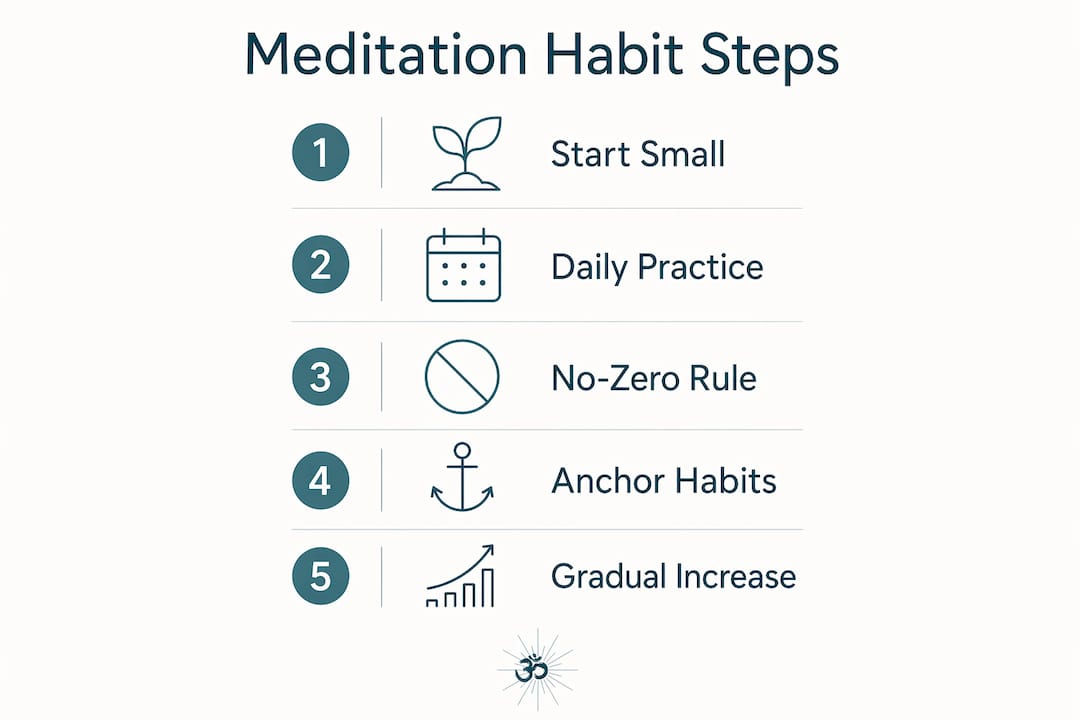
Here is a sample 30-day progression plan:
| Week | Session length | Focus technique |
|---|---|---|
| Week 1 | 3 to 5 minutes | Breath awareness |
| Week 2 | 7 to 10 minutes | Body scan |
| Week 3 | 12 to 15 minutes | Chosen technique (loving-kindness, counting, etc.) |
| Week 4 | 15 to 20 minutes | Sustained practice with orchestral audio support |
How do you personalise your practice and overcome common obstacles?
Not every meditation technique suits every person, and pretending otherwise is how people end up convinced they are “bad at meditating.” You are not bad at meditating. You have just not found the right approach yet.
Here is a quick comparison of the four most accessible techniques for beginners:
| Technique | What it involves | Best suited for |
|---|---|---|
| Breath counting | Count each exhale from 1 to 10, then repeat | Restless or analytical minds |
| Body scan | Slow attention sweep from head to feet | Physical tension and anxiety |
| Loving-kindness | Silently repeat warm wishes for self and others | Emotional difficulty or low mood |
| Open awareness | Observe thoughts and sounds without engaging | Experienced beginners wanting flexibility |
The wandering mind is the most universal obstacle in developing a mindfulness practice, and it is also the most misunderstood. A wandering mind is not a failure. It is the practice. Every time you notice your mind has drifted and return your attention, you are doing exactly what meditation is designed to do. Labelling distracting thoughts during meditation, a technique called mental noting, helps create distance between you and your thoughts, which improves emotional regulation over time.
Common barriers and how to address them:
- “I don’t have time.” Three minutes counts. Attach it to something you already do. The step-by-step guided meditation approach from Orchestralmeditations takes the planning entirely out of your hands.
- “My mind won’t stop.” That is normal. Use breath counting or a guided audio to give your mind a specific task.
- “I keep forgetting.” Place a visual cue, such as your headphones or a cushion, somewhere obvious. Physical reminders outperform phone alarms for habit formation.
- “I’m bored.” Rotate techniques weekly. Boredom is a signal to experiment, not to quit.
Pro Tip: If motivation dips, try a scientific meditation techniques list to discover evidence-backed methods you may not have tried. Sometimes a fresh technique is all it takes to reignite genuine interest.
Schedule disruptions are inevitable. Travel, illness, and busy periods will all interrupt your practice at some point. The solution is not to compensate with a marathon session afterwards. Return to your shortest, simplest version of the practice and rebuild from there. Consistency across weeks matters far more than perfection within any single one.
How to weave mindfulness into everyday life beyond formal sessions
Formal meditation sessions are the foundation, but the real transformation happens when mindfulness starts bleeding into the rest of your day. This is where informal mindfulness practice comes in, and it requires almost no extra time.
The idea is to use ordinary daily events as triggers for brief moments of conscious attention. A phone notification becomes a cue to take one slow breath before responding. Waiting for the kettle to boil becomes a 90-second body scan. Walking from your desk to the kitchen becomes an opportunity to notice the physical sensation of movement rather than mentally rehearsing your to-do list.
Specific ways to integrate mindfulness throughout your day:
- Use sensory anchors. The smell of coffee, the feeling of water on your hands while washing up, the sound of rain. These are free, always available, and surprisingly effective at pulling you back into the present moment.
- Practise the one-breath reset. Before any meeting, phone call, or stressful task, take one deliberate breath. It takes three seconds and genuinely shifts your physiological state.
- Try a midday audio break. Even five minutes with orchestral meditation music by Robert Emery or Moritz Schneider during a lunch break provides a genuine reset for the nervous system. This is not indulgence. It is maintenance.
- Use transition moments. The gap between finishing one task and starting another is a natural mindfulness window. Most people fill it with their phone. You can fill it with ten seconds of conscious breathing instead.
The combination of formal daily sessions and these informal moments is what produces the stress management and emotional regulation benefits that meditation research consistently reports. One without the other is like eating well only at breakfast and wondering why you are still tired by afternoon. Both matter, and together they compound in ways that are genuinely noticeable within a few weeks.
For anyone building a practice that also supports better sleep, the sleep meditation checklist from Orchestralmeditations is a practical companion resource worth bookmarking.
Key takeaways
A consistent meditation routine is built through short daily sessions anchored to existing habits, gradually extended over four weeks, and supported by the right techniques and audio environment.
| Point | Details |
|---|---|
| Start small and build gradually | Begin with 3 to 5 minutes daily and increase to 15 to 20 minutes over 30 days. |
| Anchor to existing habits | Attach meditation to a daily cue to remove reliance on willpower or fixed clock times. |
| Track completion, not quality | A two-minute session counts. Consistency across days beats perfection in any single session. |
| Personalise your technique | Rotate between breath counting, body scan, loving-kindness, and open awareness to maintain engagement. |
| Extend mindfulness informally | Use sensory triggers and transition moments throughout the day to reinforce formal practice. |
Why I think most people overcomplicate this from the start
Here is something I have observed repeatedly: beginners approach meditation the way they approach a new fitness regime. They buy the gear, download three apps, set a 6am alarm, and plan to meditate for twenty minutes every single morning. By day five, the alarm is snoozed, the apps are unopened, and the whole thing feels like another failure to add to the list.
The problem is not lack of discipline. The problem is the design. Aiming too high too soon is not ambition. It is a reliable recipe for dropout.
What actually works is almost embarrassingly modest. Two minutes after brushing your teeth. One breath before a stressful call. A five-minute orchestral track from Robert Emery or Moritz Schneider during your lunch break. These tiny, consistent acts do something that grand plans rarely do: they actually happen.
I have also noticed that the people who stick with meditation long-term are not the ones who find it easy. They are the ones who stopped expecting it to be easy and started treating it like any other skill worth developing. Some days your mind is a snow globe that someone has just shaken. That is fine. You sit with it anyway. The relaxation tips for mental health that genuinely endure are the ones built on patience, not performance.
My personal favourite technique remains simple breath awareness, partly because it requires nothing and works anywhere, and partly because it never stops being humbling. Twenty years of practice and a wandering mind still shows up. The difference is that now I find it mildly amusing rather than defeating.
View your practice as something that evolves with you. It will look different at 30 than it does at 50. It will look different during a stressful month than during a calm one. That is not inconsistency. That is a living practice.
— ROBERT
Deepen your practice with orchestral meditation music
If you have been meditating to generic ambient loops or silence, you may not have experienced what a genuinely well-crafted soundscape can do for your practice.

Orchestralmeditations offers a library of recordings composed by Robert Emery and Moritz Schneider, captured at Abbey Road Studios with the National Philharmonic. These are not background tracks. They are purposefully designed compositions using binaural beats, theta frequencies, and 3D surround sound to guide you into deeper meditative states. Whether you are five minutes into your first week or twenty minutes into your fourth, the right audio environment makes a measurable difference. Explore the full collection at Orchestralmeditations and find the track that fits your practice. You can also browse the best meditation music selections curated specifically for mindfulness and deep relaxation.
FAQ
How long should a beginner meditate each day?
Beginners should start with 3 to 5 minutes daily and increase gradually to 15 to 20 minutes over four weeks. Consistency matters more than duration, so a short daily session is always preferable to a long occasional one.
What is the best time of day to meditate?
The best time is whichever time you will actually do it consistently. Morning sessions before the day’s demands take hold work well for most people, but attaching your practice to any reliable daily cue, such as after lunch or before bed, is more important than the specific hour.
What should I do when my mind keeps wandering during meditation?
A wandering mind is a normal part of the process, not a sign of failure. Mental noting, where you briefly label a thought as “thinking” and return to your breath, is an effective technique for creating distance from distracting thoughts and improving focus over time.
Does meditation music actually help?
Yes. Orchestral meditation music with natural instrumentation creates a superior ambient environment compared to digital sounds, supporting deeper focus and emotional relaxation during sessions.
How do I stay consistent when life gets busy?
Anchor your practice to an existing daily habit rather than a fixed time, and adopt a no-zero rule. Even one minute on a difficult day maintains the habit and makes it far easier to return to a full session the following day.