
Sound does something to us that we still cannot fully explain. That is not a poetic statement — it is, rather, an honest admission from the scientific community itself. The role of scientific sound technology in meditation and therapeutic practice has expanded dramatically in recent years, and some of the discoveries are genuinely startling. We now know, for instance, that humans can intentionally produce vocal ultrasound and that the brain encodes it cortically — a finding that reframes what we thought we understood about our relationship with sound. Composer Robert Emery and producer Moritz Schneider have spent years working at precisely this intersection of scientific rigour and musical artistry, and their influence on how wellness soundscapes are built is considerable.
Key takeaways
| Point | Details |
|---|---|
| Sound affects us beyond hearing | Ultrasound, infrasound, and vibration all influence physiology even when they are inaudible. |
| Clinical research is promising but patchy | Over 177 trials examine ultrasound neuromodulation, yet reporting quality remains inconsistent across studies. |
| Dose matters enormously | Session length and repetition frequency shape outcomes more than most consumer claims acknowledge. |
| Inaudible sound carries real risks | Infrasound exposure has been linked to elevated cortisol and negative affect in controlled studies. |
| Artistry amplifies science | Combining scientific design principles with skilled composition, as Robert Emery and Moritz Schneider do, produces meaningfully better results. |
The role of scientific sound technology: what the science actually says
Let us start with what sound actually is, because the wellness industry has a habit of making it sound (apologies) more mysterious than it needs to be. Sound is a mechanical wave. It travels through a medium — air, water, bone, tissue — as a series of compressions and rarefactions. Two properties define every sound wave: frequency, measured in hertz (Hz), which determines pitch; and amplitude, which determines loudness.
Most of us can hear sounds between roughly 20 Hz and 20,000 Hz. Below that threshold sits infrasound. Above it sits ultrasound. For decades, we assumed both were physiologically irrelevant to human experience — present in the environment, perhaps, but not something our bodies meaningfully processed. That assumption is now being revised.
A 2026 case study demonstrated that a trained practitioner could produce cortically encoded ultrasound vocally, and that the brain did respond to it at a neurological level. Therapeutic utility remains unproven, but the finding itself matters. It suggests our auditory and sensory systems are more capable than the textbooks allowed. Think of it as discovering your old radio picks up stations it was never supposed to.
How sound interacts with the nervous system
Vibroacoustic stimulation works differently from conventional hearing. Rather than processing through the cochlea in the usual fashion, low-frequency vibrations are transmitted directly through tissue and bone. This is why you feel a bass-heavy film score in your chest, not just your ears. The therapeutic applications of sound science build on this mechano-sensory pathway, using precision vibration to influence muscle tension, circulation, and even mood-regulating neurochemistry.
Directional audio represents another branch of acoustic technology worth understanding. Traditional speakers scatter sound in all directions. Parametric array loudspeakers, by contrast, use nonlinear ultrasonic techniques to create a focused beam of sound. The importance of acoustic technology in this context is that it allows a listener to receive a specific sonic environment without the person next to them hearing a thing — something with obvious applications for private wellness sessions.
Pro Tip: When you encounter a wellness product making claims about a specific frequency “healing” a particular condition, ask for the transmission parameters: frequency used, session length, and number of sessions studied. Without these, a claim is a story, not a finding.
Applications in therapy, pain management, and meditation
Here is where the research gets genuinely exciting, and also a little humbling. Because while the applications of sound science in therapeutic settings are real, the evidence base is still being built, and not all of it is as tidy as product marketing tends to suggest.
Vibroacoustic therapy in rehabilitation
Vibroacoustic therapy (VAT) involves embedding low-frequency sound vibrations into a chair, mat, or bed, so the body receives the sound as physical sensation rather than — or in addition to — auditory experience. A case-control study of elderly patients recovering from total joint arthroplasty found that 30 minutes of VAT daily over five days produced significant reductions in pain scores and measurable improvements in functional movement. That is not a minor finding. For a population where post-surgical rehabilitation is often slow and medication-heavy, a non-pharmacological adjunct with that kind of effect size is worth taking seriously.

Separate randomised controlled trial data from chronic neuropathic pain patients showed that audio-visual stimulation neuromodulation over eight weeks produced clinically meaningful symptom reduction compared to a sham condition. Seventy-five participants. Powered for an effect size of 0.73. That is solid methodology, not a boutique experiment.
Meditation, mindfulness, and vibroacoustic stimulation compared
A pilot study pitting 20 minutes of vibroacoustic stimulation against guided mindfulness meditation used speech-prosody biomarkers to detect wellbeing changes. The vocal quality differences were measurable. The stable wellbeing improvements were not — at least not at the 20-minute mark. Which tells us something genuinely useful: the benefits of audio technology in meditative contexts are real, but they are not instant. Twenty minutes is probably not enough. You would not expect one session in the gym to build visible muscle, and sound therapy appears to follow similar logic.
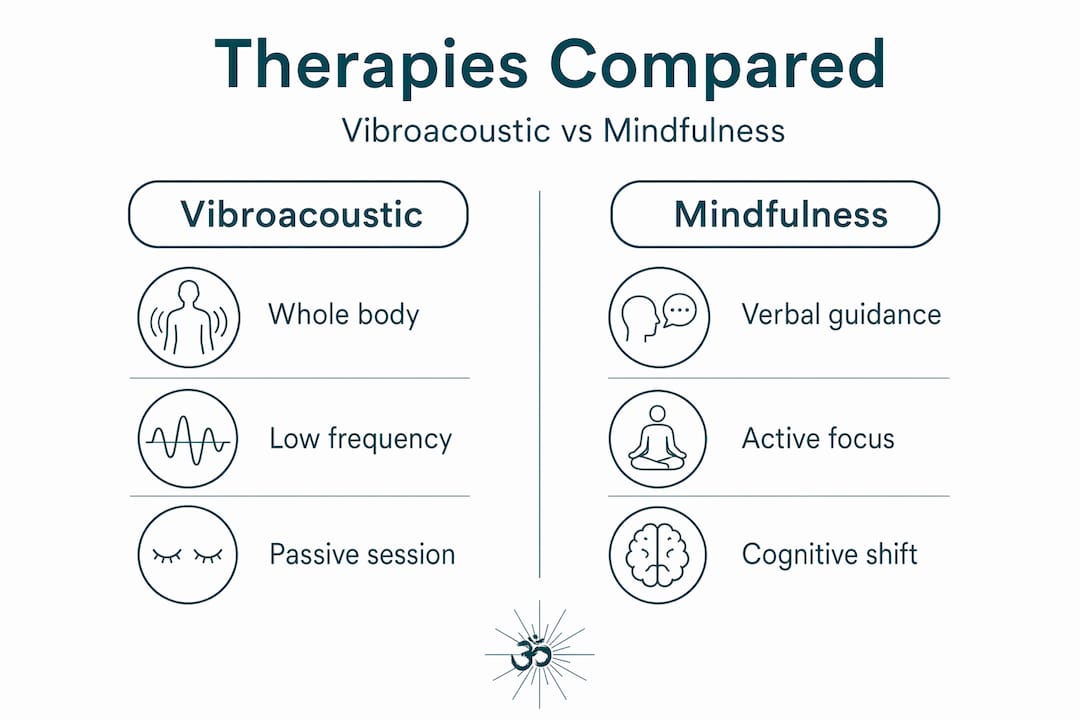
The following table summarises the major technologies, their primary indications, and where the research currently stands.
| Technology | Primary indications | Research maturity |
|---|---|---|
| Vibroacoustic therapy | Post-surgical rehab, chronic pain, relaxation | Moderate; promising case-control and RCT data |
| Transcranial ultrasound neuromodulation | Psychiatric disorders, mood regulation | Early; 177 trials globally but inconsistent reporting |
| Audio-visual neuromodulation | Neuropathic pain, stress | Emerging; one powered RCT with positive outcomes |
| Binaural beats / theta entrainment | Relaxation, focus, sleep | Popular; limited rigorous trial data |
| Directional parametric audio | Immersive wellness environments | Very early; proof-of-concept stage |
Key takeaways from the clinical landscape:
- Session length and repetition are critical variables that most consumer products do not specify
- Randomised designs account for only 40% of ultrasound neuromodulation trials registered globally
- Heterogeneity in study designs makes it nearly impossible to pool results meaningfully
- Pain management applications currently have the strongest evidence base among sound-based interventions
- Meditation applications show early biomarker effects, but stable psychological outcomes require longer study periods
You can explore more on how sound supports wellness through the lens of both research and musical design.
Risks and safety: what inaudible does not mean
Here is a thought that should give any wellness enthusiast pause: sound you cannot hear can still hurt you. Not in a dramatic, rupture-your-eardrums way. In a subtler, more insidious fashion.
Infrasound, those very low frequencies below 20 Hz, was long considered acoustically irrelevant to human experience because we cannot consciously detect it. A 2026 controlled study overturned that comfortable assumption rather bluntly. Exposure to approximately 18 Hz infrasound produced measurable increases in salivary cortisol and negative mood states, and participants did not even know they had been exposed. Your stress response, it turns out, does not require your conscious participation.
This matters for the wellness space because several sound-based products intentionally incorporate infrasound or near-infrasound frequencies, sometimes presenting inaudibility as a feature rather than a consideration to be managed. The fact that you cannot hear something does not mean your body is not responding to it.
Equally, the clinical ultrasound neuromodulation field is not without its complications. An analysis of 177 global clinical trials for low-intensity transcranial ultrasound found that only 32% of trials reported the device parameters used. That is a reproducibility problem of considerable size. Without knowing exactly what stimulus was delivered, understanding what produced a given outcome becomes rather difficult.
Practical considerations for anyone using sound-based wellness products:
- Avoid prolonged exposure to infrasound-generating devices without understanding the frequencies involved
- Seek products that disclose their operating parameters, not just their outcomes
- Be cautious with any device that places transducers directly against the skull without professional guidance
- Treat “scientifically designed” as a prompt to ask questions, not a reason to stop asking them
- Limit initial sessions to shorter durations and extend gradually, much as you would with any new physical stimulus
Pro Tip: If a wellness sound device cannot tell you its operating frequency, session duration recommendations, and the basis for those recommendations, that silence is itself informative.
More on evaluating safety in sound wellness is worth reading before you commit to any long-term programme.
Emerging innovations: directional audio and immersive soundscapes
The future of therapeutic sound is not just about what frequencies are used. It is about how they are delivered. And on that front, 2026 has brought some genuinely remarkable developments.
Research published in Nature Communications demonstrated that metamaterial-based parametric loudspeakers can produce highly localised sound zones spanning 500 Hz to 10 kHz using nonlinear ultrasonic techniques. In practical terms, this means a person sitting in a specific chair in a room could receive an immersive, enveloping sonic environment while the person next to them hears nothing at all. No headphones required. No bleed. No compromise.
For meditation and wellness applications, the implications are significant. Here are the key directions where this technology is heading:
- Private wellness rooms where a practitioner can deliver precisely calibrated vibroacoustic and directional audio simultaneously, tailored to the individual’s session
- Hospital and clinical settings where patients in shared wards could receive therapeutic sound exposure without disturbing neighbours
- Home meditation environments using compact parametric arrays to create immersive 3D soundscapes without traditional speaker placement constraints
- Personalised frequency mapping, where an individual’s physiological response profile informs which frequencies and delivery methods are used across a course of sessions
- Hybrid artistic and scientific compositions, where composers like Robert Emery work alongside acoustic engineers to design sound that is both therapeutically calibrated and emotionally resonant
Robert Emery, whose orchestral compositions for Orchestralmeditations were recorded at Abbey Road Studios with the National Philharmonic, represents this hybrid approach at its most developed. His work is not simply beautiful music arranged for relaxation. It is structured around frequency principles, spatial audio design, and an understanding of how the nervous system responds to sustained orchestral sound. Producer Moritz Schneider brings a complementary technical rigour, shaping recordings that merge scientific soundscape design with the warmth and depth that only live orchestral performance can produce.
The importance of this collaboration lies in something the clinical research does not yet fully capture: the difference between a sound that is physiologically calibrated and one that is also genuinely moving. Those are not the same thing, and the most effective sound experiences tend to be both simultaneously.
My take on where sound therapy actually stands
I will be honest with you. The gap between what the research says and what the wellness market claims is, at times, wide enough to drive a concert grand piano through.
I have spent years watching sound therapy oscillate between genuine scientific promise and fairly spectacular overclaiming. The ultrasound neuromodulation field is extraordinary in its potential, and the fact that only 32% of trials report device parameters tells me the field is still sorting out its own standards. That is not a reason to dismiss it. It is a reason to engage with it carefully.
What I have come to believe is that dose is the variable almost nobody talks about honestly. We know from the vibroacoustic versus mindfulness pilot that 20 minutes of exposure may not produce stable wellbeing changes. Yet most consumer products are sold on the basis of a single session’s impressiveness. The felt sense of relaxation after a beautifully produced orchestral meditation is real. Whether it is accumulating into durable psychological change depends on regularity, attention, and context.
Where I have seen genuinely consistent results, both personally and in the broader research, is at the intersection of scientific design and artistic quality. Robert Emery’s compositions and Moritz Schneider’s production at Orchestralmeditations are not merely pleasant. They are built with the kind of intentionality that makes repeated listening therapeutically meaningful, not just sonically enjoyable. That combination of scientific knowledge and creative depth is rarer than the market would have you believe.
My practical wisdom here is simple: treat sound therapy the way you would treat any health-supportive practice. Show up regularly. Pay attention to your responses over weeks, not minutes. And choose sources that can tell you why they made the choices they made, not just what those choices will do for you.
— ROBERT
Experience Orchestralmeditations’ science-backed soundscapes
If this article has piqued your curiosity about what scientifically grounded meditation music actually sounds like in practice, Orchestralmeditations is an excellent place to find out. Their library features orchestral meditation music composed by Robert Emery and produced by Moritz Schneider, recorded with live musicians at Abbey Road Studios. These are not synthesised approximations of calm. They are full orchestral works built around theta frequencies, binaural beats, and 3D spatial audio principles. You can also explore a curated top selection of their most effective tracks for relaxation and deep meditative states. For those wanting practical guidance, Orchestralmeditations also offers resources on enhancing meditation with sound to help you get the most from each session.
FAQ
What is the role of scientific sound technology in meditation?
Scientific sound technology uses precisely calibrated frequencies, vibroacoustic stimulation, and spatial audio design to support relaxation, focus, and neurological regulation during meditation. The impact of sound technology in this context is most effective when sessions are repeated over time rather than treated as a single-use intervention.
Is infrasound dangerous in wellness settings?
Research shows that infrasound around 18 Hz can elevate cortisol and produce negative mood effects even without conscious awareness of the sound. Users should check whether wellness devices disclose their operating frequencies before extended use.
How does vibroacoustic therapy work?
Vibroacoustic therapy transmits low-frequency sound vibrations directly through the body via a mat, chair, or bed, bypassing conventional auditory pathways. Clinical studies have shown significant pain reduction in post-surgical patients using 30-minute daily sessions over five days.
How long does a sound therapy session need to be to be effective?
Evidence suggests that 20-minute sessions are likely insufficient for stable wellbeing changes, based on biomarker data from vibroacoustic and mindfulness pilot studies. Longer and repeated sessions appear necessary for durable therapeutic benefit.
What makes directional audio useful for wellness?
Directional audio systems using metamaterials can deliver localised sound environments to a specific listener without requiring headphones or affecting others nearby. This makes them well suited to clinical and shared wellness settings where privacy and precision both matter.