
Most people think “soundscape” means a YouTube video of rain falling on a tin roof. Lovely, certainly, but about as scientific as a horoscope. The truth about what is scientific soundscape is considerably richer, and the research backing it up has exploded in recent years. We are talking about a formally defined field, with its own ISO standard, its own ecological vocabulary, and a growing stack of clinical evidence showing that the right sounds, delivered in the right way, can genuinely shift your brain and body into states of recovery and calm.
Key takeaways
| Point | Details |
|---|---|
| Formal scientific definition | A scientific soundscape is defined by ISO 12913 as the acoustic environment as perceived and understood by people in context. |
| Three core components | Every soundscape is made of biophony, geophony, and anthrophony, each reflecting a different source of acoustic energy. |
| Therapeutic effects are measurable | Vibroacoustic therapy and binaural compositions produce quantifiable changes in parasympathetic nervous system activity. |
| Design matters more than source | A scientifically crafted soundscape uses evolving, non-repetitive patterns to prevent brain habituation and sustain a restorative state. |
| Listening intent shapes outcomes | Choosing a soundscape matched to your mental goal (focus, sleep, healing) significantly changes what you actually get from it. |
The scientific soundscape definition unpacked
Most of us grow up treating sound as background noise, something to block out with earphones or tolerate in a waiting room. The academic world had a different idea. The term “soundscape” was introduced by Canadian composer and acoustic ecologist R. Murray Schafer in the 1970s, who used it to describe the sonic character of an environment in the same way a landscape describes its visual character. It was a poetic start. The science came later.

The formal scientific soundscape definition arrived with ISO 12913, which defines a soundscape as “the acoustic environment as perceived, experienced, and/or understood by a person or people, in context.” That tiny phrase “in context” is doing a lot of work. It means a scientific soundscape is not just a recording of sounds. It is the relationship between the sound, the listener, and the environment they share. That framing changes everything about how we study, design, and use sound therapeutically.
The field has grown astonishingly fast. Annual publications on soundscape research rose from just 19 in 2002 to 586 in 2024. That is not a niche hobby. That is a scientific discipline in full sprint.
The three building blocks of any soundscape
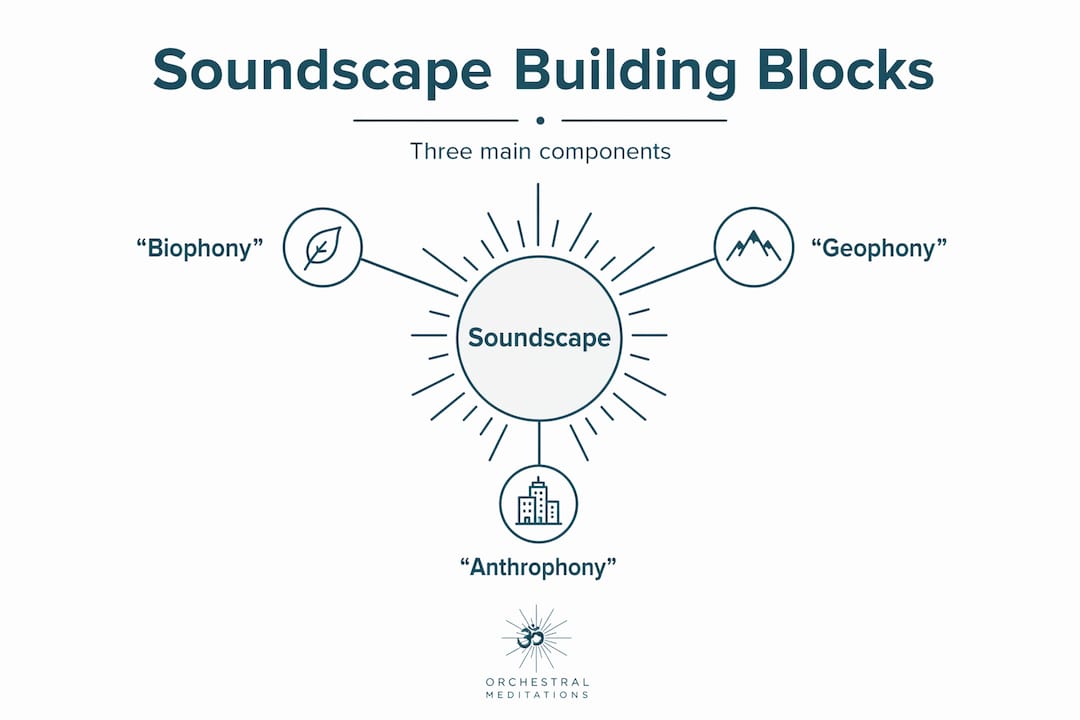
The meaning of soundscapes becomes clearer when you know the three acoustic components that scientists use to break them down:
- Biophony: Sounds produced by living organisms. Birdsong, insect chorus, whale calls, the rustle of leaves caused by a squirrel. These are the sounds your nervous system has been calibrated to interpret as signals of a safe, living environment.
- Geophony: Natural non-biological sounds. Wind, rain, rivers, thunder, ocean waves. These tend to carry that characteristic 1/f (“one over f”) pattern, which is a type of spectral complexity that the brain finds genuinely restful rather than stimulating.
- Anthrophony: Human-generated sounds. Traffic, conversation, machinery, music. This category covers everything from a bustling city street to a concert hall.
A 2025 study in Nature Ecology & Evolution employed all three components to assess ecosystem health, demonstrating that the balance of biophony, geophony, and anthrophony serves as a measurable indicator of environmental integrity. What is remarkable is that the same framework applies to human wellbeing. When anthrophony dominates, stress rises. When biophony and geophony are present in balanced proportions, the body tends to do the opposite.
Pro Tip: When choosing sounds for meditation or focus, look for recordings or compositions that feature biophony and geophony prominently. Even a subtly woven layer of distant birdsong or a gentle water current can shift your brain’s threat-detection circuitry into neutral.
How soundscapes affect mental health and cognition
Here is where things get genuinely fascinating, and where most “sound bath” articles lose the plot. There is a meaningful difference between sitting in a room while someone waves a singing bowl near your head (pleasant, mildly relaxing, not exactly clinical-grade) and a properly designed scientific soundscape session that targets your nervous system with intention.
The distinction researchers draw most often is between passive listening and vibroacoustic therapy. Passive sound baths are what most wellness studios offer. You hear sound. Your body responds moderately. Vibroacoustic therapy goes further. It stimulates the parasympathetic nervous system through tactile vibration, delivering frequencies through a specially designed surface or speaker system that the body literally feels as well as hears. A 2024 MDPI study showed measurable increases in parasympathetic activity and clear EEG changes after vibroacoustic sessions. That is the difference between a warm bath and hydrotherapy.
“Sound is not just received by the ears. The entire body participates in sound perception, and the delivery method changes the therapeutic outcome entirely.” — The Ethos, reviewing emerging soundscape science
This is also where MIT’s research into 40 Hz gamma oscillation becomes relevant. Clinical trials showed that entraining the brain to a 40 Hz frequency using sound and light slowed cognitive decline in Alzheimer’s patients. That is not a wellness claim. That is a peer-reviewed finding from one of the most rigorous research institutions on earth.
Composers who understand this science produce work that operates on an entirely different level. Robert Emery, whose orchestral meditation compositions feature in Orchestralmeditations’ library, brings together acoustic architecture and emotional intelligence in ways that a simple digital loop simply cannot replicate. Moritz Schneider, his collaborator, approaches composition with a similarly rigorous understanding of how frequency layering affects listener state. Their work, recorded with the National Philharmonic at Abbey Road Studios, is not ambient music dressed up in scientific language. It is orchestral music designed with therapeutic intent.
- Passive sound baths offer mood improvement and mild stress reduction.
- Vibroacoustic therapy produces measurable nervous system changes.
- Frequency-specific compositions (binaural beats, theta waves) can alter brainwave states.
- Orchestral arrangements add emotional depth that simple tones cannot provide.
Pro Tip: If you are using sound for a specific therapeutic goal rather than general relaxation, look for compositions that specify the frequency targets they use (theta, delta, 40 Hz gamma). Vague claims of “healing music” are not the same thing.
Principles of biophilic sound design
If the definition section was the “what”, this is the “how.” Scientifically crafted soundscapes do not simply record a forest and press play. They are built on a set of acoustic principles that exploit the brain’s evolutionary relationship with natural sound. The umbrella concept is called biophilic sound design, and it sits within the broader biophilia hypothesis, the idea that humans have an innate affinity for natural environments because we evolved within them.
The practical implications are striking. Here is how a well-designed restorative soundscape differs from a simple loop of ocean waves:
-
Non-repetitive patterning. The brain habituates rapidly to repeating loops. Within minutes, it files the sound under “background” and stops processing it. Effective scientific soundscapes use 1/f noise patterns that mirror natural acoustic variation, constantly evolving in subtle ways that keep the brain gently engaged without triggering active listening.
-
Temporal layering. Real environments have foreground, midground, and background acoustic layers that shift independently over time. A scientifically crafted soundscape mimics this by layering sounds with different rates of change, creating a sense of spatial depth and temporal movement.
-
Spectral complexity. Nature rarely produces a single sustained frequency. Effective designs combine multiple frequency bands that interact organically, creating the acoustic richness that the brain interprets as “safe and living.”
-
Spatial audio. Using 3D or binaural recording techniques, the soundscape wraps around the listener. This spatial element amplifies the sense of environmental immersion, which research links to deeper restorative states.
-
Intentional evolution. Rather than remaining static, a well-crafted soundscape shifts gradually over the course of a session, guiding the listener through phases of alertness, relaxation, and deep rest without abrupt transitions that disrupt the meditative state.
| Feature | Simple loop recording | Scientifically crafted soundscape |
|---|---|---|
| Pattern type | Repetitive | Evolving, non-repetitive (1/f noise) |
| Spatial audio | Mono or basic stereo | Binaural or 3D surround |
| Habituation risk | High within minutes | Minimal due to temporal variation |
| Therapeutic targeting | Generalised | Frequency-specific (theta, delta, gamma) |
| Emotional resonance | Flat | Layered, arc-based composition |
The importance of soundscapes designed on these principles cannot be overstated if you are serious about using sound therapeutically rather than decoratively. A looping MP3 of birdsong is like comparing a photograph of a meal to eating it.
How to analyse and experience soundscapes well
So you have found a scientific soundscape or a thoughtfully composed meditation recording. Now what? The honest answer is that most people approach this entirely wrong, which is why they listen for ten minutes, feel vaguely pleasant, and then wonder if it “worked.”
The first thing to understand is that mode of listening matters enormously. Studies reveal that music with lyrical content or dramatic shifts breaks cognitive flow states because the brain involuntarily diverts processing resources toward language and narrative. Steady, slowly evolving soundscapes maintain flow. That means the rich orchestral drama of a symphony, as gorgeous as it is in a concert hall, is not necessarily the right tool for a deep meditation session.
Here is what actually shapes your experience:
- Set a clear intent before you begin. Focus, sleep, anxiety reduction, and grief processing all call for different acoustic qualities. Treating soundscapes as interchangeable is like taking whatever pill is nearest when you have a specific diagnosis.
- Remove competing stimuli. Notifications, conversation, and environmental noise directly undermine the nervous system’s ability to settle. Headphones are not optional in many therapeutic contexts. They are structural.
- Allow time. The parasympathetic nervous system does not flip like a switch. Research suggests that meaningful physiological changes from soundscape therapy require at least 20 to 30 minutes of consistent exposure.
- Adopt a receptive rather than critical posture. Analysing whether you enjoy the music keeps you in active listening mode. The goal is subtle brain engagement without the kind of conscious attention that creates fatigue.
Emerging technologies are adding another dimension here. Adaptive soundscape systems, using AI, now respond to biometric feedback (heart rate variability, skin conductance) to adjust the sonic environment in real time. Companies working in this space, such as those involved in EU-funded studies on sound’s effects on sleep and cognition, are pushing scientific soundscape applications into genuinely personalised territory.
Pro Tip: Treat the first five minutes of any soundscape session as a transition period, not the session itself. Your nervous system needs a runway before it can genuinely land in a restorative state.
Comparing sound therapy approaches
Not all sound therapies are equal, and the differences between them are worth understanding before you commit your time or money. Here is a practical comparison of the most common approaches you will encounter in both clinical and wellness settings:
| Therapy type | Delivery method | Best application | Limitations |
|---|---|---|---|
| Passive sound bath | Acoustic instruments in a room | General stress relief, group settings | Low precision, inconsistent outcomes |
| Vibroacoustic therapy | Frequencies delivered through surfaces | Nervous system regulation, pain management | Requires specialist equipment |
| Binaural beat audio | Stereo headphones, frequency offset | Focus, sleep induction, anxiety reduction | Requires headphones, variable quality |
| Generative AI soundscapes | Adaptive software responding to biometrics | Personalised focus, mood regulation | Still largely experimental |
| Orchestral meditation music | Live ensemble recording, frequency-informed | Deep meditation, emotional release, restoration | Requires high-quality playback to fully shine |
The orchestral category deserves a particular mention, because it occupies a unique position in this table. Where generative systems are clever and vibroacoustic therapy is precise, orchestral meditation music composed by practitioners like Robert Emery and Moritz Schneider brings something none of the others can fully replicate: genuine human emotional intelligence embedded in the sound itself. Recorded with live musicians at Abbey Road Studios, these compositions carry the micro-variations in timing, breath, and vibrato that digital synthesis simply cannot produce. That is not sentimentality. Nature-inspired soundscapes consistently perform better for emotional restoration than purely synthetic equivalents, precisely because the human nervous system evolved responding to organic, variable sound.
My honest take on all of this
I have spent years exploring sound as a therapeutic tool, and the single biggest misconception I keep encountering is that “relaxing music” and “scientific soundscape” are synonyms. They are not, any more than a garden hose and a hydrology model are the same thing because both involve water.
What I have learned is that precision matters, but so does soul. The most clinically perfect soundscape in the world, built on impeccable 1/f noise principles and perfect binaural offset, will still feel hollow if there is no musical intelligence behind it. That is why I find the work of composers like Robert Emery and Moritz Schneider genuinely compelling. Emery studied orchestration at the highest level and has spent years thinking about how orchestral texture affects listener state, not just at an aesthetic level but at a physiological one. Schneider brings a similarly rigorous compositional sensibility. Their collaboration produces recordings that work both as scientific tools and as deeply moving music.
My practical advice is this: do not outsource your sound environment entirely to an algorithm or a looping file from the internet. Take the meaning of soundscapes seriously enough to choose them with the same care you would choose a therapist or a doctor. The therapeutic benefits of sound are real and measurable, but they are not automatic. You have to meet the sound halfway.
— ROBERT
Explore Orchestralmeditations’ scientifically crafted soundscapes
Understanding the science is one thing. Actually hearing it applied at the highest level is another experience entirely.
Orchestralmeditations offers a library of orchestral meditation music recorded at Abbey Road Studios with the National Philharmonic, composed with precisely the scientific principles this article has covered. Robert Emery and Moritz Schneider have built frequency-informed compositions that incorporate binaural beats, theta waves, and 3D spatial audio into full orchestral arrangements, delivering the kind of soundscape that works on your nervous system and moves you at the same time. If you have ever wondered why some holistic orchestral soundscapes leave you feeling genuinely restored rather than merely distracted, this is where the answer lives. You can also explore why orchestral outperforms digital for a deeper look at the acoustic and emotional reasons behind that difference.
FAQ
What is a scientific soundscape exactly?
A scientific soundscape is the acoustic environment as perceived, experienced, and understood by a person in a specific context, as defined by ISO 12913. It encompasses biological, geological, and human-generated sounds in their relationship with the listener.
How does a scientifically crafted soundscape differ from ambient music?
A scientifically crafted soundscape uses deliberate frequency targeting, non-repetitive 1/f noise patterns, spatial audio, and biophilic design principles to produce measurable physiological effects. Ambient music may be pleasant without achieving any of these outcomes.
What are the main benefits of scientific soundscapes?
Research links scientific soundscapes to reduced stress, improved parasympathetic nervous system activity, better cognitive focus, improved sleep quality, and in clinical settings, slowed cognitive decline when specific frequency stimulation is applied.
How do I analyse soundscapes to choose the right one for me?
Match the soundscape’s primary frequency and structural qualities to your specific goal. Steady, slowly evolving compositions support focus; delta and theta frequency compositions support sleep and deep meditation; broader orchestral arrangements with emotional arc suit emotional processing and restoration.
Are sound baths the same as scientific soundscapes?
Not precisely. Sound baths are a delivery format, typically a group experience using acoustic instruments. A scientific soundscape is a broader concept that can include sound baths but also encompasses binaural recordings, vibroacoustic therapy, generative audio systems, and orchestral compositions designed with therapeutic intent.