
A music therapy checklist is a structured guide that helps therapists systematically assess, plan, and evaluate therapeutic interventions to maximise client benefit. The term “music therapy checklist” is the practitioner’s shorthand for what the clinical world calls a music intervention checklist or music therapy assessment tool, and the distinction matters if you want your practice to hold up to scrutiny. Used well, this kind of structured framework transforms a loosely organised session into a clinically defensible, client-centred experience. Whether you are a board-certified music therapist, a wellness practitioner, or simply someone exploring the benefits of music therapy for the first time, having a reliable checklist is the difference between guessing and knowing.
1. what should a music therapy checklist include?
The foundation of any credible music therapy checklist covers four domains: physical, emotional, social, and cognitive. Miss one, and you are not assessing the whole person. You are assessing a slice of them, which is a bit like reviewing a symphony by only listening to the brass section.
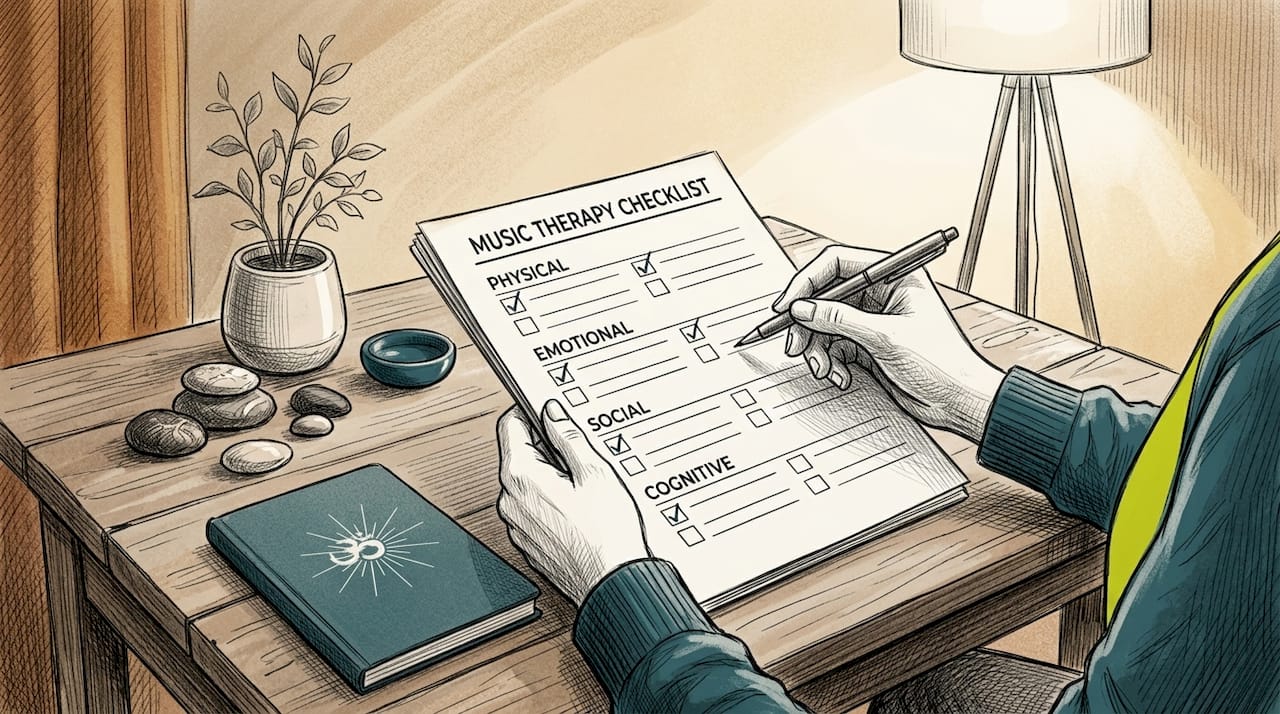
Each domain needs specific indicators. Physical checks might include pain levels, motor coordination, and respiratory patterns. Emotional indicators cover mood state, affect, and capacity for emotional expression. Social criteria examine communication, group participation, and interpersonal responsiveness. Cognitive markers assess memory recall, attention span, and executive function.
Beyond assessment criteria, a thorough checklist documents the music therapy techniques selected for each session, the rationale for choosing them, and the client’s response. It also captures session environment details: room acoustics, instrument availability, and whether the setting is individual or group-based. Music therapy is a board-certified clinical discipline available across paediatric hospitals, neurologic units, and community settings, so environment variables genuinely shift outcomes.
- Assessment domains: physical, emotional, social, cognitive
- Technique documentation: method chosen, clinical rationale, client response
- Goal tracking: short-term session goals and longer-term therapeutic objectives
- Environment checklist: room setup, instruments, individual vs. group format
- Ethical and cultural checks: cultural background, musical preferences, consent documentation
- Progress markers: baseline scores, session-by-session changes, outcome measures
Pro Tip: Balance standardisation with flexibility. A checklist that is too rigid becomes a bureaucratic cage. Build in a free-text “clinical observation” field so therapists can capture what the tick-boxes cannot.
2. core music therapy techniques to include in your checklist
Music therapy is structured into four primary methods: improvisation, receptive listening, songwriting, and lyric analysis. Each serves a distinct clinical purpose, and your checklist should document which method was used, why, and what happened.
Improvisation
Improvisation is the most spontaneous of the four methods. The therapist and client create music together in real time, with no script and no performance pressure. The Nordoff-Robbins approach posits that everyone has inborn musicality, and the therapist’s role is to facilitate expression rather than correct technique. That philosophy is genuinely liberating for clients who have spent a lifetime believing they “cannot do music.” The therapist-client partnership adapts moment to moment, creating emotional safety and supporting personal growth.
Receptive listening
Receptive listening involves the client listening to live or recorded music while the therapist observes and guides reflection. This method is particularly effective for relaxation, pain management, and memory recall. Music stimulates multiple brain regions simultaneously, producing effects that words alone cannot achieve. That is not poetic licence. It is neuroscience. Motor, emotional, and language processing all activate at once, which is why a single piece of music can unlock a memory that verbal prompts cannot reach.
Songwriting
Songwriting gives clients a vehicle for narrative and identity. Writing lyrics about personal experience externalises internal states, making them easier to examine and discuss. This method suits adolescents, adults processing trauma, and individuals with communication goals. It also produces a tangible artefact, a song the client owns, which has its own therapeutic value.
Lyric analysis
Lyric analysis uses existing songs as a starting point for therapeutic dialogue. The therapist selects a piece with relevant themes, and the client responds to the lyrics. This method offers cognitive distance: the client discusses the song’s meaning before discussing their own, which reduces defensiveness and opens conversation. It works particularly well in group settings.
Composers like Robert Emery and Moritz Schneider, whose therapeutic music compositions are crafted specifically for emotional engagement and healing, provide ideal source material for receptive listening and lyric analysis sessions. Emery, a prolific composer and producer with decades of orchestral work behind him, and Schneider, known for his meticulous approach to frequency-based sound design, bring a level of intentionality to their recordings that generic playlist music simply cannot match.
3. practical therapeutic music activities to track
Knowing your techniques is one thing. Knowing which specific activities to run in a session, and how to document them, is where checklists earn their keep. For memory care populations in particular, recommended interventions include sing-alongs, instrumental exploration, personalised playlists, movement to music, and lyric discussions. These activities reduce agitation, improve mood, and support social interaction.
Here is a practical reference table for your checklist:
| Activity | Target Outcome | Client Population |
|---|---|---|
| Sing-alongs | Memory recall, social bonding | Memory care, geriatric |
| Instrumental exploration | Emotional expression, motor skills | Paediatric, neurologic recovery |
| Personalised playlist curation | Mood regulation, identity affirmation | All populations |
| Movement to music | Balance, circulation, coordination | Geriatric, rehabilitation |
| Songwriting sessions | Narrative processing, self-expression | Adolescents, trauma recovery |
| Lyric analysis and discussion | Cognitive insight, group cohesion | Group therapy, adults |
| DIY instrument-making | Motor development, executive function | Paediatric, community settings |
DIY instrument-making offers secondary benefits beyond the obvious fun of shaking a bean-filled container like a tiny percussionist. Motor skill development, coordination, and cognitive executive function all improve through the construction process itself. It is one of those activities that looks like play and functions like therapy, which is rather the point.
Music therapists also provide specialised support during end-of-life care, offering live, soothing instrumental music to hold emotional and spiritual space. This is one of the less publicised aspects of the profession, and it deserves a dedicated section in any advanced checklist.
- Document activity duration and client engagement level for each session
- Note spontaneous responses: tears, laughter, movement, verbalisation
- Record instrument preferences as these often reveal emotional associations
- Track playlist selections and the client’s reported or observed response
Pro Tip: For clients with memory impairments, log the specific songs that prompted the strongest recall responses. Over time, this becomes a personalised “musical memory map” that is genuinely invaluable for future sessions.
4. how therapists evaluate progress and validate their checklists
A checklist is only as good as the thinking behind it. Music therapy assessment tools prioritise credibility through reliability, validity, and pragmatic utility, developing flexible client-centred instruments that balance ethics and therapeutic values. That is a mouthful, but the core idea is simple: your tool needs to measure what it claims to measure, produce consistent results across sessions, and actually be usable in a real clinical environment.
The honest truth is that perfect assessment tools rarely exist in practice. Clinicians often develop what researchers call “good enough” instruments, tools that balance rigour with practicality and enable timely, relevant therapeutic decisions. Practitioners report gaining genuine clarity and reflexivity around evidence during the tool development process itself. Building the checklist teaches you as much as using it.
“Therapists must develop assessment tools that maintain ethical and therapeutic values while being flexible enough for clinical use.” — Approaches: An Interdisciplinary Journal of Music Therapy
Client feedback is not optional. It is a core data source. Therapists who treat client self-report as anecdote rather than evidence are missing half the picture. Reflexivity, the therapist’s honest examination of their own assumptions and responses, keeps the checklist honest. Without it, a checklist becomes a mirror of the therapist’s preferences rather than the client’s needs.
Integration with multidisciplinary teams adds another layer of validation. When a music therapist’s checklist findings align with or usefully challenge the observations of a physiotherapist, psychologist, or nurse, the tool demonstrates real clinical utility. That cross-disciplinary dialogue is where alternative therapy research gains traction with sceptical colleagues.
Key takeaways
The most effective music therapy checklist combines standardised assessment domains with flexible, client-centred documentation to deliver both clinical rigour and genuine therapeutic responsiveness.
| Point | Details |
|---|---|
| Cover all four domains | Assess physical, emotional, social, and cognitive indicators in every session. |
| Document technique and rationale | Record which method was used and why, not just what happened. |
| Use activity tracking tables | Log specific activities, client responses, and observed outcomes for each session. |
| Build in reflexivity | Include a free-text field for clinical observations that tick-boxes cannot capture. |
| Validate with client feedback | Treat client self-report as core evidence, not anecdote, when reviewing checklist effectiveness. |
Why i think most checklists get the balance wrong
I have spent a long time around music and the people who use it to heal, and the pattern I keep seeing is this: therapists either cling to a rigid checklist like a life raft, or they abandon structure entirely and call it “intuition.” Both approaches have their charm. Neither serves the client particularly well.
The rigid checklist crowd produces beautifully consistent documentation and sessions that occasionally feel like a tax return set to music. The intuition camp produces genuinely moving sessions that are almost impossible to replicate or defend to a clinical supervisor. The sweet spot, as with most things worth doing, sits stubbornly in the middle.
What I find genuinely exciting is how composers like Robert Emery and Moritz Schneider are shifting the conversation. Their work, recorded at Abbey Road Studios with the National Philharmonic, is not background music dressed up in therapeutic clothing. It is intentionally crafted for emotional engagement, with frequency choices and orchestral textures that support the specific goals a checklist is trying to track. Using that kind of music in a receptive listening session gives you something to actually document, a composition with known emotional architecture rather than a random playlist.
The other thing I would say, and this is the bit most articles skip, is that building your own checklist is a therapeutic act in itself. The process forces you to articulate what you believe about music, about healing, and about the people in your care. That kind of reflexivity does not show up in any tick-box. But it shows up in every session.
— ROBERT
Discover orchestral music crafted for therapeutic practice
If you are building or refining a music therapy checklist and want source material that genuinely supports your clinical goals, Orchestralmeditations offers something most platforms cannot: professionally composed orchestral recordings designed with therapeutic intent from the ground up.
Composers Robert Emery and Moritz Schneider have created a library of immersive soundscapes recorded at Abbey Road Studios with the National Philharmonic, incorporating binaural beats, theta frequencies, and 3D surround sound. These are not incidental choices. They are deliberate tools for relaxation, emotional processing, and cognitive engagement. Explore the full meditation music library and find the compositions that fit your therapeutic framework. Your checklist will thank you.
FAQ
What is a music therapy checklist used for?
A music therapy checklist is a structured tool used to assess client needs, document therapeutic interventions, and track progress across physical, emotional, social, and cognitive domains. It helps therapists maintain clinical rigour while adapting sessions to individual client goals.
Which music therapy techniques should appear on a checklist?
The four core techniques to document are improvisation, receptive listening, songwriting, and lyric analysis. Each serves different clinical goals: active methods promote engagement and emotional expression, while receptive methods support relaxation and memory recall.
Do clients need musical ability to benefit from music therapy?
No musical ability is required. Music therapy is a board-certified clinical discipline, and the Nordoff-Robbins approach specifically holds that everyone has inborn musicality. The therapist facilitates expression, not performance.
How do therapists know if their checklist is working?
Checklist credibility depends on reliability, validity, and pragmatic utility. Therapists validate their tools through client feedback, reflexive practice, and alignment with multidisciplinary team observations over time.
Can music therapy checklists be used for memory care?
Yes. Recommended activities for memory care include sing-alongs, instrumental exploration, personalised playlists, and movement to music. These interventions reduce agitation, improve mood, and support social interaction in geriatric and memory care settings.