Healing Hz frequencies are specific sound vibrations, measured in hertz, that influence the autonomic nervous system to promote relaxation, reduce stress hormones, and support emotional recovery. The most studied of these is the 528 Hz healing frequency, which Akimoto et al. (2018) demonstrated produces measurable reductions in salivary cortisol after as little as five minutes of listening. Composers like Robert Emery and Moritz Schneider have built entire catalogues around these frequencies, translating laboratory findings into orchestral soundscapes that people actually want to sit with. This guide covers the science, the most useful frequencies, and how to build a practice that genuinely works.
What are the most common healing hz frequencies?
The Solfeggio scale is the recognised framework behind most healing hz frequencies in use today. It is an ancient six-tone musical scale rediscovered by Dr Joseph Puleo in the 1990s, later expanded to nine tones, and now widely referenced in sound therapy research and practice.
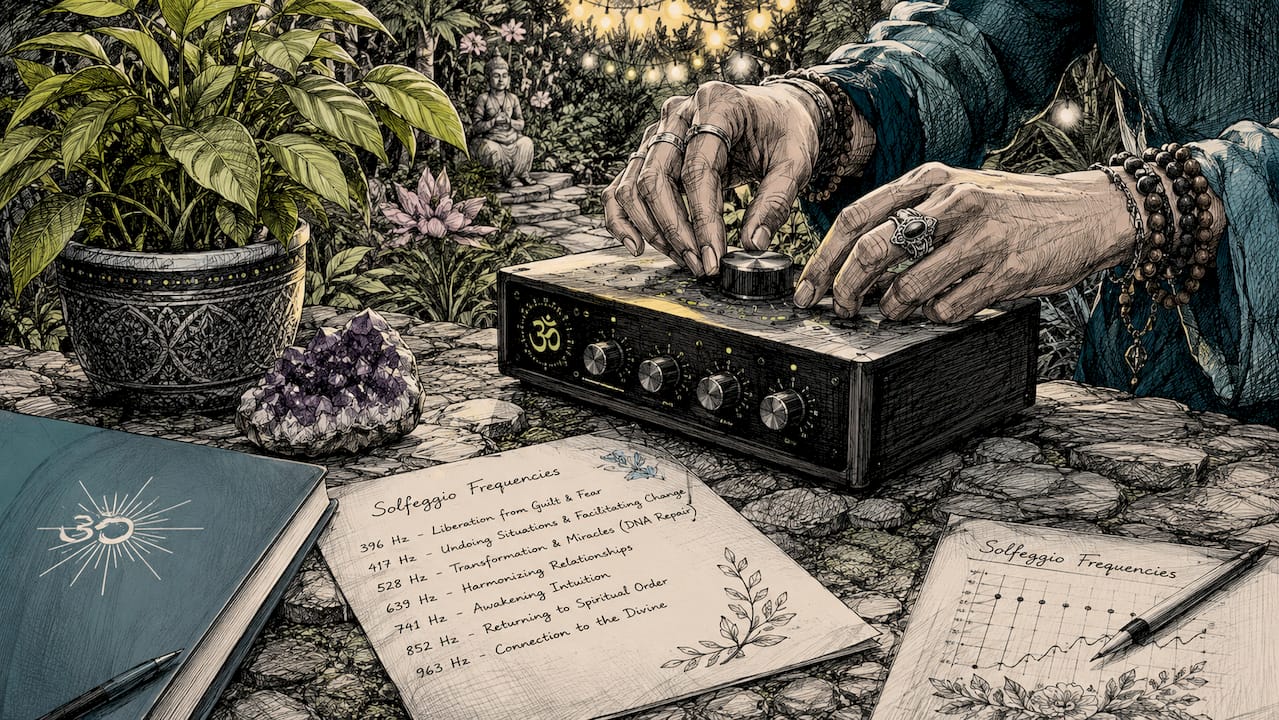
Each frequency in the scale carries a distinct, reputed effect. The table below summarises the major ones:
| Frequency | Common Name | Reputed Benefit |
|---|---|---|
| 174 Hz | Foundation Tone | Pain relief, physical grounding |
| 396 Hz | Liberation Tone | Releasing guilt and fear |
| 417 Hz | Transformation Tone | Clearing trauma, facilitating change |
| 432 Hz | Natural Tuning | Calming, heart rate reduction |
| 528 Hz | Miracle Tone | Cortisol reduction, DNA repair claims |
| 639 Hz | Connection Tone | Improving relationships, heart coherence |
| 741 Hz | Awakening Tone | Mental clarity, detoxification |
| 852 Hz | Intuition Tone | Spiritual clarity, higher awareness |
The specific benefits attributed to each frequency range from clinically supported (cortisol reduction at 528 Hz) to spiritually interpreted (DNA repair, intuition enhancement). That distinction matters. The physiological effects of 528 Hz and 432 Hz have measurable research behind them. The more esoteric claims, such as literal DNA repair, are rooted in spiritual tradition rather than peer-reviewed biology.
- 174 Hz works at the body’s physical level, often used in sound baths targeting chronic pain or tension.
- 396 Hz and 417 Hz address emotional clearing, making them popular in trauma-informed sound healing sessions.
- 528 Hz is the most researched frequency for stress reduction and is the centrepiece of most healing frequency playlists.
- 639 Hz is favoured in relationship-focused meditation, particularly in heart coherence practices.
- 741 Hz and 852 Hz are used in clarity and spiritual development work, often layered with theta binaural beats.
Pro Tip: If you are new to Solfeggio frequencies, start with 528 Hz for two weeks before experimenting with others. It has the strongest evidence base and the most accessible musical treatments available.
What scientific evidence supports healing hz frequencies?
The science here is real, but it requires careful reading. Sound therapy’s measurable effects come from physiological responses to harmonically rich auditory stimuli, not from any mystical property of a specific number. That is the honest starting point.
The most cited study in this field is Akimoto et al. (2018), which showed that 528 Hz reduces cortisol significantly compared to music tuned to the standard 440 Hz. Cortisol is the body’s primary stress hormone. Lower cortisol means the nervous system is shifting from sympathetic (fight-or-flight) to parasympathetic (rest-and-digest) dominance. That shift is not trivial. It is the same physiological state targeted by breathwork, cold exposure, and meditation.
Herbert Eder, a researcher specialising in neurophysiological sound effects, notes that 528 Hz stimulation increases parasympathetic activity with measurable changes in heart rate variability and skin conductance. These are objective biomarkers, not self-reported feelings. The same research shows that 432 Hz lowers heart rate and blood pressure more effectively than 440 Hz, the global standard tuning used by most modern recordings.
“The therapeutic value of healing frequencies lies in nervous system modulation, not in any single frequency being universally ‘correct’ or mystically superior.” — Herbert Eder
The table below summarises the biomarker evidence for the two most studied frequencies:
| Frequency | Biomarker Effect | Compared To |
|---|---|---|
| 528 Hz | Cortisol reduction, increased parasympathetic activity | 440 Hz standard tuning |
| 432 Hz | Reduced heart rate and blood pressure | 440 Hz standard tuning |
Expectation and ritual do play a role. Placebo and context effects contribute to the relaxation response, and researchers are honest about this. But that contribution does not invalidate the experience. A relaxation response triggered partly by expectation is still a genuine relaxation response. The nervous system does not care about the mechanism.
Individual variation is significant too. Some people respond strongly to 528 Hz and feel nothing particular at 432 Hz. Others find 396 Hz profoundly releasing and find 528 Hz too stimulating. This is not a failure of the frequencies. It reflects the fact that personal preference and subjective experience are central to whether any sound therapy works for a given person.
Pro Tip: Keep a simple log after each session. Note the frequency used, session length, and how you felt before and after. Three weeks of honest notes will tell you more about your personal response than any general guide.
How do healing hz frequencies compare and complement each other?
Choosing between frequencies is less like picking the right medicine and more like choosing the right instrument for a particular piece of music. The question is not which frequency is strongest. It is which frequency fits your current need.
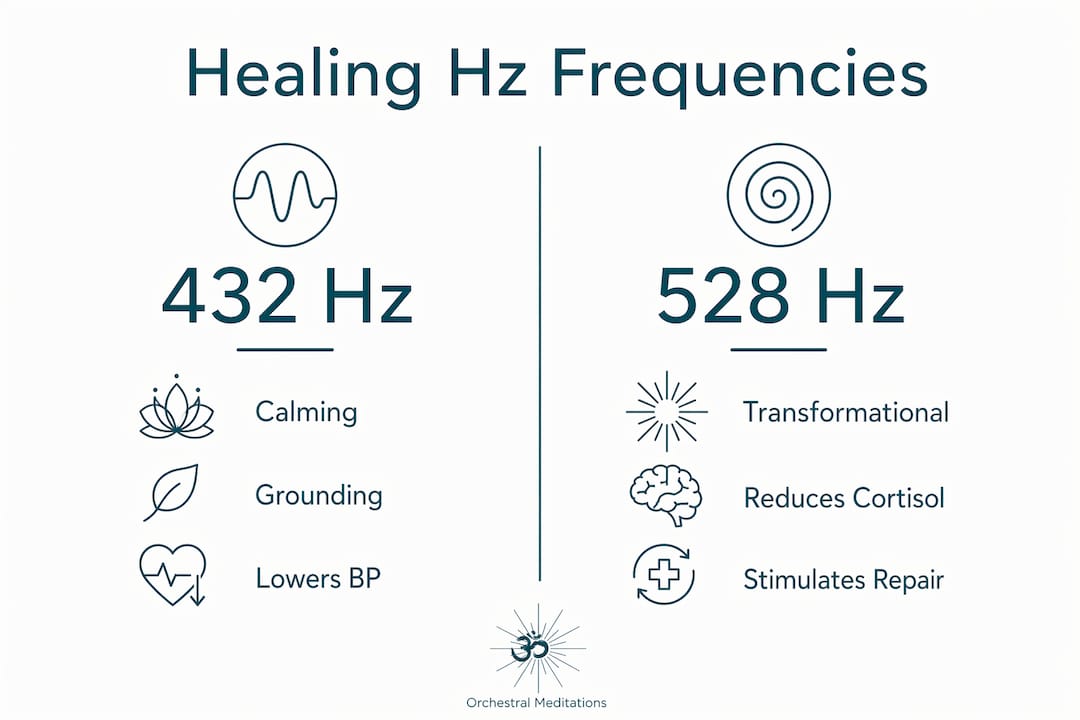
The 432 Hz versus 528 Hz distinction is the most commonly debated in sound healing circles. Here is how they actually differ in practice:
432 Hz produces a calming, grounding effect. Its measurable reduction in heart rate and blood pressure makes it well suited to evening sessions, wind-down routines, or any practice focused on physical relaxation. Think of it as the frequency equivalent of a long, slow exhale.
528 Hz is more transformational in character. Its cortisol-reducing effect is stronger in the research, and many practitioners describe it as emotionally clarifying rather than simply sedating. It suits morning meditation, emotional processing work, or sessions where you want to feel lighter rather than sleepier.
Combining frequencies is a legitimate practice. A common sequence used in sound healing sessions runs 417 Hz, then 528 Hz, then 741 Hz. The logic is sequential: 417 Hz clears old patterns, 528 Hz repairs and restores, and 741 Hz sharpens mental clarity. Whether you accept the metaphysical framing or not, the practical effect of moving through different tonal environments over 45–60 minutes is a genuinely varied and often powerful experience.
Binaural beats add another layer. When you play a tone of 528 Hz in one ear and a slightly different tone in the other, the brain perceives a third frequency equal to the difference between them. This perceived frequency can be tuned to theta (4–8 Hz) or alpha (8–12 Hz) ranges, which are associated with deep meditation and creative states respectively. Binaural beats require headphones to work. Speakers will not produce the effect.
A few practical points worth knowing:
- Volume matters more than most people realise. Loud exposure does not accelerate entrainment. Low to moderate volume, where you can still hear ambient sounds faintly, is the effective range.
- Consistency outperforms intensity. A 15-minute daily session produces better results than a two-hour session once a week.
- The musical quality of the recording shapes the experience significantly. A 528 Hz sine wave played through a phone speaker is a very different thing from a 528 Hz orchestral composition recorded at Abbey Road Studios.
The role of soundscapes in wellness extends well beyond the frequency itself. Timbre, harmonic richness, and production quality all influence how deeply the nervous system responds to a piece of music.
How to use healing hz frequencies in your meditation practice
Getting results from hertz frequencies for healing is less about finding the perfect frequency and more about building a consistent, intentional practice. The method matters as much as the material.
Here is a practical framework to follow:
-
Choose your frequency with intention. Decide before you sit down whether you want grounding (432 Hz), emotional clearing (396 Hz or 417 Hz), or stress relief (528 Hz). Having a clear purpose primes the nervous system to respond.
-
Set up your environment. Dim the lights, silence your phone, and sit or lie in a position you can hold comfortably for 15–20 minutes. Sound healing works best in a receptive, still environment. Multitasking during a session negates the neural entrainment effect almost entirely.
-
Use quality headphones for binaural content. For any track that uses binaural beats layered over a healing frequency, over-ear stereo headphones are not optional. The binaural effect depends on each ear receiving a slightly different signal. Earbuds work in a pinch, but over-ear headphones produce a noticeably deeper response.
-
Start with 15 minutes daily for four weeks. Clinical protocol suggests this as the minimum effective dose for measurable neural entrainment. Four weeks of daily practice is where most people report their first clear, consistent shift.
-
Pair with breathwork or meditation. Combining sound healing with breathwork and meditation amplifies the autonomic shift produced by the frequency alone. A simple box breath (four counts in, four counts hold, four counts out, four counts hold) during a 528 Hz session produces a noticeably stronger parasympathetic response than either practice alone.
-
Track your responses honestly. Note which frequencies you used, for how long, and how you felt before and after. There is no single correct frequency for everyone. Your personal log over several weeks is the most reliable guide to what works for you.
Robert Emery and Moritz Schneider, the composers behind Orchestralmeditations, have both approached this challenge from a professional musician’s perspective. Emery, a composer and conductor with extensive experience in orchestral and film music, has crafted tracks that embed Solfeggio frequencies within full orchestral arrangements, giving the therapeutic content genuine musical depth. Schneider, a producer and composer with a background spanning classical and electronic music, brings a layered, textural approach to frequency-based composition that makes sustained listening genuinely pleasurable rather than clinically sterile. Their work is worth seeking out specifically because the musical quality of a recording shapes how deeply you can settle into it.
Pro Tip: If you find your mind wandering during sessions, try placing one hand on your chest and one on your abdomen. The physical anchor gives your attention somewhere to rest and makes it easier to stay present with the sound.
Key takeaways
Healing Hz frequencies produce measurable nervous system effects, particularly at 528 Hz and 432 Hz, but consistent, intentional daily practice is what converts those effects into lasting wellbeing.
| Point | Details |
|---|---|
| 528 Hz has the strongest evidence | Akimoto et al. (2018) confirmed cortisol reduction and parasympathetic activation with 528 Hz exposure. |
| 432 Hz calms the body physically | Clinical studies show 432 Hz lowers heart rate and blood pressure more than standard 440 Hz tuning. |
| Consistency beats intensity | Fifteen minutes daily for four weeks outperforms occasional long sessions for neural entrainment. |
| Environment is non-negotiable | Distracted or multitasking listening negates entrainment; a still, quiet setting is required for results. |
| Personal response varies | Keep a listening log to identify which frequencies work best for your individual nervous system. |
Why i think most people are using these frequencies wrong
Here is my honest observation after years of working with frequency-based music: most people treat healing hz frequencies like a supplement they swallow on the way out the door. They put on a 528 Hz track while answering emails, half-listen during their commute, and then wonder why nothing seems to shift. That is not sound healing. That is background noise with good marketing.
The research is clear on this. Consistent, intentional listening in a still environment is what produces the physiological changes. The frequency is the vehicle. Your attention is the engine. Without both, you are going nowhere particularly interesting.
I have also noticed that people get oddly competitive about frequencies, as if choosing 528 Hz over 432 Hz is a statement of character. It is not. They do different things. 432 Hz is the frequency I reach for when I want to feel physically settled and grounded. 528 Hz is what I use when I need emotional clarity or when stress has been building for a few days and I want to genuinely shift it. Neither is superior. They are tools, and good tools deserve to be used appropriately.
The composers I keep returning to are Robert Emery and Moritz Schneider. What they do differently is embed these frequencies in music that has genuine artistic merit. Sitting with a well-crafted orchestral piece tuned to 528 Hz for 20 minutes is a completely different experience from sitting with a sine wave. The harmonic richness of a full orchestral arrangement gives the nervous system far more to work with, and the musical quality keeps you present rather than bored. That presence is everything.
My practical advice is simple. Pick one frequency. Commit to 15 minutes a day for a month. Do it in silence, with good headphones, with your phone face down. Track how you feel. Then adjust. The sound therapy frequencies guide at Orchestralmeditations is a good companion resource for that process.
— ROBERT
Experience healing frequencies through orchestral sound
Orchestralmeditations produces healing frequency music that sits in a category of its own. Recorded at Abbey Road Studios with the National Philharmonic, the compositions by Robert Emery and Moritz Schneider bring Solfeggio frequencies to life through full orchestral arrangements, binaural beats, and 3D surround sound production. This is not a sine wave generator. It is music that happens to be tuned to frequencies your nervous system responds to.
If you are ready to build a genuine sound healing practice, the meditation music library at Orchestralmeditations is the place to start. Each track is crafted with both therapeutic intent and musical integrity, making it far easier to stay present, go deeper, and actually feel the difference.
FAQ
What is the best healing hz frequency for stress?
528 Hz is the most researched frequency for stress relief. Akimoto et al. (2018) confirmed measurable cortisol reduction after as little as five minutes of exposure compared to standard 440 Hz music.
How long should i listen to healing hertz frequencies each day?
Clinical protocol recommends 15 minutes of daily listening for a minimum of four weeks. Consistent short sessions produce better neural entrainment than occasional long ones.
Do healing hz frequencies actually work, or is it placebo?
Both physiological and expectation effects contribute to the response. Research confirms measurable autonomic nervous system changes at 528 Hz and 432 Hz, but mindset and environment also shape the outcome.
Do i need headphones for healing frequency music?
Headphones are required for binaural beat content, where two slightly different tones are delivered to each ear separately. For standard Solfeggio frequency tracks without binaural layers, speakers work, though quality headphones improve the experience.
Can i combine different healing hz frequencies in one session?
Yes. Practitioners commonly sequence 417 Hz, 528 Hz, and 741 Hz in a single session for clearing, restoration, and clarity. Allow at least 10–15 minutes per frequency for the nervous system to settle into each one.