Music frequencies for healing are specific sound wave tones used in therapeutic and meditative contexts to support relaxation, emotional balance, pain management, and sleep quality. The term sits at the crossroads of ancient sound traditions and modern music therapy research, and it is worth being clear from the start: the scientific evidence is strongest for music therapy as a whole, not for any single advertised frequency. That said, there is genuine value here, and composers like Robert Emery and Moritz Schneider have spent years crafting music that draws on both the cultural richness of these frequencies and the neurological realities of how sound affects the human body. This article separates the signal from the noise.
What does scientific research reveal about music therapy and healing frequencies?
Music therapy produces measurable, clinically significant reductions in pain, anxiety, and sleep disturbance. A 2026 meta-analysis found that music therapy reduces pain with a standardised mean difference of −2.18 across randomised controlled trials. That is not a modest effect. An SMD above 2.0 puts music therapy in the same conversation as many pharmaceutical interventions for pain, which should make anyone who dismissed it as “nice background noise” sit up a little straighter.
For sleep, a meta-analysis of 1,730 participants showed that music-based sleep interventions improved Pittsburgh Sleep Quality Index scores by a mean difference of −3.37, alongside meaningful reductions in depression and anxiety. That is a clinically relevant shift in sleep quality, not a placebo whisper. For anxiety specifically, a separate meta-analysis across 18 randomised controlled trials found music therapy alleviates anxiety with an SMD of −1.54 in college students. Both passive listening and combined active formats produced results.

Here is where the nuance matters, though. The strongest evidence supports music therapy broadly rather than specific marketed frequencies like 432 Hz or 528 Hz. There are exploratory studies showing biomarker changes associated with these frequencies, but replication is limited and the clinical picture is far from settled. Think of it this way: the orchestra produces the healing, not just one instrument playing a particular note.
Subgroup analyses from the sleep meta-analysis also point to something practically useful. Sessions of 30 to 45 minutes, repeated daily or near-daily over four to eight weeks, produce the strongest outcomes. Consistency matters far more than frequency precision.
“The clinical effects come from emotional regulation and physiological responses rather than pure tone specificity.” This is the finding that most frequency marketing conveniently forgets to mention.
Pro Tip: Rather than spending hours hunting for the “perfect” Hz, commit to a daily listening routine of 30 to 45 minutes over several weeks. The research consistently rewards regularity over frequency purity.
Which are the most popular healing sound frequencies?
The world of healing vibrational frequencies can feel like a menu at a very spiritual restaurant. There are dozens of options, each with evocative descriptions, and it is not always obvious what you are actually ordering. Here is a grounded look at the most commonly discussed frequencies, what their advocates claim, and what the evidence actually supports.
432 Hz is probably the most debated frequency in wellness circles. Proponents describe it as producing a sense of deep calm and positive energy, and some claim it was the tuning standard used by classical composers before modern concert pitch settled at 440 Hz (a claim that is historically contested, for what it is worth). Exploratory studies have found some association between 432 Hz music and reduced heart rate and cortisol levels, though these findings are preliminary. Robert Emery, the composer and producer behind many of Orchestralmeditations’ most listened-to recordings, has incorporated 432 Hz tuning into orchestral compositions precisely because of its reported warmth and resonance. You can read more about the 432 Hz experience and what it feels like in practice.
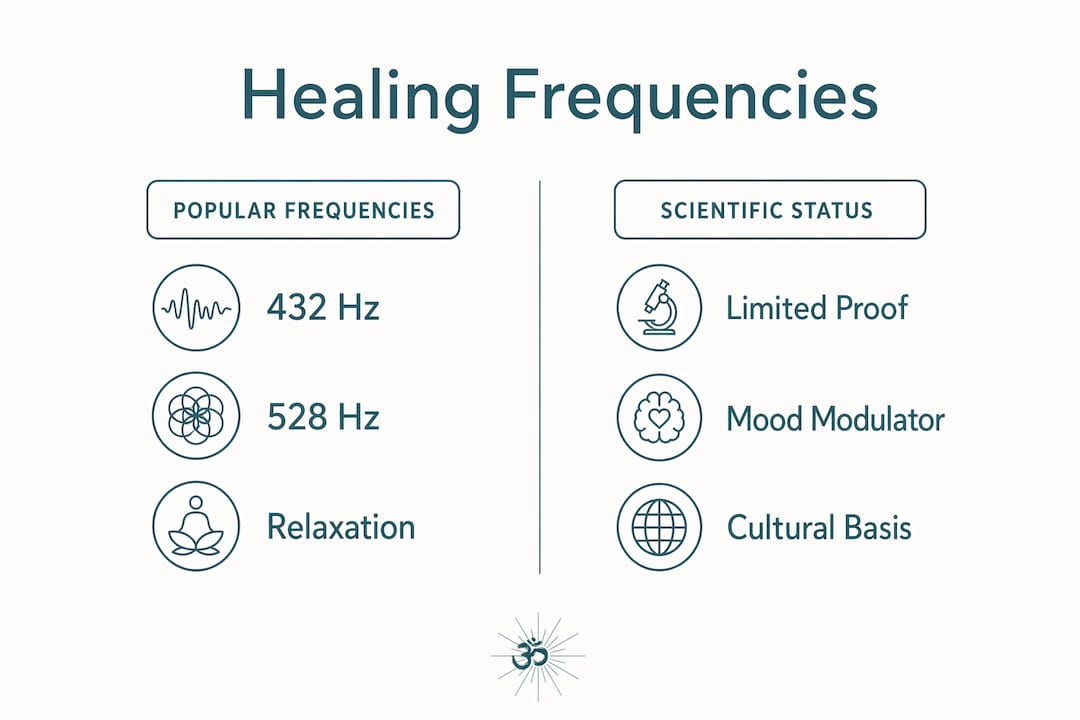
528 Hz is marketed as the “miracle frequency,” linked in popular wellness culture to DNA repair and cellular regeneration. The cellular repair claims are not supported by robust clinical evidence, but some experimental studies have found mood-related benefits and stress reduction associated with 528 Hz music. Moritz Schneider, who produces and composes alongside Emery at Orchestralmeditations, has used 528 Hz as a compositional foundation in several tracks designed for deep meditative states. The benefits of 528 Hz listening are worth exploring if you are curious about its experiential qualities.
Beyond these two, the solfeggio frequency set includes several others with their own symbolic associations:
- 639 Hz is associated with interpersonal harmony, connection, and emotional healing.
- 741 Hz is linked to problem-solving, self-expression, and clearing emotional blockages.
- 852 Hz is associated with spiritual awakening and returning to inner order.
These associations are largely cultural and experiential rather than clinically proven. That does not make them worthless. Cultural and experiential value is real value. But it is a different category of claim from “this frequency repairs your DNA.”
| Frequency | Claimed benefit | Scientific status | Cultural note |
|---|---|---|---|
| 432 Hz | Deep calm, positive energy | Exploratory biomarker data; limited replication | Historically contested tuning standard |
| 528 Hz | Cellular repair, mood uplift | Experimental mood benefits; DNA claims unproven | Known as the “miracle frequency” |
| 639 Hz | Harmony, emotional healing | No direct clinical evidence | Solfeggio tradition |
| 741 Hz | Self-expression, clarity | No direct clinical evidence | Solfeggio tradition |
| 852 Hz | Spiritual awareness | No direct clinical evidence | Solfeggio tradition |
Pro Tip: Start with the frequency that you find most pleasant to listen to, not the one with the most impressive marketing claims. The right frequency for you is the one you will actually return to consistently.
How to incorporate healing frequencies music into your wellness routine
Knowing which frequencies exist is one thing. Actually building a practice around them is another. Here is a practical, research-aligned approach that does not require you to overhaul your entire life or invest in a crystal singing bowl collection (though no judgement if you do).
-
Set a session length of 30 to 45 minutes. Subgroup data from sleep quality research consistently associates this duration with the strongest therapeutic outcomes. Shorter sessions can still be pleasant, but the physiological and emotional regulation effects accumulate with sustained listening.
-
Commit to daily or near-daily listening over at least four weeks. This is where most people fall short. They listen twice, feel mildly relaxed, and conclude it “didn’t work.” The meta-analytic data points to four to eight weeks of consistent practice as the window where meaningful change becomes measurable.
-
Choose music you genuinely enjoy. This sounds obvious, but it is actually the most evidence-backed piece of advice in this entire article. Selecting music you enjoy produces better emotional regulation outcomes than forcing yourself through a frequency you find grating, regardless of its theoretical benefits.
-
Pair listening with a complementary practice. Combining healing frequency music with mindfulness meditation, breathwork, or progressive muscle relaxation amplifies the effect. The music provides an anchor for attention; the practice deepens the physiological response.
-
Use specific frequencies for specific contexts. For sleep support, lower, slower compositions in the 432 Hz range tend to work well. For anxiety reduction during the day, ambient orchestral music with theta frequency elements can help regulate the nervous system. For pain management, longer sessions with consistent rhythmic structure have the strongest research backing.
-
Do not replace professional care. This bears saying plainly. Healing frequency music is a low-risk, potentially meaningful adjunct to wellbeing. It is not a treatment for clinical depression, chronic pain disorders, or serious medical conditions. If you are managing something significant, please work with a qualified professional alongside any music practice you adopt.
Robert Emery’s orchestral compositions at Orchestralmeditations are a genuinely good starting point for building this kind of routine. The recordings are made with live musicians, which produces a warmth and dynamic range that purely digital frequency generators simply cannot replicate.
What role do healing frequencies play in neurorehabilitation?
Neurorehabilitation is where the conversation about healing sound frequencies gets genuinely interesting, and where the research is most carefully conducted. A review published in 2025 examined the healing effects in TBI and stroke recovery, finding that music therapy produces meaningful improvements in motor function, cognitive recovery, and emotional regulation in patients recovering from traumatic brain injury and stroke.
Rhythmic auditory stimulation, which uses a steady musical beat to cue and retrain motor movements, has some of the strongest evidence in this field. The brain’s tendency to synchronise movement to an external rhythm is a well-documented neurological phenomenon, and it has been used effectively in gait rehabilitation after stroke. Binaural beats, where slightly different frequencies are played in each ear to produce a perceived third frequency, modulate brainwave activity in ways associated with relaxation and alertness, though the evidence here is still developing and highly protocol-dependent.
Specific frequencies like 432 Hz and 528 Hz appear in this literature primarily as mood and stress modulators rather than direct rehabilitation tools. They are adjuncts, not treatments. The distinction matters enormously in a clinical context.
| Auditory therapy | Mechanism | Evidence level | Clinical context |
|---|---|---|---|
| Rhythmic auditory stimulation | Motor-rhythm synchronisation | Strong (RCT evidence) | Stroke gait rehabilitation |
| Music therapy (general) | Emotional and cognitive engagement | Strong (meta-analytic) | TBI, stroke, dementia |
| Binaural beats | Brainwave entrainment | Emerging | Stress, anxiety, focus |
| 432 Hz / 528 Hz music | Mood and stress modulation | Exploratory | Adjunct in recovery contexts |
Professional oversight is non-negotiable in clinical neurorehabilitation. For home listeners, the takeaway is simpler: frequency-based music is a low-risk, potentially supportive addition to recovery, and it is worth discussing with your care team if you are in a rehabilitation context.
Key takeaways
Music therapy produces the strongest, most replicated benefits for pain, anxiety, and sleep, while specific healing frequencies like 432 Hz and 528 Hz offer cultural, experiential, and emerging adjunctive value rather than standalone clinical cures.
| Point | Details |
|---|---|
| Music therapy has strong evidence | Meta-analyses show significant reductions in pain, anxiety, and sleep disturbance across thousands of participants. |
| Frequency-specific claims need context | 432 Hz and 528 Hz have exploratory support but lack robust replication; frame them as adjuncts, not treatments. |
| Consistency beats frequency precision | Daily sessions of 30 to 45 minutes over four to eight weeks produce the strongest measurable outcomes. |
| Enjoyment drives results | Choosing music you find pleasant produces better emotional regulation than chasing a theoretically optimal Hz. |
| Neurorehabilitation shows real promise | Rhythmic auditory stimulation and music therapy have strong evidence for motor and cognitive recovery after stroke and TBI. |
Why I think the frequency debate misses the point entirely
Here is something I have noticed after years of working with healing music: the people who get the most out of it are almost never the ones obsessing over whether they are listening to 432 Hz or 440 Hz. They are the ones who have built a quiet, consistent habit of sitting with good music and letting it do its work.
The frequency marketing world has done something rather clever and slightly maddening. It has taken a genuine phenomenon (music affects the body and mind in measurable ways) and dressed it up in pseudo-scientific specificity that makes people feel they need to optimise their listening like a biohacking experiment. You do not. The evidence for healing sound frequencies points clearly toward regular, enjoyable listening as the active ingredient, not the precise Hz value on the label.
That said, I do think there is something worth taking seriously in the cultural and experiential dimension of these frequencies. When Moritz Schneider tunes an orchestral piece to 432 Hz, the result has a particular warmth and resonance that listeners consistently report as calming. Whether that is the frequency itself, the compositional choices, the quality of the recording, or simply the placebo effect of believing it will work, the outcome is the same: people feel better. And for a low-risk, genuinely pleasant intervention, that is not nothing.
My honest advice is this. Approach healing frequencies with open-minded scepticism. Try them. Notice what you notice. Build a routine around what works for you personally, and treat anything that claims to cure a serious condition with appropriate caution. Use music as one thread in a broader approach to wellbeing, alongside sleep, movement, connection, and professional support when you need it. Robert Emery’s compositions are a good place to start, not because they are magic, but because they are genuinely beautiful and made with real care.
— ROBERT
Explore healing frequency music at Orchestralmeditations
If you are ready to build a proper listening practice, Orchestralmeditations offers a curated library of orchestral healing music composed and produced by Robert Emery and Moritz Schneider, recorded at Abbey Road Studios with the National Philharmonic. The difference between live orchestral recordings and purely digital frequency generators is not subtle. You can read more about why orchestral music outperforms digital for meditative and healing purposes. The library includes 432 Hz and 528 Hz compositions, binaural beat tracks, and theta frequency soundscapes, all produced to a standard that makes daily listening genuinely something to look forward to.
Browse the full collection and find the recordings that suit your practice at Orchestralmeditations.
FAQ
What are healing frequencies in music?
Healing frequencies are specific sound wave tones, such as 432 Hz and 528 Hz, used in music to support relaxation, emotional balance, and physical wellbeing. They are most accurately understood as adjuncts to broader music therapy rather than standalone clinical treatments.
What is the best healing frequency to listen to?
The best healing frequency is the one you find most pleasant and will return to consistently. Research supports that emotional regulation through enjoyable music drives outcomes more reliably than any specific Hz value.
How long should I listen to healing frequency music each session?
Sessions of 30 to 45 minutes, repeated daily or near-daily over four to eight weeks, produce the strongest outcomes in sleep and anxiety research. Shorter sessions can still be beneficial, but consistency over weeks is the key variable.
Can healing frequencies help with anxiety and sleep?
Yes, as part of a broader music therapy approach. Meta-analyses show music-based interventions produce significant improvements in both anxiety and sleep quality, with the anxiety reduction effect measured at an SMD of −1.54 across 18 randomised controlled trials.
Are healing frequencies safe to use alongside conventional treatment?
Healing frequency music is considered low-risk and can be used as an adjunct to conventional medical or psychological treatment. Always inform your healthcare provider, particularly in clinical contexts such as neurorehabilitation or mental health care.