
A healing environment is defined as an integrated system of physical, psychological, social, and behavioural conditions deliberately arranged to support recovery and well-being. The process for creating healing environments goes far beyond repainting a room or buying a diffuser. It draws on evidence-based design research, neuroscience, and practices like mindfulness and music therapy to build spaces that genuinely restore the nervous system. Composer Robert Emery and producer Moritz Schneider, whose orchestral meditation recordings are crafted specifically to support this kind of restorative experience, understand this better than most. The good news is that you do not need to knock down walls to get started.
What are the four pillars of healing environments and why are they essential?
The four core pillars of an optimal healing environment are the internal environment, the interpersonal environment, the behavioural environment, and the external environment. This framework, developed and articulated by the Samueli Institute, treats healing as a whole-system process rather than a single-room makeover. Each pillar reinforces the others, and neglecting any one of them is a bit like trying to sit on a three-legged stool. It works, technically, but you will spend a lot of energy not falling over.
Here is what each pillar actually means in practice:
-
Internal environment. This is your inner world: your intentions, beliefs, emotional states, and sense of meaning. Research consistently shows that a person who approaches recovery with a sense of agency and positive expectation heals more effectively than one who feels passive or hopeless. Mindfulness practices, journalling, and guided meditation all work directly on this pillar.
-
Interpersonal environment. Social connection is not a soft extra. Strong relationships, community support, and even brief positive interactions with carers or housemates measurably affect recovery outcomes. Isolation, by contrast, is physiologically stressful in ways that undermine every other healing effort.
-
Behavioural environment. What you eat, how you move, how you sleep, and what rituals you build into your day all constitute your behavioural environment. Nutrition, gentle exercise, and consistent sleep schedules are the unglamorous backbone of any healing process.
-
External environment. This is the physical space: light, air quality, acoustics, temperature, materials, and layout. It is the pillar most people focus on first, and it genuinely matters. But effective healing depends on all four working together, not just a beautifully arranged room.
The interaction between these pillars is where the real magic happens. A person who has cultivated positive intentions, strong social bonds, and healthy daily habits will extract far more therapeutic value from a well-designed space than someone who has only addressed the furniture arrangement.
How to design and optimise the external environment for therapeutic effect
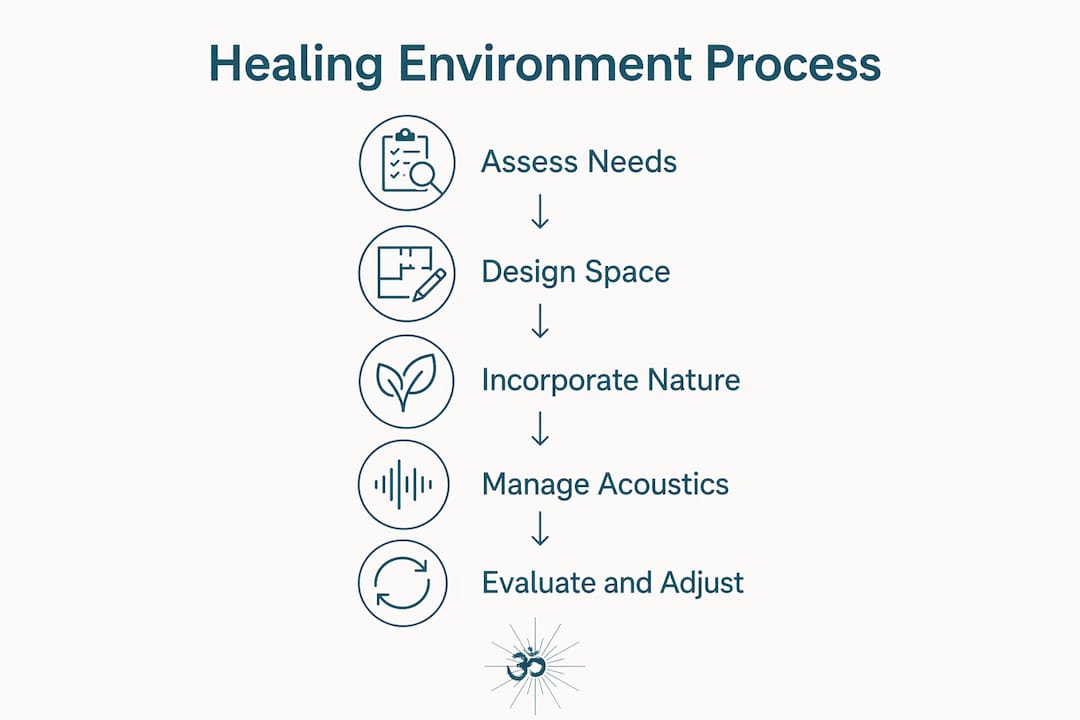
Designing healing spaces well means treating every architectural and sensory decision as a deliberate health intervention. The Studio Matrx “architecture of recovery” model does exactly this, framing each design element as a clinical instrument with measurable outcomes rather than an aesthetic preference.

Natural light and views of nature are the highest-leverage interventions available to most people. Biophilic design, which integrates natural elements and daylight, produces the strongest therapeutic effects of any environmental strategy studied in healthcare settings. For those working with existing homes rather than new builds, the practical implication is straightforward: maximise the time you spend near windows, and position your primary rest or work area to face greenery where possible.
Window positioning matters more than most people realise. Patients spend 80 to 95% of their inpatient time in bed, which is why a window sill height of 750 mm or less from the floor is recommended to allow views of natural focal elements from a lying position. In a home context, this translates to a simple audit: can you see trees, sky, or a garden from your sofa or bed? If not, that is worth addressing before you buy any other wellness product.
Acoustic management is the most underestimated element of creating therapeutic environments. Sound transmission class ratings of 45 or above are recommended for rest areas, and 50 or above for spaces requiring focused calm. In practical terms, this means heavy curtains, bookshelves on shared walls, door draught excluders, and rugs on hard floors. None of these require a builder.
Transition spaces are a genuinely underused tool. The autonomic nervous system shifts from external stress to home relaxation more effectively when the environment provides a clear cue at the threshold. A tidy, uncluttered entry space with a coat hook, a mat, and perhaps a plant signals to your nervous system: “we are done with the outside world now.” It sounds almost comically simple, but the neurological effect is real.
Here is a comparison of key external environment elements and their therapeutic impact:
| Design element | Therapeutic effect | Practical application |
|---|---|---|
| Natural light and views | Reduces stress hormones, improves mood | Position rest areas facing windows or greenery |
| Acoustic insulation | Lowers noise stress, supports calm | Heavy curtains, rugs, draught excluders |
| Biophilic materials | Reduces cognitive load, lowers anxiety | Wood, stone, plants, natural textiles |
| Transition threshold | Cues nervous system to relax | Uncluttered entry space with sensory anchors |
| Air quality | Supports respiratory and cognitive health | HEPA filters, ventilation, indoor plants |
| Temperature control | Regulates sleep and recovery | Consistent cool temperature in rest spaces |
Pro Tip: You do not need to renovate your entire home. A single optimised room with blackout curtains, a HEPA filter, correct temperature, and acoustic softening produces cumulative healing effects over time. Start with your bedroom.
How to foster internal, interpersonal, and behavioural environments for healing
The external environment gets all the attention in design articles, but the internal and interpersonal pillars are where most healing actually happens or stalls. A beautifully designed room occupied by someone in a state of chronic self-criticism is still a stressful environment. This is the uncomfortable truth that the Samueli Institute’s framework makes explicit.
Cultivating the internal environment starts with intention. This does not mean wishful thinking. It means deliberately setting the conditions for your nervous system to feel safe. Practices that work on this pillar include:
- Daily mindfulness meditation, even five minutes, to build awareness of internal states
- Written affirmations or journalling focused on recovery and self-compassion
- Guided meditation using music specifically composed for relaxation, such as the orchestral soundscapes created by Robert Emery and produced by Moritz Schneider, whose compositions are built around theta frequencies and binaural structures designed to shift brainwave states toward calm
- Limiting consumption of news and social media during designated healing periods
Robert Emery is a composer whose work spans orchestral, cinematic, and meditative genres. His collaboration with producer Moritz Schneider on the Orchestralmeditations catalogue represents a deliberate application of music theory to therapeutic outcomes. Schneider’s production approach, which includes 3D surround sound and Solfeggio frequency alignment, is not decorative. It is functional. The meditative soundscapes they create together support emotional regulation in ways that complement every other pillar of a healing environment.
Building the interpersonal environment requires honesty about your current social landscape. Strong social connections are not just pleasant. They are physiologically protective. Strategies that genuinely help include scheduling regular contact with people who leave you feeling restored rather than drained, being explicit with housemates or family about your need for quiet healing time, and seeking out communities built around shared wellness practices.
Behavioural environment changes are most effective when they are small and consistent rather than dramatic and short-lived. A few that make a measurable difference:
- Eating anti-inflammatory foods such as oily fish, leafy greens, and berries
- Incorporating gentle movement like walking or yoga into daily routines
- Establishing a consistent sleep and wake time to regulate circadian rhythms
- Creating a wind-down ritual in the hour before bed that includes low lighting and calming sound
Pro Tip: Pair a specific piece of music with your wind-down ritual every night. The brain learns to associate that sound with relaxation through classical conditioning. After two weeks, the music alone begins to trigger the physiological shift. Orchestralmeditations has a healing music library worth exploring for this purpose.
What common challenges arise in creating healing environments?
Creating therapeutic environments is not always straightforward. Here are the most common obstacles people encounter, paired with practical solutions.
-
Limited space. A studio flat or shared house feels like it cannot accommodate a dedicated healing space. The solution is the minimum viable therapeutic space approach: one optimised room, ideally the bedroom, with acoustic softening, controlled light, and clean air. You do not need a whole room dedicated to wellness. You need one corner of one room that is consistently calm.
-
Budget constraints. Professional biophilic design and acoustic renovation are expensive. But the highest-impact interventions, natural light, decluttering, a single plant, a rug, and a good pair of headphones for therapeutic music, cost very little. Prioritise by impact, not by aesthetics.
-
Lack of social support. If your immediate environment is socially depleting rather than restorative, this is the hardest challenge to address. Online communities built around meditation, sound healing, or wellness practices can provide genuine interpersonal support when physical community is limited.
-
Mental blocks and self-sabotage. Some people find that creating a healing space surfaces resistance. “I don’t deserve this” or “this is self-indulgent” are common internal responses. This is where the internal pillar work becomes non-negotiable. An emotional healing workflow that addresses these psychological barriers directly can be a useful complement to environmental changes.
-
Noise from neighbours or traffic. This is one of the most common acoustic challenges in urban homes. White noise machines, heavy soft furnishings, and therapeutic music played through quality headphones all provide effective masking. The audio healing benefits of sound therapy are well documented, and music serves a dual purpose here: it masks disruptive noise while actively supporting relaxation.
Pro Tip: Buy a basic decibel meter (under £20) and a CO2 monitor (around £40 to £60). Measure your bedroom at night. If noise levels exceed 35 dB or CO2 exceeds 800 ppm, these are your two highest-priority interventions. Everything else is secondary.
Which tools and resources can assist in creating effective healing environments?
The right tools make the process measurable rather than guesswork. Here is a practical overview of what is worth having:
| Tool | Purpose | Approximate cost |
|---|---|---|
| Decibel meter | Measure ambient noise levels in rest spaces | £15 to £30 |
| CO2 and air quality monitor | Track ventilation and air quality | £40 to £80 |
| HEPA air purifier | Remove particulates and allergens | £60 to £200 |
| Lux meter or smart lighting app | Assess and optimise light levels | £10 to £25 |
| Blackout curtains | Control light for sleep and rest | £20 to £60 |
| Quality headphones | Deliver therapeutic music without noise intrusion | £50 to £200 |
| Orchestralmeditations subscription | Access orchestral meditation music by Robert Emery and Moritz Schneider | Varies |
Digital resources are equally useful. Apps like Insight Timer support mindfulness practice and habit tracking. Circadian lighting design tools, available through several architectural and wellness platforms, help you map how light changes throughout your home across the day. For sound therapy specifically, understanding healing frequencies and how different Hz ranges affect the nervous system adds a layer of intentionality to your music choices.
The Orchestralmeditations library, produced by Moritz Schneider and composed by Robert Emery, is particularly well suited to this toolkit. Their recordings, made at Abbey Road Studios with the National Philharmonic, use 3D surround sound and theta frequency structures that are specifically designed to support the kind of deep relaxation that healing environments aim to produce. This is not background music. It is a therapeutic instrument in its own right.
Progress measurement matters too. Keep a simple log of sleep quality, mood, and energy levels across the first four weeks of implementing changes. The data will tell you which interventions are working and which are not, which is far more useful than relying on vague impressions.
Key takeaways
Creating healing environments requires all four pillars, internal, interpersonal, behavioural, and external, to work together as a system rather than as isolated interventions.
| Point | Details |
|---|---|
| Four-pillar framework | Internal, interpersonal, behavioural, and external environments must all be addressed for genuine healing. |
| Start with one room | A single optimised bedroom with acoustic softening, clean air, and controlled light produces cumulative benefits. |
| Sound as a therapeutic tool | Orchestral meditation music by Robert Emery and Moritz Schneider actively supports emotional regulation and calm. |
| Measure before you spend | A decibel meter and CO2 monitor reveal your highest-priority interventions before any money is spent on aesthetics. |
| Internal pillar is non-negotiable | Positive intentions, mindfulness, and self-compassion amplify the effect of every physical change you make. |
Why I think most people start this process backwards
Here is my honest observation after years of working with music designed specifically for healing contexts. Most people who set out to create a restorative space spend 90% of their energy on the external environment and almost none on the internal one. They buy the diffuser, the linen cushions, the Himalayan salt lamp (bless), and then wonder why they still feel anxious in their beautifully curated room.
The external environment is the easiest pillar to work on because it is visible and tangible. You can photograph it and feel like you have accomplished something. The internal environment, your beliefs about whether you deserve to heal, your habitual thought patterns, your relationship with stillness, is invisible and uncomfortable to examine. But it is the one that determines whether your physical space actually functions as a healing environment or just looks like one.
What I have found genuinely transformative, both personally and in observing others, is the combination of deliberate sound and deliberate intention. When Robert Emery’s compositions are used not as ambient background noise but as a structured practice, something you sit with intentionally for 20 minutes with no phone and no agenda, the effect is qualitatively different. Moritz Schneider’s production choices, particularly the theta frequency layering and the spatial depth of the 3D recordings, are designed to do something specific to your nervous system. They are not decorating the silence. They are working on it.
The other thing I would say is that healing environments are not finished projects. They are living practices. The therapeutic courtyard concept in architecture recognises that spaces need to balance accessibility with retreat, connection with solitude, and that this balance shifts depending on who is using the space and when. Your healing environment will need to shift too. That is not a failure. That is the process working correctly.
— ROBERT
Discover orchestral meditation music for your healing space
If you have been building your healing environment from the outside in, sound is the element most people add last and wish they had added first.
Orchestralmeditations offers a library of orchestral meditation recordings composed by Robert Emery and produced by Moritz Schneider, recorded at Abbey Road Studios with the National Philharmonic. These are not generic spa tracks. They are precisely crafted therapeutic soundscapes using binaural beats, theta frequencies, and 3D surround sound to support deep relaxation, emotional regulation, and meditative states. Whether you are designing a dedicated healing room or simply trying to make your bedroom feel less like a stress container, the right music changes the atmosphere in a way that no amount of rearranging furniture can replicate. Explore the full meditation music library and find the sound that fits your space.
FAQ
What is the process for creating healing environments?
The process involves addressing four interconnected pillars: internal mental states, interpersonal connections, behavioural habits, and physical space design. Each pillar supports the others, and the most effective healing environments work on all four simultaneously.
What are the most important elements of healing spaces?
Natural light, acoustic control, clean air, biophilic materials, and a clear transition threshold are the highest-impact physical elements. These work best when paired with positive intentions, social support, and consistent restorative habits.
How can music support a healing environment?
Sound frequencies in the theta range (4 to 8 Hz) support deep relaxation and meditative states. Orchestral compositions using binaural beats and 3D sound, such as those produced by Moritz Schneider and composed by Robert Emery, actively shift the nervous system toward calm rather than simply masking noise.
Can I create a healing environment in a small or rented space?
A single optimised room with blackout curtains, a HEPA filter, acoustic softening, and controlled temperature produces measurable healing benefits without any structural changes. Renters can achieve significant results through soft furnishings, lighting adjustments, and therapeutic sound.
How long does it take to notice the benefits of a healing environment?
Consistent changes to light, acoustics, and daily habits typically produce noticeable improvements in sleep quality and mood within two to four weeks. Tracking sleep and energy levels daily during this period helps identify which interventions are delivering the most benefit.