
Not all music relaxes you equally. That might sound obvious, but it’s a distinction that most people completely overlook when they press play on a playlist and wonder why they still feel wound up twenty minutes later. The question of why use orchestral soundscapes is actually one of the more fascinating areas in music psychology right now, and the answer goes well beyond “it sounds nice.” Orchestral soundscapes offer a layered, dynamically rich auditory experience that engages your nervous system, your emotional centres, and your capacity for self-reflection in ways that a looping synth pad simply cannot. This article unpacks exactly what orchestral soundscapes are, what the science says about their benefits, and how you can use them practically to support your wellbeing.
Key takeaways
| Point | Details |
|---|---|
| Orchestral soundscapes are uniquely layered | Their dynamic range and instrumental variety engage the brain more deeply than ambient or digital music alone. |
| Science confirms physiological benefits | Research shows orchestral music lowers cortisol, increases heart rate variability, and reduces anxiety measurably. |
| Session length matters more than you think | Listening for 24 to 36 minutes produces the strongest anxiety reduction and mood improvements. |
| Emotional engagement is the active ingredient | Music that triggers aesthetic chills during meditation amplifies self-transcendence and emotional breakthrough. |
| Consistency builds lasting results | Structured, repeated daily sessions deliver stronger, more sustained benefits than occasional background listening. |
What orchestral soundscapes actually are
Let’s start with the basics, because “orchestral soundscape” gets used loosely in wellness circles. At its core, an orchestral soundscape is a musical composition performed by live instruments — strings, woodwinds, brass, and percussion — arranged specifically to create an immersive auditory environment rather than a traditional song with melody and verse structure.
Think of it less like a symphony and more like stepping into a sonic room. The music breathes, swells, recedes, and shifts in ways that feel organic and alive. That’s quite different from a digital ambient track, which often loops a static texture. Orchestral soundscapes have genuine dynamic range, from the whisper of a solo violin to the full swell of strings in unison, and that range is not merely aesthetic. It actively engages your auditory cortex in shifting ways throughout the listening experience.
What makes orchestral soundscapes stand apart from other relaxation music includes several defining characteristics:
- Timbral richness: Dozens of instruments producing overlapping harmonics create a sonic complexity that electronic music rarely matches.
- Dynamic shaping: Composers deliberately build tension and release, which mirrors and then gently regulates emotional arcs.
- Human performance nuance: The subtle imperfections of live players, breath and bow pressure and slight timing variation, make the music feel warmly human rather than mechanically precise.
- No lyrics: Without words competing for your verbal cortex’s attention, your mind can drift into deeper reflective states.
- Intentional frequency design: Composers like Robert Emery and Moritz Schneider layer orchestral textures with theta frequencies and binaural elements to target specific meditative states.
Robert Emery is the lead composer behind Orchestralmeditations, bringing decades of orchestral writing experience to productions specifically designed for meditation and healing. Moritz Schneider, producer and co-creator, brings a meticulous ear for spatial audio and frequency design, integrating 3D surround sound and auditory beat stimulation into orchestral frameworks recorded at Abbey Road Studios with the National Philharmonic. The result is something that sits at the precise intersection of art and therapeutic intent.
The science behind the relaxation benefits
Here is where things get genuinely interesting. The benefits of orchestral soundscapes are not anecdotal. There is a growing body of peer-reviewed research documenting measurable physiological changes from structured music listening, and orchestral music keeps showing up as particularly effective.
A 2026 meta-analysis of 34 studies involving nearly 2,900 participants found that music interventions produced a standardised mean difference of −0.48 for anxiety, alongside significant reductions in both systolic and diastolic blood pressure and pulse rate. That is not a small effect. It is comparable to what some pharmacological interventions achieve, without a single side effect.
On the physiological side, orchestral soundscapes do something rather extraordinary to your body’s stress machinery. Research published in Frontiers in Human Neuroscience found that a curated multi-piece music combination increased heart rate variability, lowered cortisol, and elevated immunoglobulin A levels in participants under stress. In plain terms: your heart rhythm became more flexible (a sign of parasympathetic dominance), your primary stress hormone dropped, and your immune system got a small but meaningful boost.
| Physiological marker | Effect of orchestral music | What it means for you |
|---|---|---|
| Heart rate variability (HRV) | Increases | Nervous system shifts towards rest and recovery |
| Cortisol | Decreases | Stress hormone levels fall, reducing tension |
| Immunoglobulin A (IgA) | Increases | Immune function supported during stress recovery |
| Blood pressure (systolic/diastolic) | Decreases | Cardiovascular strain reduces |
| Pulse rate | Decreases | Heart settles into a calmer rhythm |
Session length turns out to matter rather a lot. Research on meditative music with auditory beat stimulation found that 24 minutes produced the strongest anxiety reduction, while 36 minutes showed the peak effect with greater mood improvements. Twelve minutes? Barely moved the needle. So your lunch-break meditation habit of ten minutes is better than nothing, but you are leaving a lot of benefit on the table.
“Calming music can quiet the body’s alarm system, facilitating relaxation rapidly — but only when the listener is emotionally engaged with what they’re hearing, not passively tolerating background noise.”
— Psychology Today, on music’s power to heal
Pro Tip: Treat your orchestral listening session like a scheduled appointment rather than something you do while answering emails. Close your eyes, use headphones if possible, and give the music your actual attention. That shift alone dramatically changes the physiological outcome.
How orchestral soundscapes deepen meditation and emotional healing
This is the part of the conversation that tends to surprise people, even those who already use music for meditation. The role of orchestral soundscapes in meditation is not simply to create a pleasant background. It is to serve as an active co-participant in the meditative process.

Research published in Frontiers in Psychology explored what happens when people combine guided loving-kindness meditation with music specifically selected to induce aesthetic chills. Those goosebump moments, the ones where music suddenly sends a wave of sensation through your body, turned out to be the key variable. Participants who experienced chills during meditation showed significantly greater self-transcendence, emotional breakthrough, and psychological insight than those who did not.
This is not about finding music that happens to give you chills. The research specifically points to music that is emotionally congruent with the meditation’s intention. That is, the music must match the mental state you are trying to induce, not just sound broadly nice. Orchestral compositions designed for meditation, like those Robert Emery crafts with Moritz Schneider, are built precisely around this principle. The emotional arc of the music mirrors the arc of a meditation session itself: an opening that invites stillness, a middle section that gently deepens and sometimes challenges, and a resolution that leaves you feeling settled and open.
There are a few key mechanisms worth understanding here:
- Emotional priming: Orchestral music activates the limbic system before you even consciously engage. By the time you settle into your breath, your emotional brain is already oriented towards openness and receptivity.
- Sustained attention: The dynamic shifts in orchestral music give your attention gentle cues to remain present without gripping. It is the sonic equivalent of a guide lightly touching your shoulder to keep you from drifting into to-do lists.
- Aesthetic transcendence: When the music swells at precisely the right moment in a meditation, it can dissolve the boundary between “me listening” and “something larger.” That is self-transcendence, and research confirms it is genuinely predictive of lasting wellbeing improvements.
- Cultural and personal resonance: Music that carries personal or cultural significance amplifies all of the above. A 12-week study using culturally adapted Turkish classical music demonstrated significant reductions in anxiety and meaningful improvements in sleep quality among cardiac surgery patients, showing how resonant music adds a layer of healing that generic tracks simply cannot replicate.
Pro Tip: If you find your mind wandering constantly during meditation, try selecting an orchestral piece with slow, intentional dynamic shifts rather than something static. The gentle ebb and flow gives your attention something to follow without becoming a distraction.
Getting the most from your listening practice
Knowing the theory is one thing. Actually sitting down and making this work in your daily life is another. The importance of orchestral soundscapes shows up most clearly when you listen with a degree of structure, not rigidly, but with intention.
Here is how to build a practice that actually delivers:
- Target 24 to 36 minutes per session. This is the range where research consistently finds meaningful anxiety reduction and mood improvement. A single piece or a curated sequence works equally well, as long as you are not chopping the session short.
- Use headphones when possible. Orchestral recordings made with binaural or 3D audio design, like those produced by Moritz Schneider, are specifically engineered to create an immersive spatial experience that flat speakers cannot fully reproduce. The difference is not subtle.
- Choose a consistent time of day. Morning listening sets a calm attentional tone for the hours ahead. Evening listening helps your nervous system transition out of the day’s demands. Both work. Randomised, whenever-I-remember-it listening works rather less well.
- Select pieces with emotional intention. If you are processing grief or navigating something heavy, you want music that moves through shadow and into light, not something blandly cheerful. If you are winding down from a pressured day, something more spacious and unhurried serves better.
- Commit to daily practice for at least several weeks. Structured repeated listening over time, such as daily 30-minute sessions across 12 weeks, produces significantly stronger and more sustained anxiety reduction than occasional dipping in. Think of it less like taking a painkiller and more like building a new resting state for your nervous system.
- Pair it with body stillness. Orchestral soundscapes work best when your body is not competing for attention. Lying down, sitting supported, or even a gentle walk in nature all allow the music to do its work more freely.
Comparing orchestral soundscapes with other sound therapies
Sound therapy comes in many forms, and it is worth knowing how orchestral soundscapes in media and wellness contexts compare to the alternatives, without being dismissive of any of them.
Ambient and electronic music can be deeply effective for background relaxation, particularly for focus or sleep. Its predictability is actually a feature in those contexts. Nature soundscapes, such as rain or forest recordings, activate a gentle attentional restoration that suits certain needs beautifully. Binaural beats alone, without musical content, can shift brainwave states but often feel clinical and emotionally flat. Singing bowls and gong baths carry cultural depth and work through resonance in the body, though they can feel alienating to listeners without prior exposure.
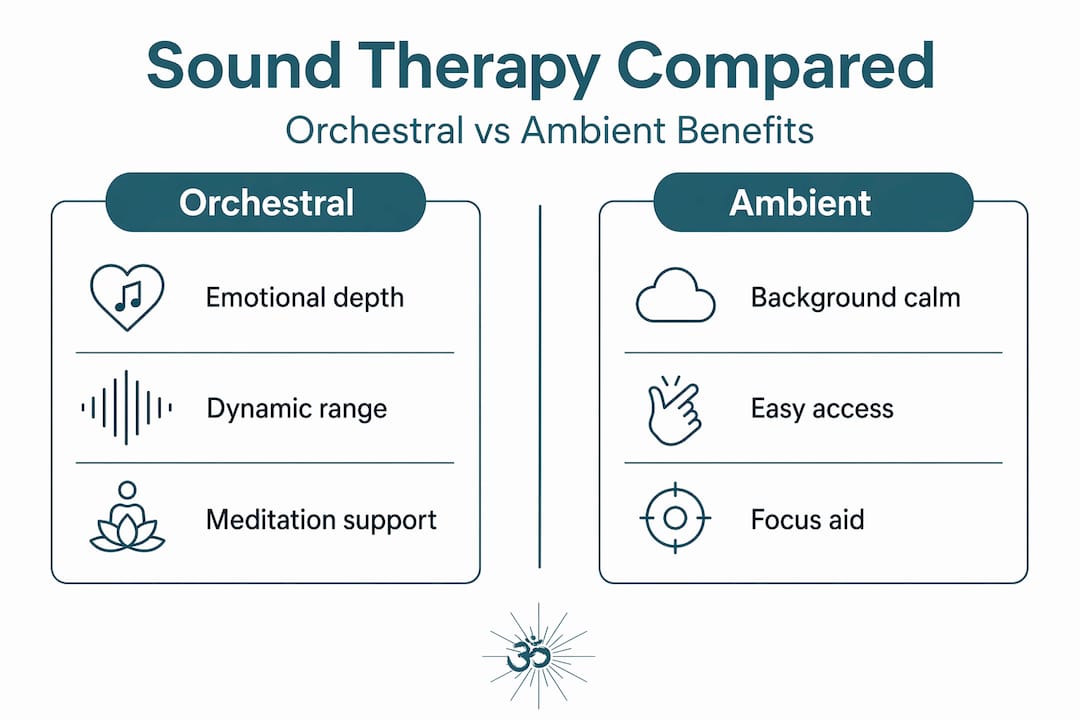
| Sound therapy type | Emotional depth | Physiological evidence | Accessibility | Meditation suitability |
|---|---|---|---|---|
| Orchestral soundscapes | High | Strong (HRV, cortisol, anxiety) | Requires quality recording/headphones | Excellent |
| Ambient/electronic | Low to moderate | Moderate | Very accessible | Good for light relaxation |
| Nature sounds | Moderate | Moderate | Highly accessible | Good for focus/restoration |
| Binaural beats alone | Low | Moderate | Accessible | Variable |
| Singing bowls/gong bath | Moderate to high | Limited formal studies | Requires in-person or specific recording | Excellent for body-centred work |
Orchestral soundscapes sit at the top of this table for meditation and emotional healing work specifically because of their emotional engagement and physiological reach. The one honest limitation is cost of quality. A poorly recorded orchestral track will not deliver what a well-recorded one does. This is precisely why the recording environment matters, something Orchestralmeditations addresses by working at Abbey Road Studios with the National Philharmonic.
My honest take on why orchestral soundscapes stand apart
I have spent years watching people grab the most convenient playlist and then wonder why their meditation practice feels shallow. And I get it. Convenience wins. But here is what I have genuinely come to believe: treating orchestral music as interchangeable with any other background sound is a bit like drinking instant coffee and insisting you have experienced espresso. Technically both are coffee. The experience is not remotely the same.
What I have seen, both in my own experience and in the growing body of research, is that orchestral soundscapes work because they demand a kind of quiet attention. Not effort, exactly. More like a willingness to be moved. And that willingness, that opening, is where the real therapeutic work happens. The music takes you somewhere you would not find sitting in silence with a wandering mind.
I also think people underestimate the importance of who made the music and why. Robert Emery does not write orchestral meditation music as a side project. It is a practice of its own, a considered craft where every dynamic choice, every pause, every harmonic resolution is weighted against its emotional and physiological effect on the listener. Moritz Schneider’s production choices, integrating theta frequencies and binaural elements within a full orchestral context, are not gimmicks. They are precision tools.
If I had one piece of advice to offer: give it a proper trial. Thirty days, thirty minutes a day, with headphones, eyes closed, and something genuinely beautiful playing. Then tell me your nervous system feels the same as before.
— Robert
Explore orchestral meditation music with Orchestralmeditations
If this article has made you curious, the best next step is simply to listen. Not to read more. Not to make a plan. To listen.
Orchestralmeditations brings together the craftsmanship of Robert Emery and Moritz Schneider with world-class recording conditions at Abbey Road Studios and the National Philharmonic to produce orchestral meditation music unlike anything you are likely to have heard in a wellness context before. The library includes binaural and 3D audio recordings, theta frequency-integrated compositions, and guided and unguided sessions designed for everything from morning calm to deep emotional processing.
If you are new to this kind of listening, start with the best meditation music curated for personal use. Whether you are working through stress, seeking deeper meditative states, or simply want to know what it feels like to have a full orchestra play specifically for your nervous system, this is where that experience begins.
FAQ
What makes orchestral soundscapes better for meditation than other music?
Orchestral soundscapes combine dynamic range, timbral richness, and intentional emotional shaping, making them uniquely effective for deep meditative states. Research shows that emotionally engaging music triggers aesthetic chills during meditation, which significantly increases self-transcendence and emotional breakthrough compared to neutral background sound.
How long should I listen to orchestral soundscapes for anxiety relief?
Research on meditative music with auditory beat stimulation found that 36 minutes produces the peak effect for mood and anxiety improvement, with 24 minutes showing the strongest anxiety reduction. Sessions shorter than 12 minutes produce considerably weaker results.
Can orchestral soundscapes actually change physical stress markers?
Yes. Studies show that structured orchestral music listening increases heart rate variability, lowers cortisol, and raises immunoglobulin A, all measurable signs of reduced physiological stress. These are objective biomarkers, not just subjective feelings of calm.
Do I need special equipment to benefit from orchestral soundscapes?
Good headphones make a meaningful difference, particularly with recordings designed using binaural or 3D audio techniques. You do not need expensive audiophile gear, but over-ear headphones will deliver far more of the spatial and frequency depth than phone speakers.
How quickly can orchestral soundscapes reduce stress?
Calming music can begin quieting the nervous system within minutes by reducing cognitive demand and simplifying sensory input. However, the most significant and lasting anxiety reductions from music come from consistent, structured daily listening over several weeks rather than a single session.