
Most people scroll past testimonials the same way they skip the small print on a shampoo bottle. Too subjective, too polished, too suspiciously five-star. Yet the role of testimonials in wellness music turns out to be far more layered and genuinely useful than that dismissive attitude gives them credit for. When someone tells you that a particular orchestral meditation piece helped them sleep through the night for the first time in months, that is not marketing fluff. That is a personalised data point, and it deserves your attention. Composers like Robert Emery and Moritz Schneider, whose work forms the foundation of Orchestralmeditations, have built catalogues that attract exactly this kind of detailed, emotionally rich listener feedback.
Key takeaways
| Point | Details |
|---|---|
| Testimonials guide personalisation | Listener accounts help you identify which music features match your emotional and physical needs. |
| Structured feedback beats vague praise | Testimonials specifying context, duration, and outcomes are far more replicable than generic five-star reviews. |
| Preferences evolve over time | Wellness music feedback needs ongoing updating because what soothes you today may not serve you in six months. |
| Testimonials are hypothesis starters | They point you in a useful direction but work best when blended with your own listening experience. |
| Composer credibility matters | Music from trusted composers like Robert Emery and Moritz Schneider attracts richer, more reliable listener accounts. |
The role of testimonials in wellness music
The technical term in music therapy and clinical research is “patient-reported outcomes,” but outside clinical settings most of us simply call them testimonials or personal stories. Both phrases point to the same thing: a listener’s account of what actually happened when they pressed play. And music-listening outcomes in wellness depend heavily on how music is selected, making these accounts far more than decoration on a product page.

What makes testimonials genuinely valuable here is their emotional specificity. A well-written account does not just say “this was relaxing.” It says “I was lying awake at two in the morning with my thoughts racing, I put on a theta frequency track, and within twenty minutes the internal noise had quietened enough that I could actually breathe.” That level of detail maps onto your own situation in a way that a clinical study abstract simply cannot.
From a psychological standpoint, testimonials capture what feels meaningful and safe for the individual listener, reflecting deeper mechanisms like emotional connection and personal identity. This matters enormously in wellness music because the genre is not one-size-fits-all. What sounds profoundly calming to one person sounds like background noise in a doctor’s waiting room to another.
There is also a persuasion element worth acknowledging honestly. Personal stories in wellness music increase adherence. When you read that someone stuck with a daily meditation practice because a particular album made the experience feel effortless, you are more likely to try it and persist with it. Research on music interventions for anxiety suggests that personal experience stories translate clinical outcomes into individual expectations, which is a rather elegant way of saying: other people’s stories help you believe the thing might actually work for you.
“Testimonials are not evidence in the scientific sense. They are evidence in the human sense. They tell you what is possible, not what is guaranteed. That distinction is worth keeping close to hand.”
- Whether the response was driven by familiar music (comfort, safety) or novel music (curiosity, engagement)
- The emotional or physical state the listener was in before pressing play
- Specific features of the music that seemed to matter, such as tempo, instrumentation, or frequency type
- How the listener felt afterwards, and whether the effect lasted
These four elements transform a testimonial from a vague thumbs-up into something you can actually use.
What makes a testimonial worth following
Here is where most wellness music discussions drop the ball. They treat all feedback as equally useful, which is a bit like treating all cooking advice as equally useful regardless of whether it came from a Michelin-starred chef or someone who once burnt toast. The impact of reviews on wellness music depends almost entirely on the quality and specificity of those reviews.
A 2026 MDPI scoping review makes this explicit: effective testimonials should be treated as structured interventions that others can replicate, and the best ones include four core components.
-
The listener’s initial state. Were they anxious, grief-stricken, physically tense, or simply trying to wind down after a long day? Context completely changes how music lands.
-
The music selection rationale. Did they choose a binaural beat track because they had read about theta frequencies, or did they stumble onto it randomly? Moritz Schneider, whose compositions for Orchestralmeditations are built around precise frequency work and orchestral depth, frequently receives testimonials that mention why listeners chose his tracks, not just the effect. That reasoning is what makes the account replicable.
-
Timing and duration. A ten-minute session before a board meeting and a forty-five-minute session before sleep are completely different interventions, even if the same track is used.
-
Follow-up changes. Did the listener return to the same piece repeatedly? Did they adjust the volume, the headphones, the time of day? Robert Emery’s orchestral meditations, recorded at Abbey Road Studios with the National Philharmonic, attract this kind of layered feedback because the richness of the recordings rewards repeated listening and closer attention.
Pro Tip: When reading a testimonial for wellness music, ask yourself: does this person describe their state before listening, not just after? If they do, the account is worth taking seriously. If they only describe the outcome, treat it as a warm recommendation rather than a replicable prescription.
The structured testimonial format is not just academically useful. It is practically liberating. When you know that a listener with chronic shoulder tension found a specific Robert Emery orchestral piece helpful at thirty minutes before sleep, with headphones, you have a starting hypothesis you can test for yourself tonight.
The complications nobody talks about
Right. So testimonials are useful. But let us not get carried away, because there are real complications that the “five stars, changed my life” style of feedback tends to obscure completely.
The most significant issue is that listener preferences evolve. What felt deeply restorative during a period of grief may feel too heavy six months later when you are rebuilding energy. Research into music personalisation shows that poor initial music choices can cause refusal or withdrawal, and the same principle applies outside clinical settings. If you follow an old testimonial that no longer matches your current state, you may write off an entire genre or composer prematurely.
Here is a comparison worth sitting with:
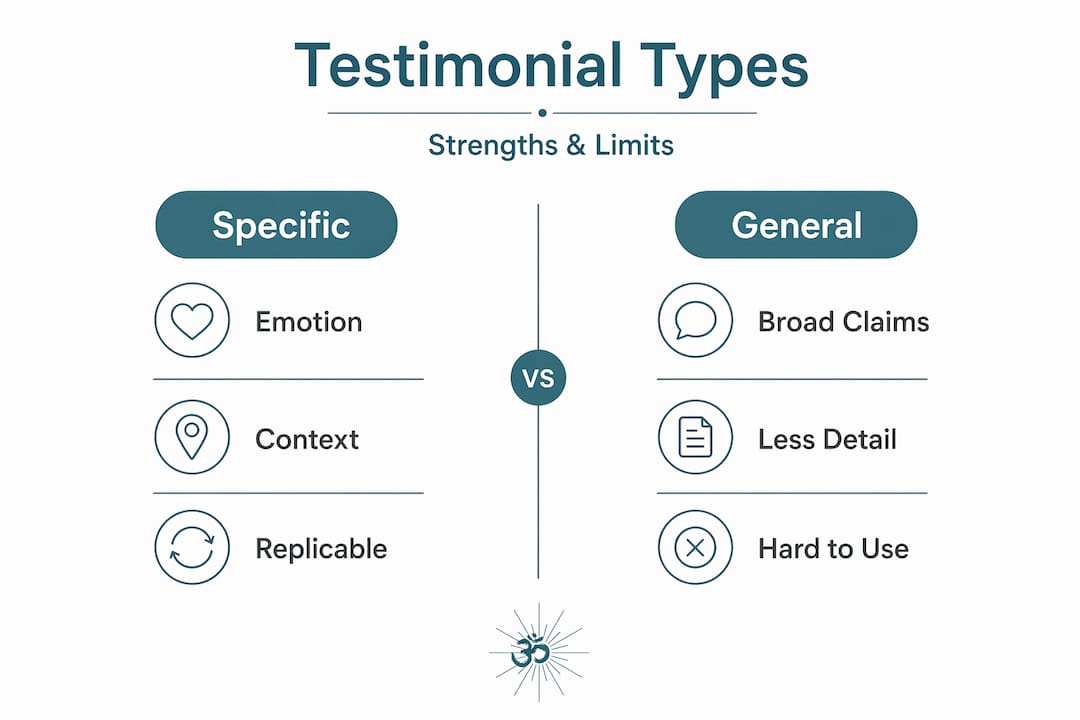
| Testimonial type | Strengths | Limitations |
|---|---|---|
| Specific and contextual | Replicable, emotionally detailed, useful for personalisation | May not match your current state or listening context |
| Vague and enthusiastic | Easy to read, emotionally encouraging | Impossible to replicate; no actionable information |
| Clinically structured | Highly reliable, evidence-adjacent | Can feel impersonal; may not capture the full sensory experience |
| Outdated personal account | Shows long-term engagement | Preferences change; the account may no longer reflect the creator’s current output |
The second complication is reliability. Wellness music feedback is self-reported, which means it is filtered through memory, mood, and the very human desire to believe something worked. Using testimonials as ongoing feedback helps adapt music choices to changing listener preferences, but only if the testimonials themselves are regularly refreshed rather than left to calcify as static endorsements.
This is why platforms that actively cultivate new listener accounts, rather than displaying a handful of glowing reviews from 2019, tend to offer more genuinely useful social proof. Orchestralmeditations benefits from the ongoing engagement of listeners who return to Robert Emery’s and Moritz Schneider’s catalogues repeatedly, which naturally generates updated, layered feedback rather than one-time impressions.
The third complication is what researchers call the “hypothesis starter” problem. A 2026 MDPI review stresses that testimonials point toward possible effects without guaranteeing them. If you read that binaural beats reduced someone’s pre-surgery anxiety by a meaningful margin, that is a reason to try it, not a reason to cancel your anxiolytic prescription. The distinction sounds obvious but is surprisingly easy to blur when you are desperate for relief.
How to actually use testimonials when choosing wellness music
Knowing that testimonials matter is only half the story. Knowing how to read them is where the practical value lives. Here is how to approach wellness music feedback in a way that actually serves your practice.
-
Look for emotional specificity before outcome claims. A testimonial that opens with “I was in the middle of a burnout and could not switch off” is more useful than one that opens with “this music is incredibly healing.” The former gives you a match-point; the latter gives you nothing to anchor.
-
Check whether the listener describes their listening environment. Headphones versus speakers, morning versus evening, silent room versus background household noise: these details alter everything. How music supports mental health depends substantially on context, and testimonials that include environmental details help you replicate conditions rather than just hoping for the best.
-
Notice whether the listener mentions return visits. Single-session testimonials tell you about first impressions. Accounts that describe returning to the same composer’s work over weeks or months tell you about sustained therapeutic value, which is what most wellness music seekers actually need.
-
Pay attention to what the listener says did not work initially. Counterintuitively, testimonials that describe a false start before finding the right track or frequency are among the most useful. They tell you that the process requires some calibration, which sets accurate expectations and reduces early dropout.
-
Cross-reference testimonials with your own responses. This is the bit people skip, and it is the most important step. Personalised music choices are critical for therapeutic effectiveness, which means no testimonial, however detailed, can substitute for your own direct experience of the music.
Pro Tip: Keep a brief listening journal for your first two weeks with any new wellness music. Note your state before, what you noticed during, and how you felt an hour afterwards. After a fortnight, you will have your own testimonial, and it will be the most useful one you ever read.
The practical magic happens when you treat user experiences with wellness music as a starting library rather than a final verdict. Testimonials from listeners of Robert Emery’s orchestral pieces, for instance, frequently describe how the 3D surround sound at Orchestralmeditations creates a sense of being inside the music rather than listening to it from outside. That specific detail tells you to prioritise headphone listening for the first few sessions, which is exactly the kind of operational insight a generic “very relaxing” review never provides.
You might also find it genuinely helpful to explore what listeners across different circumstances use wellness music for before settling on a genre or composer. The breadth of applications, from surgical anxiety reduction to sleep improvement to deep meditative practice, reflects just how context-specific effective wellness music choices tend to be.
My honest take on testimonials as a guide to healing music
I will be straight with you. I spent years being quietly snobbish about testimonials. Too anecdotal, I thought. Too easy to game. I preferred the clinical studies, the double-blind trials, the tidy statistics. Then I started paying close attention to the accounts listeners left for composers I knew well, and I noticed something that the studies alone could not capture: the moment a piece of music stopped being a product and became part of someone’s daily ritual.
There is a testimonial pattern I have seen repeatedly with Robert Emery’s work that genuinely changed my thinking. Listeners rarely describe it as “relaxing music.” They describe it as music that seems to find them where they are. Someone grieving describes it as holding space. Someone anxious describes it as a hand on the shoulder. Someone in physical pain describes it as a distraction that does not feel like distraction. That variance is not inconsistency. That is music working across different mechanisms simultaneously, which is precisely what familiar music does for safety and what novel, structured compositions do for engagement.
What I have learned is that the most valuable testimonials are the ones that surprise you, the ones where someone describes an effect you would not have predicted from the track description alone. Those are the accounts that tell you something genuinely new about the music’s range.
Moritz Schneider’s frequency-based compositions attract a particularly interesting breed of testimonial: technically observant listeners who describe specific moments within a track, a shift in the binaural beat frequency at the four-minute mark, a swell in the strings that coincides with a felt sense of release. That level of attention speaks to the quality of the music and the quality of the listening. Both matter.
My advice? Read testimonials with curiosity rather than credulity. Let them open doors, not make decisions for you. And update your own internal account regularly. What you need from wellness music at forty is probably not what you needed at thirty, and that is not a problem. It is just life, moving through you.
— ROBERT
Discover the music behind the testimonials
The accounts you have been reading about, the ones describing profound sleep, quietened anxiety, and that rare feeling of being genuinely held by sound, are not hypothetical. They belong to real listeners of the orchestral meditation collections created by Robert Emery and Moritz Schneider at Orchestralmeditations.
Every piece in the catalogue was recorded at Abbey Road Studios with the National Philharmonic, then layered with binaural beats, theta frequencies, and 3D sound design specifically to support deep meditative and healing states. The meditation music library brings together these compositions in a way that has generated the kind of detailed, emotionally rich listener feedback this article has been exploring. If you are ready to move from reading about wellness music to actually experiencing the best of it, this is a sensible place to begin.
FAQ
What is the role of testimonials in wellness music?
Testimonials provide emotionally specific, context-rich accounts of how music affected a listener’s state, helping others identify tracks likely to match their own needs. They function as personalised guidance that clinical studies alone cannot replicate.
How do I know if a wellness music testimonial is actually useful?
Look for accounts that describe the listener’s state before the session, the specific music features that seemed relevant, and any changes noticed afterwards. Vague praise with no contextual detail is difficult to apply to your own practice.
Can testimonials replace scientific research on music and wellbeing?
No. Music interventions in clinical settings are validated through structured trials, and testimonials work best as a complement to that evidence rather than a replacement. Think of them as personalised case studies, not proof.
Why do listener preferences change over time in wellness music?
Emotional and physical states shift as life circumstances change, and music that matched a period of grief or acute stress may feel misaligned during recovery or growth. Ongoing testimonial feedback helps track these shifts and adjust playlists accordingly.
Are testimonials on wellness music platforms trustworthy?
The most trustworthy accounts include specific details about context, duration, and outcome rather than generic enthusiasm. Platforms that publish varied, updated testimonials, including accounts of false starts or adjustments, tend to offer more honest and useful social proof than those displaying only uniformly glowing reviews.