Meditation is defined as a mental and physical practice of focusing or clearing the mind through techniques such as breath awareness, mantra repetition, or guided imagery. Whether you are brand new to sitting still for five minutes or you have been practising for years and want to go deeper, a clear step by step meditation process removes the guesswork and gives you something concrete to follow. Meditation takes many forms, including mindfulness, body-centred, mantra, movement, and visual-based styles, which means there is genuinely something for everyone. Composers like Robert Emery and Moritz Schneider have built entire careers around enhancing these practices through orchestral sound, and their work at Orchestralmeditations shows just how far a well-structured session can take you.
How to set up for your step by step meditation process
Before you sit down, close your eyes, and attempt to achieve inner peace (only to immediately start composing your shopping list in your head), a little preparation goes a long way. The environment you choose and the habits you build around your sessions are what separate a one-off experiment from a genuine practice.

Choosing your space
Your meditation space does not need to be a Himalayan retreat. It does need to be quiet, reasonably comfortable, and free from the kind of interruptions that make you leap out of your skin. A corner of your bedroom, a garden chair, or even a parked car before you walk into the office all work perfectly well. The key is consistency: using the same spot trains your brain to associate that location with calm, much like how a dog knows walkies are happening the moment you pick up the lead.
Timing and routine
Setting a regular routine reduces trial-and-error and helps you find a technique that actually fits your life. Morning sessions before the day’s noise kicks in are popular, but evening practice works just as well for winding down. Pick a time you can realistically protect, even if it is only ten minutes.
Posture options
You have more flexibility here than most guides admit:
- Sitting cross-legged on a cushion or yoga block is the classic choice and keeps the spine naturally upright.
- Sitting in a chair with feet flat on the floor is equally valid and far more comfortable for most Western bodies.
- Lying down works for body scan meditations, though falling asleep is an occupational hazard (not always a bad outcome, to be fair).
- Standing or walking suits movement-based styles and is excellent if sitting still makes you feel like a caged animal.
Preparing your mind
Focused breathing for about one minute lowers stress and improves mental clarity before you even begin the formal session. Use this as your transition ritual: three slow breaths in through the nose, out through the mouth, and you have already signalled to your nervous system that something different is happening.
Pro Tip: Dim the lights, set a gentle timer so you are not clock-watching, and consider playing orchestral meditation music at low volume. The acoustic richness of live instruments, particularly the kind recorded at Abbey Road Studios by composers like Robert Emery, creates a sensory cue that tells your brain it is time to settle.
Step by step execution of popular meditation styles
Right, this is the meaty bit. The good news is that mindfulness meditation needs no props, just a comfortable place and a non-judgmental mindset. The even better news is that you can start with as little as five minutes and build from there.
Mindfulness breath meditation
This is the most widely practised form and a brilliant starting point for any guided meditation process.
- Sit comfortably and close your eyes or soften your gaze downward.
- Take two or three deep breaths to settle in.
- Allow your breathing to return to its natural rhythm. Do not force it.
- Place your attention on the physical sensation of breathing: the rise of your chest, the air passing your nostrils, the slight pause between inhale and exhale.
- When your mind wanders (and it will, probably within about eight seconds), gently return your attention to the breath without any self-criticism.
- Continue for five to thirty minutes, gradually increasing the duration as your practice develops.
The wandering mind is not a failure. Returning attention gently to the breath each time it drifts is the actual training. Think of it as a bicep curl for your attention span.
Body scan meditation
The body scan is a step by step mindfulness meditation that moves your awareness slowly through the body, noticing sensations without trying to change them.
- Lie down or sit in a reclined position.
- Close your eyes and take several slow breaths.
- Bring your attention to the top of your head. Notice any sensations: warmth, tingling, tension, or nothing at all.
- Slowly move your awareness downward: forehead, jaw, neck, shoulders, chest, arms, hands, abdomen, hips, thighs, knees, calves, and feet.
- At each area, simply observe without judgement. If you notice tension, breathe into it gently.
- When you reach your feet, take a few full-body breaths and slowly open your eyes.
The body scan is particularly useful for releasing physical tension and building body awareness, and it works beautifully as a pre-sleep routine.
Loving-kindness (metta) meditation
This one surprises people. You are essentially practising directed compassion, which sounds a bit soft until you realise how genuinely difficult it is to feel warmth toward your difficult colleague without gritting your teeth.
- Sit comfortably and close your eyes.
- Begin by directing kind phrases toward yourself. Silently repeat: “May I be safe. May I be well in body and mind. May I be happy. May I live with ease.”
- Hold those feelings for a minute or two, even if they feel a little forced at first.
- Gradually expand your focus: a loved one, a neutral person, a difficult person, and eventually all beings.
- Loving-kindness meditation typically runs fifteen to twenty minutes, though even five minutes of the self-directed phase produces noticeable results.
“The mind is like water. When it’s turbulent, it’s difficult to see. When it’s calm, everything becomes clear.” This is the spirit behind metta practice: you are not forcing positivity, you are creating the conditions for it to arise naturally.
Walking meditation: step by step instructions
Mindful walking offers a genuine alternative for anyone who finds seated practice uncomfortable or who simply cannot sit still without their leg bouncing like a sewing machine.
- Find a quiet path, garden, or even a long corridor where you can walk slowly without obstruction.
- Stand still for a moment and take three grounding breaths.
- Begin walking at roughly half your normal pace.
- Focus on the physical sensations of each step: the heel making contact, the weight shifting, the toes pushing off.
- Expand your awareness to sounds, smells, and the feeling of air on your skin.
- When your mind drifts to your to-do list, gently return your attention to the sensation of your feet on the ground.
- Walk for ten to twenty minutes, then stand still again for a closing breath before resuming normal activity.
Pro Tip: Design your first session with a manageable time of three to five minutes and a clear endpoint. Knowing the session has a finish line removes the anxiety of open-ended sitting and makes it far easier to show up the next day.
What are the most common meditation challenges and how do you fix them?
Every person who has ever tried to meditate has, at some point, sat there wondering whether they are doing it wrong because their brain refuses to shut up. You are not doing it wrong. Here is what is actually happening and what to do about it.
Distraction and restlessness are the most universal complaints. The mind generates thoughts the way a kettle generates steam: it is simply what it does. Experienced meditators reframe each distraction as a training repetition, returning focus without self-criticism, which makes the practice sustainable even on chaotic days. You are not failing when your mind wanders. You are practising.
Physical discomfort is the second most common reason people quit early. If sitting cross-legged makes your knees scream, switch positions immediately. Switching to mindful walking or body scan techniques can alleviate stress-related distractions and improve focus for those who find seated practice physically uncomfortable. There is no medal for suffering through the wrong posture.
Common challenges and practical fixes:
- Racing thoughts: Label them briefly (“thinking”) and return to your anchor point, whether that is breath, sound, or body sensation.
- Sleepiness: Sit upright rather than reclining, meditate earlier in the day, or try walking meditation.
- Boredom: Shorten your session and build duration gradually. Five engaged minutes beats twenty restless ones.
- Inconsistency: Attach meditation to an existing habit, such as after your morning coffee or before brushing your teeth at night.
- Wrong fit: There is no single correct way to meditate, and switching methods is actively encouraged if the first style does not suit you.
Pro Tip: A deliberate closure phase after meditation, pausing to notice how you feel before returning to your day, strengthens your routine and integrates the calm into daily life rather than leaving it behind on the cushion.
Why orchestral meditation music deepens your practice
Music and meditation have been paired for thousands of years, but not all meditation music is created equal. There is a meaningful difference between a looping digital ambient track and a full orchestral composition recorded with live musicians in a world-class studio.
Robert Emery is a composer and producer whose work spans film, television, and meditation music, bringing cinematic depth and emotional intelligence to his recordings. Moritz Schneider brings a classical European sensibility to his compositions, with arrangements that move through tension and release in ways that mirror the natural arc of a meditation session. Together, their work for Orchestralmeditations, recorded at Abbey Road Studios with the National Philharmonic, produces something that a synthesised track simply cannot replicate.
Here is why it matters for your practice:
- Acoustic richness: Live strings, brass, and woodwind create overtones and micro-variations that engage the brain differently from digital sounds, supporting deeper focus.
- Theta frequency integration: Orchestralmeditations incorporates theta frequencies (4 to 8 Hz) into compositions, which are associated with the deeply relaxed, pre-sleep state ideal for meditation.
- Emotional warmth: Orchestral meditation music creates an immersive auditory environment that enhances focus and emotional warmth during practice, making it easier to sustain attention.
- Style matching: Slow, sparse compositions suit breath meditation and body scans; richer, more dynamic pieces support loving-kindness and visualisation practices.
- 3D surround sound: The binaural and 3D recording techniques used by Orchestralmeditations mean the music feels spatial rather than flat, which amplifies the sense of immersion.
You can explore guided meditation techniques that pair specific musical styles with particular meditation methods for a more structured experience.
Key takeaways
A consistent, flexible step by step meditation process, supported by the right environment, a compatible style, and quality sound, is the most reliable path to sustainable mindfulness practice.
| Point | Details |
|---|---|
| Preparation shapes the session | A quiet space, a regular time, and one minute of settling breath set the foundation for every practice. |
| Style flexibility is not optional | Switching between breath, body scan, loving-kindness, or walking meditation keeps practice sustainable and personally relevant. |
| Wandering thoughts are the training | Each gentle return of attention to the breath or anchor point is the actual exercise, not a sign of failure. |
| Start small and build | Three to five minutes with a clear endpoint is more effective than forcing twenty uncomfortable minutes from day one. |
| Music quality changes the experience | Orchestral compositions with theta frequencies and live acoustic textures deepen focus and emotional engagement beyond what digital tracks offer. |
Why I think most meditation advice overcomplicates the starting point
Here is my honest position on this: the meditation world has a slight tendency to make the whole thing sound like you need a certificate, a special cushion, and possibly a guru before you are allowed to begin. You do not.
When I first started working with meditation music, I noticed that the people who struggled most were not those with busy minds (that is everyone) but those who had been told there was a “correct” experience they were supposed to be having. They would sit down, notice that their mind was doing its usual chaotic thing, and conclude they were broken. They were not broken. They had simply been given the wrong expectations.
The step by step approach works precisely because it removes that ambiguity. You have a sequence, a duration, and a clear anchor point. You know what you are doing and you know when you are done. That structure is not a crutch. It is the scaffolding that lets genuine practice develop underneath it.
My personal recommendation is to start with breath meditation for five minutes, add orchestral music at low volume from the first session, and resist the urge to evaluate whether it “worked” for at least two weeks. The benefits of mindfulness practice accumulate quietly, like interest in a savings account. You rarely notice the growth day to day, but one morning you realise you handled something stressful with a composure that would have surprised your earlier self.
If you want to go deeper into the mindfulness side specifically, the step by step mindfulness guide at Orchestralmeditations is worth your time. And if you are curious about relaxation techniques beyond meditation, that resource covers body scan methods and broader wellness practices in useful detail.
Trust the process. It is genuinely simpler than the internet makes it look.
— ROBERT
Take your practice further with Orchestralmeditations
If you have followed the steps above and found that music genuinely changes the quality of your sessions (most people do), then the Orchestralmeditations library is worth exploring properly.
Robert Emery and Moritz Schneider have produced a curated collection of orchestral meditation recordings, each crafted to support specific states: deep relaxation, theta brainwave entrainment, loving-kindness, and focused mindfulness. Recorded at Abbey Road Studios with the National Philharmonic, these are not background tracks. They are full compositions designed to carry your attention through a complete session. Browse the orchestral meditation music collection and find the sound that fits your practice. Individual tracks and subscription options are both available, so you can start without committing to a full library.
FAQ
What is the basic step by step meditation process for beginners?
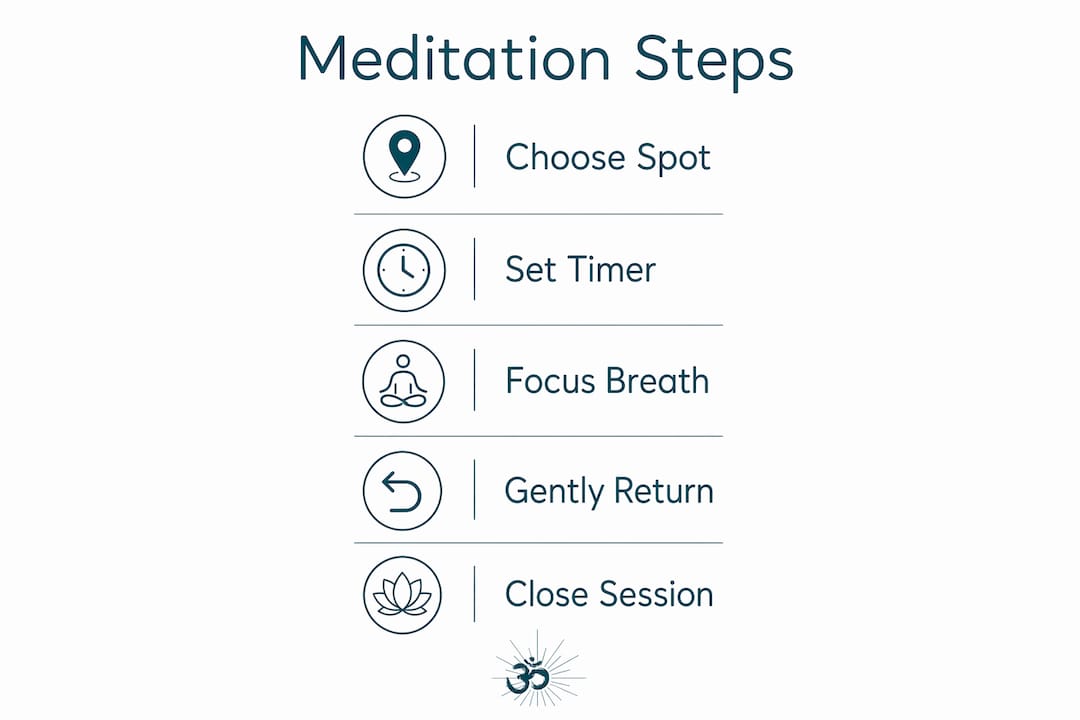
Choose a quiet spot, sit comfortably, set a timer for three to five minutes, and focus your attention on the physical sensation of breathing. Each time your mind wanders, gently return your focus to the breath without judgement.
How long should a beginner meditate each day?
Start with three to five minutes and increase gradually toward twenty to thirty minutes as your practice becomes consistent. Short, regular sessions build the habit more effectively than occasional long ones.
Does meditation music actually help?
Yes. Orchestral meditation music creates an immersive auditory environment that enhances focus and emotional warmth, and compositions incorporating theta frequencies support the deeply relaxed states associated with effective meditation.
What should I do when my mind keeps wandering?
Treat each wandering thought as a training repetition rather than a failure. The practice of returning attention gently to your anchor point is the core exercise of mindfulness, not a sign that you are doing it wrong.
Which meditation style is best for complete beginners?
No single style suits everyone, but breath-focused mindfulness meditation is the most accessible starting point because it requires no equipment, no prior knowledge, and can be done anywhere in as little as five minutes.