
Here’s something that might ruffle a few feathers: putting on an orchestral recording does not automatically send you into a blissful, stress-free trance. Surprising, right? We tend to assume that anything with violins and a cello section is inherently soothing, like a warm bath for the ears. But not all orchestral music relaxes in the same way. Specific musical qualities are doing the heavy lifting, and knowing which ones actually matter can transform how you choose music for relaxation, mindfulness, and meditation. This guide unpacks the science, explains the nuances, and gives you practical tools to pick the right orchestral pieces every single time.
Key Takeaways
| Point | Details |
|---|---|
| Not all orchestral music relaxes | The tempo, melody, and instrumental texture determine a composition’s relaxation effects. |
| Physical and emotional benefits | Empirical studies show that the right orchestral music can reduce stress and anxiety markers in the body and brain. |
| Personalisation is key | Your health, preferences, and familiarity with the music will influence how effective it is for you. |
| Science-guided listening works best | Choosing your music based on scientific principles yields better relaxation than relying solely on gut feeling. |
What makes orchestral music uniquely calming?
Let’s start with the fundamentals, because they are genuinely fascinating once you dig in. Orchestral music is not calming simply because it sounds “fancy” or because your secondary school music teacher told you it was good for you. There are specific, measurable musical characteristics that interact with your nervous system in predictable ways.
The most important of these is tempo. A slow tempo, typically between 60 and 80 beats per minute, closely mirrors the resting human heart rate. When your auditory system picks up a rhythm in that range, your cardiovascular system has a tendency to synchronise with it. Think of it as your heart quietly following along, like a polite guest matching the pace of the host. This is sometimes called entrainment, and it is one of the most well-documented mechanisms linking music to physiological calm.
Then there is the matter of lyrics. Or rather, the glorious absence of them. Vocal music, even beautiful vocal music, engages the language-processing centres of your brain. That means part of your mind is always working, parsing words, following meaning, occasionally getting distracted by a lyric you find annoying. Orchestral music sidesteps all of that entirely. Your brain can simply listen without having to decode anything.
Beyond tempo and instrumentation, key musical traits like smooth melodic lines, limited dynamic shifts, and harmonic complexity all contribute to relaxation. A melody that moves in gentle, stepwise motion rather than jagged leaps feels physically easier to follow. Similarly, rich harmonic palettes, the layered chords that orchestras produce so effortlessly, create a sense of depth and warmth that can feel almost like being wrapped in something comfortable.
Here is a quick summary of the core qualities to look for:
- Slow tempo (60 to 80 bpm) to encourage cardiovascular entrainment
- No lyrics to reduce cognitive load and mental distraction
- Smooth melodic lines with gentle, stepwise movement
- Limited dynamic contrast to avoid sudden jolts of arousal
- Rich harmonic texture for a sense of warmth and depth
The relaxation music benefits of these qualities are not just theoretical. They translate into measurable changes in the body, which we will get into shortly. But it is worth pausing to appreciate how much thought goes into composing music that genuinely supports relaxation, rather than simply sounding pleasant.
“The orchestra is the only instrument capable of producing the full emotional and physiological range that deep relaxation requires.” This is not hyperbole. It is a reflection of how uniquely suited orchestral writing is to this purpose.
For a deeper look at how these elements work together in practice, the guide on deep relaxation with orchestral soundscapes is well worth your time.
How orchestral music affects the mind and body: Scientific insights
With an understanding of key musical features, the next step is uncovering how these characteristics translate to real changes in your body and mind. And here is where things get genuinely exciting, because the research is more specific than most people realise.
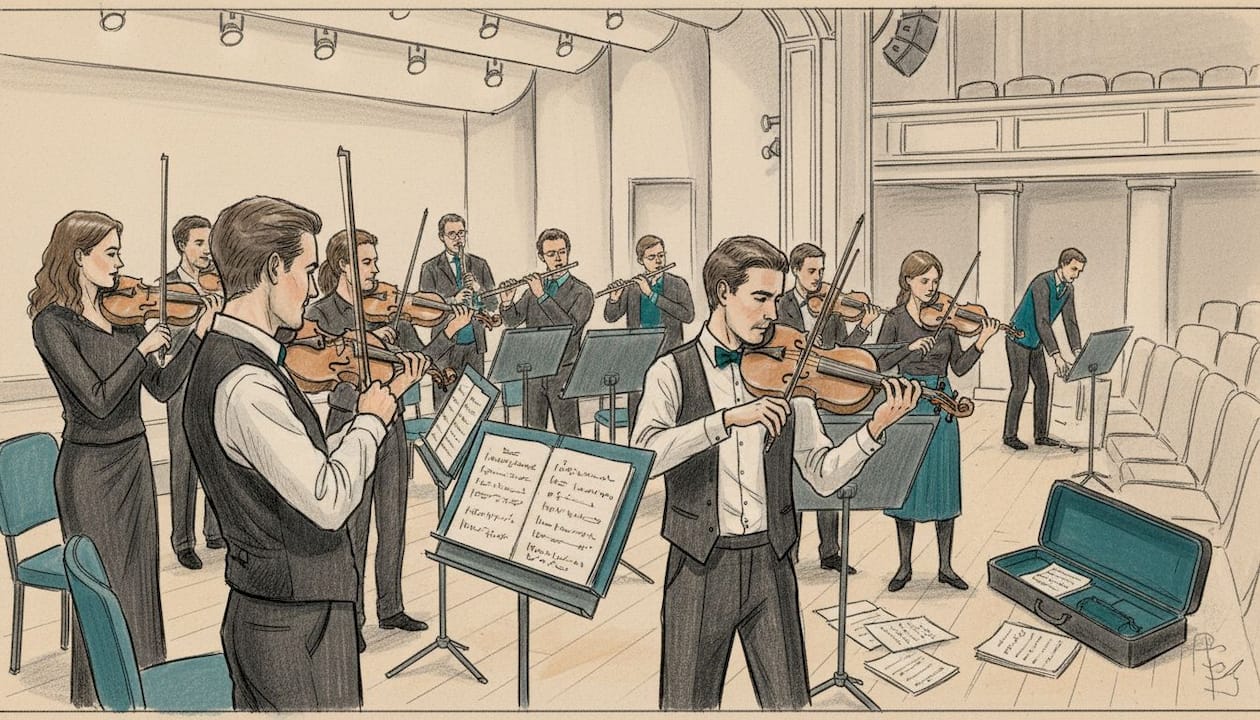
A landmark study found that relaxing classical music measurably decreases brain tissue pulsatility, heart rate, and skin conductance. In plain terms: your brain calms down, your heart slows, and your body stops sweating quite so much. These are not subtle, subjective impressions. They are quantifiable physiological shifts recorded under controlled conditions.
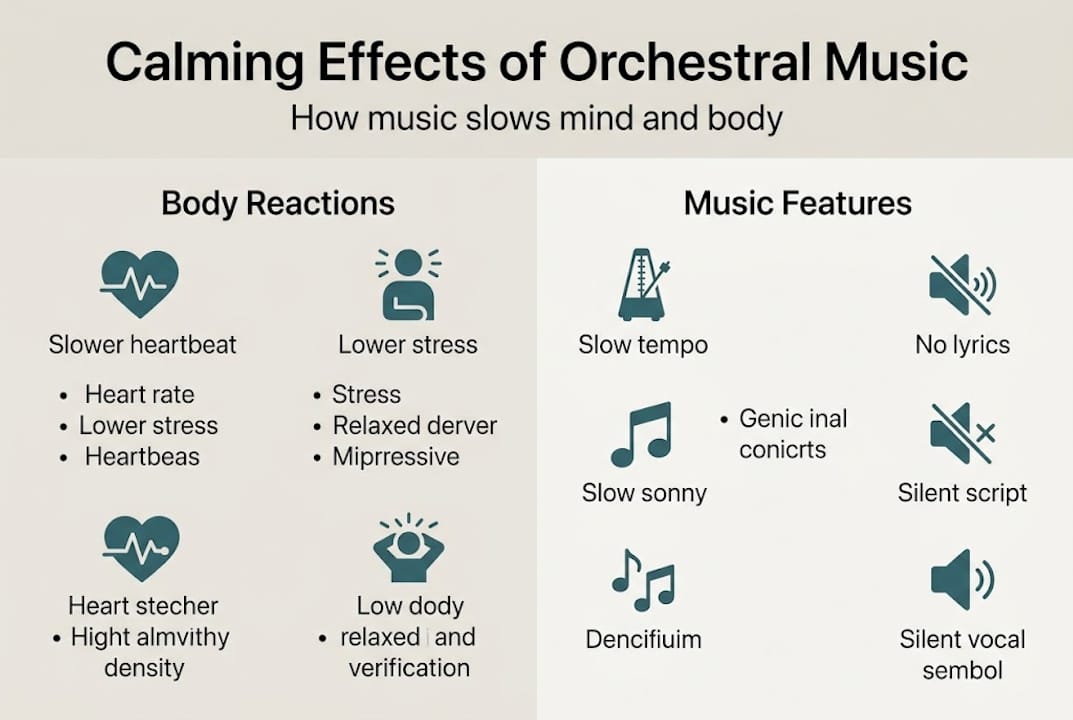
The table below summarises some of the key physiological effects observed in research:
| Physiological marker | Effect after orchestral listening | Notes |
|---|---|---|
| Heart rate | Decreased | Especially with slow-tempo pieces |
| Brain tissue pulsatility | Reduced | Linked to lower neural arousal |
| Skin conductance | Lowered | Indicator of reduced stress response |
| Anxiety levels | Measurably reduced | Particularly with major-key violin music |
| Emotional engagement | Heightened | More pronounced in live performance settings |
Major-key violin music deserves a special mention here. Research suggests it can reduce anxiety through the modulation of gamma oscillations in the brain, which are high-frequency brain waves associated with alertness and cognitive processing. When those oscillations settle, so does the anxious mental chatter that so many of us carry around like unwanted luggage.
Live performance adds another layer entirely. Studies indicate that hearing an orchestra perform in person enhances both emotional impact and heart response compared to recorded listening. There is something about the physical presence of sound waves, the slight imperfections, the human breath behind each note, that recorded audio simply cannot fully replicate. That said, high-quality recordings, particularly those made with immersive 3D or binaural techniques, come remarkably close.
Pro Tip: If you are using orchestral music for a meditation session, aim for recordings that were made with spatial audio or binaural processing. These techniques recreate the sense of being surrounded by sound, which deepens the physiological relaxation response considerably.
It is also worth noting that music response differences between individuals are real and significant. Your personal history with music, your current health status, and even your cultural background all influence how your nervous system responds. This is not a reason to give up on orchestral music for relaxation. It is simply a reason to approach it thoughtfully.
“Music is not a one-size-fits-all prescription. But for many people, the right orchestral piece is the closest thing to one.”
For those wanting to go further, exploring orchestral music for meditation offers a thorough look at how symphonic compositions support meditative states specifically. And if stress relief is your primary goal, the guide on relaxation music for stress relief covers the practical side beautifully.
Beyond the basics: When orchestral music relaxes—and when it may not
Is all orchestral music equally relaxing? Absolutely not, and this is where a lot of well-meaning advice falls apart. The assumption that anything orchestral will calm you down is a bit like assuming all food is nutritious because some of it is. Context, composition, and individual response all matter enormously.
Not all classical or orchestral music relaxes. Arousing works, think Stravinsky’s Rite of Spring or Beethoven’s Fifth Symphony at full throttle, can actually increase sympathetic nervous system activity. That is the fight-or-flight side of your autonomic nervous system. Rather than calming you down, these pieces can wind you up. Which is brilliant if you are trying to motivate yourself for a run, but rather counterproductive if you are attempting a mindfulness session.
Research also shows that people with hypertension show reduced relaxation effects from music overall, which is a genuinely important finding for anyone using music therapeutically.
Here are the key factors that determine whether a piece of orchestral music will relax or arouse you:
- Tempo: Fast tempos (above 100 bpm) tend to increase arousal rather than reduce it
- Dynamic range: Sudden loud passages (fortissimo) trigger a startle response
- Familiarity: Unfamiliar music requires more cognitive processing, reducing relaxation
- Personal associations: A piece linked to a stressful memory may trigger that stress response
- Health conditions: Hypertension and anxiety disorders can alter music’s physiological impact
The comparison below illustrates how different orchestral styles tend to affect the nervous system:
| Orchestral style | Typical tempo | Likely effect on nervous system |
|---|---|---|
| Romantic slow movements | 50 to 70 bpm | Parasympathetic (calming) |
| Dramatic symphonic works | 120 to 160 bpm | Sympathetic (arousing) |
| Ambient orchestral soundscapes | 40 to 65 bpm | Deep parasympathetic (deeply calming) |
| Film score action sequences | 140 to 180 bpm | Strong sympathetic (high arousal) |
Pro Tip: Before committing to a piece for a relaxation session, listen to the first 60 seconds. If you notice your breathing quicken or your jaw tighten, that piece is working against you. Trust your body’s initial response.
For help navigating this, exploring curated playlists for relaxation takes the guesswork out of selection. And if sleep is your goal, the resource on music for sleep healing is specifically tailored to that purpose.
Practical guide: Choosing orchestral compositions for optimal relaxation
Armed with an understanding of what works and why, here is how you can confidently select orchestral compositions most likely to help you unwind. This is not about following rigid rules. It is about giving yourself a framework that you can adapt as you learn what works for you personally.
-
Start with tempo as your filter. Look for pieces marked Adagio, Andante, or Lento in their titles or programme notes. These Italian tempo markings indicate slow, walking, or broad pacing, all of which sit comfortably within the 50 to 80 bpm range associated with relaxation.
-
Favour major keys for anxiety reduction. Minor keys are not inherently bad, but major-key compositions tend to produce more consistent relaxation responses across a wider range of listeners. If you are new to using orchestral music for wellness, major key is a safer starting point.
-
Choose smooth dynamics over dramatic contrasts. Pieces that stay within a relatively consistent volume range are far less likely to trigger an arousal response. Avoid anything marked with frequent fortissimo or sforzando passages.
-
Match music to context. What works for a midday mindfulness break may not work for sleep. For meditation, slightly more textured and layered compositions support focused awareness. For sleep, simpler, quieter, and more repetitive structures tend to work better.
-
Experiment with Western orchestral repertoire specifically. Interestingly, Western classical music may outperform some other classical traditions for emotion regulation, potentially due to its complex polyphonic structure. The layering of multiple independent melodic lines creates a richness that seems to engage the brain’s emotional processing in a particularly effective way.
-
Keep a simple listening journal. Note which pieces helped you relax, which ones did not, and any physical sensations you noticed. After a few weeks, patterns will emerge that tell you more about your personal response than any study ever could.
Pro Tip: If you are using orchestral music to support hypnotherapy or deep relaxation work, the guide on music for hypnotherapy offers specific recommendations tailored to that context.
Building a reliable relaxation playlist takes a little time, but it is genuinely one of the most rewarding wellness investments you can make. Once you have a handful of pieces that consistently work for you, the benefits compound. Your nervous system begins to associate those sounds with safety and calm, making the relaxation response faster and deeper over time.
Why science-backed listening beats intuition with relaxation music
Here is an uncomfortable truth that I have come to accept over years of working with music and wellbeing: our intuitions about what will relax us are often spectacularly wrong. We reach for the dramatic, emotionally stirring piece because it feels meaningful. We assume that music we love will automatically calm us. Neither of these instincts is reliably accurate.
The science tells a more nuanced story. Not all slow music is relaxing. Not all music you enjoy produces a parasympathetic response. Individual differences in how people respond to orchestral vs digital meditation music are real and significant, and ignoring them means you might spend years using music that is simply not doing what you think it is doing.
This is precisely why evidence-based curation matters so much. When playlists are built around measurable physiological outcomes rather than aesthetic preference alone, the results are consistently better. Research reveals subtleties that intuition misses entirely: the specific tempo range that triggers entrainment, the harmonic qualities that reduce neural arousal, the dynamic profiles that avoid triggering the stress response.
I am not suggesting you abandon your personal taste. Far from it. What I am suggesting is that you let science do some of the heavy lifting in the selection process, and then let your personal experience refine the results. The combination of evidence-based frameworks and individual experimentation is, in my experience, the most reliable path to genuinely effective relaxation through music.
Explore curated orchestral music for your relaxation journey
Ready to put science-backed recommendations into action? If this guide has sparked a desire to actually use what you have learned rather than just file it away as interesting reading, then the next step is finding music that has already been built around these principles.
At Orchestral Meditations, every track in our meditation music collections has been crafted with exactly these scientific foundations in mind. Recorded at Abbey Road Studios with the National Philharmonic, our compositions are designed around the specific tempo ranges, harmonic qualities, and dynamic profiles that research links to genuine physiological relaxation. Whether you are looking to deepen your meditation practice, improve sleep, or simply find a reliable way to decompress, our personalised orchestral meditations offer a tailored starting point. Stop guessing and start listening to music that is actually built to help you relax.
Frequently asked questions
Can listening to orchestral music help reduce anxiety?
Yes, major-key violin music and slow-tempo orchestral pieces can measurably reduce anxiety by lowering heart rate and brain stress markers, making them a genuinely effective tool for anxiety management.
Is all orchestral music suitable for relaxation purposes?
No, fast or dramatic orchestral works may increase arousal rather than reduce it, so selecting slow, smooth, and harmonically rich compositions is essential for relaxation purposes.
Does live orchestral music offer additional relaxation benefits?
Live performances can boost emotional impact and heart response compared to recordings, though individual results vary depending on personal sensitivity and health context.
How should I choose the right orchestral music for meditation?
Choose slow-tempo, major-key pieces with smooth dynamics and limited dramatic contrast, then adjust your selections based on your own physical and emotional responses over time.