
Most of us assume meditation’s benefits are somehow mystical, a kind of invisible magic that either works for you or doesn’t. But here’s the thing: modern brain imaging has rather rudely gate-crashed that assumption. Meditation induces measurable changes in deep brain areas associated with memory and emotional regulation, observable in real time via fMRI scanners. That’s not mystical. That’s neuroscience. In this guide, we’re going to look at what the latest research actually says about meditation’s effects on the brain and body, how scientists structure their studies, and why orchestral music and soundscapes are increasingly recognised as powerful variables in the equation. We’ll also be honest about the risks, because yes, there are some. Ready? Let’s get into it.
Key Takeaways
| Point | Details |
|---|---|
| Meditation alters the brain | Scientific imaging shows meditation decreases default mode network activity and boosts neuroplasticity. |
| Music enhances meditation | Chills-inducing orchestral music and natural soundscapes increase the effectiveness of meditation, especially for mood and insight. |
| Choose your method wisely | Mindfulness-based programmes, loving-kindness, and digital interventions each offer unique benefits—compare approaches to fit your needs. |
| Be aware of risks | Adverse effects are common during intensive practices, so proper screening and adaptation are key. |
What does science reveal about the effects of meditation?
With the groundwork set, we now turn to the actual changes meditation produces in the brain and body, according to the latest research.
If someone had told you twenty years ago that sitting quietly for forty minutes could physically reshape your brain, you’d probably have smiled politely and backed away slowly. Yet that’s precisely what fMRI and EEG studies are showing us. Meditation decreases activity in the default mode network (DMN), the chatty, self-referential part of your brain that loves to remind you about that embarrassing thing you said in 2009. Quieting the DMN is associated with reduced mind-wandering and greater present-moment awareness. Useful, to say the least.
Beyond the DMN, loving-kindness meditation produces specific structural and functional changes in the amygdala and hippocampus, regions governing emotional reactivity and memory formation. Think of it as gently remodelling your brain’s emotional control room. The neuroimaging evidence also points to strengthened connectivity in the salience network (SN) and the dorsolateral prefrontal cortex (DLPFC), which supports focused attention and executive function.
Here’s a quick overview of the key brain regions affected and what that means for your practice:
| Brain region or network | What changes | Practical outcome |
|---|---|---|
| Default mode network (DMN) | Decreased activity | Less mind-wandering, more presence |
| Amygdala | Reduced reactivity | Lower emotional stress responses |
| Hippocampus | Increased volume/connectivity | Better memory and emotional regulation |
| Salience network (SN) | Enhanced engagement | Sharper attention to inner states |
| Dorsolateral prefrontal cortex (DLPFC) | Strengthened connectivity | Improved focus and decision-making |
Beyond the brain, meta-analyses confirm measurable physiological and psychological improvements, including:
- Reduced cortisol levels and perceived stress
- Decreased chronic pain sensitivity
- Improved sleep quality and duration
- Enhanced interoception (awareness of internal bodily signals)
- Increased BDNF (brain-derived neurotrophic factor), supporting neuroplasticity
- Elevated endogenous opioid activity, contributing to natural pain relief
One of the more surprising findings is how quickly changes can appear. Short, intensive retreats, sometimes as brief as seven days, produce detectable shifts in brain network connectivity. You don’t need a decade of daily practice before your brain starts responding. That’s genuinely encouraging, and it’s part of why the symphonic stillness advantages of adding structured music to practice are drawing so much research attention.
Key finding: Meta-analyses report medium-to-large effect sizes for meditation’s impact on stress and pain, with standardised mean differences often ranging from 0.5 to 0.8, placing it firmly in the territory of clinically meaningful interventions.
The picture that emerges is one of a practice that is genuinely, measurably transformative. Not magic. Science.
Core methodologies: From mindfulness to digital interventions
Now that we’ve seen meditation’s effects, how do researchers structure and compare the techniques themselves, especially as new digital options emerge?
Not all meditation is created equal, and scientists are quite particular about this. The field has moved well beyond “just sit quietly and breathe.” Mindfulness-based stress reduction (MBSR) and loving-kindness are the two most rigorously studied methodologies, with neuroimaging, biomarker analysis, and EEG all used to measure their distinct effects. But they’re far from the only players.
Here’s how the leading scientific approaches compare:
| Method | Structure | Typical duration | Primary focus | Evidence strength |
|---|---|---|---|---|
| MBSR | Group-based, 8 weeks | 45 min/day | Present-moment awareness | Very strong |
| Loving-kindness (LKM) | Guided, solo or group | 20-30 min/session | Compassion, emotional regulation | Strong |
| Transcendental ™ | Mantra-based, twice daily | 20 min/session | Deep rest, stress reduction | Moderate-strong |
| Focused attention (FA) | Solo, object-based | Variable | Sustained concentration | Strong |
| Open monitoring (OM) | Solo, non-directive | Variable | Meta-awareness, insight | Moderate |
| Digital MBIs | App or online-delivered | 10-20 min/session | Accessibility, habit formation | Growing |
A typical scientific meditation study follows a fairly consistent sequence:
- Participant recruitment and baseline neuroimaging or biomarker collection
- Random assignment to intervention or control group
- Structured meditation programme delivery (in-person, retreat, or digital)
- Mid-point assessments to track early changes
- Post-intervention neuroimaging, EEG, and psychological questionnaires
- Follow-up measurements at 1, 3, or 6 months to assess durability
One of the more exciting developments is the rise of digital MBIs and intensive retreat formats. Seven-day retreats and well-designed digital programmes both yield measurable mental health improvements, which matters enormously for accessibility. Not everyone can take a week off to sit in silence in the Himalayas (lovely as that sounds).
The meditation research methods used in these studies increasingly incorporate music and sound as independent variables, which is where things get particularly interesting for practitioners who already use music for deep relaxation or music for mindfulness practices.
Pro Tip: If you’re unsure which method suits you, start with MBSR if you want structure and strong evidence, or try loving-kindness if emotional regulation is your primary goal. Digital programmes are a perfectly valid entry point and the science backs them up.
The key takeaway here is that methodology matters. Picking a technique that aligns with your specific goals, whether that’s stress reduction, focus, or emotional resilience, will almost certainly yield better results than a vague commitment to “meditating more.”
The power of orchestral music and soundscapes in meditation
While core techniques matter, music and soundscapes are increasingly seen as critical variables in shaping the meditation experience.

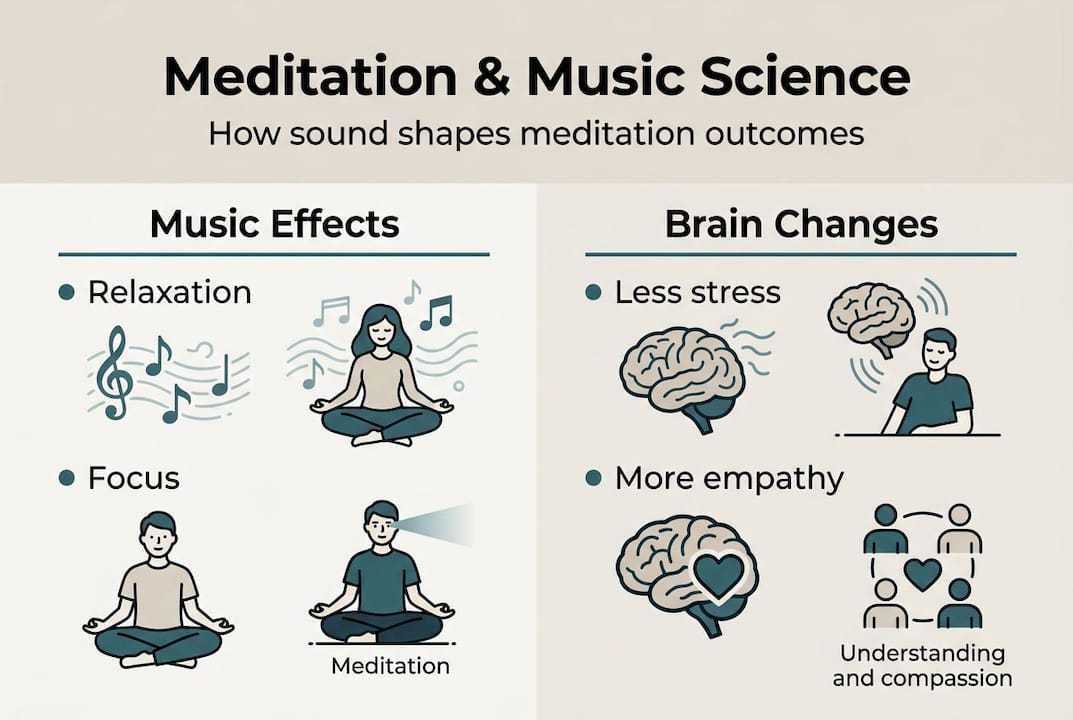
Here’s something that might make a string quartet player rather smug: chills-inducing orchestral music measurably augments loving-kindness meditation, deepening emotional breakthroughs and facilitating moments of genuine insight. Those spine-tingling moments when a swell of strings hits just right? That’s not mere sentimentality. That’s your brain releasing dopamine, and in a meditative context, it can catalyse profound shifts in emotional processing.
The benefits of integrating music into meditation are becoming clearer with each new study:
- Enhanced emotional depth: Music activates the limbic system, amplifying the compassion and warmth cultivated in loving-kindness practices
- Improved focus and flow: Structured musical compositions provide an auditory anchor, reducing mind-wandering more effectively than silence alone for many practitioners
- Elevated mood: Music-assisted meditation sessions consistently show greater improvements in positive affect compared to unaccompanied practice
- Self-transcendence: Certain orchestral passages appear to facilitate experiences of self-dissolution and expanded awareness, the very states advanced meditators spend years cultivating
- Reduced cognitive effort: Music can lower the activation energy required to enter meditative states, making practice more accessible for beginners
The soundscape dimension is equally fascinating. Natural soundscapes such as forest environments, birdsong, and flowing water measurably improve mood and cognitive performance compared to industrial or urban noise. The effect isn’t subtle either. Participants exposed to natural soundscapes before or during meditation show significantly lower stress biomarkers and report higher subjective wellbeing.
Statistic to note: Research on chills-inducing music in meditation contexts reports effect sizes comparable to those seen with established psychological interventions, suggesting music is not merely decorative but functionally significant.
For those already exploring music for meditation and sleep, this research is validating what many practitioners already sense intuitively. And if you’re still looking for your ideal sonic companion, exploring free music to meditate to is a genuinely worthwhile starting point.
Pro Tip: Use natural soundscapes or orchestral compositions at a volume where the music feels present but not dominant, roughly 40 to 50 decibels. Sessions of 20 to 45 minutes tend to yield the most consistent results. Experiment with different types (strings-only versus full orchestral versus pure nature sounds) to discover what your nervous system responds to most readily.
The emerging consensus is clear: sound is not a passive backdrop to meditation. It’s an active ingredient.
Nuances, risks, and edge cases: What practitioners must know
To ensure responsible practice, let’s clarify the nuances and potential pitfalls that are often overlooked.
Let’s be honest about something the wellness industry doesn’t always love to discuss: meditation carries real risks for some people. This isn’t a reason to avoid it. It’s a reason to approach it thoughtfully.
Research on adverse events in meditation reveals a surprisingly wide range of potential difficulties. These include:
- Increased anxiety or panic, particularly in practitioners with trauma histories
- Re-experiencing of distressing memories during silent or intensive practice
- Depersonalisation (a sense of detachment from oneself or reality)
- Heightened risk-taking behaviour following brief meditation sessions
- Sleep disturbances, paradoxically, especially after intensive retreats
- Emotional dysregulation during or after sessions
Sobering statistic: Adverse effects in meditation may occur in up to 87% of practitioners at some point, ranging from mild discomfort to more significant psychological disturbance. The majority are transient, but awareness is essential.
For most people, most of the time, these effects are mild and temporary. But for practitioners with anxiety disorders, PTSD, or a history of psychosis, silent intensive retreats in particular warrant caution and ideally professional guidance.
Practical risk management strategies worth building into your practice:
- Start with shorter sessions (10 to 15 minutes) before attempting extended practice
- Choose guided formats initially, as a skilled teacher’s voice provides grounding
- Use serene sound meditation to create a gentle, supportive sonic environment that reduces the starkness of pure silence
- Maintain a practice journal to track emotional responses over time
- If distressing content arises repeatedly, consult a mental health professional before continuing intensive practice
- Avoid intensive retreats during periods of high life stress or emotional vulnerability
It’s also worth noting that meta-analyses of meditation outcomes show meditation is not consistently superior for all physical health outcomes. Chronic pain is a good example: meditation can meaningfully reduce pain perception and improve quality of life, but it doesn’t reliably improve physical function in the same way that physiotherapy or medical treatment might. Managing expectations is part of responsible practice.
Meditation is powerful. It’s also not a universal cure-all. Holding both of those truths simultaneously is, arguably, the most scientifically informed position you can take.
Why ‘scientific’ meditation is about balance, not perfection
Stepping back from all the data, tables, and effect sizes, something important risks getting lost. The numbers are genuinely exciting. Watching a brain scan light up in response to a loving-kindness session, or seeing cortisol levels drop after a week of structured practice, is remarkable. But chasing measurable results as the primary goal of meditation is a bit like judging a piece of music solely by its decibel output. Technically accurate. Entirely missing the point.
The science guides us beautifully toward what works and why. It tells us which techniques are most likely to reduce stress, which soundscapes support deeper states, and which risks to watch for. What it cannot capture is the quality of a single moment of genuine stillness, or the quiet shift that happens when exploring meditation music unlocks something you didn’t know needed unlocking.
The most effective practitioners we’ve encountered are those who use scientific knowledge as a framework, not a straitjacket. They understand the research on theta frequencies and natural soundscapes, and then they let go of the research once the music starts. Structure and creativity. Evidence and intuition. Both, together.
“Meditation’s greatest value is often precisely what cannot be measured: the moment when the music, the breath, and the silence become indistinguishable.”
That’s not anti-science. That’s the full picture.
Enhance your meditation with orchestral music and soundscapes
If the research in this article has confirmed what you’ve perhaps already felt during a particularly moving meditation session, that music is doing far more than filling the silence, then you’re already halfway there. The science is clear: curated, high-quality orchestral soundscapes can deepen emotional processing, reduce the effort required to enter meditative states, and make your practice genuinely more transformative.

At Orchestral Meditations, every recording is crafted with precisely this in mind. From sessions recorded at Abbey Road Studios with the National Philharmonic to binaural beats and theta-frequency compositions, the library is built around the science of sound and the art of stillness. Whether you’re a seasoned practitioner or just beginning, you can explore meditation music across a range of styles and intentions, or go straight to the best meditation music collection to find something that resonates. Your nervous system will thank you.
Frequently asked questions
What measurable brain changes occur during meditation?
Meditation induces measurable brain changes via fMRI and EEG, decreasing activity in the default mode network while increasing connectivity in regions governing attention, memory, and emotional regulation. These shifts can appear after relatively short periods of consistent practice.
Does listening to orchestral music scientifically enhance meditation?
Yes. Chills-inducing music augments loving-kindness meditation, deepening emotional and cognitive effects in ways that silence alone often cannot replicate. Orchestral compositions in particular appear well-suited to facilitating self-transcendent states.
Are there risks or adverse effects to meditation?
Up to 87% of practitioners report adverse effects at some point, including anxiety, emotional disturbance, or increased risk-taking, particularly during intensive or retreat-based formats. Most effects are mild and temporary, but practitioners with trauma histories should approach intensive practice with care.
How long does it take to notice benefits from meditation?
Seven-day intensive meditation measurably affects brain activity and well-being, suggesting that meaningful changes can begin far sooner than most people expect. Digital programmes and structured short-form practices also show genuine, detectable improvements within weeks.