
Choosing a meditation practice from the mountain of options available can feel a bit like standing in a vast music library, headphones in hand, with absolutely no idea where to start. The good news? Science has done a fair bit of the legwork for you. This article gives you a curated scientific meditation techniques list, each method backed by research, explained clearly, and matched to your actual goals, whether that’s calming anxiety, sharpening focus, or simply switching off after a long day. We’ll also look at how guided audio and immersive orchestral music can make every single one of these techniques work better, faster, and more enjoyably.
Key Takeaways
| Point | Details |
|---|---|
| Meditation types framework | Scientific meditation techniques fall into five clusters and have guided or unguided variants suited to different needs. |
| Guided audio benefits | Beginners benefit most from guided meditation audio which helps reduce mind-wandering and builds structure. |
| Immersive music advantage | Orchestral music paired with meditation enhances focus, emotional relaxation, and long-term adherence. |
| Track measurable progress | Tracking breath rate, heart rate variability, and distraction logs help you evaluate meditation effectiveness. |
| Personalise your practice | Combining techniques like body scan with mantra meditation and musical immersion tailors meditation to your wellness goals. |
How to evaluate scientific meditation techniques
Before diving into the list itself, it helps to understand what separates a scientifically grounded meditation method from, say, something you found on a wellness influencer’s Instagram at 2am. Not all meditation is created equal, and the research makes that rather clear.
Meditation techniques are classified into five broad typology clusters: physical, emotional, psychological, spiritual, and mixed. This framework is enormously useful because it means you can match a technique to your actual need rather than just picking whatever sounds nicely exotic. Feeling emotionally frayed? An emotional cluster technique like Loving-Kindness is your friend. Want better concentration? Psychological techniques like focused attention meditation are where you want to look.
There’s also a crucial practical distinction worth understanding from the outset: guided versus unguided meditation. Guided meditation is led by a teacher, voice recording, or audio track. Unguided means you practise in silence, relying entirely on your own internal structure. For beginners especially, guided audio is far more than a convenience. It actively reduces mind-wandering, which, if you’ve ever tried to sit quietly for five minutes, you’ll know is basically the brain’s default hobby.
Here are the key criteria to use when evaluating any meditation technique you come across:
- Research base: Does peer-reviewed evidence support the claimed benefits? Not just testimonials, but actual studies.
- Typology fit: Does the technique address your primary goal (physical relaxation, emotional balance, psychological focus, spiritual depth, or a mix)?
- Guided or unguided suitability: Is it designed for solo silent practice, or does it work best with audio guidance?
- Duration and accessibility: Can you realistically practise this for 10 to 20 minutes daily without specialist training?
- Musical compatibility: Does the technique lend itself to being paired with immersive audio, such as orchestral music or frequency-based sound?
When you discover relaxation techniques through a scientific lens rather than just vibes, you’re far more likely to stick with them. Aligning your method to your goals isn’t fussy, it’s just sensible.
Top scientific meditation techniques explained
Right then. Here is the part you came for. These are the most researched, evidence-supported meditation techniques available, explained in plain English, with their particular strengths called out clearly.
-
Mindfulness meditation. The heavyweight of the scientific meditation techniques list. Mindfulness involves observing your thoughts, feelings, and sensations with non-judgmental awareness, essentially watching your mental weather without getting soaked in it. Mindfulness meditation produces moderate improvements in anxiety and emotional balance, making it one of the most broadly applicable options available. It pairs beautifully with guided audio and works well with slow orchestral music that mirrors the calm, observational quality of the practice itself.
-
Transcendental Meditation ™. TM involves silently repeating a personalised mantra for roughly 20 minutes, twice daily. It sounds deceptively simple. The results, however, are anything but. Transcendental Meditation showed the largest effect size in anxiety reduction and craving reduction across meditation styles reviewed. If effortless relaxation with serious research credibility is what you’re after, TM deserves a long look. You can read a fuller meditation styles overview to see how it stacks up against other approaches.
-
Loving-Kindness (Metta) Meditation. This technique involves silently repeating phrases of goodwill, first towards yourself, then progressively towards others, including people you find, shall we say, somewhat challenging. It reduces depression, increases positive emotion, and builds a genuine sense of social connection. Particularly powerful when combined with warm, lyrical orchestral music that reinforces the emotional tone of the practice.
-
Body scan meditation. You move your attention slowly and deliberately through each part of the body, from the soles of your feet to the top of your head, noticing sensations without trying to change them. It’s one of the best techniques for physical tension release, and it works extraordinarily well paired with immersive audio. Exploring the guided vs self meditation benefits in this context reveals that a guided body scan is dramatically more effective than an unguided one, especially for newcomers.
-
Mantra meditation. Similar in structure to TM but broader in application, mantra meditation uses repetitive sounds, words, or phrases, such as “OM” or “So Hum,” to create a vibrational focus that quiets the mind. The repetition acts like a mental anchor, and when combined with rhythmically matched orchestral music, the effect can be deeply calming.
-
Qigong meditation. This one brings the body into play more actively, combining slow, intentional movement with breath control and meditative focus. It’s particularly useful for people who find purely still meditation frustrating, and it bridges physical and mindfulness practices in a genuinely embodied way.
How guided audio and musical immersion enhance meditation
Understanding the techniques is one thing. Understanding how to practise them effectively is another. And this is where guided audio and immersive music genuinely change the game, not as a gimmick, but as a scientifically supported tool.
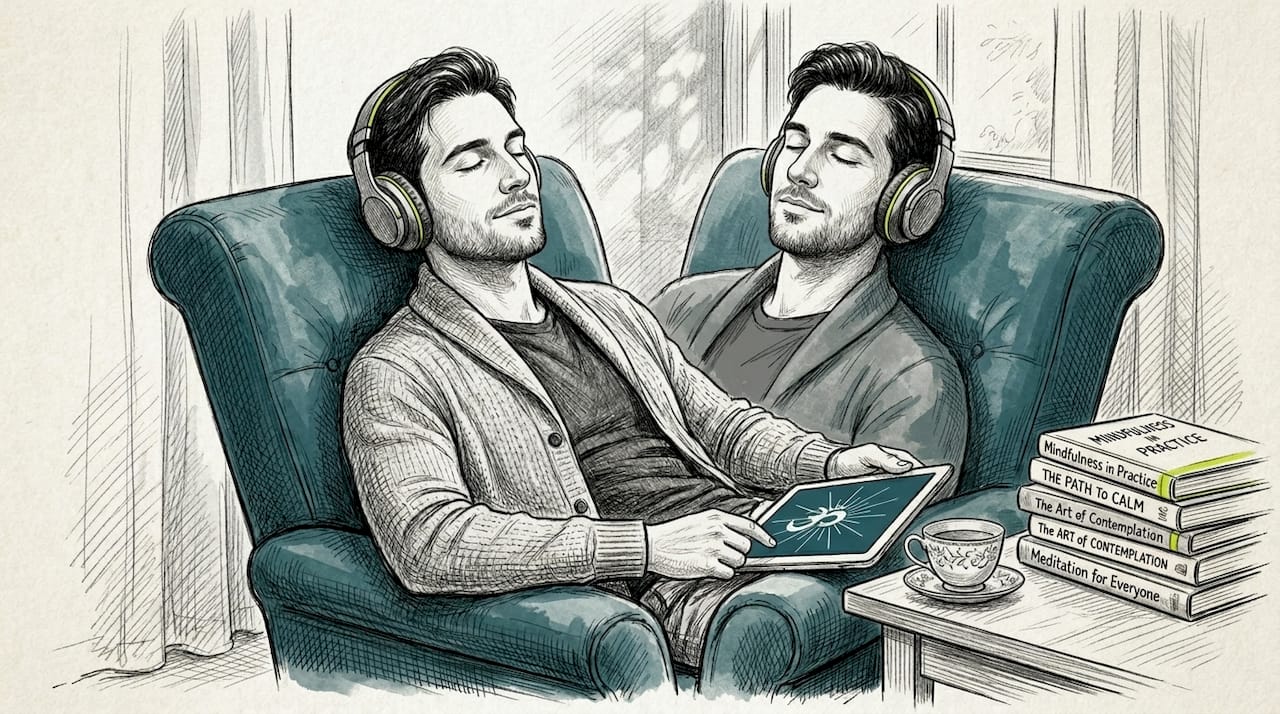
Unguided silent practice leads to mind-wandering in 90% of novices, which is a statistic that should make every beginner feel considerably less alone in their struggles. Guided audio solves this by giving the mind something purposeful to follow. Structure, pacing, verbal anchors: these all reduce the mental chaos that derails early practice.
Here’s what the evidence and practitioner experience tells us about making the most of audio-enhanced meditation:
- Start small and structured. Begin with 5 to 10 minute guided sessions. As your focus builds, you can progressively personalise your anchors, choosing breath, body sensation, or a mantra as your primary point of attention.
- Match music tempo to your breath. Orchestral music with a slow, deliberate tempo (roughly 60 beats per minute or under) naturally encourages a slower breath rate and activates the parasympathetic nervous system, the part of you that signals genuine calm.
- Combine body scan with mantra. Mantra repetition with guided audio syncs breath to rhythm, reducing overthinking when combined with body scan. This dual-anchor approach is particularly effective for people whose minds tend to race.
- Prioritise immersion. Binaural beats, theta frequencies, and 3D surround sound recordings don’t just sound beautiful. They create an auditory environment that makes it easier for the brain to shift into meditative states, which means less effort for you and faster results.
- Consistency over duration. A daily 10-minute guided session with quality music will outperform a monthly 60-minute silent sit almost every time.
Pro Tip: If you’re finding it hard to settle into a session, try selecting music that matches your current emotional state first, then gradually shift to something slower and more expansive. Think of it as leading your nervous system by the hand rather than trying to drag it somewhere it doesn’t want to go.
The science of music in meditation supports the idea that musical immersion doesn’t just enhance enjoyment. It actively improves adherence, meaning you’re more likely to keep practising long-term, which is ultimately where the real benefits live.
Tracking progress: scientific ways to know your meditation is working
Here’s a quiet frustration many people share: they’ve been meditating for a few weeks and genuinely can’t tell if anything is happening. Is the calm they feel just tiredness? Is the slightly improved patience just coincidence? Good news: there are actual, measurable indicators of progress.
Guided meditation sessions reduce breath rate to 4-9 breaths per minute, engaging the parasympathetic nervous system. That’s the physiological gold standard for genuine relaxation, and you can track it without any equipment at all, just a timer and a bit of honest counting.
Beyond breath rate, here are the validated indicators worth monitoring:
- Heart rate variability (HRV). A higher HRV during and after meditation indicates greater autonomic nervous system flexibility, essentially a measure of how well your body can adapt to stress. Many wearables now track this passively.
- Electrodermal activity (EDA). This measures skin conductance, which drops during genuine relaxation. More niche than HRV, but increasingly available through consumer wearables.
- Distraction logs. Keep a simple note after each session: how many times did your mind wander noticeably? Over weeks, a downward trend here is a meaningful signal.
- Emotional response patterns. Are you reacting less explosively to small daily frustrations? Are you recovering faster after stress? These behavioural shifts are real and trackable.
“Progress in meditation is rarely dramatic. It’s the accumulation of tiny shifts: a slightly longer pause before reacting, a slightly faster return to calm after difficulty, a slightly deeper breath when things go sideways.”
Meditation apps can closely match in-person benefits with adequate session length, though high drop-off rates without motivational rewards remain a challenge. This is precisely why pairing app-based or digital practice with genuinely enjoyable music matters so much.
Use a meditation progress checklist to keep yourself honest and motivated. Tracking isn’t obsessive, it’s just respectful of your own effort.
If progress genuinely stalls after four to six weeks, that’s a signal worth listening to. Consider switching your primary anchor, perhaps from breath to body sensation, or changing the technique entirely. Meditation isn’t a loyalty programme. There’s no prize for suffering through a method that isn’t working.
Comparing scientific meditation techniques: which fits your goals?
To help you decide which technique deserves your time and attention, here’s a side-by-side comparison across the key dimensions that matter most for guided audio and musical immersion sessions.
| Technique | Primary benefit | Guided audio fit | Music immersion | Ease for beginners | Ideal session length |
|---|---|---|---|---|---|
| Mindfulness meditation | Anxiety, emotional balance | Excellent | High | Moderate | 10-20 min |
| Transcendental Meditation | Stress reduction, relaxation | Moderate | Low to moderate | Low (requires training) | 20 min x2 daily |
| Loving-Kindness (Metta) | Emotional healing, compassion | Excellent | High | High | 10-15 min |
| Body scan meditation | Physical tension, body awareness | Excellent | Very high | High | 15-30 min |
| Mantra meditation | Focus, mental calm | High | High | Moderate | 10-20 min |
| Qigong meditation | Embodied calm, movement | Moderate | Moderate | Moderate | 20-30 min |
A few things worth noting from this comparison:
- Mindfulness-based interventions are supported by particularly strong structural evidence. Consistent practice increases grey matter density and cortical thickness in brain regions linked to attention and memory after 8-week programmes. That’s not metaphorical improvement, that’s measurable physical change in your brain.
- Body scan meditation is arguably the strongest candidate for pairing with immersive orchestral music, given its sequential, sensory-focused structure which mirrors the movement and texture of a full orchestral arrangement.
- Loving-Kindness works beautifully with emotionally warm, melodic compositions, particularly strings-heavy pieces that carry a quality of tenderness.
If you’re curious about the deeper differences between concentration-based and awareness-based approaches, it’s worth taking time to compare concentration vs mindfulness meditation before committing to a daily practice.
Pro Tip: Don’t feel you must pick just one technique and stick with it rigidly forever. Pairing a body scan with a mantra and immersive orchestral music, for instance, gives you physical relaxation, mental focus, and sensory anchoring simultaneously. The meditation typology study supports combining approaches for richer, more varied results.
Why starting with guided audio and music immersion transforms meditation practice
Here’s my honest take, and it might ruffle a few feathers in certain serious meditation circles: the single biggest reason people quit meditation is not laziness. It’s boredom combined with frustration, which is a particularly demoralising combination.
Silent, unstructured meditation asks an enormous amount from a beginner’s brain. You’re essentially requesting that an untrained mind, one that has spent its entire existence being stimulated, rewarded, and distracted, suddenly sit quietly and focus on absolutely nothing. And then you’re surprised when it rebels spectacularly.
Long-term focused attention meditation needs more than 10,000 hours for deep structural brain changes. Most people quit before they hit 100 hours, and mind-wandering is the primary culprit. This is a genuine problem, not a character failing.
Guided audio with immersive orchestral music addresses this at its root. The music acts as a sensory anchor that doesn’t compete with the meditation, it reinforces it. The guided voice provides scaffolding so the mind always has something purposeful to return to when it drifts. Together, these elements engage both the emotional processing networks and the executive control systems of the brain simultaneously, which is a rather elegant neurological efficiency.
From direct experience working with music produced specifically for meditation, I can tell you that pairing a body scan with a richly layered orchestral composition, the kind recorded with live musicians in an acoustically alive space, relaxes both mind and body at a speed that frankly surprises most first-time listeners. It’s not the same as background music. It’s a designed sonic environment.
Composers like Robert Emery and producers like Moritz Schneider understand this distinction intuitively. Their work doesn’t just sound beautiful; it’s architecturally constructed to support meditative states. If you want to understand more about why this matters scientifically, the science of meditation music explains the underlying mechanisms with satisfying clarity.
The bottom line? Stop treating the absence of music as more virtuous. Start where you’ll actually succeed.
Explore orchestral meditation music designed to deepen your practice
If this article has nudged you towards trying or deepening a meditation practice, the next natural step is finding audio that genuinely supports it rather than merely tolerating it. That’s exactly what we’ve built at Orchestral Meditations.
Our orchestral meditation music collection features compositions by Robert Emery, produced by Moritz Schneider, and recorded with live musicians, including sessions at Abbey Road Studios. These aren’t synthesised loops. They’re living, breathing orchestral soundscapes built specifically to support body scan, mantra, mindfulness, and Loving-Kindness sessions. You can explore the best meditation music options to find tracks matched to your specific goals, or discover why orchestral music outperforms digital alternatives for genuine meditation depth. Your practice deserves something this good.
Frequently asked questions
What are the main types of scientific meditation techniques?
Scientific meditation techniques generally fall into five clusters: physical, emotional, psychological, spiritual, and mixed, and can be practised guided or unguided depending on your preference and experience level. The five typology clusters framework helps you match a technique to your actual wellness goal rather than choosing one arbitrarily.
How does guided meditation audio improve practice?
Guided meditation audio reduces mind-wandering for beginners, provides structure, and can synchronise breath with music rhythms to deepen relaxation and focus. Unguided silent practice leads to mind-wandering in 90% of novices, making audio guidance a genuinely practical tool rather than a shortcut.
Can meditation change brain structure?
Yes, and the evidence is quite striking. Mindfulness-based interventions increase grey matter density and cortical thickness in brain regions related to attention and memory after consistent practice over several weeks, typically within 8-week programmes.
How can I tell if my meditation is effective?
Track breath rate during sessions, aiming for 4-9 breaths per minute as a sign the parasympathetic system is engaged. Also monitor heart rate variability, log how often your mind wanders, and notice gradual positive shifts in daily stress responses and emotional reactivity.