
Here is something worth sitting with for a moment. Live string music has been shown to reduce stress by 2.18 points on a standard ten-point scale in paediatric settings, with a Cohen’s d of 1.0, which statisticians will tell you is a very large effect indeed. And the most intriguing part? You do not need to be a devoted music fan for it to work on you. The nervous system, it turns out, is not particularly fussed about your personal taste in entertainment. It just responds. This guide walks you through what therapeutic music actually is, how it works at a brain and body level, why orchestral soundscapes hold a uniquely powerful position in the field, and how you can start using these insights to meaningfully support your own wellbeing.
Key Takeaways
| Point | Details |
|---|---|
| Definition clarified | Therapeutic music uses specific elements to affect health and emotional wellbeing, not just for relaxation. |
| Approaches vary | Both active and receptive methods are valid, but immersive orchestral music excels in passive meditation for stress relief. |
| Science-backed effects | Empirical evidence shows orchestral soundscapes reduce stress, enhance cognition, and support wellness. |
| Personalisation matters | Individual preferences and cultural factors strongly influence therapeutic efficacy, so personalised playlists work best. |
| Orchestral advantage | Immersive orchestral soundscapes provide emotional depth and self-transcendence through non-verbal healing. |
What defines therapeutic music?
Let us get one thing straight from the outset. Therapeutic music is not simply the ambient flute-and-rain-sounds playlist your dentist pipes through the waiting room speakers (though no offence to dentists). It is a purposeful, evidence-informed use of music to support mental, emotional, and physical health outcomes. That distinction matters enormously, because it shifts the conversation from “does this sound nice?” to “is this producing a measurable change in how I feel, think, or function?”
The formal definition, if you like your things tidy, is the clinical and non-clinical use of music to address human needs across therapeutic, educational, and wellbeing contexts. It operates through a constellation of sonic elements, including rhythm, melody, harmony, tempo, and timbre, each of which exerts a distinct influence on your physiology and emotional state. Music therapy works through mechanisms like brainwave entrainment, stress reduction via parasympathetic activation, and emotional regulation through limbic system engagement. That last part is worth paying attention to: the limbic system is your brain’s emotional processing centre, and music has a surprisingly direct line into it.
Here is where people often get it wrong. A great many folk assume that therapeutic music is essentially a synonym for “relaxing music.” It is not. While relaxation is certainly one potential outcome, therapeutic music can also energise, uplift, help process grief, sharpen cognition, or even assist in physical rehabilitation. The goal defines the music, not the other way around.
Common misconceptions worth clearing up:
- “I need to enjoy it for it to work.” Not necessarily. Neurological responses to rhythm and pitch operate below conscious preference.
- “It is only for people with serious mental health conditions.” Therapeutic music has applications across a vast spectrum, from everyday stress management to clinical settings.
- “Slow and quiet equals therapeutic.” Tempo and dynamic range are tools, not rules. Some therapeutic music is quite brisk and bold.
- “It is the same as music therapy.” Music therapy is a clinical profession requiring qualified practitioners. Therapeutic music is a broader category that includes self-directed practice.
Now, what actually happens in your brain when music enters the picture? Brainwave entrainment is the process by which neural oscillations begin to synchronise with external auditory rhythms. Play a steady 40Hz pulse beneath a lush orchestral swell, and your brain starts to follow. This is not metaphor; it is measurable electroencephalography data. Beyond that, the parasympathetic nervous system, which governs your “rest and digest” mode, responds to certain musical qualities by lowering heart rate and cortisol. The relaxation music science behind this is genuinely fascinating and worth exploring if you want to go deeper.
“Therapeutic music is not background noise wearing a lab coat. It is a carefully structured acoustic event designed to produce specific neurological, physiological, and emotional responses in the listener.”
Understanding the orchestral music calming mechanisms specifically adds another layer of richness here. Orchestral compositions work with an unusually wide timbral palette, meaning the variety of sound colours produced by strings, brass, woodwind, and percussion creates a multi-dimensional acoustic environment that engages the brain in ways a simple sine-wave tone simply cannot match.

Therapeutic music methodologies: active vs. receptive
With those foundations set, we can explore how therapeutic music actually gets used in practice. And this, I will admit, is where things get genuinely interesting from a “what do I actually do with this information?” perspective.
There are two primary approaches, and understanding the distinction will help you choose your path with considerably more confidence.
| Approach | What it involves | Best suited to | Orchestral relevance |
|---|---|---|---|
| Active | Playing, singing, guided movement, improvisation | Clinical settings, group therapy, motor rehabilitation | Moderate, often used in conducted group sessions |
| Receptive | Intentional listening to music without active participation | Meditation, relaxation, emotional processing, cognitive support | Very high, particularly immersive orchestral soundscapes |
Methodologies include receptive and active, with orchestral music providing vast soundscapes that induce awe, dopamine release, and self-transcendence in holistic practices. The receptive pathway is where orchestral music genuinely excels, and here is why. When you sit with a richly layered orchestral piece, something rather extraordinary tends to happen. The sheer scale of the sound, the way it fills sonic space from bass to treble, from quiet breath to full-throated tutti, creates what researchers sometimes call “awe.” And awe, as it turns out, has measurable psychological benefits including a reduction in self-focused rumination and a broadening of perspective.
Dopamine release is another compelling piece of the puzzle. Orchestral music, with its structural arc of tension and release, is particularly adept at triggering what musicians call “chills” or frisson, those involuntary shivers that accompany a particularly beautiful musical moment. This is your brain’s reward system responding to the anticipation and resolution built into the composition. It is, in the most literal sense, pleasurable in a neurochemical way.
Here is a practical starting point for integrating receptive therapeutic listening into your life:
- Choose your environment. Find a quiet space where you will not be interrupted. Headphones are genuinely worth the investment here, particularly for relaxation soundscapes designed with binaural or 3D audio in mind.
- Set an intention. Before pressing play, take a breath and decide what you are bringing to this session. Are you processing stress? Seeking clarity? Inviting rest? The intention shapes the experience.
- Choose appropriate material. Not all orchestral music serves the same purpose. A thundering Shostakovich symphony and a gently bowed string meditation are both orchestral, but they will take you to very different places.
- Engage without analysing. This one trips up a lot of people, particularly those with a musical background. Try to listen with the music rather than at it. Notice how it moves through your body rather than cataloguing its technical features.
- Document your responses. Even a brief note afterwards (“felt heavy in chest during strings, lightened near the end”) builds an invaluable personal map of how music affects you.
The orchestra meditation guide offers excellent practical frameworks for this kind of intentional listening practice.
Pro Tip: Start with sessions of fifteen to twenty minutes rather than launching straight into an hour-long orchestral work. Shorter, consistent practice tends to build the neurological familiarity that makes subsequent sessions progressively more effective.
The science and effects of orchestral and immersive soundscapes
Understanding the methodology leads us naturally to the evidence. And the evidence, I am delighted to report, is increasingly robust and genuinely exciting.
Let us look at some of the data points that stand out:
- Paediatric stress reduction: Live string music reduced stress by 2.18 points on a 0-10 VAS scale (p<0.001, Cohen’s d=1.0), a clinically significant result by any measure.
- Parkinson’s disease: Orchestral participation improved depressive symptoms by 5.5 points on the Beck Depression Inventory (p=0.011).
- Cognitive function in elderly individuals: Receptive listening improved cognition with a standardised mean difference of 0.40, alongside measurable quality of life improvements.
These are not trivial findings. A Cohen’s d of 1.0 in the stress reduction study means the effect size is large enough to be clinically meaningful, not just statistically significant. That distinction matters enormously when we are talking about real people in real settings.
| Population | Intervention | Key outcome | Statistical significance |
|---|---|---|---|
| Paediatric patients | Live string music (receptive) | Stress reduced by 2.18 points (VAS) | p<0.001, Cohen’s d=1.0 |
| Parkinson’s patients | Orchestral participation (active) | Beck Depression Inventory improved by 5.5 points | p=0.011 |
| Elderly individuals | Receptive orchestral listening | Cognition improved (SMD 0.40), QoL enhanced | Statistically significant |
What about the mechanisms driving these outcomes? The science behind sound therapy points to several interacting pathways. Cortisol reduction is perhaps the most studied, with music consistently shown to lower circulating cortisol levels, particularly during stressful procedures or in high-anxiety environments. Mood enhancement follows partly from this cortisol reduction and partly from dopamine and serotonin dynamics triggered by pleasurable musical experience.
Brainwave entrainment deserves its own paragraph because it is genuinely remarkable. Immersive soundscapes embedded with specific frequencies (gamma at approximately 40Hz, theta at 4-8Hz) can guide neural oscillations into states associated with deep focus, creative insight, or profound rest, depending on the target frequency. This is the scientific meditation music principle at its most applied. When an orchestral recording is layered with precisely calibrated binaural beats, you are getting both the emotional richness of live musicians and the neurological precision of frequency therapy simultaneously.
It is worth noting that the benefits extend beyond the purely psychological. There is growing evidence that music-based interventions influence immune function, pain perception, and even inflammatory markers. For those using music within a broader holistic wellness practice, this physiological reach makes it a surprisingly potent tool.
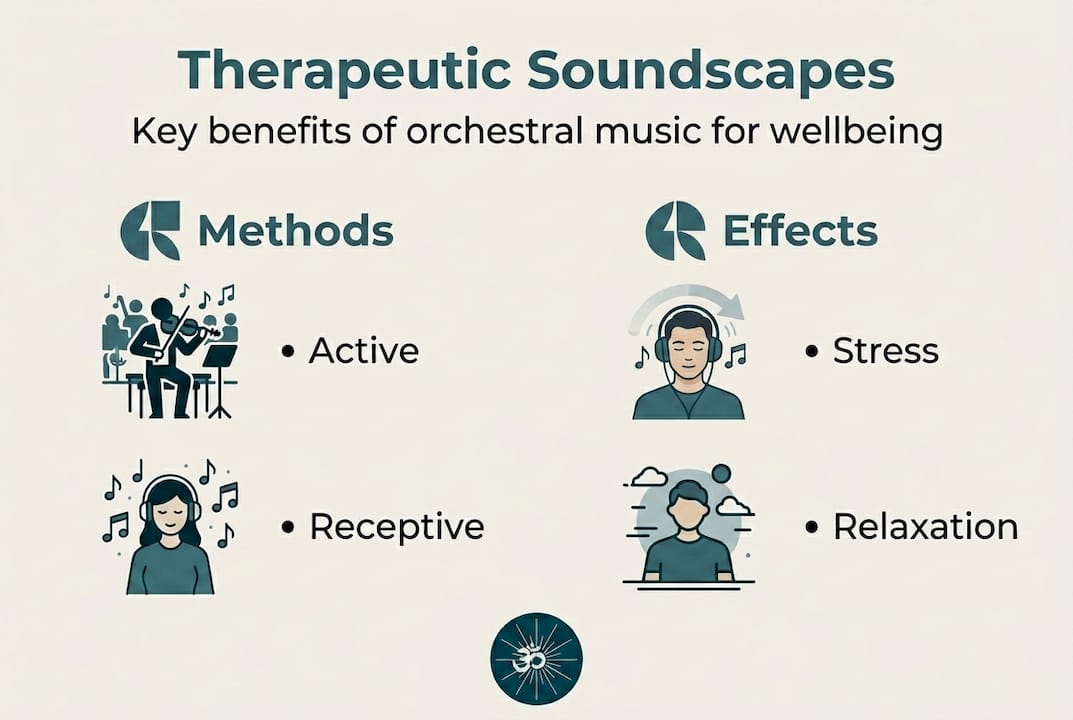
The application of immersive orchestral soundscapes in deep relaxation practice is particularly well-suited to those who find traditional silent meditation difficult. The music provides an anchor for attention, something the wandering mind can return to without the sense of failure that often accompanies an attempt to sit in complete silence.
Nuances, edge cases, and practical guidance
While the science is genuinely promising, applying it in real life requires a bit more nuance than “press play and feel better.” This is the part of the conversation that most guides tend to skip over, which strikes me as rather a shame, because the nuances are where it gets truly useful.
The most important thing to acknowledge is that Neurological Music Therapy works even for non-music lovers via the brain’s response to rhythm, but individual preferences still affect how that benefit lands. Two people can listen to the same piece and have radically different experiences, not because one is doing it wrong, but because their nervous systems, histories, and associations with sound are different.
Key nuances to hold in mind:
- Music can evoke distress as well as comfort. A piece associated with grief or trauma does not become therapeutic simply because it is well-composed. Cultural context matters enormously here; music carries social and emotional meaning that varies widely across backgrounds.
- Cultural sensitivity is essential. What feels soothing within one musical tradition may feel alien or even unsettling within another. Good therapeutic practice acknowledges this rather than assuming Western classical music is the universal default.
- Volume and acoustic environment matter. Music played too loudly, or in an acoustically harsh space, can increase arousal rather than reduce it. The environment is part of the intervention.
- Frequency of exposure builds cumulative benefit. A single session of therapeutic listening has value, but consistent practice over weeks tends to produce more durable neurological and emotional changes.
- Some individuals may need guided support. Those processing significant trauma or managing serious mental health conditions may benefit from working with a qualified music therapist rather than self-directing their practice.
There is also the matter of what researchers call the therapeutic function of music matrix, a framework for matching musical function to therapeutic context. Not every piece of beautiful music serves the same function, and being thoughtful about the match between your current need and the character of the music dramatically improves outcomes. Sound therapy evidence from clinical practice supports this view.
For practical guidance, curated meditation playlists take much of the guesswork out of this matching process. If you are also working with sleep support, relaxation music for sleep is a specific sub-category worth exploring, since the optimal musical qualities for facilitating sleep onset differ from those best suited to active meditation.
Pro Tip: Keep a simple listening journal for three weeks. Note the piece, the time of day, your emotional state before and after, and any physical sensations that arose during the session. Patterns emerge quickly, and they are genuinely illuminating.
Why orchestral immersive soundscapes redefine therapeutic music
Here is my honest perspective, shaped by years spent with this music and with the research that surrounds it: most guides to therapeutic music are playing it safe. They stay in the comfortable territory of generic relaxation, soft piano, and ambient drones. And while none of that is without value, it represents a rather timid use of what music can actually do for human consciousness.
Orchestral immersive soundscapes occupy a different category altogether. When live musicians, real human beings with breath and bow and the accumulated weight of musical tradition, perform in a space like Abbey Road and their sound is captured in three dimensions, something happens that a synthesiser simply cannot replicate. The micro-variations, the harmonic complexity, the emotional intelligence encoded in a principal cellist’s phrasing, these qualities carry information that the human nervous system receives and processes at a level far below conscious thought.
For holistic wellness, orchestral immersive soundscapes excel in meditation and sound healing by entraining brainwaves at gamma (40Hz), reducing cortisol, and enhancing emotional depth without requiring active participation. That last point is worth emphasising. You do not need musical training, a particular cultural background, or even a strong affinity for classical music. You simply need to listen with some degree of intention.
What I find particularly underutilised in the wellness world is the capacity of receptive orchestral listening to facilitate genuine self-transcendence. The sensation of being moved beyond the ordinary boundaries of self-concern by a piece of great music is not merely poetic language. It is a documented psychological state with measurable neurological correlates. And the orchestral meditation benefits of this state, including reduced anxiety, enhanced compassion, and broader perspective, are precisely what so many wellness seekers are genuinely searching for, often without finding it in more conventional approaches.
The field has, I think, undersold orchestral music in the therapeutic context. That is changing, and I am glad of it.
Explore orchestral meditation music for holistic sound healing
If this exploration has sparked curiosity about integrating immersive orchestral soundscapes into your own practice, you are in exactly the right place.
Orchestral Meditations offers a meditation music collection of professionally recorded works captured at Abbey Road Studios with the National Philharmonic, featuring binaural beats, theta frequencies, and 3D surround sound. Each recording is crafted with specific therapeutic intentions in mind, whether you are seeking deep rest, emotional release, cognitive clarity, or spiritual depth. Explore what works for you, start with something that feels aligned with your current need, and let the science do its work. Finding the best meditation music for your personal practice is far less daunting when the curation has already been done with both artistry and evidence in mind.
Frequently asked questions
How does therapeutic music work for people who are not music lovers?
Neurological music therapy leverages the brain’s innate response to rhythm and auditory patterns, producing measurable physiological effects regardless of personal musical preference. Your nervous system responds to sound independently of whether your conscious mind considers itself a fan.
Is orchestral music the most effective for meditation?
Clinical evidence suggests that immersive orchestral soundscapes can significantly reduce cortisol, entrain brainwaves, and deepen emotional engagement during meditation, though individual response will always vary. For many people, the timbral richness and dynamic range of orchestral music provides a uniquely powerful meditative anchor.
What are the risks or drawbacks of using therapeutic music?
Music can provoke distress or discomfort depending on personal history or cultural associations, and individual preferences affect efficacy in ways that make careful selection important. It is always worth listening with awareness rather than assumption.
Are there proven benefits of therapeutic music for elderly wellness?
Studies show that receptive listening improved cognition with a standardised mean difference of 0.40 and produced measurable quality of life improvements in elderly individuals. These are clinically meaningful outcomes from a relatively accessible intervention.