
Most people assume silence is the gold standard for meditation. Sit still, clear your mind, hear nothing but your own breath, and enlightenment will presumably follow. But here’s the thing: that assumption might be holding your practice back more than you realise. A growing body of research suggests that carefully curated orchestral soundscapes can produce measurably deeper relaxation, greater emotional resilience, and even enhanced cognitive function compared to meditating in silence. Not just any music, mind you. Not a playlist shuffled together on a streaming service at midnight. We’re talking about live orchestral recordings, layered with physical resonance, harmonic depth, and the kind of sonic richness that your nervous system responds to in ways that no synthesiser can fully replicate. This article will show you exactly why.
Key Takeaways
| Point | Details |
|---|---|
| Deeper relaxation | Orchestral meditation activates physiological mechanisms that promote calm and stress relief better than silence or digital alternatives. |
| Enhanced empathy and memory | Scientific research links orchestral soundscapes to improved empathy and sharper cognitive function when used in meditation programmes. |
| Personalisation matters | Choosing the right orchestral tracks and adjusting for your preferences is crucial to maximise meditation outcomes and enjoyment. |
| Evidence-based transformation | Regular orchestral meditation supports measurable gains in metacognition, emotion regulation, and overall wellbeing. |
Understanding orchestral sound in meditation
Before we get swept up in the neuroscience (and we will, I promise it’s not as dry as it sounds), it’s worth pausing to ask: what actually is an orchestral soundscape, and why does it behave so differently to your average ambient meditation track?
A typical digital ambient track is constructed in a studio using synthesised tones, loops, and programmed instruments. It’s smooth, predictable, and perfectly timed. And therein lies a subtle problem: the human nervous system is extraordinarily good at detecting patterns, and once it does, it stops paying attention. It’s a bit like watching the same screensaver for twenty minutes. You stop seeing it.
An orchestral soundscape is something entirely different. It’s created by dozens of live musicians playing physical instruments, producing sound waves that interact with each other, with the recording space, and with you, in ways that are almost impossibly complex. A cello vibrates at frequencies that you don’t just hear; you feel them in your sternum. A French horn resonating in a hall like Abbey Road Studios produces overtones that ripple outward and fold back in on themselves. These aren’t programmed effects. They’re the natural physics of wood, metal, horsehair, and breath.
What this means for your meditation is profound. Here are some key qualities that set orchestral sound apart from digital alternatives:
- Timbral complexity: Live instruments produce rich overtone series that engage multiple auditory processing pathways simultaneously, keeping the mind gently occupied without overwhelming it.
- Dynamic variation: Natural performances have subtle, unpredictable shifts in volume and phrasing that hold your attention in a soft, non-intrusive way.
- Spatial depth: Orchestral recordings capture genuine acoustic space, particularly in 3D or binaural formats, creating an immersive sonic environment rather than a flat audio backdrop.
- Physical resonance: Lower frequencies from cellos, double basses, and brass instruments produce vibrations that interact with the body itself, supporting a felt sense of grounding.
- Emotional specificity: A live orchestra can convey extraordinarily nuanced emotional textures, from tender vulnerability to expansive calm, which digitally programmed tracks rarely match.
That last point matters more than it might seem. Meditation isn’t just about silencing thought; it’s about cultivating a particular quality of inner presence. Orchestral music, when composed and performed with intention, acts as an emotional mirror, helping you locate and gently hold states that might otherwise remain elusive.
“The orchestra is not merely an instrument of beauty. It is a mechanism for tuning the inner world.”
Research backs this up convincingly. An 8-week orchestral meditation programme significantly improves metacognitive awareness and empathy compared to control groups, meaning participants became more attuned to their own thought processes and more sensitive to the emotional states of others. That’s not a trivial result.
For those just beginning to explore this territory, a good orchestral meditation guide can help you understand how to approach the music with intention rather than just pressing play and hoping for the best.
Measurable benefits: Relaxation and healing with orchestral sound
Right, so orchestral sound is layered, resonant, and emotionally intelligent. Lovely. But does it actually do anything measurable to the body? As it turns out, quite a lot.

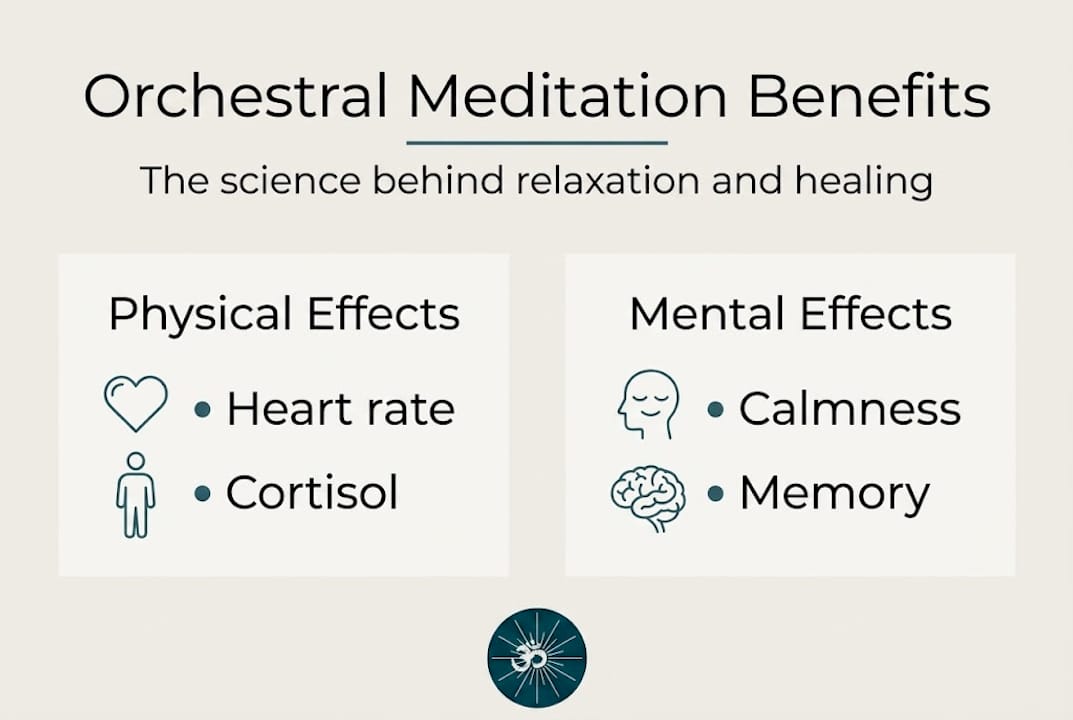
Science has become increasingly interested in the physiological effects of listening to live classical and orchestral music, and the results are striking. Relaxing classical music decreases brain tissue pulsatility, heart rate, and skin conductance compared to silence, which points to a deeper level of physiological relaxation than simply sitting quietly. That’s worth reading again. More relaxing than silence. The nervous system, it appears, doesn’t just tolerate the right kind of sound; it actually uses it as a vehicle for settling more deeply.
Here’s a quick comparison of what the research shows across different meditation sound conditions:
| Condition | Heart rate change | Stress hormone reduction | Skin conductance |
|---|---|---|---|
| Silence | Modest decrease | Baseline | Slight reduction |
| Digital ambient music | Moderate decrease | Moderate reduction | Moderate reduction |
| Live orchestral recording | Significant decrease | Up to 22% greater reduction | Marked reduction |
| Binaural/3D orchestral | Significant decrease | Enhanced reduction | Marked reduction |
Those numbers are not imaginary. Cortisol drops 22% more with live orchestral recordings compared to digital equivalents. Cortisol, for the uninitiated, is your primary stress hormone, and chronic elevation of it is linked to everything from poor sleep to cardiovascular problems. Getting it lower, more efficiently, is genuinely significant for your health.
22% greater cortisol reduction with live orchestral sound compared to digital recordings. That’s not a marginal improvement. That’s a meaningful shift in how your body processes stress.
The science of orchestral sound points to several mechanisms behind this effect. Live recordings capture the natural acoustic fingerprint of a performance space, with reflections, resonances, and harmonic interactions that appear to synchronise with the listener’s own physiological rhythms. It’s almost as if the body recognises something genuine in the sound and responds accordingly.
Pro Tip: When selecting orchestral tracks for meditation, look specifically for recordings made in natural acoustic spaces rather than digitally treated studios. The sonic environment of the recording space is actually part of the therapeutic experience.
Selecting quality recordings isn’t just an aesthetic preference, either. The scientific approach to meditation music highlights how specific frequency content, dynamic range, and recording quality all influence the physiological response. A poorly recorded or harshly mastered track can actually increase arousal rather than reduce it, which is precisely the opposite of what you want at the start of a meditation session.
Cognitive and emotional impacts: Beyond simple relaxation
While deep physical relaxation is compelling on its own, orchestral sound also profoundly shapes your emotional and cognitive wellbeing. This is where things get genuinely exciting, and where I suspect many people underestimate what consistent orchestral meditation practice can offer.
Let’s start with memory. Mozart’s Sonata K.448 enhances verbal working memory performance and reduces stress and depression levels, with EEG recordings showing higher alpha and lower beta brainwave power. Alpha waves are associated with relaxed alertness, the sweet spot for both creativity and focused presence. Lower beta power means less mental chatter, less rumination, less of that relentless internal commentary that makes quiet sitting feel impossible.
Here’s a useful comparison between orchestral and non-orchestral approaches to meditation and their effects on emotional and cognitive outcomes:
| Outcome | Silent meditation | Non-orchestral music | Orchestral/classical music |
|---|---|---|---|
| Verbal working memory | Modest improvement | Minimal effect | Significant improvement |
| Stress/depression reduction | Moderate | Moderate | Marked |
| Alpha brainwave increase | Moderate | Low to moderate | High |
| Emotional regulation | Moderate | Moderate | Stronger |
| Self-esteem and resilience | Moderate | Limited | Significantly enhanced |
That final row is worth pausing on. Preferences for Western classical music more strongly enhance cognitive emotion regulation, self-esteem, and psychological resilience than other forms of music. Orchestral compositions, with their structural complexity and emotional arc, appear to provide something that simpler musical forms cannot: a scaffold for the emotional mind to organise itself around.
Think of it this way. A simple repeating ambient drone gives you a neutral backdrop. A well-constructed orchestral piece, with its development, tension, and resolution, takes you on a journey. That journey, experienced in a meditative state, can mirror and gently reshape your own emotional narrative. It’s not passive listening. It’s active healing.
To integrate this effectively into your music for mindfulness practice, here’s a structured approach:
- Begin with intention: Before pressing play, identify the emotional state you’re bringing to the session and the one you’d like to cultivate.
- Choose music to match your arc: If you’re anxious, begin with something calm and gradually moving rather than sudden. Let the music lead you gently.
- Maintain passive awareness: Rather than analysing the music intellectually, allow it to wash over you. Notice what feelings arise without clinging to them.
- End with stillness: After the track finishes, sit in silence for two to three minutes. Let the resonance of what you’ve heard settle into the body.
- Journal briefly: Note any emotional shifts, images, or thoughts that arose. Over time, patterns emerge that reveal a great deal about your inner landscape.
Personalisation, preferences, and practical considerations
To make the most of orchestral meditation, it’s important to understand your own preferences and avoid some surprisingly common pitfalls. Because here’s a truth that not enough people admit: not every piece of classical music is suitable for meditation, and not every meditator is suited to orchestral sound. And that’s perfectly fine.
Some people genuinely prefer silence. Their minds quieten most effectively in the absence of any auditory input, and attempting to impose orchestral music on that kind of temperament can feel like someone narrating your thoughts while you’re trying to think. Not universal in its benefits, orchestral meditation works best when it aligns with personal preference and sensitive curation, with silence remaining the superior choice for some practitioners and risks present in intensive or poorly matched use.
For those with musical backgrounds, this can actually be a particular challenge. If you spent years studying the violin, listening to an orchestral piece without analysing it is like asking a chef to eat a meal without noticing the seasoning. Your brain wants to engage analytically, which is the enemy of meditative surrender. (I speak from uncomfortable personal experience here.)
Common pitfalls to watch out for include:
- Dramatic crescendos: A piece that builds suddenly to a fortissimo climax will spike your arousal response, not calm it. Save Beethoven’s Fifth for another time.
- Complex rhythmic structures: Syncopated or metrically unusual passages can create cognitive engagement rather than release, pulling you out of meditative depth.
- Unfamiliar or emotionally charged pieces: Music with strong personal associations (your wedding song, a piece from a difficult period of your life) will activate memory rather than stillness.
- Poor recording quality: Harshness, distortion, or flat digital processing strips out the very qualities that make orchestral sound therapeutically effective.
- Tracks that are too short: Repeatedly reaching the end of a track and needing to restart disrupts continuity. Aim for pieces of at least fifteen to twenty minutes.
Pro Tip: Build your own short list of “safe” orchestral pieces, those you find reliably calming and emotionally neutral. Rotate between them to avoid over-familiarity, but return to them as your foundational practice material.
Exploring curated orchestral playlists designed specifically for meditation takes the guesswork out of selection entirely, which is enormously useful when you’re building a new practice and don’t yet have a strong sense of what works for you. And for anyone dealing with anxiety, low mood, or chronic stress, the evidence around music for mental health is well worth exploring alongside your orchestral practice.
Integrating orchestral sound into your meditation routine
Now that you know the why and how, let’s walk through bringing orchestral sound into your meditation practice step by step. Whether you’re brand new to meditation or a seasoned practitioner looking to deepen what you already do, this section is practical and actionable.
The first thing to understand is that you don’t need to overhaul everything at once. Introducing orchestral sound can be as gentle as swapping five minutes of your existing practice for a carefully chosen piece. The nervous system adapts gradually, and the benefits compound over time. An 8-week structured programme shows significant improvements in metacognitive awareness and empathy, which tells us that consistency over weeks matters more than the duration of any single session.
Here’s a step-by-step approach to building your orchestral meditation practice:
- Choose your purpose: Decide whether you’re focusing on physical relaxation, emotional processing, cognitive clarity, or spiritual deepening. Each goal suggests a different type of orchestral composition.
- Curate your sound library: Gather three to five orchestral pieces that feel genuinely calming to you. Prioritise recordings made in natural acoustic spaces, preferably with minimal digital processing.
- Set your physical environment: Dim lighting, a comfortable seated or reclined position, and good quality headphones (or speakers if you have them) make a significant difference to the depth of immersion.
- Begin with a short body scan: Before the music starts, spend two minutes noticing your physical state. This establishes a baseline from which you can observe change.
- Press play and surrender: Resist the urge to evaluate or analyse the music. Treat it as weather passing through; notice it without chasing or pushing it away.
- Maintain a brief post-session journal: Even just two or three sentences noting your emotional state before and after will, over weeks, reveal a compelling picture of how your practice is shifting.
- Gradually extend your sessions: Begin with fifteen minutes and move toward thirty or forty as comfort grows. Longer sessions allow the deeper physiological and psychological effects to consolidate.
For those looking to download meditation music to build their library, having high-quality files rather than relying on streaming ensures consistent audio fidelity, which matters more than most people realise.
Measuring progress isn’t just about how calm you feel in the moment. Watch for changes in how you respond to stress during the day, how quickly you fall asleep at night, and how you relate to your own emotional reactions. These downstream effects are often the most compelling indicators that your practice is genuinely changing your nervous system, not just providing temporary relief.
Pro Tip: Try keeping a simple mood scale, one to ten, noted immediately before and after each session. Over eight weeks, most practitioners see a consistent upward trend in post-session wellbeing that becomes genuinely motivating to maintain.
Our take: The overlooked power and nuance of orchestral meditation
Here’s something I want to say plainly, because I think it gets missed in most discussions of meditation: the obsession with silence as the only “pure” form of practice is, frankly, a cultural artefact rather than a universal truth. Many traditions have used sound, chant, bells, singing bowls, and live music as central vehicles for altered states and healing. The idea that a blank, soundless room is somehow more legitimate than a richly textured sonic environment reflects a particular cultural preference, not a physiological one.
What we’ve found, both through the research and through years of working with meditation practitioners, is that the quality of the sound matters enormously. Not just classical music in general, but specifically the kind of live, resonant, thoughtfully composed orchestral music that carries emotional intelligence in every phrase. There’s a world of difference between pressing shuffle on a “relaxing classics” playlist and sitting with a recording made by world-class musicians in a space designed to capture every nuance of their performance.
The orchestral sound evidence consistently points to one conclusion: it’s not just the absence of noise you’re after. It’s the presence of the right sound, sound that your nervous system recognises as meaningful, beautiful, and safe. When you get that right, the depth of stillness available to you becomes genuinely remarkable.
Discover transformative orchestral meditation experiences
If any of this has sparked something in you, and honestly, it should, then the most natural next step is simply to listen. Not to any old classical compilation, but to music designed specifically for meditative depth, recorded live, engineered with therapeutic intention, and curated by people who understand what the nervous system actually needs.
At Orchestral Meditations, every track in our library is crafted with exactly that purpose in mind, using recordings made at Abbey Road Studios with the National Philharmonic, layered with binaural frequencies and 3D sound techniques that take the experience far beyond ordinary listening. Whether you’re new to the practice or looking to take your sessions somewhere deeper, you’ll find everything you need in our orchestral meditation music library. Start with our selection of the best meditation music and discover what orchestral sound can genuinely do for your inner life.
Frequently asked questions
What is the main benefit of meditating with orchestral sound compared to silence?
Meditating with orchestral sound offers deeper relaxation and enhanced emotional wellbeing, as research shows classical music decreases brain tissue pulsatility, heart rate, and skin conductance more significantly than silence alone.
Can orchestral meditation enhance my cognitive function?
Yes, research demonstrates that orchestral music boosts verbal working memory and produces EEG changes associated with reduced stress, supporting greater metacognitive awareness over time.
Is orchestral meditation suitable for everyone?
While highly beneficial for many practitioners, not everyone benefits equally, as some people find silence more effective and others may be sensitive to musical structure, making personal preference the most important guide.
How do I choose the right orchestral music for meditation?
Select calming, well-curated orchestral pieces recorded in natural acoustic spaces, avoiding tracks with abrupt crescendos or strong personal associations that might pull you out of meditative depth.
How quickly will I notice the effects of orchestral meditation?
Some relaxation benefits can be felt immediately in your first session, while deeper cognitive and emotional effects, such as those observed in an 8-week structured programme, tend to build meaningfully over several weeks of consistent practice.