TL;DR:
Deep relaxation requires a quiet environment, slow orchestral music, and a guided, structured practice.
Techniques like body scans, PMR, and Yoga Nidra, combined with calming music, deepen restorative effects.
Regular practice and appropriate music selection enhance stress reduction, sleep quality, and overall calm.
Most of us have had that experience: you lie down, close your eyes, tell yourself to relax, and your brain immediately starts drafting a shopping list. True deep relaxation, the kind that genuinely restores you, is not something that happens by accident. It requires a structured approach, the right sonic environment, and a little guidance. In this guide, we’ll walk through mindfulness body scans, progressive muscle relaxation (PMR), Yoga Nidra, and the surprisingly powerful role of orchestral music in pulling your nervous system away from the edge and into genuine rest.
Key Takeaways
| Point | Details |
|---|---|
| Choose structured techniques | Methods like PMR and Yoga Nidra produce more profound relaxation than generic meditation. |
| Select the right music | Orchestral and ambient soundscapes help deepen your relaxation—avoid high-arousal genres like rock. |
| Consistency drives results | Regular practice and routine timing are critical for measurable improvements in calm and sleep quality. |
| Review and refine | Track your outcomes and adjust your practice to continually deepen relaxation benefits. |
Essential tools and prerequisites for deep relaxation
Before you attempt to dissolve into a puddle of blissful calm, you need to set the stage properly. Think of it like baking a soufflé. The ingredients matter, but so does the oven temperature. Get either wrong and you end up with something rather disappointing.
First, the physical basics. You need a quiet space, a comfortable mat or chair, and ideally a blanket (because your body temperature drops when you relax, and nobody achieves deep rest while shivering). Loose clothing helps too. This sounds obvious, but you’d be surprised how many people attempt a 40-minute Yoga Nidra session in stiff jeans.
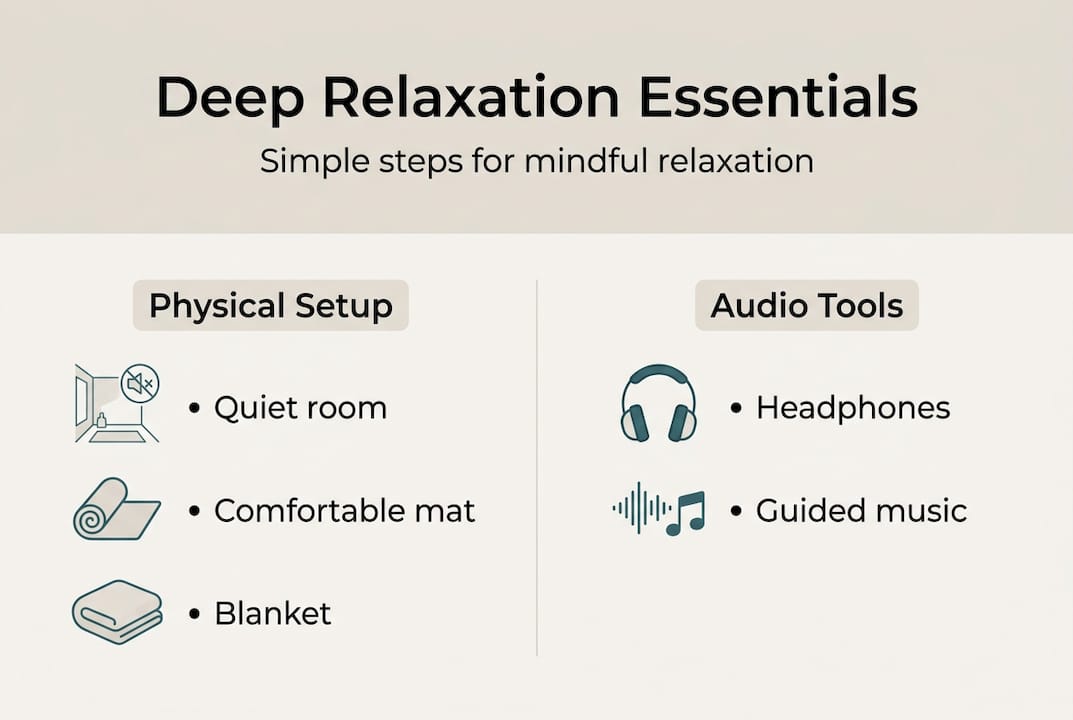
Next, your audio environment. Guided meditation sessions using orchestral music activate the parasympathetic nervous system, which is the biological gear your body needs to shift into for genuine restoration. That means your music selection is not decoration. It is functional. Avoid anything high-arousal: rock, fast electronic beats, or anything with an unpredictable tempo. Instead, look for slow, layered orchestral compositions or ambient soundscapes. Our guides to best Youtube music to relax and relaxing music for meditation and sleep are good starting points if you are unsure where to begin.

For session length, 20 to 60 minutes is the sweet spot for full-depth relaxation. Shorter sessions of 10 to 15 minutes can still be effective for midday breaks, but they rarely take you into the deeper restorative states. Set a gentle timer rather than a jarring alarm, and silence your phone (yes, really).
Here is a quick comparison to help you choose your setup:
| Feature | Ideal option | What to avoid |
|---|---|---|
| Music genre | Orchestral, ambient | Rock, fast electronic |
| Session length | 20 to 60 minutes | Under 5 minutes |
| Environment | Quiet, dim, warm | Bright, noisy, cold |
| Posture | Lying flat or reclined | Sitting upright at a desk |
Key things to have ready before you begin:
-
A comfortable mat, reclined chair, or bed
-
Headphones or quality speakers
-
A chosen guided track or soundscape
-
A blanket and eye mask if available
-
A set intention (rest, stress relief, sleep preparation)
Pro Tip: Use headphones rather than speakers wherever possible. The immersive quality of binaural and 3D orchestral recordings is significantly reduced through open-air playback, and you will lose much of the depth that makes these tracks genuinely effective.
Step-by-step guide: The deep relaxation process
Once you have your tools and prerequisites sorted, follow these evidence-based steps to move through genuine deep relaxation.
-
Begin with a mindfulness body scan. Lie down, close your eyes, and spend three to five minutes simply noticing each part of your body from feet to crown. No judgement, no forcing. Just awareness. This primes your nervous system for what follows.
-
Start PMR (progressive muscle relaxation). Working from your feet upward, tense each muscle group for five seconds, then release. Breathe in as you tense, breathe out as you let go. PMR measurably improves sleep quality and reduces anxiety and depression, and when paired with orchestral music it also lowers cortisol and blood pressure. End the PMR phase with three slow, deep breaths and a brief moment of gratitude, which sounds a bit earnest but genuinely anchors the calm.
-
Transition into Yoga Nidra. This is the jewel of deep rest practices. You remain on the threshold between waking and sleep, guided by a voice through rotating awareness, visualisation, and intention-setting. A single 20-minute session delivers restorative effects equivalent to several hours of ordinary sleep. That is not marketing copy. That is what practitioners and researchers consistently report.
-
Layer in your orchestral soundscape. Begin your chosen track at the body scan stage and let it run continuously. The music should be a background presence, not a focal point. Think of it like relaxation music for stress relief, supporting the process rather than demanding attention. For deeper states, tracks featuring theta frequencies work particularly well during Yoga Nidra.
-
Close with stillness. After the guided portion ends, remain still for five minutes. Let the meditation music for inner peace fade naturally. Re-enter awareness slowly.
| Technique | Duration | Primary benefit | Best music pairing |
|---|---|---|---|
| PMR | 15 to 20 minutes | Muscle tension release, anxiety reduction | Slow orchestral strings |
| Yoga Nidra | 20 to 45 minutes | Deep rest, equivalent to hours of sleep | Ambient, theta-frequency tracks |
| Mindfulness meditation | 10 to 30 minutes | Present-moment awareness, stress reduction | Gentle orchestral or silence |
Please note: Avoid PMR if you are recovering from acute injury, as tensing damaged muscle groups can worsen the condition. If you tend to fall fully asleep during Yoga Nidra rather than resting in that threshold state, try practising in a seated position rather than lying flat.
Troubleshooting and avoiding common mistakes
With practice, you may encounter obstacles or mistakes. Here is how to troubleshoot and refine your relaxation approach before frustration sets in.
The most common errors people make:
-
Choosing mismatched music. High-arousal music may actively induce stress rather than calm. If your heart rate is rising during a session, your track is almost certainly the culprit. Switch to something slower and less rhythmically complex.
-
Sessions that are too short. Ten minutes is better than nothing, but it rarely gets you past the surface layer of tension. If you are not feeling the effects, try extending to 25 minutes before changing anything else.
-
A poorly prepared environment. Notifications, ambient noise, and uncomfortable temperatures are relaxation killers. Treat your space like a small ritual, not an afterthought.
-
Skipping the body scan. Many people jump straight into PMR or Yoga Nidra without grounding themselves first. The body scan is the warm-up. Skip it and you are essentially sprinting before stretching.
-
Inconsistent timing. Your nervous system responds to routine. Practising at the same time each day, even for shorter sessions, builds a conditioned relaxation response over time.
Pro Tip: Establish a consistent start time for your sessions. Morning practice tends to set a calmer tone for the day, while evening practice supports sleep. Pick one and stick with it for at least two weeks before evaluating results.
A word of caution: Avoid PMR if you are recovering from injury, and choose music with a slow tempo and low arousal level. For Yoga Nidra, if you consistently fall fully asleep, try royalty free music for hypnotherapy paired with a seated or semi-reclined posture to maintain the liminal awareness state.
For those prone to sleep during Yoga Nidra, soothing music for sleep healing can actually support a more intentional drift, which is perfectly valid as a separate practice. Just know the difference between restorative Yoga Nidra and a nap.
How to verify your results and deepen your practice
After completing your session, it is vital to evaluate your results and refine your approach for ongoing gains. Deep relaxation is not a one-and-done event. It is a practice, which means it improves with repetition and honest self-assessment.
Signs that your sessions are working:
-
Improved sleep quality. Falling asleep faster and waking less frequently are reliable early indicators.
-
Reduced stress reactivity. You notice you are less triggered by everyday irritations. (Your commute feels slightly less like a personal affront.)
-
Lower resting heart rate. Over weeks of consistent practice, many people notice a measurable drop.
-
A persistent sense of calm. Not bliss, not euphoria, just a baseline that feels steadier and more grounded.
-
Greater body awareness. You begin to notice tension earlier, before it becomes a headache or a stiff neck.
Beginners benefit most from guided PMR and Yoga Nidra, with consistency being the single most important factor in achieving measurable results. This is not a technique where effort alone drives progress. Regularity does.
Pro Tip: Keep a simple relaxation journal. After each session, jot down your stress level before and after (on a scale of one to ten), your sleep quality that night, and any observations about the music or technique. Within two weeks, patterns emerge that help you refine your approach far more effectively than guessing.
For those who have been practising for a while, consider layering in more advanced elements. Explore music to meditate to free to experiment with different orchestral textures, or try extending your Yoga Nidra sessions to 45 minutes for deeper restorative effect. Advanced practitioners often report accessing subtle physiological states, such as spontaneous body warmth or a sense of weightlessness, that simply are not available in shorter or less structured sessions.
Expert perspective: Why orchestral music transforms guided relaxation
Here is something that conventional wellness advice rarely says out loud: not all meditation music is equal, and the gap between a generic digital track and a live orchestral recording is not just aesthetic. It is functional.
Music is a passive enhancer in clinical relaxation methods, which is true. But passive does not mean inconsequential. The texture, dynamic range, and harmonic complexity of a live orchestral recording engage the auditory cortex differently than a looped synthesiser pad. Real instruments breathe. They have micro-variations in timing and tone that digital tracks simply cannot replicate, and those variations matter to a nervous system trying to let go.
We have seen this repeatedly in feedback from people using our best meditation music recordings. The depth of the relaxation response is consistently described as qualitatively different, not just more pleasant. That is the difference between decoration and design. Digital-only tracks can support relaxation, but for many people they plateau quickly. Orchestral soundscapes, particularly those recorded with spatial audio techniques, continue to reward deeper listening the further into practice you go.
Discover orchestral meditations for deep relaxation
If you are ready to take your practice somewhere genuinely restorative, we have built something worth exploring. Our Meditation Music library features recordings made at Abbey Road Studios with the National Philharmonic, crafted specifically to support PMR, Yoga Nidra, and deep mindfulness practice.
Every track in our collection is designed with therapeutic intent, not just pleasant ambience. From theta-frequency orchestral compositions to immersive 3D soundscapes, you will find something that fits your practice precisely. Visit Orchestral Meditations to explore the full library, or go straight to the best meditation music curated for your unique relaxation needs.
Frequently asked questions
Which deep relaxation method is best for beginners?
Guided PMR and Yoga Nidra are especially effective for beginners, offering structured routines and measurable benefits that build with consistent practice.
Can orchestral music enhance the effects of deep relaxation?
Yes. Music acts as a passive enhancer in clinical relaxation methods, helping activate the nervous system’s rest response when paired with guided techniques like PMR or Yoga Nidra.
How long should I practise deep relaxation techniques?
Sessions of 20 to 60 minutes deliver the fullest restorative effect, though shorter practices of 10 to 15 minutes remain genuinely useful for midday stress relief.
Are there any safety concerns with PMR or Yoga Nidra?
Avoid PMR during acute injury recovery, as tensing damaged muscles can cause harm. With Yoga Nidra, use a seated posture if you consistently fall fully asleep rather than resting in the threshold state.