
There is something almost comical about sitting cross-legged on the floor, eyes shut, trying to think about nothing, while your brain helpfully reminds you that you left the oven on. Genuine mindfulness is harder than it sounds, and in a world buzzing with notifications, deadlines, and the peculiar ambient stress of modern life, most of us are essentially trying to meditate inside a blender. The good news? A structured approach, paired with the right sonic environment, changes everything. Mindfulness meditation anchors your awareness in the present moment, and when you layer immersive orchestral soundscapes over that process, something genuinely extraordinary happens. This guide walks you through every step, from setting up your space to choosing the perfect musical overlay, so you can stop guessing and start experiencing real relaxation and personal growth.
Key Takeaways
| Point | Details |
|---|---|
| Prepare your environment | A comfortable, well-prepared space and upright posture set the stage for effective meditation. |
| Follow core steps | Seven essential steps guide your attention to the present, improving focus and relaxation. |
| Choose your technique | Tailor your practice using breath awareness and guided orchestral music for deeper results. |
| Avoid common mistakes | Assess mental health and avoid digital overreliance for the safest, most immersive experience. |
| Personalise with music | Immersive orchestral soundscapes elevate mindfulness and help unlock emotional breakthroughs. |
Setting up your mindfulness meditation environment
Having clarified why mindfulness matters, let’s build the ideal foundation for your practice. Because here’s the thing: most people skip this part entirely. They plonk themselves down on a sofa cushion, stick in a single earbud, and wonder why they can’t concentrate. Your environment is doing roughly 40% of the work before you’ve even closed your eyes, with posture and breath handling the remaining 60%. So it genuinely pays to get this right.
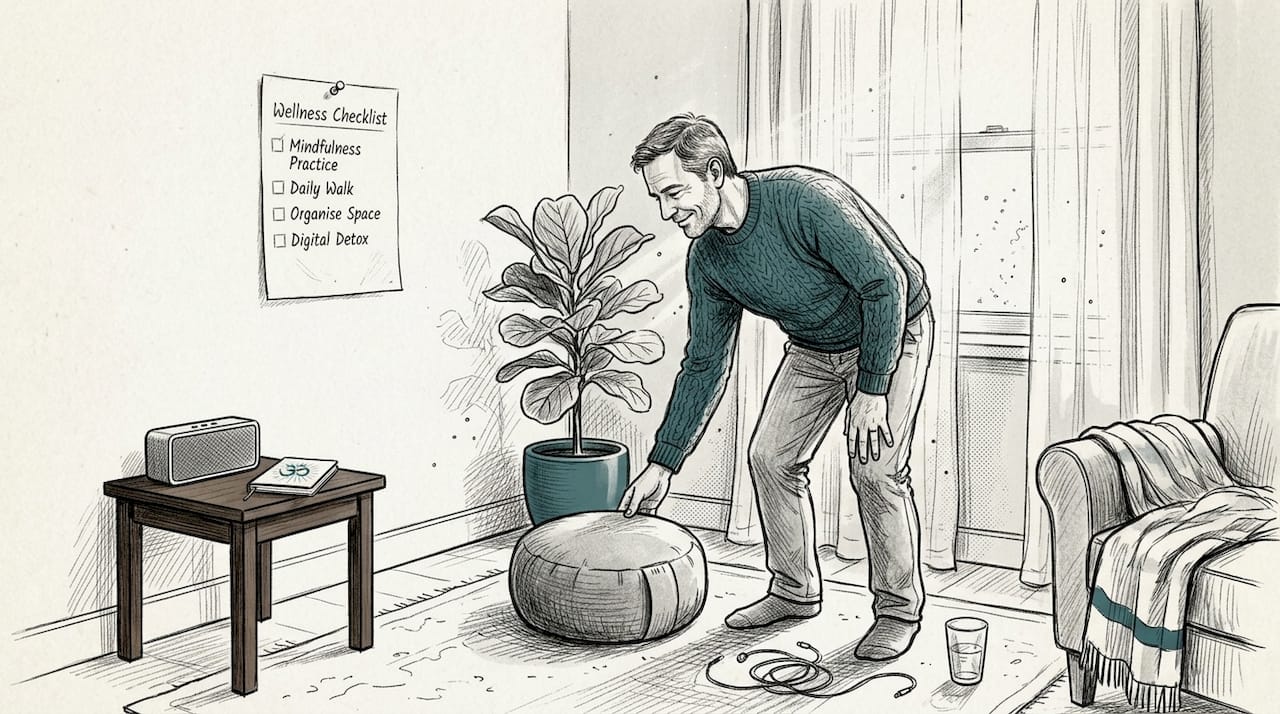
Choosing your location is the first decision, and it’s worth taking seriously. You want a space that feels calm rather than cluttered, ideally one that your brain doesn’t associate with work, stress, or scrolling through social media at midnight. A corner of a bedroom, a quiet garden, even a tidy spare room will do nicely. The key is consistency. Return to the same spot every session and your nervous system will start recognising it as a signal to relax, almost like Pavlov’s dog, but with considerably less drool and considerably more peace.
Creating atmosphere is where the real magic happens. Consider these elements:
- Lighting: Soft, warm light or natural daylight. Harsh overhead lighting is the enemy of inner calm.
- Scent: A subtle candle or diffuser with lavender or sandalwood can cue relaxation without overpowering.
- Sound: This is non-negotiable. Explore curated mindfulness music options designed specifically for meditative states, and you’ll feel the difference immediately.
- Temperature: Slightly cool is better than warm. Warmth makes you drowsy; cool keeps you gently alert.
- Clutter: Remove visual distractions. Your wandering mind doesn’t need extra inspiration.
Essential tools to consider:
| Tool | Purpose | Recommended option |
|---|---|---|
| Upright chair or cushion | Correct posture support | Firm cushion or straight-backed chair |
| Quality headphones | Immersive orchestral sound | Over-ear, closed-back headphones |
| Meditation timer | Session structure without clock-watching | Dedicated app or gentle bell timer |
| Eye mask | Reduces visual distraction | Simple, lightweight fabric mask |
You’ll notice that stress relief music features prominently in the toolkit above. That’s not accidental. Orchestral compositions, particularly those using binaural frequencies, engage the auditory cortex in ways that digital chimes and rain-sounds simply cannot replicate. There’s a richness to live-recorded strings and brass that seems to physically slow the racing mind.
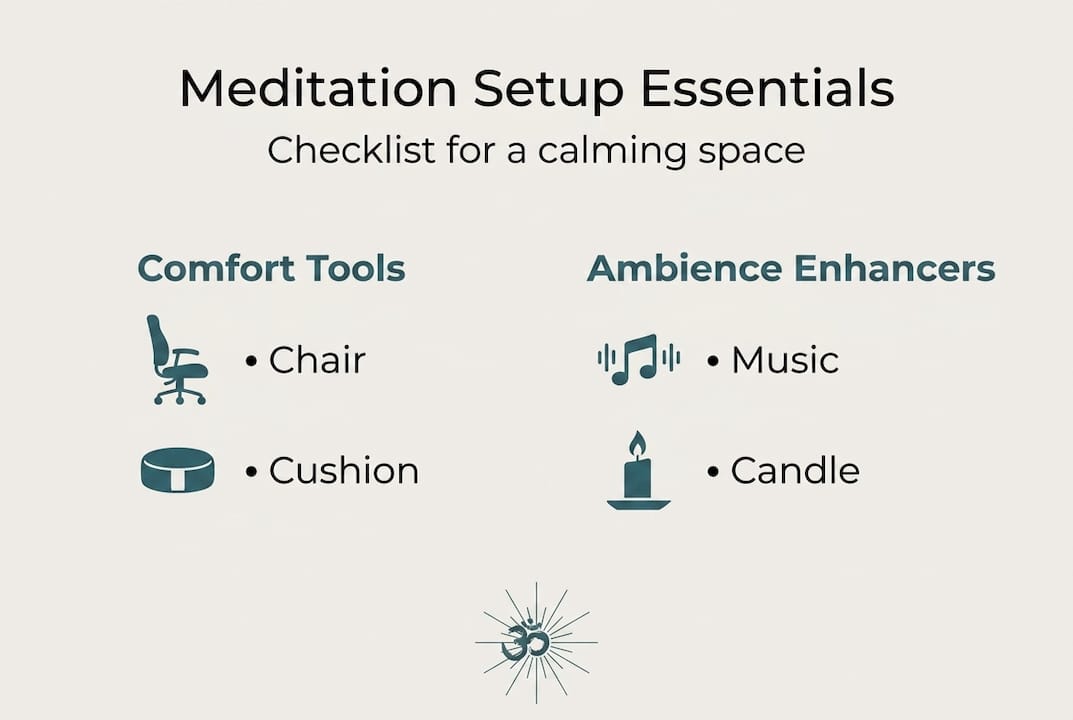
For anyone wanting a broader overview of what makes a meditation-ready environment, a solid wellness checklist for meditation can help you audit your space systematically. It’s also worth exploring methodologies for mindfulness to understand why environmental cues are so deeply embedded in classical meditation traditions.
Pro Tip: Ritualise your set-up sequence. Light the candle, press play on your chosen track, adjust your posture, and breathe. Do this in the same order every time and your brain will start triggering a calm response before the first note even plays. Ritual is essentially a shortcut to stillness.
Step-by-step mindfulness meditation: Core mechanics
With your environment ready, here’s the precise sequence to follow. Think of this as your meditation recipe: skip a step and the whole dish suffers.
The 7-step process works as follows:
- Choose your location. Settle into your prepared space. Begin your orchestral track before you sit down.
- Adopt your posture. Sit upright, spine gently lengthened, hands resting on your thighs. Upright posture is not about rigidity; it’s about dignified ease.
- Close your eyes. Gently. No scrunching. Let darkness arrive naturally.
- Body scan. Move awareness slowly from the crown of your head to your feet. Notice tension without judging it.
- Take deep breaths. Three slow, deliberate breaths. Inhale for four counts, exhale for six. Feel your ribcage expand.
- Return to natural breathing. Stop controlling. Let the breath breathe itself. This is where the orchestral overlay earns its place, anchoring wandering attention back with melodic cues.
- Close your practice. After your session, take a moment before opening your eyes. Gently wiggle fingers and toes. Re-enter the world gracefully.
Step-by-step benefits at a glance:
| Step | Primary benefit | Orchestral overlay role |
|---|---|---|
| Location | Sets mental context | Begin ambient track |
| Posture | Improves alertness and focus | None yet |
| Eyes closed | Reduces sensory input | Soft introduction |
| Body scan | Releases physical tension | Gentle strings |
| Deep breaths | Activates parasympathetic system | Swells and crescendos |
| Natural breathing | Deepens meditative state | Theta-frequency layers |
| Closing | Grounds awareness | Fade to silence |
For a deeper understanding of why sound selection matters at each transition, the scientific approach to meditation music is genuinely illuminating. It explains how specific frequencies interact with brainwave states during each phase. And if sleep is your primary goal, relaxing music for sleep offers tailored recommendations for evening sessions.
For those who prefer their mindfulness within structured mindfulness programmes, it’s worth noting that the seven-step framework above aligns neatly with clinically validated approaches used in therapeutic settings.
Pro Tip: In step 5, rather than counting breaths mechanically, imagine each exhale as releasing a colour from your chest. Sounds a little theatrical, but this visualisation technique can trigger a surprisingly powerful emotional release, especially when paired with a swelling orchestral passage.
Safety note: Mindfulness meditation is beneficial for most people, but it is not universally suitable. If you experience anxiety disorders, trauma histories, or psychosis, please consult a qualified mental health professional before beginning a regular practice.
Choosing the best guided meditation techniques and orchestral overlays
Now that you understand the fundamentals, let’s tailor your practice for maximum impact. Because not all techniques suit all people, and selecting the wrong approach is a bit like using a tuba to play a lullaby: technically possible, thoroughly unpleasant.
Five core techniques and what they’re actually good for:
- Breath awareness: Best for beginners and stress relief. Keeps the mind tethered without effort.
- Body scan: Excellent for physical tension and chronic pain. Encourages deep somatic awareness.
- Loving-kindness (Metta): Ideal for self-compassion and relational healing. Builds warmth from the inside out.
- Walking meditation: Perfect for restless types who struggle with stillness. Brings mindfulness into movement.
- Mantra repetition: Powerful for concentration and spiritual depth. Provides a cognitive anchor for the wandering mind.
Each technique pairs differently with musical overlays, and this is where orchestral compositions genuinely outperform generic digital tracks. Consider the comparison:
| Feature | Orchestral overlays | Standard digital apps |
|---|---|---|
| Frequency precision | 528Hz, binaural, theta layers | Basic ambient loops |
| Emotional depth | Live strings, dynamic range | Synthesised tones |
| Session duration | 23 to 58 minutes (e.g., Samsara) | Often 5 to 20 minutes |
| Personalisation | Track selection by technique | Limited customisation |
| Immersive quality | 3D surround, Abbey Road sessions | Stereo, studio digital |
The research here is also rather compelling. A chills-augmented meditation study involving 398 participants found that music-induced chills during loving-kindness meditation significantly increased self-transcendence and insight compared to silent practice. That’s not a small effect; it’s the difference between a pleasant sit-down and a genuinely transformative experience.
For anyone curious about why symphonic music in particular creates such potent meditative states, the symphonic meditation guide explores the acoustic and psychological mechanisms in satisfying detail. If you’re debating between focused concentration and open mindfulness styles, mindfulness vs concentration offers a clear, practical comparison.
The relaxation music science behind these effects is also worth exploring, particularly the role of tempo, harmonic structure, and frequency layering in guiding brainwave states. And for a broader academic perspective, music-augmented meditation research provides accessible summaries of current findings.
In practical terms, match your track duration to your experience level. Beginners often find 23-minute sessions entirely sufficient. More seasoned practitioners can comfortably extend to 45 or 58 minutes, particularly when the orchestral composition evolves gradually and supports each stage of the meditative arc.
Troubleshooting and common mindfulness meditation mistakes
Even the best intentions can be derailed by overlooked errors, and here’s how to avoid them. I say this with genuine sympathy, because I’ve made most of these mistakes myself at some point.
Common mistakes and how to fix them:
- Skipping environment preparation. Sitting in a cluttered room with the television murmuring in the background is not meditation; it’s just sitting. Prepare your space every time, without exception.
- Ignoring posture. Slumping is the enemy of alertness. A collapsed spine signals the brain to switch off rather than tune in. Use a firm cushion or upright chair.
- Expecting a blank mind. Thoughts will appear. That’s not failure; that’s the practice. The skill is in noticing the thought and returning attention to breath or music without drama.
- Over-relying on apps. Many popular meditation apps offer brief, inconsistent sessions without real personalisation or scientific grounding. They’re a starting point, not a destination.
- Skipping steps in the sequence. The body scan and breath transition steps aren’t optional extras; they are the architecture that makes deep states accessible. Remove them and you’re essentially skipping the warm-up before a sprint.
- Meditating only when stressed. Waiting until you’re frazzled to meditate is like waiting until you’re ill to start eating well. Consistency across calm and difficult days builds the real neurological habit.
For ongoing inspiration and curated track recommendations, enhancing mindfulness with music is a reliable resource. Equally, relaxation music for meditation covers the art of matching musical character to your emotional state on any given day.
Pro Tip: Research consistently shows that structured programmes outperform meditation alone. Adding psychoeducation, journalling, or community accountability to your practice dramatically improves long-term retention. Apps rarely provide this scaffolding. Orchestral programmes, particularly those with composer notes and session guidance, often do.
Important: Adverse effects from mindfulness are more common than often reported. Before beginning a regular practice, honestly assess your current mental health and seek guidance if needed. There is no shame in approaching this carefully. Please also review meditation safeguards for practical risk-reduction advice.
Why orchestral soundscapes transform mindfulness: Our unique take
Having mastered the steps and troubleshooting, let’s reflect on the most powerful insight we’ve gathered from years of working with meditation music: the medium is not separate from the practice. It is the practice.
We’d genuinely challenge the mainstream assumption that music is simply background decoration for meditation. When a live orchestra, recorded in a space like Abbey Road with meticulous acoustic intention, plays a theta-frequency composition over binaural beats, it doesn’t decorate your meditation. It structures it. The harmonic relationships, the dynamic arc, the spatial richness of 3D surround sound: these elements guide brainwave states as reliably as any verbal instruction.
Digital apps, for all their convenience, frequently strip away the safeguards and contextual depth that traditional meditative practices preserve. They offer speed and accessibility, but often at the cost of depth and safety. Meanwhile, physical tools and rituals consistently outperform purely digital approaches for long-term retention and genuine wellbeing.
Personalisation is the other critical variable. Matching the right orchestral composition to your technique and emotional state on a given day is not a luxury; it’s the difference between a polite conversation and a revelation. Explore the scientific approach to orchestral meditation to understand exactly how this personalisation operates at a neurological level.
Pro Tip: Create a simple ritual cue. Start every session with the same opening passage of your chosen track, and end with the same closing bars. Over time, these sonic bookmarks become powerful psychological anchors, signalling your nervous system to transition in and out of meditative states with remarkable reliability.
‘Music is not just background: it is the meditation itself.’
Explore orchestral meditation music for your practice
Ready to elevate your mindfulness journey? Everything we’ve discussed, the environment, the steps, the technique matching, the ritual anchoring, works best when the music itself is genuinely extraordinary. And that’s precisely what we’ve built at Orchestral Meditations.
Our library of orchestral meditation music features live recordings from Abbey Road Studios, layered with binaural beats, theta frequencies, and 528Hz Solfeggio tones, all precisely composed to support each stage of your practice. Whether you’re a beginner finding your feet or a seasoned practitioner seeking deeper states, you’ll find something that fits your session perfectly. Browse our curated selection of best guided meditation music and discover which orchestral overlay transforms your practice from routine into something genuinely remarkable.
Frequently asked questions
What is the best posture for mindfulness meditation?
An upright, comfortable posture is recommended, as it supports focus and maintains a gentle alertness throughout the session without causing strain.
Can music enhance mindfulness meditation?
Absolutely. Music-augmented meditation boosts immersion and emotional engagement, though the greatest benefit comes from personalising your track selection to your chosen technique and goals.
Are there risks to practising mindfulness meditation?
Adverse effects are underreported, so it’s wise to assess your current mental health before beginning a regular practice and to seek professional guidance if you have a history of anxiety, trauma, or psychosis.
What meditation techniques are most effective with music?
Body scan, breath awareness, loving-kindness, and guided mantra repetition are all especially powerful when paired with orchestral overlays, as the musical structure supports each technique’s distinct attentional demands.
How long should I meditate for optimal benefits?
Sessions of 23 to 58 minutes with immersive orchestral music are shown to maximise relaxation and personal growth, with beginners starting at the shorter end and building gradually over time.
Recommended
- Relax Deeply With Step By Step Guided Meditation
- Deep Relaxation Guide: Mindful Steps And Orchestral Soundscapes
- Explore Deep Meditative States For Profound Relaxation
- Relax And Unwind With Meditation And Sleep Music
- Effectieve ontspanningstechnieken voor thuis: tips en voorbeelden
- 7 Tipps für Achtsamkeit im Alltag – Kühlkern UG (Haftungsbeschränkt)