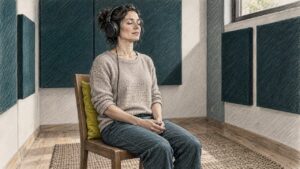
Immersive meditation audio is sound recorded or engineered to surround you rather than sit flatly between two speakers, using techniques like Ambisonic capture, binaural beats, or true 3D processing to create a sense of space around the listener. The best first choice for most people is a genuine Ambisonic recording or a purpose-made binaural track, played on decent over-ear headphones. Studios like Abbey Road showcase what immersive meditation audio sounds like when it’s done with high acoustic care rather than bolted on in software.
TL;DR:
- True Ambisonic recordings and high-quality binaural tracks, primarily played on over-ear headphones, deliver the most immersive meditation experience when properly decoded and free of EQ presets.
- Robust research confirms binaural beats can modestly influence brainwave states such as theta and delta, aiding relaxation and sleep but not producing dramatic cognitive changes.
- Matching the format to your goal is crucial, with long-form ambient tracks ideal for sleep and repetitive soundscapes better for concentration, while studio-quality recordings enhance emotional and attentional depth.
- Low-bitrate streaming, faulty playback devices, or active EQ and virtual surround effects can significantly diminish the sense of space and movement in the audio.
- Considering the studio provenance and production quality, such as recordings at Abbey Road, adds confidence that the soundscape offers genuine acoustic depth and musical craftsmanship.
What counts as immersive meditation audio? The formats explained
Not everything labelled “3D” or “surround” earns the name. Some formats capture real spatial information; others fake it convincingly enough to fool most ears, which is fine but worth knowing.
- Ambisonic/3D capture: recorded with specialised microphone arrays that pick up sound from every direction at once, preserving the actual acoustic scene so a renderer can reproduce it accurately on playback. Ambisonics recordings differ fundamentally from stereo widening because they capture a full sphere of sound rather than simulating one afterwards.
- Binaural beats: two slightly different frequencies played separately into each ear, a trick your brain resolves into a third, perceived tone. The aim isn’t spatial realism at all. It’s to nudge your brainwave activity towards states like theta or delta, often for relaxation or sleep support.
- “8D audio”: almost always a marketing term for processed stereo panning, sound swept left to right and back using effects plugins. It can sound striking on cheap earbuds, but it isn’t spatial capture in any technical sense.
- Solfeggio and frequency-based tracks: built around specific tones (396Hz, 528Hz, and similar) claimed to carry particular healing properties. The tradition is old and the listening experience can be genuinely soothing, but the specific frequency claims rest on far thinner evidence than binaural entrainment research.
Some newer immersive formats blend narration with spatial sound entirely, closer to first-person audio storytelling than a pure soundscape, which shows how wide this category has grown.
How to listen for the full effect
The format only matters if your playback does it justice. Get this wrong and even a proper Ambisonic recording will sound like an ordinary podcast.
- Use over-ear headphones, not speakers or earbuds where possible. Spatial cues rely on precise stereo separation that room speakers blur and cheap earbuds often can’t reproduce cleanly.
- Match the player to the format. True Ambisonic files need an Ambisonic-capable player or app to decode direction correctly; binaural tracks just need clean stereo playback with nothing “helpfully” reprocessing the signal.
- Download rather than stream where quality matters. Low-bitrate streaming can compress away the subtle frequency and phase information that gives these recordings their depth.
- Turn off EQ presets, bass boost, and virtual surround processing in your headphone app or device settings. These are built for pop music, not spatial or binaural audio, and they actively work against the effect.
- Check your browser isn’t blocking playback. Autoplay restrictions can interrupt a session before it starts, so it’s worth knowing how to manage autoplay permissions if a track refuses to play.
If a track sounds flat with no sense of movement, the likely culprits are earbuds instead of over-ear headphones, an EQ preset fighting the mix, or a compressed stream rather than the original file.
Pro Tip: If a binaural track sounds “off” or gives you a mild headache in the first minute, stop and check you’re not accidentally listening through only one earpiece or a mono Bluetooth connection. Binaural beats collapse into nothing without true stereo separation.
What the evidence actually supports
Binaural beats have a genuine, if modest, research base. The frequency difference between the ears is understood to encourage specific brainwave states such as theta and delta, and they’re widely used for stress reduction and sleep improvement. That’s a real mechanism, not folklore, but it’s also not a guaranteed switch you flip.
What the research shows: Binaural beats work by exploiting the small frequency gap between your ears to nudge brainwave activity, with the most consistent applications being relaxation and sleep support rather than dramatic cognitive transformation.
Spatial audio’s contribution is different and, in some ways, easier to explain. A soundfield that genuinely surrounds you gives your attention something to settle into, which supports the sense of presence meditation asks for in the first place. Customisable immersive soundscapes, like those on myNoise, lean on exactly this principle to help people block distraction and hold focus during work or creative sessions.
Treat immersive audio as a supportive tool, not a clinical treatment. It can lower the barrier to a calmer state; it won’t resolve anxiety disorders or replace therapy. Worth flagging too: some listeners feel unexpectedly drowsy afterwards, so this isn’t the audio to have running while driving, and anyone with photosensitive conditions should be cautious around visual meditation content paired with these tracks.
Choosing tracks and structuring your session
Session length should match the goal, not the other way round. A quick reset during a lunch break needs a different track to a proper wind down before sleep.
- 10 to 15 minutes suits a quick calm down between meetings or before a stressful conversation.
- 20 to 40 minutes works well for a focused seated meditation, long enough to settle in without losing the afternoon.
- Long durations fit deep sound baths or sleep support, closer to the continuous long-form format many overnight listeners prefer.
When choosing a track, run it against a short checklist: does it clearly state whether it’s Ambisonic or binaural, rather than just “3D” or “8D”? Is the sample rate high enough to preserve detail (look for 48kHz or above)? Does it credit a composer or producer, and does it name the studio it was recorded in? Abbey Road Studios, for instance, signals a level of acoustic care that a bedroom recording simply can’t match. Finally, check the licensing terms if you plan to use it professionally, in a class, an app, or client sessions.
Names matter here more than people expect. A track produced by Robert Emery, whose composing and production work spans orchestral recording sessions at Abbey Road with the National Philharmonic, tells you something concrete about the musicianship behind it, not just the technical specs on the file.
Pro Tip: Always preview a full track, start to finish, before building it into a guided session or therapy practice. Tracks can shift mood or intensity halfway through in ways a 30 second preview won’t reveal.
How format changes the meditation experience itself
The format you choose doesn’t just change how a track sounds. It changes what your attention does during the session.
Binaural beats work quietly in the background, nudging your physiological state without asking for conscious attention, which suits people who find pure silence agitating rather than calming. True Ambisonic recordings do the opposite: they reward attention, inviting you to notice sound moving around and behind you, which can deepen the sense of presence that seated meditation depends on. Processed “8D” stereo panning sits somewhere in between, novel and engaging on first listen, but often less convincing on repeat sessions once the trick becomes familiar.
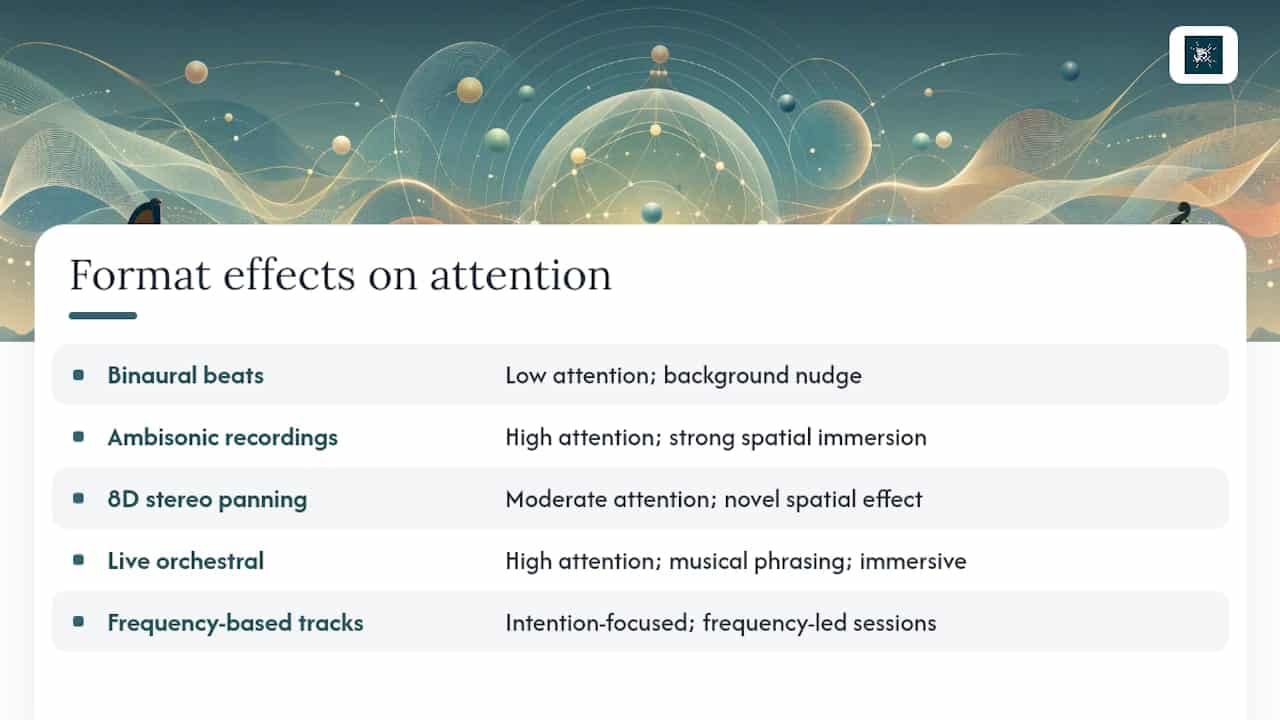
Orchestral, live-instrument recordings add a layer neither pure tone generation nor synthetic panning can replicate: musical phrasing. A swell in strings or a held horn note carries emotional information that a sine-wave beat simply doesn’t, which is part of why sessions built around live orchestral performance often feel less like background noise and more like something to sit inside.
Frequency-based tracks (Solfeggio and similar) tend to suit listeners who want a specific intention attached to their listening, a stated purpose for the session, even where the frequency claims themselves are contested. None of these formats is objectively “better.” They simply ask different things of your attention, which is exactly why matching format to goal matters more than chasing the most technically advanced option available.
Matching the audio to your actual goal
Start with what you’re trying to solve, not with which format sounds most impressive on paper.
If sleep is the target, favour long-form, low-intensity tracks with minimal musical movement, closer to ambient drones than orchestral pieces with dynamic swells that might pull you back to alertness. If you want help concentrating during work, a subtler, more repetitive immersive soundscape tends to outperform anything with strong melodic hooks, since a track you can hum along to is a track that’s competing for attention rather than supporting it.
For seated meditation practice, genuine Ambisonic recordings or well-produced orchestral pieces tend to reward the time investment best, because they give your attention somewhere gentle to land without being distracting. If you’re newer to meditation and structure helps, pairing immersive audio with guided meditation techniques and simple breathwork often works better than diving straight into unguided ambient listening.
Anyone using audio therapeutically, in massage, yoga, or clinical settings, should prioritise clean licensing and consistent quality over novelty. A partner resource on hypnotic audio for sleep covers a related angle worth reading if sleep support specifically is your priority. And if you’re still not sure which format fits, the honest answer is to trial two or three short sessions across formats before committing to a full library or subscription.
Why studio craft still matters to me
There’s a difference between sound designed to fill silence and music designed to hold you. I hear it immediately when a track was recorded with real musicians in a room built for acoustics, rather than assembled from stock loops. Abbey Road sessions carry a warmth and depth that synthetic beds can’t fake.
Composers like Robert Emery and producers like Moritz Schneider bring genuine musical craft to this work, and that craft is precisely what separates a track you forget within a minute from one that actually changes your state.
— ROBERT
How Orchestral Meditations delivers this properly
Everything covered above, genuine Ambisonic capture, careful binaural design, and studio provenance you can actually verify, is exactly what Orchestral Meditations builds its library around. Every recording is captured at Abbey Road Studios, using 3D surround techniques and binaural methods, with composers including Robert Emery shaping the musical side rather than leaving it to software presets.
For personal listening, the Personal subscription gives you ongoing access to the full immersive library for €21 per month. If you’re a therapist, yoga instructor, app developer, or content creator needing tracks for client or commercial use, the Professional subscription at €150 per month covers that licensing. Practitioners who prefer buying tracks outright rather than subscribing can explore the Royalty Free Meditation Music catalogue instead, with pricing available on the site. Browse the library and sample a track before you commit to either plan.
Sources
- Binaural beats | Psychology Today
- Ambisonics | Into the Soundfield (University of Oxford project)
- Manage autoplay | Mozilla Support
FAQ
What is immersive meditation audio?
It’s meditation music or soundscapes recorded or engineered to surround the listener spatially, using techniques such as Ambisonic capture, binaural beats, or 3D processing rather than standard flat stereo mixing.
Is 8D audio the same as true 3D or Ambisonic sound?
No. “8D audio” is typically processed stereo panning created with software effects, while true Ambisonic recordings capture the full soundfield with specialised microphone arrays during recording itself.
Do binaural beats actually work for relaxation?
Research suggests binaural beats can encourage brainwave states like theta and delta linked to relaxation and sleep, though effects vary between individuals and shouldn’t be treated as guaranteed.
What headphones do I need for immersive meditation audio?
Over-ear headphones with clean stereo separation work best; earbuds and speakers often can’t reproduce the precise spatial cues these recordings depend on.
How much does Orchestral Meditations cost?
Orchestral Meditations offers a Personal subscription at €21 per month and a Professional subscription for commercial licensing at €150 per month, alongside royalty-free tracks priced individually on the site.