
The short answer: orchestral music with nature sounds works best when the orchestra leads and the nature is a quiet backdrop, or when you choose one and use the other in a separate session. Slow, unhurried strings carry the evidence for calming the body. Familiar, local-sounding nature recordings add a sense of place. Stack them carelessly and you get two things competing for the same bit of your brain. At Orchestral Meditations we record live musicians at Abbey Road Studios with the National Philharmonic, so we have strong views on the orchestral half of the equation, and we will share them below.
If you have ever put on rain sounds, then a string piece, then wondered why your shoulders were still up around your ears, this article is for you.
TL;DR
- Nature sounds and orchestral music are different tools. A 2025 scoping review found strong evidence for music lowering physiological stress markers, with nature sounds showing promise but less research behind them.
- Familiarity matters. In a 2026 German study, nearby temperate forest recordings lifted mood more than tropical ones.
- Keep the layering simple: slow orchestral music, few rhythms, and nature kept low enough that you only notice it when it stops.
- Match the mix to the job: sleep, meditation, yoga and focus each want a slightly different balance.
- Music therapy is its own profession in Germany. If you are treating a medical condition, speak to a qualified music therapist or your doctor.
What orchestra plus nature actually sounds like
Picture two very different things. The first is a field recording: rain on leaves, a blackbird, distant water. Nothing is composed, nothing resolves. It simply happens, and your mind decides what to do with it.
The second is an orchestra: strings sustaining a chord, a flute floating over the top, harp or piano marking time gently. Everything is composed. Every swell was decided by a person.
Put them together and you get one of three results.
- Nature as a bed. A very soft rain, sea or forest layer sits under the music. You feel it more than you hear it.
- Nature as a texture inside the music. A few birds or a stream appear at moments, as part of the arrangement.
- Nature imitated by the orchestra. No recordings at all: the instruments themselves paint the scene. A German example is the Orchester des Wandels, whose Sounds of Nature programme pairs chamber works that imitate natural sounds with short scientific contributions on what real soundscapes tell us about an ecosystem.
That last point is worth a second look. A composed piece suggests nature. A real recording documents it. They give you different experiences, and neither is a cheaper version of the other.
Which nature sounds go with an orchestra
The usual suspects are rain, ocean waves, forest ambience with birdsong, flowing water and, less often, wind. A glance at what a German listener finds when searching this topic confirms it: the results are dominated by sleep albums with rain, thunderstorm, beach and forest tracks.
Here is how each tends to behave under strings, in our experience of arranging and listening to meditation music.
| Nature sound | How it sits with orchestra | Best for |
|---|---|---|
| Soft rain | Steady, broadband, fills the gaps between notes | Sleep, winding down |
| Ocean waves | Slow rise and fall that echoes the swell of long string phrases | Breath-led meditation |
| Forest and birdsong | Busier and more varied, so it needs very low volume | Walking, gentle yoga, morning practice |
| Running water | Bright and detailed, can clash with high harp or flute | Short breaks, focus |
| Wind | Can blur low strings and double basses | Spacious, open meditation |
The pattern is simple. Steady, even sounds (rain, waves) blend easily. Busy, detailed sounds (birds, streams) need more care, because your brain keeps trying to decode them.
What the research says
Let us separate what is well supported from what is a nice idea.
Music has the stronger evidence
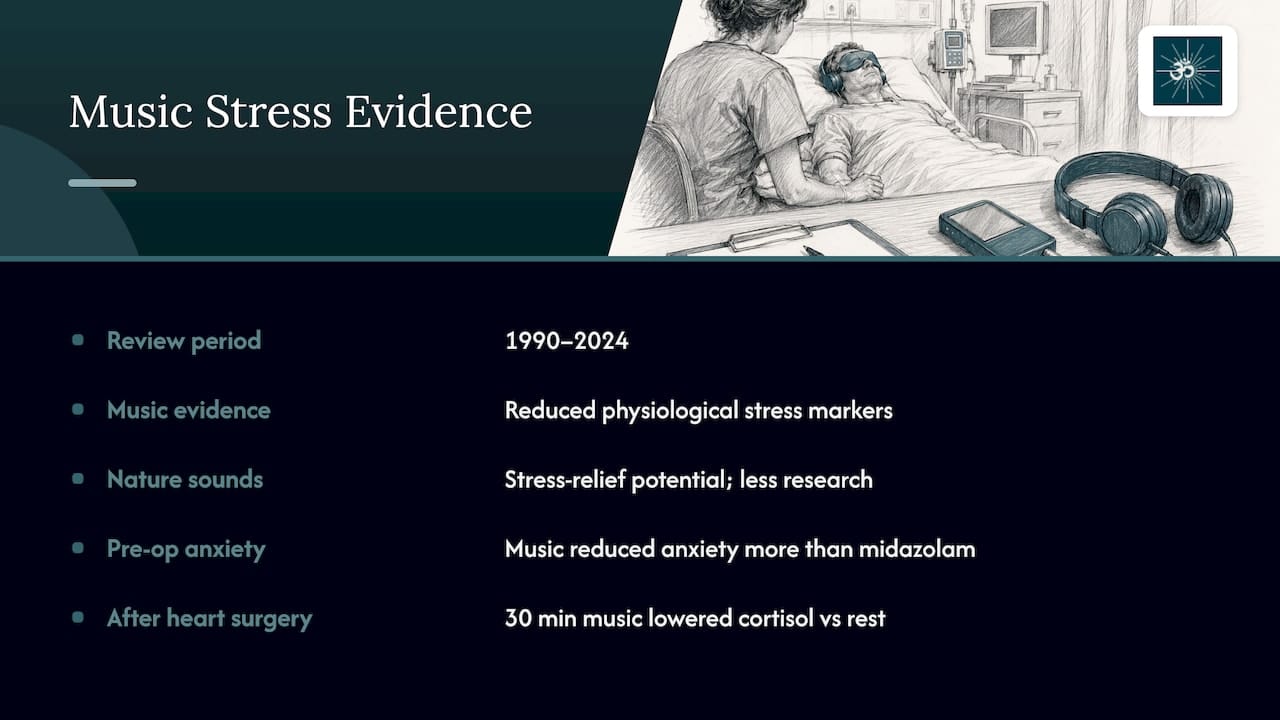
A 2025 scoping review of sound interventions (Saskovets, Saponkova and Liang, covering 1990 to 2024) concluded that music, especially classical and self-selected pieces, effectively reduces physiological stress markers, including cortisol, heart-rate variability and blood pressure. Non-musical nature sounds also showed stress-relief potential, but with more limited research. The review adds that outcomes depend on personal preference, delivery method and cultural context.
Older clinical work points the same way. A review of music in intensive care medicine reports that relaxing music before an operation reduced anxiety scores more than the sedative midazolam, and that after open-heart surgery, 30 minutes of bed rest with music produced significantly lower cortisol than rest without it. It also notes that vocal and orchestral music produced significantly better coordination between cardiovascular and respiratory signals. The same review says the greatest benefit is seen with classical music and meditation music, whose slow sounds and few rhythms have a sedative effect.
Slow sounds, few rhythms. Hold on to that phrase, because it is the whole recipe for the orchestral side of your mix.
Nature sounds lift mood, especially familiar ones
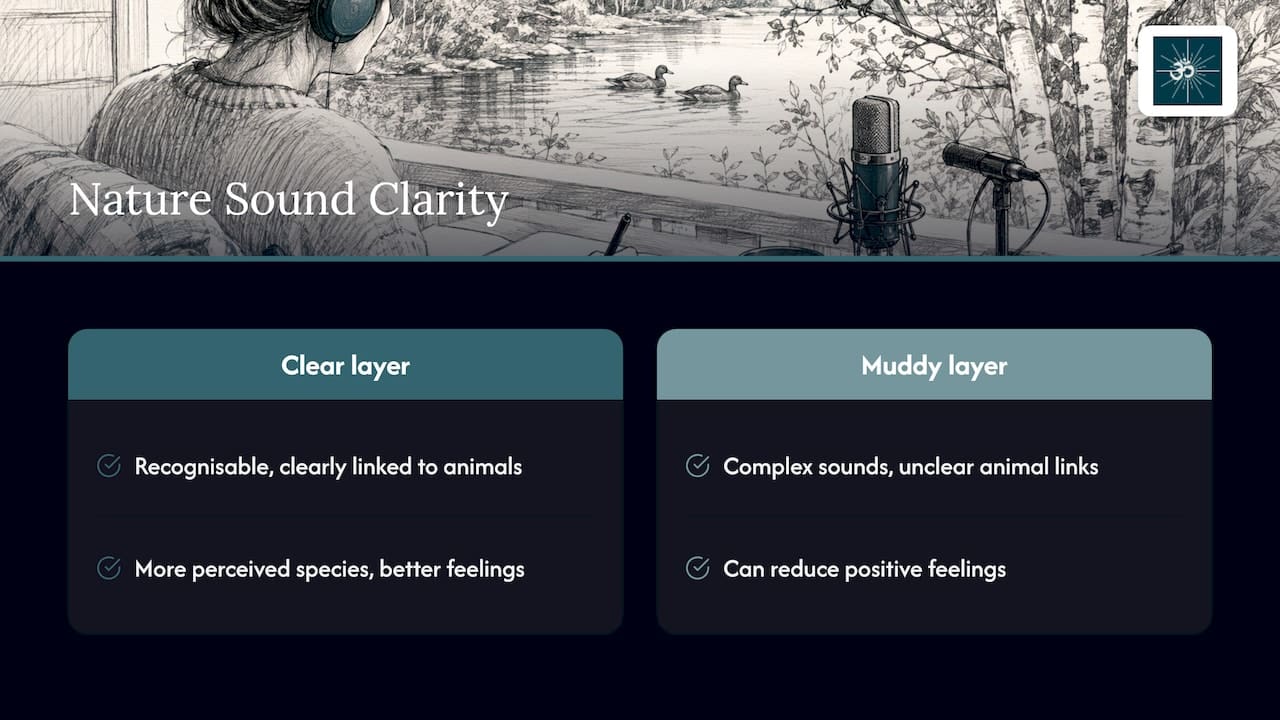
A 2026 study led by the German Centre for Integrative Biodiversity Research (iDiv), published in the Journal of Environmental Psychology, had 195 students in Germany listen to one-minute forest recordings. They reported more positive emotions, better focus and less stress, with the strongest effects from nearby temperate forests rather than tropical ones, according to the iDiv summary.
The detail that matters for anyone building a playlist: listeners who believed they heard more animal species felt better, while complex sounds that were not clearly linked to animals could reduce positive feelings. In other words, a recognisable, clear nature layer helps, and a muddy, ambiguous one does not. If you want to read more on how a familiar, biodiverse environment supports wellbeing and attention, this piece on lifestyle changes that support focus is a good companion.
A Max Planck study with 30 participants compared urban, natural and no soundscapes on three separate days. Natural soundscapes did not significantly change cognitive performance, but they significantly decreased negative affect and were rated as more aesthetic. So nature sounds are better thought of as mood and comfort, not as a concentration booster.
What this means for your mix
Take the evidence at face value and the logic follows:
- Let the music do the physiological work. Slow, sustained orchestral writing is the best-supported ingredient.
- Use nature for comfort and place. Pick sounds you recognise, ideally from an environment like the ones you know.
- Avoid ambiguity. A recording you cannot identify is more likely to pull your attention than settle it.
One more honest note: personal preference decides a lot. The scoping review says so explicitly. If a mix feels calming to you, that matters more than any rule in this article.
How to layer orchestra and nature sounds yourself
If you want to experiment, here is a routine that works for meditation, yoga or sleep. It takes ten minutes to set up and then you can leave it alone.
Step 1: start with the orchestra
Choose a piece with slow tempo, long phrases and little percussion. Set a comfortable volume first, quieter than you think. If the music already fills the room, there is nothing left for the nature layer to do.
Step 2: add one nature sound, not three
Rain plus thunder plus birds plus a stream is a soundtrack for a very busy forest. Choose one. For sleep, rain or waves. For morning practice, a quiet forest. One layer, one job.
Step 3: set the level by subtraction
Bring the nature sound up until you can clearly hear it, then lower it until you only notice it in the gaps between musical phrases. That is usually around the right level.
Step 4: avoid clashes in pitch and rhythm
Bright running water competes with harp and flute. Wind blurs low strings. Waves with a slow, regular cycle can lock in nicely with long bowed notes, a bit like two people walking at the same pace. If you hear them fighting, swap one.
Step 5: use headphones if you can
Spatial detail is easier to appreciate in headphones, and binaural beats, which present slightly different tones to each ear, only work as designed through them. Keep the volume modest, especially at bedtime.
Step 6: keep the session length honest
A University of the Bundeswehr randomised trial with 362 participants found that 11- and 30-minute yoga nidra sessions significantly improved stress, sleep and well-being compared with a waitlist, while a 10-minute music intervention increased life satisfaction. Short sessions are worth doing. Pair a guided practice with music for a fuller routine, and do it regularly.
Matching the mix to the moment
For sleep
The goal is to leave nothing that surprises you. Choose very slow orchestral music, a steady nature bed such as rain, and a long runtime or a loop. Avoid anything with sudden dynamic jumps, and that includes the dramatic cymbal swell that arrives in minute 37 and sits you bolt upright.
For meditation
Breath-led practice suits music with room in it. Sustained strings, a soft pad, and perhaps a faint ocean swell. Some listeners prefer theta-range music, with its slow, dreamlike character, and others prefer a gentle orchestral piece with no electronics at all. Try both for a week each and note how you feel afterwards.
For yoga and movement
You can tolerate more detail here: gentle forest sounds, harp, piano, light woodwind. Movement keeps your attention busy, so the sound environment can be a little richer.
For focus
The Max Planck results suggest nature sounds alone will not sharpen your thinking, though they can lighten your mood. Keep the orchestral piece quiet, slow and free of vocals, and treat the nature layer as optional.
Choosing a recording: what to look for
Whether you are listening for yourself or choosing music for clients, a few things separate a recording that holds up from one that wears thin.
- Live musicians. Real players breathe, bow and phrase. That subtle human variation is what keeps a long piece from feeling like a loop.
- Room and recording quality. A recording made in a famous acoustic space has natural depth that is hard to fake.
- Slow tempo, few rhythms. The characteristic the clinical review links to sedative effects.
- Clean, identifiable nature sounds. If you cannot tell what it is, your brain will keep trying.
- A clear licence. If you teach, treat or publish, check you have the right to use the music with clients, in class or in an app.
A word for music therapy professionals. In Germany the BAG Musiktherapie describes music therapy as an independent healing profession (Heilberuf) with quality-assured members who work with nonverbal and preverbal approaches. A playlist is not a therapy. If you are managing anxiety, trauma, pain or another health condition, a qualified music therapist or your doctor is the right person to guide you, and good meditation music can sit alongside that care as a daily relaxation habit.
Where Orchestral Meditations fits
Our library is built around the orchestral side of this question: live musicians, recorded at Abbey Road Studios with the National Philharmonic, with 3D surround sound, binaural beats, theta frequencies and Solfeggio-frequency tracks for meditation, relaxation and sleep.
The people behind it matter too. Pianist, conductor and producer Robert Emery was named music director of the National Philharmonic Orchestra of Great Britain in 2023, and recorded the Abbey Road meditation sessions with more than 128 musicians and singers. Earlier in his career he worked with composer Moritz Schneider, with whom he composed, produced and conducted the Swiss singer SEVEN’s album 4Colors, released on 7 July 2017. A career spent writing for orchestra, singers and stage is what you hear in the long, patient phrasing of the meditations.
If you want a deeper look at how sound and music can support a practice, our article on science-backed sound and music for mindfulness is a good next read.
Our perspective
When people ask us about orchestra plus nature sounds, we usually start with a confession: the orchestra came first for us, and it still does.
Here is why. A forest recording is something that happened once, somewhere else. An orchestra in a great room is something happening right now, in front of you, with forty or fifty people breathing together. When we recorded at Abbey Road with the National Philharmonic, what struck us was how much the stillness between the notes mattered. A held chord from live strings has tiny movements in it that no loop can imitate, and those movements are what keep a ten-minute meditation from feeling like ten minutes.
The research agrees with the instinct. The clinical literature keeps coming back to slow music with few rhythms, and the best-supported benefits sit with classical and meditation music. Nature sounds are lovely company, and familiarity helps, but they are the cushion rather than the chair.
That is why we put our effort into live recording, 3D surround sound, and carefully designed binaural, theta and Solfeggio material, made by composers who write for orchestra for a living. If you want the nature layer on top, you can add it at a level that suits you. If you do not, the music stands on its own.
Do try it at night with the lights low, headphones on, and your phone in another room. It is surprising how quickly a room goes quiet.
ROBERT
Take it into your practice
If you want a library of orchestral meditation music you can return to every day, our personal subscription is 21 EUR per month and covers listening for yourself.
If you teach yoga, lead meditation, work with clients or build apps and audio content, our professional subscription is 150 EUR per month and comes with professional licensing, and you can see the full collection on the royalty free meditation music page.
Browse the library, pick one piece, and use the six steps above to build your own evening routine around it.
FAQ
Does orchestral music with nature sounds work better than either alone?
There is no study that settles this, so it comes down to preference. The best evidence supports slow music for lowering stress markers, and nature sounds for lifting mood. Many people find the combination comforting, as long as the nature layer stays quiet and simple.
Which nature sound is best for sleep?
Steady, even sounds such as rain or ocean waves are the most popular, because they have no sudden events. Choose one you find familiar and pleasant, set it low, and pair it with slow, sustained orchestral music.
Should I use headphones or speakers?
Headphones give you the full stereo or 3D detail, and are needed for binaural beats to work as intended. Speakers are fine for background listening during yoga or a group class. At bedtime, keep the volume low either way.
Can I use this music with clients or in a class?
You need a licence that covers professional use. Our professional subscription is designed for yoga and meditation teachers, therapists and content creators, and our royalty-free library covers use in guided audio, apps and wellness content.
Is this a replacement for music therapy?
No. Music therapy is a healing profession in Germany with its own training and quality standards. Relaxing music is a good daily habit, and a qualified music therapist or your doctor is the right person for any health condition.
Sources
- Effects of Sound Interventions on the Mental Stress Response (PMC, 2025)
- Role of music in intensive care medicine (PMC, 2012)
- Soundscapes from nearby forests are more uplifting than those from faraway places (iDiv)
- On how natural and urban soundscapes alter brain activity (Max Planck, 2023)
- The Conscientious Meditator (Universität der Bundeswehr München, 2025)
- Sounds of Nature (Orchester des Wandels)
- Berufsbild Musiktherapie (BAG Musiktherapie, 2019)
- Robert Emery (pianist)
- 8 ADHD lifestyle changes to boost focus and well-being