
If you have typed “National Philharmonic meditation” into a search bar, you are probably after one of two things: a classic recording by the National Philharmonic Orchestra that happens to be called a meditation, or the newer meditation music the orchestra recorded live at Abbey Road Studios. The second is ours. Our library at Orchestral Meditations is built on those sessions, with live musicians, binaural recording, theta and Solfeggio-frequency tracks, and composers who write for the practice rather than for the playlist.
Below you will find what the phrase refers to, who is behind the music, how to bring an orchestral recording into a real sitting, and how to choose one that suits you on the day.
TL;DR
- “National Philharmonic meditation” can mean the orchestra’s older classical “méditations”, such as Massenet’s famous piece from Thaïs, or the purpose-made meditation music recorded at Abbey Road in 2023.
- Orchestral Meditations is the second kind: live orchestral meditation music with binaural, theta and Solfeggio-frequency tracks, written by Robert Emery and Moritz Schneider.
- Pair the music with your breath: let a repeating phrase set your pace, and return to it gently whenever your mind wanders.
- Match the track to your state. Research suggests tense listeners and relaxed listeners respond to different tempos and volumes, so choose what you genuinely enjoy.
- Listening to meditation music is a personal practice. Music therapy is a separate, clinical discipline delivered within a therapeutic relationship.
What “National Philharmonic meditation” actually refers to
The National Philharmonic Orchestra is a British orchestra with decades of film, studio and concert work behind it. That history is why the search results for this phrase are such a mixed bag: streaming catalogues, CD listings and compilations, plus unrelated meditations by other orchestras entirely (a Sibelius finale from a different philharmonic, a Bernstein movement from Mass). Not one of those was written to guide a person into stillness.
There are two real meanings worth separating.
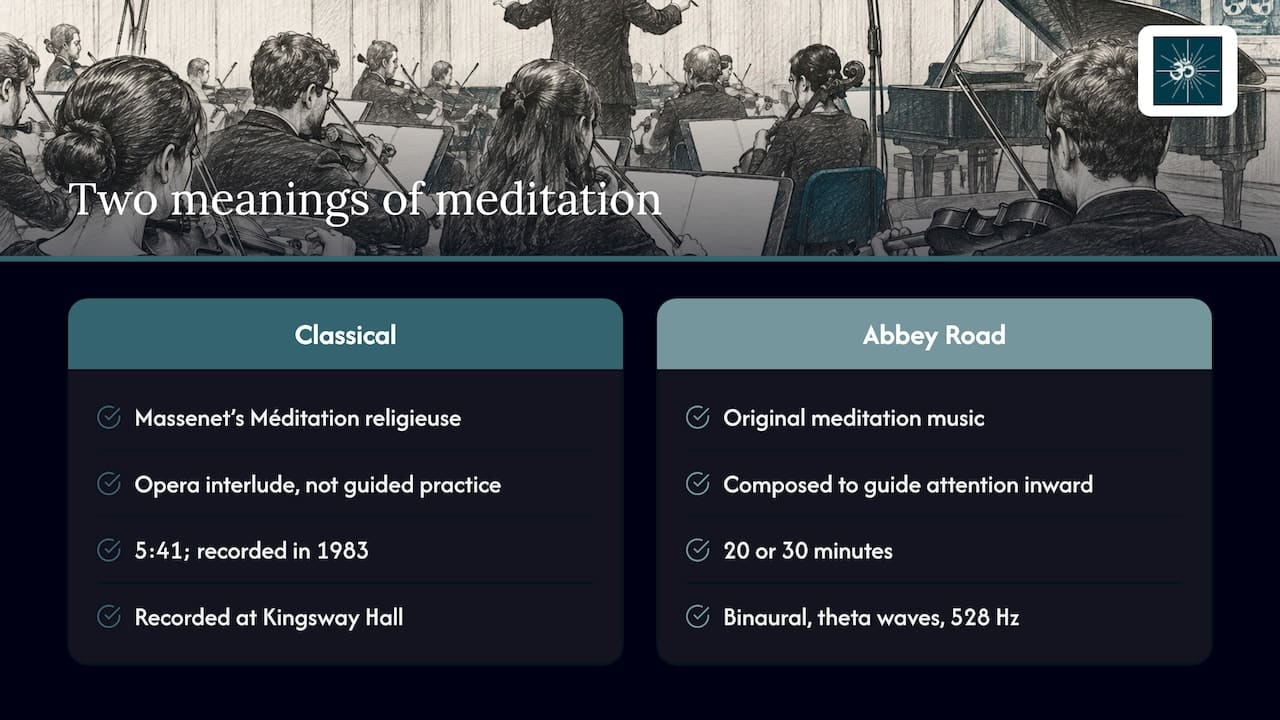
The classical “méditation”. The Decca album Meditation – Musik zum Entspannen und Träumen includes Massenet’s Méditation religieuse from Thaïs, played by Nigel Kennedy with the National Philharmonic Orchestra under Richard Bonynge, recorded on 7 December 1983 at Kingsway Hall and lasting 5:41. It is a lovely, slow violin line, and a perfectly good way to spend six minutes. In the context of the opera it is an interlude, though, not a guided practice.
The Abbey Road meditation sessions. On 16 May 2023 the orchestra announced it was back at Abbey Road, with 90 players and 32 chorus singers recording over two days. The 20 November 2023 launch announcement for the project describes live orchestral meditation music using binaural recording, theta waves and 528 Hz frequencies. That is the music Orchestral Meditations offers.
So the short answer to “which is which?” is simple. If the piece has a catalogue number and an opera behind it, it is classical repertoire. If it was composed from the first bar to carry your attention inward for twenty or thirty minutes, it is meditation music.
Why the Abbey Road recordings sound the way they do
I will confess something: for years I assumed “orchestral meditation” meant a synthesiser pad with a string preset and a stock photo of a waterfall. Then you hear forty live string players breathe together on one sustained chord, and the preset suddenly sounds like a fridge humming.
There are three practical differences when real musicians are in a real room.
- Human timing. Live players swell and release a fraction unevenly, the way breath does. That slight give is what makes a long, slow phrase feel alive rather than looped.
- Space. Abbey Road is one of the best-known recording rooms in the world, and a large ensemble recorded there carries the sense of a room around it. Our tracks use 3D surround sound and binaural techniques so that, on headphones, the sound seems to sit around you rather than between your ears.
- Intent. Our library is not mass-produced. We do not churn out thirty meditations a month. Each piece is composed for a particular state, whether that is settling, deep theta-range stillness or gentle opening.
A word on the frequency side, since it comes up constantly. Theta music is written around slow, spacious rhythms associated with deep relaxation, and Solfeggio-frequency tracks are built around specific reference tones. A review of music as a stress-management tool notes that 528 Hz music apparently lowers cortisol and increases oxytocin, and that melody, rhythm, tonality and frequency all shape how a given listener responds. That is the thinking behind how we design our recordings: sound as a considered set of ingredients, not wallpaper.
The people behind the music: Robert Emery and Moritz Schneider
When readers ask whether this is “real” orchestral work, the quickest answer is to look at who wrote and produced it.
Robert Emery is an English pianist, conductor, producer and orchestrator, born in Pelsall in the West Midlands. According to his biography, he became known after performing with artists including Russell Watson, Meat Loaf and Stewart Copeland (often conducting barefoot, which is a detail I rather admire), produced and conducted the Jubilee Anthem for Queen Elizabeth II’s Platinum Jubilee in 2022, and in 2023 was named music director of the National Philharmonic Orchestra of Great Britain. That last role is the bridge between the orchestra and this project: the person leading the players is also the person writing for them.
Moritz Schneider is the composer who works alongside him. The two have collaborated for years: they composed, produced and conducted the Swiss singer SEVEN’s album 4Colors, released on 7 July 2017. Together they lead the Orchestral Meditations team, which, as our royalty-free meditation music page puts it, specialises in music intended to relax you on both a conscious and a subconscious level.
Why does this matter to you as a listener? Because a composer-conductor pairing that has spent years writing pop, theatre and orchestral arrangements understands pacing. A meditation track lives or dies on how it handles the long middle: the stretch where nothing dramatic happens, and the music still has to hold you. Writers who know how to build and release tension know how to remove it gracefully, too.
How to use orchestral music in a meditation practice
Having a beautiful recording is the easy half. Here is a routine that works for a twenty-to-thirty-minute sitting, with the places where it tends to go wrong.
1. Choose the length before you press play
Decide whether you are doing ten minutes before a meeting or thirty before sleep, and choose a track close to that length. Where it goes wrong: a track that ends abruptly at minute seven breaks the state you have just reached.
2. Use headphones for the binaural and 3D tracks
Binaural recording works by delivering slightly different information to each ear, so it needs headphones to do what it was designed to do. Set the volume to a comfortable level and leave it there; a German clinical study of relaxation music used headphones, 30-minute sessions on ten consecutive days and a comfortable, self-selected volume, with breathing and relaxation instructions and visualisation. That is a sensible model for your own routine: same time, same setup, a level that never startles you.

3. Let the music set the breath
University of Miami music-therapy guidance suggests using repetitive patterns as a framework for breathing or meditation, pacing breaths or phrases with the rhythm. In an orchestral piece, listen for the rising and falling string phrases. Breathe in as a phrase lifts and out as it settles. You do not need to count anything.
4. Return, do not fight
Your mind will wander, probably to an email, possibly to whether you left the oven on. The same guidance describes passive return when attention drifts as part of what induces relaxation. Treat the music as a place to come back to: notice you have wandered, then rejoin the next phrase. Where it goes wrong is in scolding yourself, which is a rather effective way to ruin a perfectly good sitting.
5. Repeat the same piece for a week
Familiarity does a lot of the work. When the opening bars become a signal that it is time to settle, the music begins to do its job faster. Rotate pieces after a week or two, not every day.
Choosing a recording: match it to how you feel today
Here is the part most “best meditation music” lists skip. Teaching material from the University of Oldenburg on how music works on us points out that a listener’s starting level of arousal changes the effect: tense people may find fast, loud music more pleasant, while relaxed people tend to prefer slow, quiet music. In plain terms, a wound-up listener may find a very slow, very quiet piece oddly irritating at first.
The Miami guidance adds that preferred music can engage reward pathways, and that slow music may regulate heart rate and respiration. Taste is not a side issue, it is part of the mechanism. If a track moves you, you are more likely to stay with it.
A practical way to apply this:
| How you feel | What to reach for | Why |
|---|---|---|
| Wired, racing thoughts | A piece with a gentle, steady pulse and fuller orchestration, then slower tracks | Meets your energy, then lowers it |
| Tired but restless at bedtime | Slow theta-range tracks with long, soft string lines | Gives the mind little to chase |
| Calm and curious | Spacious, quiet pieces with 3D surround | Lets you explore the soundscape |
| Low or flat | Warm, melodic pieces you genuinely like | Preference supports engagement |
An enjoyable track is also a bridge to other traditions. If you practise energy work, for instance, the characteristics of reiki music will sound familiar: slow, soft, unhurried, built to be felt more than analysed.
What the research says about relaxing music
Here is the claim you can safely lean on. The stress-management review mentioned above reports that many studies, often involving classical music, found reductions in cortisol and sympathetic activity, including heart rate and blood pressure. It also stresses that responses depend on melody, rhythm, tonality, frequency and the individual listener. A review of music in intensive-care medicine likewise states that reactions to music are subjective and reports that relaxing music can reduce anxiety and cortisol in some clinical settings.
Two things follow. First, music is a reasonable, enjoyable partner to a relaxation practice. Second, the best recording is the one that suits the person, which is exactly why a library with different moods, lengths and frequencies is more useful than a single “perfect” track.
If you have a medical condition, are in treatment for anxiety, depression or pain, or have trouble sleeping that persists, speak to your doctor first. Meditation music is something to enjoy alongside professional care, not instead of it.
Meditation music versus music therapy
Music professionals in particular ask us where the line sits. The German Music Therapy Association defines music therapy as the purposeful use of music within a therapeutic relationship to promote mental, physical and cognitive health. Its July 2025 briefing reports that music therapy appears in 37 German AWMF guidelines, 29 of them S3 guidelines (the highest evidence level for German clinical guidelines), and describes improvements in areas such as pain, sleep quality, fatigue, anxiety and depression.
Those findings belong to therapy delivered by trained therapists. A recording you play at home is a different, personal practice: you choose it, you control it, and nobody is assessing you. Neither is a lesser version of the other. Related sound-based approaches, such as vibroacoustic therapy research, show how wide the field of sound and the body has become, and why it helps to be clear about which kind of experience you are having.
For therapists, yoga teachers and sound practitioners who use recorded music with clients, the licence matters as much as the track. Our professional licensing covers use in therapy, yoga, apps, guided audio, massage and wellness content, so you can play the music in your sessions without the awkward question of who owns it.
Hear the Abbey Road recordings yourself
If you want the National Philharmonic sessions in your own practice, there are two routes. The personal subscription costs €21 per month and gives you the library for your own listening. If you teach, guide or create, the professional subscription costs €150 per month and carries a professional licence. Our royalty-free meditation music collection is where you can browse the individual tracks for personal or professional use.
Most people begin by picking one track that fits their usual sitting length and repeating it for a week. It is a small experiment, and a rather pleasant one.
Our perspective
We started Orchestral Meditations because we kept noticing the same gap. There was plenty of meditation music, and very little of it had been played by people in a room.
Recording with the National Philharmonic at Abbey Road changed what we thought was possible. When a full orchestra and chorus play a single slow phrase together, you get a warmth and a slight unevenness that no sample library has ever quite given us. We wanted that in the hands of anyone who sits down to meditate, practise yoga, teach, or simply wind down after a long day.
We also wanted the craft to be taken seriously. Binaural recording, theta rhythms and Solfeggio-frequency tracks are not decoration for us: they are part of how each piece is composed and mixed, so that the music supports a state rather than merely accompanying it.
That is why we do not mass-produce. A smaller library of carefully composed, live-recorded pieces gives you something you can return to for months, and that familiarity is a big part of what makes meditation music work.
Whether you are listening for yourself or building sessions for others, our aim is the same: music with enough depth that you can lose yourself in it, and enough care that you can trust it.
ROBERT
FAQ
Is the National Philharmonic Orchestra the same as the London Philharmonic?
No. They are separate British orchestras. The National Philharmonic Orchestra recorded the Orchestral Meditations sessions at Abbey Road Studios, and its music director since 2023 is Robert Emery, who also composes for the project with Moritz Schneider.
Which National Philharmonic recording should I start with for classical relaxation?
A well-known starting point is Massenet’s Méditation from Thaïs, played by Nigel Kennedy with the National Philharmonic Orchestra under Richard Bonynge. It lasts 5:41. For a full-length sitting built specifically for meditation, our Abbey Road tracks are designed for that purpose.
Do I need headphones?
For binaural and 3D surround tracks, yes. Headphones deliver the spatial detail these recordings are designed around. Choose a comfortable volume that you can leave unchanged for the whole session.
Can I use the music in my yoga classes or therapy practice?
Yes, with a professional licence. Our professional subscription is €150 per month and the royalty-free library is licensed for use in therapy, yoga, apps, guided audio, massage and wellness content. Personal use is covered by the €21 per month personal subscription.
Is meditation music the same as music therapy?
No. Music therapy is delivered by a trained therapist within a therapeutic relationship. Meditation music is something you choose and use yourself as part of a personal relaxation or mindfulness practice.
Sources
- The NPO Back In Abbey Road, National Philharmonic
- Revolutionary New Meditation Music: Recorded at Abbey Road Studios
- Meditation – Musik zum Entspannen und Träumen, Decca (Presto)
- Robert Emery (pianist)
- Listening to music as a stress management tool
- Short-term effects of relaxation music on patients
- Leap into Well-being, University of Miami
- Wie wirkt Musik, University of Oldenburg
- Role of music in intensive care medicine
- German Music Therapy Association evidence briefing, July 2025
- Vibroacoustic therapy benefits backed by clinical research
- Cómo es la música de reiki