
Orchestral music is built from acoustic instruments and arranged narrative; ambient music prioritises texture and atmosphere over structure. They overlap constantly, especially in meditation, film, and installation work, where composers borrow orchestral timbres to thicken an ambient bed. Orchestral Meditations, working with composer and producer Robert Emery, sits right at that intersection, recording live orchestral material specifically for immersive, ambient‑leaning listening.
TL;DR:
- Orchestral recordings used in ambient music often feature natural decay and spatial cues captured through room miking or convolution reverb to enhance immersive texture.
- A blend of orchestral instruments and ambient techniques offers emotional depth and flexibility, suitable for meditation, film, and installation soundscapes.
- Using a single orchestral motif layered with a drone or pad can create effective ambient beds, emphasizing space and subtle dynamics over complex arrangements.
- Correct processing, including careful reverb application and automation, is essential to maintain clarity and avoid muddiness in ambient-leaning orchestral tracks.
- Purchasing or licensing live orchestral recordings, such as those from Orchestral Meditations, provides high-quality, spatially immersive sound for wellness, therapy, or meditative content.
Orchestral vs ambient: the core definitions
Ambient music is built to sit at the edge of attention. It leans on tone and atmosphere rather than melody or a steady beat, and the best of it works whether you’re listening closely or letting it drift into the background. Brian Eno’s own framing, gathered in research from Durham University, is that it can be “as ignorable as it is interesting.” That’s not a backhanded compliment. It’s the whole design brief.
Orchestral music works the opposite way. It’s written for acoustic sections, strings, brass, woodwind, percussion, arranged to build a narrative with real dynamic peaks and troughs. Where ambient wants you calm, orchestral often wants you moved, and it does that through contrast: a quiet passage followed by a swell, a solo instrument answered by the full ensemble.
Here’s how the two stack up side by side:
- Melody: ambient often minimises or abandons melodic hooks; orchestral usually foregrounds them.
- Rhythm: ambient typically avoids a steady pulse; orchestral uses tempo and metre to drive momentum.
- Instrumentation: ambient frequently uses synths, pads, and field recordings alongside or instead of acoustic instruments; orchestral relies on live sections and acoustic timbre, as Wikipedia’s overview of the genre sets out clearly.
- Dynamics: ambient stays largely flat and sustained; orchestral moves through wide dynamic swings.
- Production approach: ambient favours reverb, layering, and slow-evolving textures; orchestral favours close capture of ensemble detail and arrangement.
Ambient tends to soundtrack studying, meditation, or sleep. Orchestral tends to soundtrack a story, whether that’s a film, a game cutscene, or a live concert hall.
Where orchestral soundscapes and ambient textures blend
Genre lines get blurry fast once composers start borrowing across categories, and honestly, that’s where the interesting work happens. Neo-classical writing takes orchestral instrumentation and strips out the narrative momentum, leaving something closer to ambient in feel but acoustic in texture. Drone-with-strings pieces do something similar: a sustained low string pad, minimal harmonic movement, functioning less like a symphony and more like a slowly shifting wash of sound.
The overlap isn’t just aesthetic, it’s functional. Meditation apps, film scores, and sound installations all need music that can hold attention without demanding it, and that’s a job both genres can do depending on how they’re arranged. A composer scoring a contemplative film scene might use a string section the way an ambient producer uses a pad: not to tell you what to feel moment-to-moment, but to colour the room.
A few typological examples worth knowing:
- Ambient soundtrack work: minimal melodic material, heavy reliance on texture and space, built to sit under dialogue or visuals without competing.
- Neo-classical crossover: piano or strings arranged with ambient production values (long reverb, sparse harmony) rather than traditional classical structure.
- Orchestral drone pieces: sustained string or brass tones treated almost like a synth pad, occupying the same functional space as pure ambient.
This is also, not coincidentally, where a platform like Orchestral Meditations does most of its work, using live orchestral recordings but arranging and producing them with an ambient sensibility.
Blending orchestral instruments into ambient textures
Recording choices matter before you touch a plugin. Room miking captures the natural decay and air around an orchestral section, which gives you something an ambient mix can stretch and manipulate later. Close miking gives you detail and control but less of that natural bloom. Many producers record both and blend to taste. If you don’t have access to a live room, orchestral impulse responses used with convolution reverb can approximate that space convincingly, a technique Masterclass’s guide to ambient production points to as standard practice for building immersive texture.
Here’s a workable process:
- Capture or source clean orchestral material with as much dynamic headroom as possible.
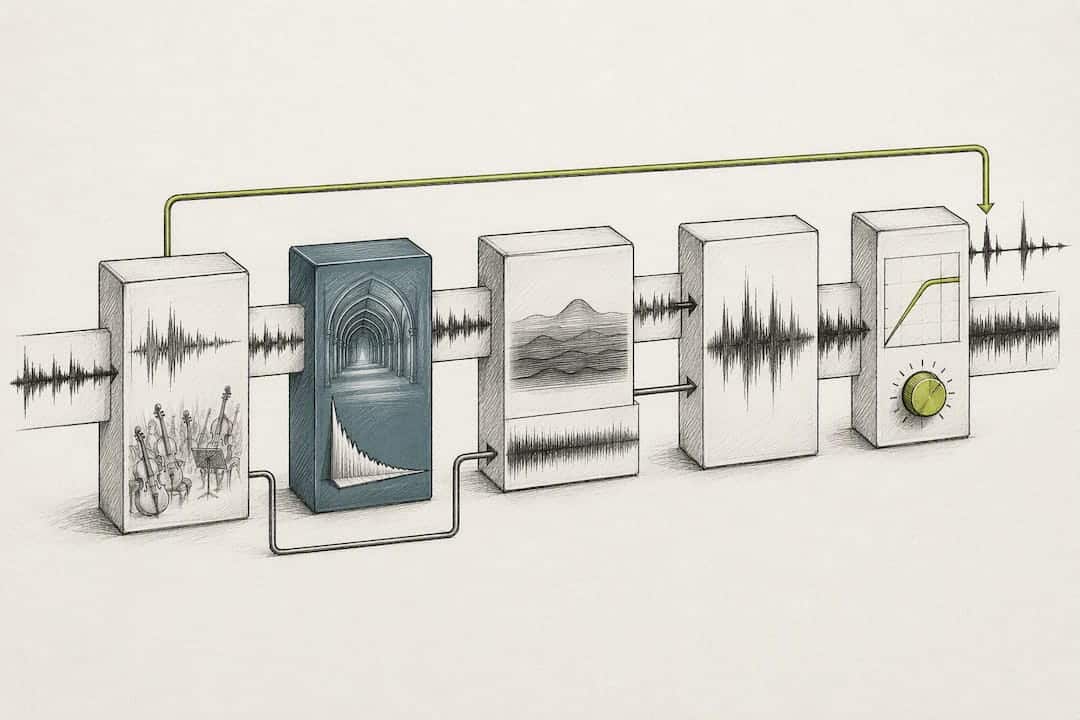
- Apply long, musical reverb using a convolution engine, ideally with an orchestral hall impulse rather than a generic plate or room.
- Gate or damp the reverb tails selectively so the sustain doesn’t turn to mud under repeated listening.
- Layer a drone or pad underneath the strings, low in the mix, to give the ambient bed continuity between orchestral phrases.
- Automate levels and EQ to preserve the original dynamic peaks rather than flattening everything into one texture.
Pro Tip: Automate a gentle EQ cut on your reverb return whenever the low end starts to build, rather than compressing it. Compression kills the sense of space that made the reverb worth using in the first place.
The signal chain that tends to work: dry orchestral track, a send to convolution reverb with an orchestral impulse, a parallel drone layer, then gentle bus compression only on the combined ambient bed, never on the orchestral source itself. Keep the transients intact. That’s where the emotional impact lives.
Choosing orchestral, ambient, or a blend
The decision comes down to how much attention your listener is likely to give the music, and how specific you need the emotional response to be.
- Pick orchestral when you need narrative precision, a film cue with a clear emotional turn, a game boss encounter, a concert piece.
- Pick ambient when you need something that can recede, meditation backing, long-form installation audio, focus or sleep tracks.
- Combine them when you want emotional depth without demanding full attention, guided meditation with live strings, a game’s exploration ambience, spa or wellness content.
Delivery format matters too. A film cue usually stays in stereo for practical reasons. Meditation and wellness audio increasingly uses 3D surround or binaural mixing to deepen immersion, which is part of why platforms built specifically for that use case, like Orchestral Meditations, invest in spatial techniques rather than a standard stereo bounce.
A starter workflow for your first orchestral-ambient track
You don’t need a full studio to start. You need a clear intent and a willingness to keep things simple on the first attempt.
- Define your lane first. Decide whether the track leans more orchestral (narrative, dynamic) or more ambient (textural, flat), because that decision shapes every choice after it.
- Pick one orchestral motif and one ambient bed. Don’t stack five ideas. A single string phrase over a single pad is enough to test the blend.
- Source your material properly. Use cleared live recordings or a properly licensed sample library if the track is going anywhere commercial. Licensing gets expensive to fix retroactively.
- Process and spatialise. Apply convolution reverb, layer the drone, and start shaping stereo or surround placement early rather than as an afterthought.
- Mix and master with restraint. Preserve transients on the orchestral element, resist over-smoothing the whole mix into mush, and use automation instead of blanket compression wherever you can.
The single most common beginner mistake is treating “ambient” as permission to skip mix discipline. It isn’t. Ambient tracks still need clarity, or they collapse into noise.
Orchestral Meditations: studio provenance and production credits
Orchestral Meditations records its orchestral meditation library with the National Philharmonic at Abbey Road Studios, pairing live orchestral timbre with binaural and 3D surround production. Composer and producer Robert Emery leads the compositional and production work behind these recordings.
- Live orchestral sessions at Abbey Road Studios rather than sample-based scoring.
- Production built around 3D and binaural techniques for immersive, spatial listening.
- Long decay times and spacious arrangement suited to meditation rather than narrative scoring.
That combination, live timbre plus deliberate spatialisation, is exactly the studio craft described earlier: room capture, careful reverb, and dynamic restraint, applied specifically for meditative listening rather than film narrative.
Why the fusion matters more than the argument
People love a tidy binary, orchestral versus ambient, as if you have to pick a side. I don’t think that’s how the best work gets made. The fusion gives you emotional range that pure ambient can’t and a usability that pure orchestral often lacks: something that rewards close listening but doesn’t collapse if the listener’s mind wanders. Experiment with the blend depending on context, a meditation track wants a different ratio than a film cue, and don’t treat either genre as the “correct” default.
— ROBERT
Where to hear and licence orchestral-ambient meditation tracks
If you’d rather licence finished material than build the blend yourself, Orchestral Meditations offers exactly the kind of ready-made option this article has been describing: live orchestral recordings, produced with binaural and 3D techniques specifically for meditation, therapy, yoga, and wellness content, rather than adapted from film or concert material after the fact.
Tracks are available for individual purchase or through a subscription, with both personal and professional licensing available for practitioners, therapists, app developers, and content creators who need cleared, commercial-ready audio. If you want a working example of how orchestral instruments translate into genuinely immersive ambient listening, browse the Orchestral Meditations shop and preview a track before deciding which licence fits your project.
Sources
FAQ
What qualifies as ambient music?
Music built around tone, texture, and atmosphere rather than melody or a steady beat, designed to work whether the listener is paying close attention or letting it fade into the background, as Wikipedia’s genre overview sets out.
What’s the difference between classical and orchestral music?
Classical refers to a historical style and period of composition, while orchestral simply describes music written for an orchestra, an ensemble of string, brass, woodwind, and percussion sections, regardless of era or genre.
What are the four types of orchestras?
Orchestras are commonly grouped into symphony orchestras, chamber orchestras, string orchestras, and concert or pops orchestras, distinguished mainly by size and the range of instrument sections used.
Is ambient considered EDM?
No. Ambient predates and sits outside most EDM subgenres because it typically avoids a steady danceable beat, focusing on texture and atmosphere instead, though the two occasionally cross over in downtempo or chill-out production.
Can orchestral music work for meditation?
Yes, when arranged with long decays, spacious production, and restrained dynamics rather than a narrative arc, which is the approach Orchestral Meditations takes with its live-recorded, binaural meditation tracks.