Delta binaural waves are auditory tones designed to synchronise the brain’s electrical activity to deep sleep and relaxation frequencies between 0.5 and 4 hertz. The technique works through a phenomenon called binaural beating: play a tone of 200 Hz in one ear and 204 Hz in the other, and your brain perceives a third tone at the 4 Hz difference. That perceived pulse sits squarely in the delta brainwave range, the same territory your brain occupies during the deepest, most restorative stages of sleep. Whether you are chasing better rest, a deeper meditation practice, or simply a way to quiet a relentlessly chatty mind, understanding how delta wave sound therapy actually works is the most useful place to start.
What does the science say about delta binaural waves?
The research picture is genuinely encouraging, though not without its wrinkles. A 2026 pilot study examining brainwave entrainment in medical students found that delta entrainment improved N3 deep sleep duration, sleep efficiency, and reduced the time it took participants to fall asleep. N3 is the stage scientists associate with physical repair, immune function, and memory consolidation. Getting more of it is not a minor perk.
The neurological mechanism behind this is thalamocortical synchronisation. Put simply, the thalamus and cortex begin to fire in coordinated rhythms during deep sleep, and delta wave entrainment appears to nudge that process along. Think of it like a metronome helping a slightly out-of-time orchestra find its groove. The brain does not always need much encouragement; sometimes it just needs a reliable pulse to follow.
“Binaural beats may modulate brain activity indirectly through attentional and cross-frequency coupling mechanisms rather than direct cortical entrainment. The effect is real, but the pathway is more nuanced than early research suggested.”
Cedars-Sinai Health Insights
That nuance matters. A 2023 systematic review found five studies supporting binaural beat effectiveness, eight contradicting it, and one returning mixed results. That is not a ringing endorsement, but it is also not a dismissal. Individual neurobiological differences play a significant role in how strongly any given person responds to auditory entrainment.
Binaural beats are a complementary tool, not a medical treatment. Practitioners consistently advise combining them with healthy sleep hygiene, stress management, and regular relaxation practices for the best results. If you are treating them as a standalone cure for chronic insomnia, you are setting yourself up for disappointment.
Pro Tip: Read binaural beat research with healthy scepticism. Look for studies that specify the exact frequency used, the session duration, and whether participants wore headphones. Studies that omit these details are difficult to replicate and harder to trust.
How do delta binaural waves compare with other entrainment methods?
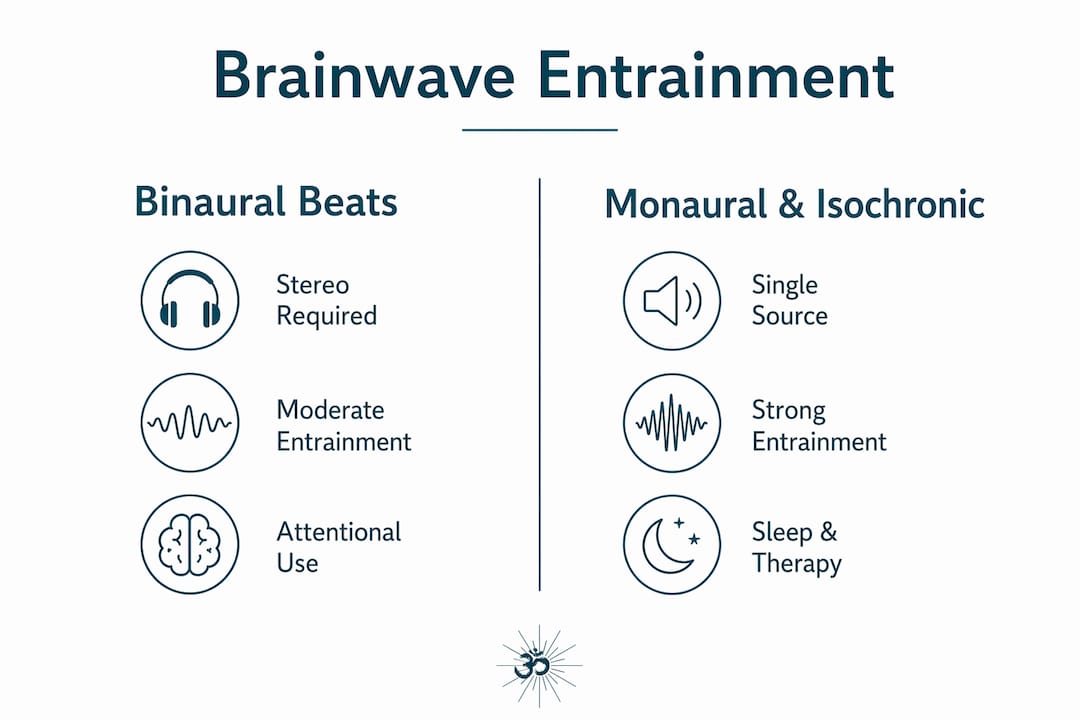
Binaural beats are not the only way to drive brainwave entrainment through sound. Two other techniques, monaural beats and isochronic tones, take a different approach and produce measurably different neurological effects. Understanding the distinctions helps you choose the right tool for the right moment.

Monaural beats and isochronic tones generate stronger cortical entrainment responses than binaural beats. Monaural beats combine two tones before they reach the ear, creating a physical amplitude modulation that both hemispheres process simultaneously. Isochronic tones use sharp, discrete pulses with clear on-off patterns. Both methods produce what researchers call auditory steady-state responses, which are measurable and consistent. Binaural beats, by contrast, create their effect entirely inside the brain. The “beat” does not exist in the air; it exists in your auditory cortex.
That subtlety is actually an advantage in certain contexts. Because binaural beats work through attentional and cross-frequency coupling mechanisms, they tend to feel gentler and more immersive. For deep sleep and meditation, where the goal is to ease the brain into a relaxed state rather than jolt it, that softer touch is often preferable. For readers curious about how these methods stack up against each other in clinical settings, the isochronic tones comparison on Orchestralmeditations goes into useful detail.
| Method | How it works | Entrainment strength | Best use |
|---|---|---|---|
| Binaural beats | Brain perceives frequency difference between two tones | Subtle, indirect | Sleep, deep meditation |
| Monaural beats | Two tones mixed before reaching the ear | Moderate, physical | Focused relaxation |
| Isochronic tones | Discrete pulses with sharp on-off pattern | Strong, direct | Active focus, alertness |
Sound quality matters enormously in this comparison. A poorly produced binaural track with frequency drift or background noise will undermine the entrainment effect regardless of the method used. This is precisely why the expertise of the composer and producer is not a luxury; it is a functional requirement.
How to use binaural beats for delta wave meditation safely
Getting the most from deep sleep binaural waves requires more than pressing play and hoping for the best. The listening environment, session timing, and your broader wellness habits all shape the outcome.
The non-negotiables for effective listening:
- Use stereo headphones. Binaural beats require separate audio signals to each ear. Speakers mix the tones before they reach you, which eliminates the binaural effect entirely.
- Choose a quiet, comfortable space. External noise disrupts the subtle frequency perception the brain needs to entrain. A dark room before bed is ideal for delta wave meditation.
- Keep sessions to 30–60 minutes. Longer sessions do not necessarily produce stronger effects and can occasionally cause grogginess or mild headaches in sensitive listeners.
- Time your sessions strategically. Listening 20–30 minutes before sleep or at the start of a meditation session gives the brain time to shift into a receptive state.
- Stop if you feel discomfort. Dizziness, anxiety, or irritability are signals to pause. Safe binaural beat use always includes the option to discontinue without guilt.
Consistency matters more than intensity. A 30-minute session three or four times a week will produce more noticeable results than an occasional two-hour marathon. The brain responds to patterns, not heroic one-off efforts.
Integrating delta wave sound therapy with other wellness practices amplifies the effect considerably. Good sleep hygiene, a regular bedtime, reduced screen exposure in the evening, and holistic stress management all create conditions in which the brain is already primed to shift into lower frequency states. Binaural beats work best when they are nudging a brain that is already heading in the right direction, not dragging a wired, stressed mind into submission.
Pro Tip: Keep a simple sleep log for two weeks when you start using delta binaural waves. Note your session duration, how quickly you fell asleep, and how rested you felt in the morning. Patterns emerge faster than you expect, and the data helps you adjust your routine with confidence.
For a deeper look at how delta frequencies interact with sleep cycles and night-time recovery, the Orchestralmeditations article on delta waves and sleep is worth reading alongside this one.
How Robert Emery and Moritz Schneider shape the delta binaural wave experience
The difference between a mediocre binaural track and a genuinely effective one often comes down to the person who made it. Robert Emery and Moritz Schneider, the composers and producers behind Orchestralmeditations, represent the serious end of this craft.
Robert Emery is a composer and producer with deep roots in orchestral and ambient music. His work draws on classical training and a thorough understanding of how harmonic structure affects emotional and physiological states. He approaches meditation music not as background wallpaper but as a precisely engineered acoustic environment. That distinction shows in the detail: the way a cello line resolves, the space left between phrases, the careful placement of a frequency layer beneath the melody.
Moritz Schneider brings a complementary perspective, with expertise in sound design and the technical architecture of frequency-based audio. His understanding of how binaural beats frequencies interact with ambient orchestral layers is what separates a track that feels immersive from one that feels clinical. The meditation music library at Orchestralmeditations reflects their combined approach: recordings made with the National Philharmonic at Abbey Road Studios, layered with scientifically considered frequency work.
What makes their production philosophy distinctive:
- Ambient layering. Natural soundscapes, orchestral textures, and binaural frequencies are blended so the listener is not consciously aware of the technical architecture beneath the music.
- Frequency precision. Delta frequencies are embedded accurately and consistently throughout each track, avoiding the drift that undermines cheaper productions.
- Dynamic pacing. Tracks are structured to guide the listener gradually into deeper states rather than dropping them abruptly into a low-frequency environment.
- Production environment. Recording at Abbey Road Studios with live musicians produces a warmth and spatial depth that digital-only productions rarely achieve.
The quality of the music is not incidental to the therapeutic outcome. Expert music production that layers ambient soundscapes with binaural frequencies creates a listening experience the brain finds genuinely easier to follow into relaxation. A rough, poorly mixed track creates cognitive friction. A beautifully produced one removes it.
Key takeaways
Delta binaural waves work most reliably when combined with consistent sleep hygiene, quality headphones, and professionally produced recordings that embed accurate delta frequencies throughout.
| Point | Details |
|---|---|
| Delta frequency range | Delta binaural waves operate between 0.5 and 4 Hz, matching the brain’s deep sleep and restoration frequencies. |
| Research is promising but mixed | 2026 pilot studies show improved N3 sleep and efficiency, but a 2023 review found contradictory results across multiple studies. |
| Headphones are non-negotiable | Binaural beats require separate signals to each ear; speakers eliminate the effect entirely. |
| Complement, do not replace | Delta wave sound therapy works best alongside good sleep hygiene, not as a standalone treatment. |
| Producer quality matters | Composers like Robert Emery and Moritz Schneider embed frequencies accurately within orchestral layers, which directly affects entrainment outcomes. |
Why I think most people are using binaural beats wrong
Here is something I have noticed after years of working with meditation music: most people treat binaural beats like a vending machine. They press play, expect an immediate result, and give up after a week when they do not feel transformed. That is not a failure of the technology. That is a failure of expectation management.
The research is clear that individual variability is enormous. Some listeners shift into a measurably different brainwave state within minutes. Others show little measurable response even after weeks of consistent use. Neither outcome says anything definitive about the quality of the recording or the validity of the method. It says something about the extraordinary complexity of the human nervous system.
What I have found actually works is treating delta wave meditation as a practice rather than a product. You would not expect one yoga class to change your flexibility permanently. The same logic applies here. Consistent, patient, low-pressure listening, ideally with music produced by people who genuinely understand both the science and the craft, is where the real benefit accumulates.
Robert Emery and Moritz Schneider’s work at Orchestralmeditations represents the kind of production I would point anyone towards who is serious about this. The Abbey Road recordings carry a physical warmth that cheaper productions simply cannot replicate, and that warmth matters more than most people realise when you are trying to coax a stressed brain into a delta state.
The science will keep evolving. The 2026 findings are encouraging, and I expect the next decade of research to clarify the mechanisms considerably. In the meantime, the practical advice is simple: use good headphones, find music made by people who know what they are doing, and give it more than a fortnight.
— ROBERT
Orchestralmeditations’ collection for deep sleep and relaxation
Orchestralmeditations produces a curated library of meditation music that incorporates delta binaural waves within full orchestral arrangements recorded at Abbey Road Studios with the National Philharmonic.

The collection spans tracks designed specifically for sleep, deep meditation, and relaxation, each produced by Robert Emery and Moritz Schneider with frequency accuracy and musical depth in mind. Whether you are new to binaural beats or looking to replace a poorly produced track with something that actually works, the meditation music library offers a range of options built around the science covered in this article. For those exploring alternative sound-based approaches to mental well-being, the Orchestralmeditations catalogue sits at the intersection of clinical awareness and genuine musical craft.
FAQ
What are delta binaural waves?
Delta binaural waves are auditory stimuli that create a perceived frequency between 0.5 and 4 Hz by playing two slightly different tones to each ear separately. The brain perceives the difference as a pulse, which can encourage brainwave activity to shift towards the delta range associated with deep sleep.
Do binaural beats for sleep actually work?
Research is mixed but encouraging. A 2026 pilot study found measurable improvements in N3 deep sleep duration and sleep efficiency after delta brainwave entrainment sessions. A 2023 systematic review found contradictory results across studies, so individual response varies considerably.
Do you need headphones for delta wave meditation?
Yes. Binaural beats require a separate audio signal to each ear. Without stereo headphones, the two tones mix before reaching the brain, and the binaural effect does not occur.
How long should a delta binaural wave session last?
Sessions of 30–60 minutes are generally recommended. Longer sessions do not reliably produce stronger effects and can occasionally cause mild grogginess in sensitive listeners.
Can delta binaural waves replace sleep medication or therapy?
No. Delta binaural waves are a complementary wellness tool, not a medical treatment. They work best alongside healthy sleep hygiene, stress management, and, where relevant, professional medical or psychological support.