Many people who try 963 Hz meditation describe a settling sense of calm, a feeling of “opening” at the crown of the head, and occasional moments of unity or connection. These are common personal experiences worth taking seriously, though there is no direct scientific proof that the frequency itself causes these effects rather than the meditation practice around it. Therefore, the honest approach is to experiment gently and remain curious rather than certain.
TL;DR:
- Scientific studies have not demonstrated any biological effects unique to 963 Hz, and its claimed benefits are likely due to meditation, relaxation, and expectancy effects.
- High-quality recordings from professional studios use orchestral and binaural techniques, which can enhance the listening experience and reduce discomfort from digital artefacts.
- Listening should be limited to short durations, at moderate volume, and avoided during activities like driving or operating machinery to ensure safety.
- The association of 963 Hz with spiritual awakening or the crown chakra is based on modern reinterpretation, not ancient tradition or proven science.
- Practical integration includes quick reset sessions during breaks or pairing 963 Hz with other guided meditations, with tracking to assess personal effects over time.
What 963 Hz is and its Solfeggio lineage
Long before anyone was uploading tones to streaming apps, an Italian monk named Guido d’Arezzo built a set of six syllables (ut, re, mi, fa, sol, la) to help singers remember pitches in Gregorian chant. That was music theory, not mysticism: a mnemonic device for choir practice, roughly a thousand years ago.
The modern “Solfeggio frequencies” you see attached to 963 Hz are a different animal entirely. Modern Solfeggio frequency sets were only systematised in the 1990s, built around a numerology-based reinterpretation rather than a continuation of medieval chant theory. In that later scheme, 963 Hz sits at the top of the sequence and gets tied to the crown chakra, sometimes nicknamed the “frequency of God” because it is framed as the tone of oneness, awakening and connection to higher consciousness.
You will find it presented in a few common formats:
- Pure sine-wave tones, played alone for extended stretches.
- Tuning forks calibrated to 963 Hz, used in sound healing sessions.
- Layered ambient or orchestral tracks where 963 Hz sits underneath music rather than as a standalone drone.
None of that history makes the frequency dangerous or fraudulent. It just means the “ancient wisdom” framing is more marketing than archaeology, and it is worth knowing that before you build expectations around it.
What the research actually says: evidence, plausible mechanisms and gaps
Here is the plain version: no peer-reviewed study has shown that 963 Hz activates the pineal gland, repairs DNA, or does anything uniquely biological that other calming sounds do not also do. A 2020 review on sound and healing found no evidence for these frequency-specific claims, and it also flags a common mix-up: binaural beats work through a low-frequency differential between two tones played in each ear, typically in the 1 to 30 Hz range, which is mechanically unrelated to listening to a single audible tone like 963 Hz.
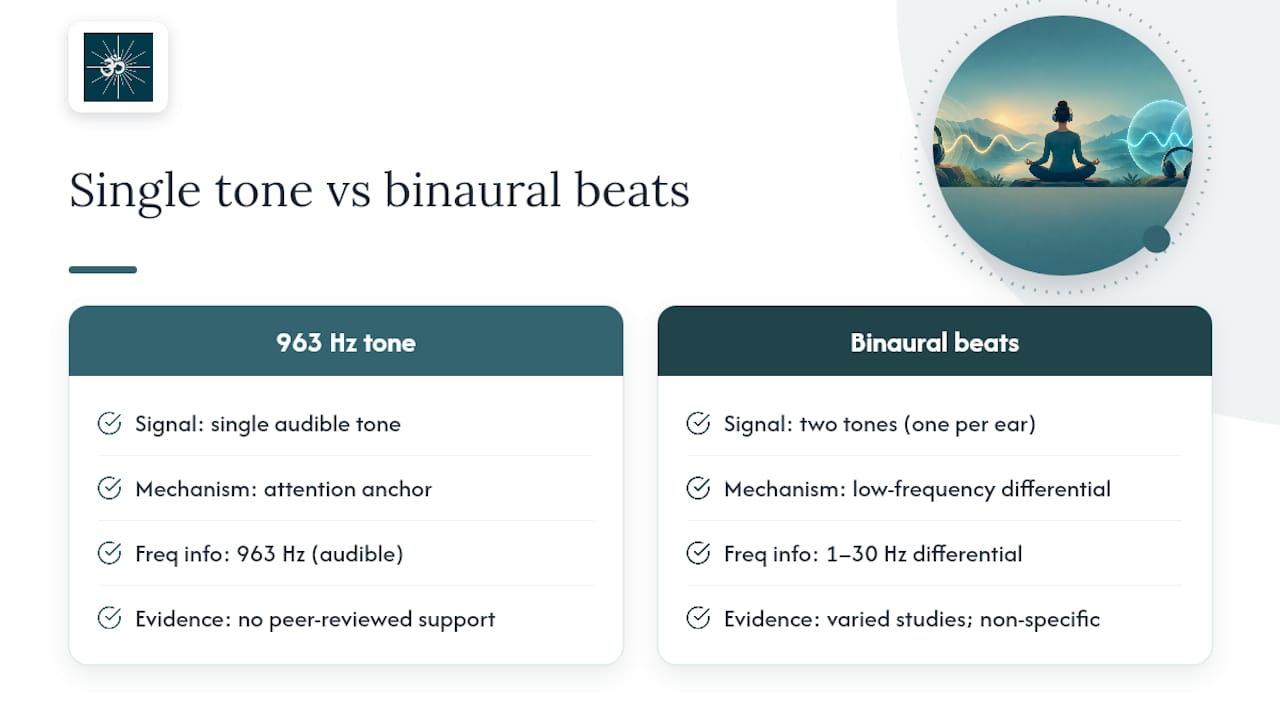
A systematic review of sound-based interventions covering singing bowls and related sound therapies found that sound-based practice can reduce anxiety and shift markers like heart-rate variability and EEG activity, but the studies are too varied to isolate any single frequency’s effect. That is a meaningful, if modest, evidence base for sound and meditation generally. It is not evidence for 963 Hz specifically.
So what is actually happening when someone feels lighter after a session? Three plausible mechanisms, none of them exotic:
The value of frequency practice likely derives from meditative attention and relaxation rather than a frequency-specific biological effect.
That framing, drawn from the review above, points to an attention anchor (the tone gives your mind something steady to return to), a relaxation response (slow, sustained sound tends to favour a calmer nervous-system state), and expectancy (believing a tone is spiritually significant can genuinely shape how you experience it). None of that makes the experience fake. It just means the mechanism is you, more than the hertz.
Practical safety and listening guidance for 963 Hz sessions
Treat your first sessions as an experiment, not a ritual you have to get right.
- Start with 5 to 10 minutes and only extend the session once you know how your body responds.
- Never listen while driving, cycling or operating machinery, and stop immediately if you feel dizzy, get a headache or notice rising anxiety, in line with general NHS guidance on meditation and mindfulness.
- Use decent headphones or speakers rather than a phone’s built-in speaker: heavily compressed audio can introduce harsh overtones at high frequencies that some people find genuinely uncomfortable.
- Keep the volume moderate. Loud is not the same as effective.
- If you have a history of seizures, severe anxiety, or another significant mental health condition, talk to a clinician before adding altered-state audio practices to your routine.
Pro Tip: Download or stream the highest bit-rate version available; a poorly compressed 963 Hz track is more likely to produce a fatiguing whine than a soothing tone.
Practical session templates and ways to integrate 963 Hz into practice
You do not need a special ritual to try this, just a plan that fits the time you actually have.
- The micro reset (5 to 10 minutes): play a single 963 Hz tone or a soft ambient version during a commute pause or a work break, eyes closed if it is safe to do so, breathing slowly.
- The focused crown session (20 to 30 minutes): set a simple intention, use the tone as an anchor whenever your attention drifts, and give yourself two or three minutes at the end to return gently before standing up.
- The layered session: pair 963 Hz with a theta or binaural background track, or use it as a closing few minutes after a longer guided meditation, letting it act as a soft outro rather than the whole practice.
- The two to four week check-in: jot down duration, volume, and how you felt afterwards each time, then look back after a few weeks to see whether the effect holds up or fades, which is a useful way to separate a genuine shift from simple novelty.
Production quality and credentials behind studio-grade 963 Hz recordings
Not all 963 Hz audio is made equally, and the difference is audible the moment you put on decent headphones. Orchestral Meditations records its meditation music at Abbey Road Studios with the National Philharmonic, which is a different proposition entirely from a synthesised tone bounced out of a free plugin.
- Studio recordings with live musicians avoid the harsh digital artefacts that cheap, heavily compressed tone generators produce.
- The catalogue uses 3D surround sound and binaural techniques layered around orchestral material rather than a single flat sine wave.
- Composer and producer Robert Emery, known for his work across film, television and orchestral recording, brings the same production discipline to meditation music that he applies to scored soundtracks, and fellow composer Moritz Schneider contributes to the same body of work.
Better production is not a luxury detail. Cleaner audio, without the whining overtones that budget compression introduces, means fewer of the small discomforts (a nagging headache, an irritating buzz) that can derail an otherwise calm session before it has properly begun.
A balanced view on 963 Hz and what to expect
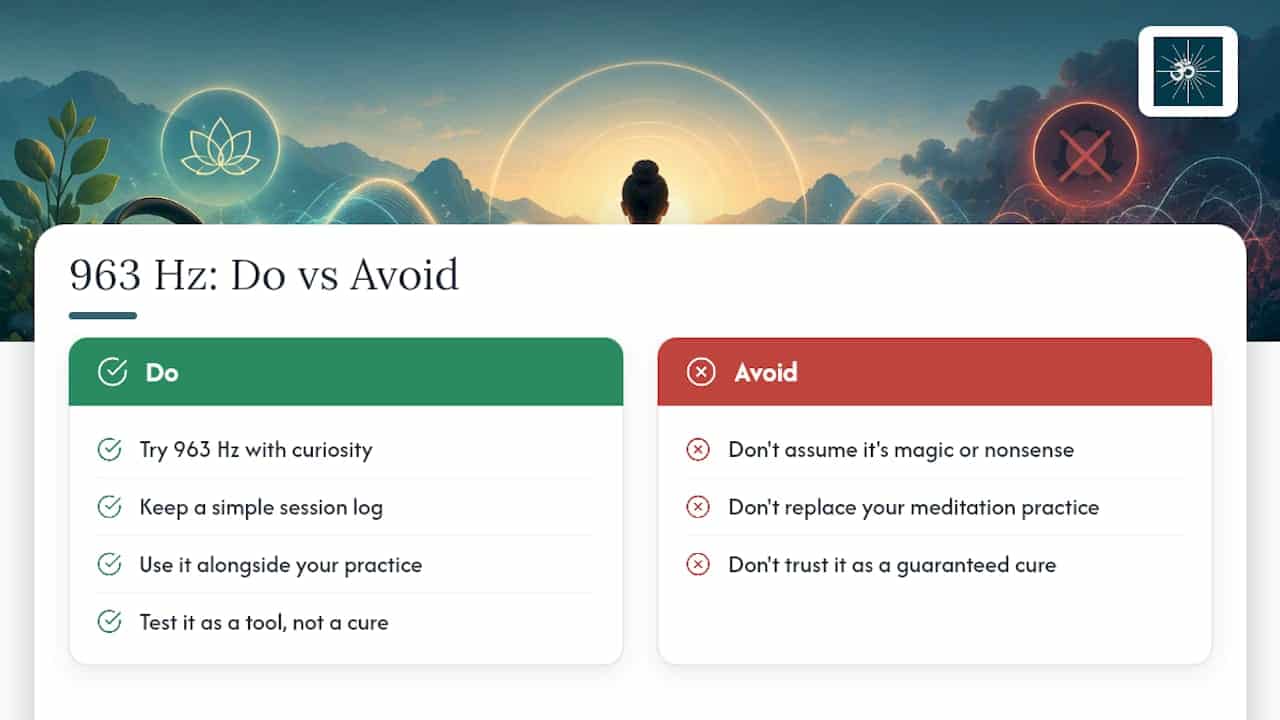
I would rather you try 963 Hz with curiosity than with the conviction that it is either nonsense or magic. The honest middle ground is this: the tone can genuinely help you settle, mostly because it gives your attention something steady to hold onto, and that is worth something on its own.
Keep a simple log of how sessions feel, and let 963 Hz sit alongside an established meditation practice rather than replace one. Treat it as a tool you are testing, not a cure you are trusting.
— ROBERT
How Orchestral Meditations can help you find studio-grade 963 Hz recordings
Once you know you like the experience, the next question is where to find recordings that will not undercut it with cheap production. Orchestral Meditations records its Solfeggio and 963 Hz material at Abbey Road Studios with the National Philharmonic, so you are working with the same audio quality used for professional film and television scoring rather than a generated tone with rough edges.
- The Personal subscription gives individual listeners ongoing access to the full catalogue, including Solfeggio-based tracks, at current prices listed on the website.
- The Professional subscription is built for therapists, yoga instructors and other practitioners who need licensed, royalty-free tracks for client sessions, with pricing details available on the website.
- If you prefer to buy outright rather than subscribe, the Royalty Free Meditation Music library lets you licence individual tracks for personal or commercial use, including in apps, classes and guided audio.
Whichever route suits you, you get music built for the way this practice actually works: something steady, well recorded, and comfortable to sit with for as long as you need.
Sources
- PMC7493074 — review on sound and healing (2020)
- Systematic review of Tibetan singing bowl interventions and related sound therapies (PubMed 2025)
FAQ
What does 963 Hz frequency do?
Listeners commonly report relaxation, a sense of mental clarity and, for some, a feeling of connection or unity during meditation. There is no peer-reviewed evidence that the frequency itself produces these effects biologically, so the calming quality most likely comes from the meditative attention the tone supports, as the review on sound and healing notes.
Is it safe to listen to 963 Hz?
For most healthy adults, listening at a moderate volume for short sessions is considered low-risk, similar to other calming audio. You should avoid it while driving or operating machinery, and stop if you feel dizzy or anxious, following general NHS guidance on mindfulness practices.
Why is 963 Hz called the frequency of God?
The nickname comes from its place at the top of the modern Solfeggio sequence, where it is associated with the crown chakra, spiritual awakening and a sense of oneness. This framing emerged when modern Solfeggio sets were systematised in the 1990s rather than from any documented ancient tradition.
What is the healthiest Hz to listen to?
There is no single frequency proven to be the healthiest, since research on sound-based meditation shows general benefits like reduced anxiety without isolating one tone as superior. Choosing well-produced audio at a comfortable volume tends to matter more than the exact frequency you pick.