No, 432 Hz is not objectively better than 440 Hz. It is a slightly lower reference pitch, sitting roughly 32 cents below the international standard, with a small body of preliminary evidence suggesting modest physiological differences and a much larger body of internet mythology suggesting everything from cosmic harmony to Nazi conspiracies. Here is what you actually need to know before you go down that rabbit hole.
- ISO 16 sets A4 at 440 Hz as the recognised international reference pitch for concert tuning.
- Switching to 432 Hz lowers every note by approximately 31.8–32 cents, or about 1.8–1.9% in frequency.
- Interval relationships in equal temperament do not change. A major third is still a major third.
- A 2019 double-blind pilot study found a mean heart-rate reduction of about 4.8 bpm when listening to 432 Hz music, but the authors flagged the result as preliminary and called for larger trials.
- Claims linking 432 Hz to sacred geometry, the Schumann resonance, or Nazi propaganda have been fact-checked and rejected by Reuters.
This article is for general information only. If you are exploring frequency-based music for a specific health concern, please consult a qualified healthcare professional.
The evidence and practical steps are below. Whether you are a curious listener, a meditation practitioner, or a musician considering a retune, there is something genuinely useful here.
Key takeaways
The 432 Hz vs 440 Hz debate is genuinely interesting, but the evidence points clearly toward production quality and personal preference as the variables that matter most for listeners and practitioners.
| Point | Details |
|---|---|
| The pitch difference is small but audible | 432 Hz sits approximately 32 cents below 440 Hz, a subtle shift most listeners notice as a slightly “lower” or “warmer” sound. |
| Intervals and harmony are unchanged | Equal-tempered interval relationships are identical at both reference pitches; only absolute pitch height shifts. |
| Preliminary evidence exists, but is limited | A 2019 double-blind pilot study found a mean heart-rate reduction of about 4.8 bpm at 432 Hz, but the authors called for larger trials before drawing clinical conclusions. |
| Conspiracy claims are unfounded | Reuters fact-checked viral claims about Nazi imposition of 440 Hz and found no credible supporting evidence. |
| Orchestralmeditations offers native 432 Hz masters | Professionally recorded, artefact-free 432 Hz tracks with personal and professional licensing are available for reliable listening tests and therapeutic use. |
How did A = 440 Hz become the modern standard?
The short answer is: slowly, messily, and through a lot of arguing.
For most of Western music history, there was no single agreed pitch. Baroque organs in Germany were tuned to what we would now call A = 415 Hz. Handel reportedly used an A closer to 422 Hz. By the 19th century, orchestras were creeping upward, some reaching A = 452 Hz or higher, partly because a brighter, more piercing sound carried better in large concert halls. Verdi famously campaigned against this pitch inflation, arguing it was straining singers’ voices and distorting the character of his operas.
The push for standardisation gathered pace in the early 20th century. A 1939 international conference in London proposed A = 440 Hz as a workable compromise, and the standard was formalised as ISO 16 in the mid-20th century, with subsequent reaffirmations keeping it in place. Today, virtually every instrument manufacturer, orchestral body, and recording studio in the world calibrates to 440 Hz.
Why does this matter practically? Because a shared reference pitch means a violin made in Manchester, a piano tuned in Tokyo, and a digital audio workstation in Los Angeles can all play together without sounding like a cat fight. Standardisation is, frankly, one of the less glamorous but more genuinely useful achievements in music history.
Pro Tip: If you listen to recordings from before the 1940s and something sounds slightly “flat” compared to modern releases, you are probably hearing the effect of a lower historical reference pitch. It is not a recording flaw. It is history.
What exactly changes when you shift from 440 Hz to 432 Hz?
Let us do the maths, because it is simpler than the internet makes it sound.
The frequency difference between A = 440 Hz and A = 432 Hz is 8 Hz in absolute terms. In musical cents (the standard unit for measuring small pitch intervals, where 100 cents equals one semitone), the shift is approximately 31.8–32 cents. For context, most trained musicians can reliably detect a difference of around 5–10 cents in a direct comparison. So yes, the shift is audible, but only just, and mostly as a general sense that the music sounds slightly “lower” or “warmer.”
Every note shifts by the same number of cents. The intervals between notes stay identical. A perfect fifth is still a perfect fifth. A minor third is still a minor third. The entire harmonic architecture of the music is preserved; only the absolute pitch height changes.
This is where a practical problem creeps in. If you mix a 432 Hz source with a 440 Hz source without retuning, you will hear audible beating and a persistent out-of-tune quality. It is the musical equivalent of two people trying to sing the same song in different keys simultaneously. Not pleasant.
Here is a simple listening test you can run at home:
- Find two versions of the same piece, one at 440 Hz and one at 432 Hz (or use a pitch-shifting app to create both from a single source).
- Match the playback volume carefully. Louder almost always sounds “better,” so volume parity is non-negotiable for a fair test.
- Listen to each version for at least 60 seconds before switching. Short snippets do not give your auditory system time to settle.
- Note your impressions without looking at which version is playing. Write them down before switching.
- Repeat the comparison at least three times, randomising the order.
If your impressions are consistent across repetitions, that is a meaningful preference signal. If they vary, you are probably responding to context rather than pitch.
What are the most common 432 Hz claims, and do they hold up?
Here is where things get colourful. The 432 Hz debate has attracted some genuinely creative mythology, and it is worth walking through the greatest hits.
“432 Hz is the natural frequency of the universe.” The claim usually involves Pythagoras, sacred geometry, and the assertion that 432 Hz resonates with the Schumann resonance (the electromagnetic frequency of Earth’s cavity, which sits around 7.83 Hz). The problem is that 432 Hz and 7.83 Hz are not harmonically related in any meaningful physical sense, and no peer-reviewed physics paper supports the “universal frequency” framing. It is a compelling story. It is not a fact.
“Mozart, Verdi, and other classical composers used 432 Hz.” As the history section above shows, historical pitch varied enormously and was rarely documented precisely. Attributing a specific Hz value to composers who predated electronic tuning by centuries is, to put it charitably, speculative. Verdi advocated for a lower pitch than the inflated standards of his era, but the specific figure of 432 Hz is a modern retrofitting.
“The Nazis imposed 440 Hz to make people anxious and compliant.” This one gets repeated with remarkable confidence on social media. Reuters fact-checked it thoroughly and found no credible evidence. The 1939 London conference that proposed 440 Hz was an international gathering, not a German initiative, and the ISO standardisation happened after the war. The conspiracy narrative appears to have originated in alternative-health circles in the early 2000s and spread via YouTube.
The broader pattern here is worth noting. Social media rewards confident, emotionally resonant claims. A story about Nazi frequency manipulation or cosmic harmony is far more shareable than “pitch standardisation is a practical engineering decision.” That asymmetry is why these myths persist long after they have been debunked. When you see a 432 Hz claim, ask: what is the primary source? If the answer is a YouTube video citing another YouTube video, treat it accordingly.
What does the actual research say about 432 Hz and your body?
Honestly? Less than the enthusiasts claim, and more than the sceptics sometimes admit.
The most rigorous study to date is a 2019 double-blind cross-over pilot study published in the journal Explore. Participants listened to the same music transposed to both 432 Hz and 440 Hz in separate sessions, without knowing which version they were hearing. The published findings reported a mean heart-rate reduction of approximately 4.8 bpm when listening to the 432 Hz version, alongside a small respiratory-rate change. Blood pressure showed a slight, non-significant reduction.
That is a genuinely interesting signal. But the authors themselves are careful about what it means, and they are right to be.
The study’s limitations are significant. The sample size was small, which is typical for pilot work but means the result could reflect chance or individual variation rather than a real physiological effect. The music used was a single piece in one genre, so generalising to all music at 432 Hz is a stretch. There is also a methodological wrinkle worth understanding: most 432 Hz recordings are created by digitally pitch-shifting a 440 Hz master rather than being recorded natively at 432 Hz. Digital resampling can introduce subtle timbral artefacts, and it is not entirely clear whether any observed effects come from the pitch itself or from those artefacts. Placebo and expectancy effects are also plausible, even in a double-blind design, if participants have prior beliefs about frequency.
For listeners and therapists, the practical interpretation is this: the evidence is suggestive but not conclusive. If you find 432 Hz music more relaxing, that preference is real and worth acting on. Claiming it is clinically proven to reduce heart rate is a step the research does not yet support.
Music’s evidence-based effects on mental health are well-documented across many studies. The question of whether a 32-cent pitch shift adds meaningfully to those effects remains genuinely open.
As always, if you are using music therapeutically for a specific health condition, please discuss it with a qualified healthcare professional.
How can you try 432 Hz music yourself?
Whether you want to run a proper listening test or simply explore what the sound healing frequencies debate is actually about, here is a practical approach.
For listeners
- Source a track that was natively recorded or properly mastered at 432 Hz, rather than a crude pitch-shift of a 440 Hz file. The difference in audio quality is audible.
- Find or create a 440 Hz version of the same piece for comparison.
- Use headphones rather than speakers for the initial test. Spatial cues from a room can distract from the pitch perception you are trying to evaluate.
- Set your listening environment consistently: same time of day, same level of background noise, same physical position.
- Run the blind test protocol from the technical section above. Randomise which version you hear first across multiple sessions.
- After several sessions, review your notes. A consistent preference across sessions is meaningful. A preference that flips with your mood is probably about your mood.
For a deeper dive into the spiritual and meditative uses of 432 Hz, there are practical guides that go well beyond the listening test into ritual and intention-setting contexts.
For musicians
- Retune your instrument to A = 432 Hz using a chromatic tuner that allows custom reference pitch. Most digital tuners and tuning apps support this.
- Be aware that string instruments will have slightly lower string tension at 432 Hz. This is generally not a structural concern, but it does affect feel and response.
- Never mix 432 Hz and 440 Hz sources in the same session without retuning everything. The beating effect is immediately obvious and unpleasant.
- If you are producing a 432 Hz recording, record natively at 432 Hz rather than pitch-shifting afterwards. Digital pitch-shifting introduces resampling artefacts that affect timbre and can compromise the listening experience.
- If you must pitch-shift an existing recording, use a high-quality algorithm (iZotope RX or similar) and compare the output carefully against a native recording before releasing it.
Pro Tip: To run a proper single-blind test, ask a friend to prepare two labelled files (A and B) without telling you which is 432 Hz and which is 440 Hz. Listen to both, record your impressions, then ask for the reveal. This removes expectation bias almost entirely, and the results tend to be more honest than self-administered tests.
Curious how 432 Hz compares to other popular healing frequencies? The 432 Hz vs 528 Hz comparison is a good next read.
Why production quality matters more than a single Hz value
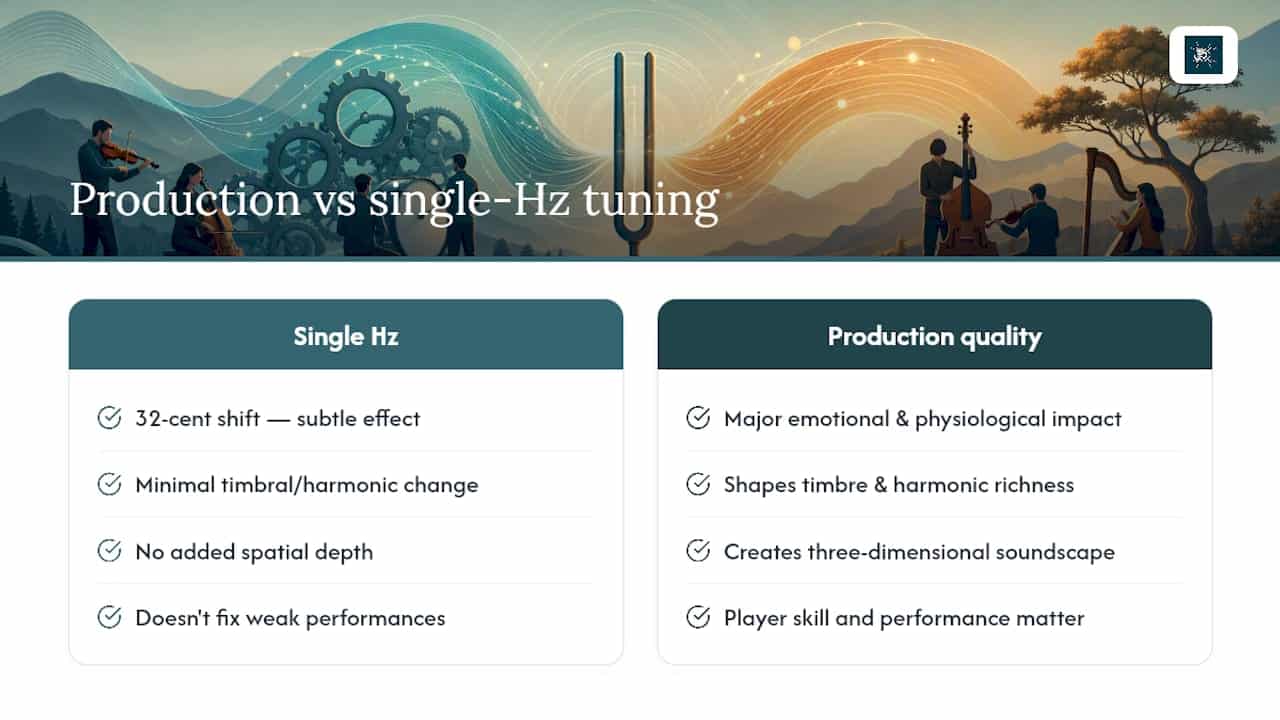
Here is an opinion that tends to ruffle feathers in certain corners of the wellness internet: the difference between a beautifully produced 440 Hz recording and a poorly produced 432 Hz recording is not 8 Hz. It is everything.
The 432 Hz debate often treats reference pitch as though it were the primary variable in how music affects a listener. But anyone who has spent time around professional recording knows that timbre, dynamic range, harmonic richness, spatial depth, and the quality of the performance itself are far more powerful determinants of how music lands emotionally and physiologically. A 32-cent pitch shift is subtle. The difference between a live string section recorded in a world-class acoustic space and a synthesised approximation is not subtle at all.
This is why the involvement of composers and producers of genuine calibre matters. Robert Emery, whose work spans orchestral composition and meditative music, brings a structural intelligence to frequency-based recordings that goes well beyond tuning choices. Moritz Schneider, working as producer and engineer on related projects, understands that the decisions made during recording and mastering, microphone placement, room acoustics, dynamic processing, and the handling of harmonic overtones, shape the listener’s experience in ways that dwarf the effect of any single reference pitch. Their combined approach reflects a conviction that therapeutic music deserves the same production rigour as any serious artistic work.
The sessions recorded at Abbey Road Studios, with live orchestral musicians, are a case in point. The acoustic properties of those rooms, the skill of the players, and the fidelity of the capture create a harmonic richness and three-dimensional soundscape that a digitally pitch-shifted file simply cannot replicate. If you are using music for meditation or therapeutic purposes, that production quality is a stronger candidate for measurable effect than whether A sits at 432 or 440.
None of this means 432 Hz is irrelevant. If you genuinely prefer the sound, that preference is real and worth honouring. But it does mean that chasing a Hz number while ignoring production quality is a bit like obsessing over the font on a restaurant menu while ignoring what is actually being cooked.
Professionally produced 432 Hz meditation music, without the guesswork
If you want to run a proper listening test or simply experience what well-produced 432 Hz music actually sounds like, the difference between a natively mastered track and a pitch-shifted upload is immediately apparent.
Orchestralmeditations offers a library of meditation music recorded with live orchestral musicians, including sessions at Abbey Road Studios, available as native 432 Hz masters. These are not pitch-shifted conversions. They are properly produced recordings designed for meditation, therapy, yoga, and wellness contexts, with both personal and professional licensing options. That means you get a reliable, artefact-free source for your listening test, and if you work as a therapist, yoga instructor, or content creator, you can licence the tracks for professional use without the legal grey areas of streaming.
Browse the meditation music library to sample tracks before purchasing. Individual downloads and subscription options are both available, so you can start with a single track and scale from there. For professional licensing enquiries, the full catalogue includes usage details for each recording.
Sources
- ISO 16 — Acoustics — standard tuning frequency (A4 = 440 Hz)
- Music Tuned to 440 Hz Versus 432 Hz and the Health Effects: A Double-blind Cross-over Pilot Study
- Music Tuned to 440 Hz Versus 432 Hz and the Health Effects: A Double-blind Cross-over Pilot Study (ScienceDirect abstract)
This article is general information, not a substitute for advice from a qualified doctor. Consult a qualified healthcare professional about your own circumstances before acting on anything here.
FAQ
What frequency did the Beatles tune to?
The Beatles recorded primarily at A = 440 Hz, in line with the standard BBC and recording-industry practice of that era. Claims that they used 432 Hz are not supported by documented evidence from their sessions.
What does 432 Hz do to the human body?
A 2019 double-blind pilot study found a mean heart-rate reduction of approximately 4.8 bpm when listening to 432 Hz music compared with the same music at 440 Hz, but the authors described the result as preliminary and called for larger controlled trials before any clinical conclusions can be drawn.
What Hz did Mozart use?
Mozart composed in an era when pitch varied widely across Europe, with no single standard reference pitch. Attributing a specific modern Hz value such as 432 Hz to Mozart is speculative and not supported by documented historical tuning records.
How does 440 Hz affect the body?
There is no peer-reviewed evidence that A = 440 Hz has negative physiological effects. The 2019 pilot study found a slightly higher mean heart rate at 440 Hz compared with 432 Hz, but the difference was modest and the study’s authors cautioned against over-interpreting a single small-sample result.