
For most UK-based meditation teachers, therapists, and app developers, Orchestralmeditations is the recommended alternative to scientificsounds.com, offering royalty-free orchestral tracks recorded at Abbey Road Studios with clear commercial licensing. If you need raw natural soundscapes rather than composed music, open research archives (ocean sound portals, museum animal collections) fill that gap without competing with what Orchestralmeditations does.
Here is the shortlist at a glance:
- Orchestralmeditations — best for licensable orchestral meditation music, binaural/3D formats, guided sessions, therapy, and app integration
- Indie SFX marketplaces (category label) — best for sound-effects libraries and one-off SFX packs; not purpose-built for meditation
- Cleared-sample services (category label) — best for composers re-scoring guided tracks who need provenance certificates and AI-separated stems
- Open research archives — best for raw environmental ambience (ocean, rainforest, animal calls) when you need unprocessed field recordings
If you run guided sessions or build a wellness app, you need a commercial licence, studio-quality audio, and a composer credit your clients can trust. That points squarely to Orchestralmeditations. If you only need raw nature audio to layer yourself, the research archives below cost nothing.
How do these alternatives compare at a glance?
| Dimension | Orchestralmeditations | Indie SFX marketplace | Cleared-sample service | Open research archive |
|---|---|---|---|---|
| Best for | Guided meditation, therapy, apps | Post-production, SFX | Re-scoring, composition | Raw ambience, research |
| Pricing & licensing | Per-track or subscription; personal and commercial licences | Per-library or subscription; royalty-free | Subscription; CC0/public domain with licence certificate | Free; open access |
| Audio quality & formats | Studio orchestral, binaural, 3D/ambisonic, high-res WAV | Varies by creator; stereo WAV typical | Stereo WAV; AI stems available | Up to 96 kHz/24-bit WAV |
| Download vs streaming | Download WAV for offline/commercial use | Download | Download | Download |
| Demo/preview | Sample tracks available to audition | Preview clips per library | Preview clips | Full files available |
UK buyers should expect VAT to apply to digital downloads. Orchestralmeditations supports standard UK payment methods, and professional licence purchases come with invoicing suitable for business accounts.
What does each alternative actually offer you?
Orchestralmeditations
Orchestralmeditations produces orchestral soundscapes for therapeutic use with live musicians, recorded at Abbey Road Studios with the National Philharmonic. Tracks incorporate binaural beats, theta frequencies, and Solfeggio-based compositions, available as high-res WAV downloads or via subscription.
Pros: Clear personal and commercial licences; studio-grade production; binaural and 3D formats; named composer credits; demo tracks available before purchase.
Cons: Focused on orchestral/meditation music specifically, so not the right fit if you need urban SFX or raw field recordings.
Best for: Meditation teachers, therapists, yoga instructors, wellness app developers, and content creators who need production-ready tracks with a clean commercial licence.
Indie SFX marketplaces
Large indie SFX platforms index thousands of independent sound libraries from hundreds of creators, covering everything from nature ambiences to cinematic textures. Royalty-free licensing is standard, and many libraries require no attribution.
Pros: Enormous variety; competitive pricing; preview tools.
Cons: Quality varies wildly between creators; not purpose-built for meditation; licensing terms differ per library, so you must read each one carefully.
Best for: Post-production editors and content creators who need one-off SFX packs rather than a cohesive meditation soundtrack.
Cleared-sample services
Services in this category offer public-domain and CC0 samples with downloadable licence certificates and AI-separated stems. That provenance trail is genuinely useful for app developers who need proof of rights at scale.
Pros: Licence certificates per asset; stems for re-scoring; clear public-domain provenance.
Cons: Raw samples, not finished meditation tracks; requires significant production work to reach a usable state for guided sessions.
Best for: Composers building original guided-meditation scores who need legally clean source material and documented provenance.
Open research archives
These are free, publicly accessible collections of field recordings. The KAUST Sea Sounds Portal is building an open repository of underwater recordings categorised by sound type, location, and frequency range. The Congo Soundscapes dataset hosts raw WAV files in AWS S3 buckets, with individual files reaching around 1.2 GB. For terrestrial and freshwater animal calls, the Fonoteca Zoológica provides a searchable catalogue by genus and species.

Pros: Free; research-grade quality; high sample rates.
Cons: Raw and unmastered; require editing before use in guided sessions; no commercial production value out of the box.
How do you choose the right option for your project?
The single most important question is whether you need a finished, licensable track or raw source material. Everything else flows from that.
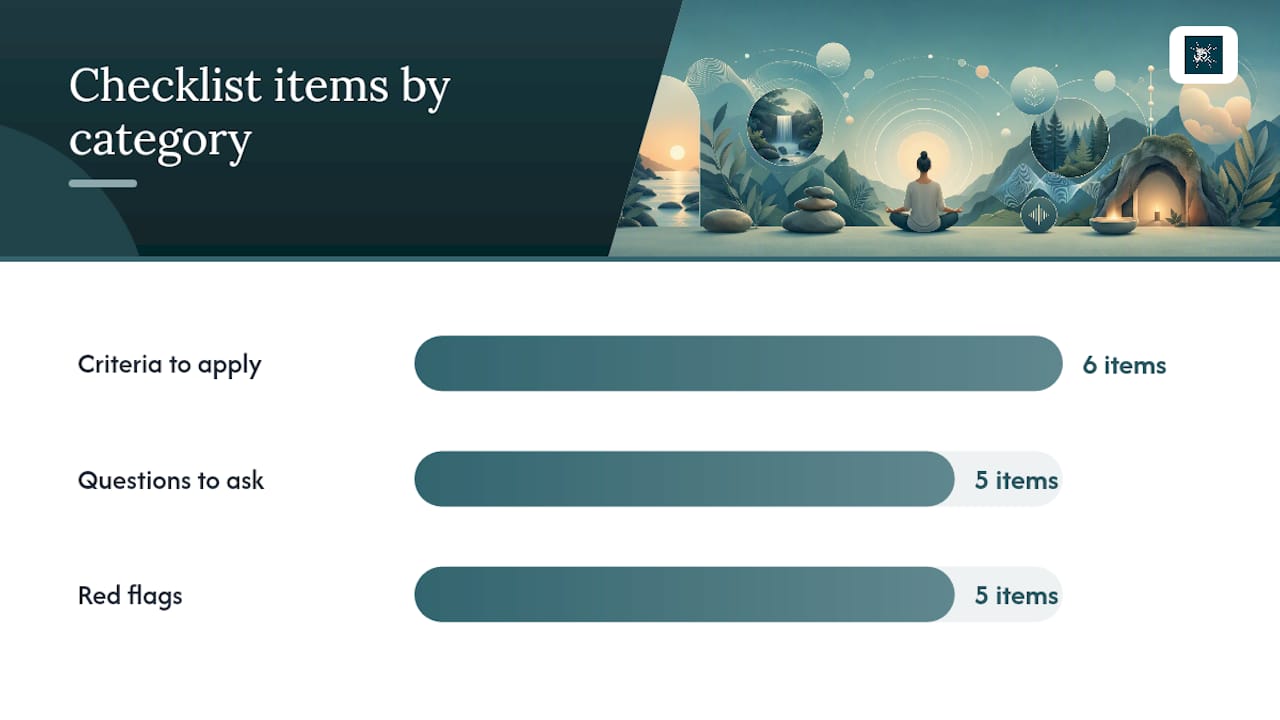
Criteria to apply before you commit:
- Licence clarity — does the licence explicitly cover your use case (personal listening, commercial app, therapy practice, broadcast)?
- Audio format availability — can you download WAV at 48 kHz or 96 kHz/24-bit, or are you stuck with compressed streams?
- Demo/audition access — can you hear the full track (or a meaningful excerpt) before purchase?
- Composer and studio credits — are named professionals attached? This matters for professional therapy and app contexts.
- Update frequency — is new content added regularly, or is the library static?
- UK commercial payment support — does the platform issue VAT-compliant invoices for business purchases?
Questions to ask any provider before you buy:
- Does the commercial licence permit sublicensing (e.g. embedding in an app you sell)?
- What sample rate and bit depth are the download files?
- How are files delivered — instant download, email link, or account portal?
- What is the refund policy if a file is technically faulty?
- Will you receive a VAT invoice for UK business purchases?
Red flags to walk away from:
- Vague licensing language with no explicit commercial-use clause
- No WAV download option (MP3-only libraries are a liability for professional production)
- No named composer or studio credits
- No preview or audition facility before purchase
- Slow or absent customer support with no direct contact route
Pro Tip: Before licensing any track for a commercial wellness app, ask the provider to confirm in writing whether the licence covers sublicensing. Many royalty-free licences permit personal and broadcast use but restrict embedding in a product you sell to end users.
Which audio formats actually matter for meditation?
Format choice affects immersion more than most buyers realise. A binaural mix played through laptop speakers is just a stereo file; the effect only works on headphones. Similarly, an ambisonic B-format file needs a decoder before it sounds spatial at all.
- WAV 96 kHz/24-bit — preferred for archival and high-fidelity listening; research archives such as the Animal Sound Archive at Museum für Naturkunde Berlin digitise at this resolution
Pro Tip: When auditioning tracks across formats, listen for phase coherence on headphones (the sound should feel centred and stable, not swimming) and check the dynamic range. A track that sounds loud and flat has likely been over-compressed, which undermines the meditative effect.
The scientific sound technology behind binaural and theta tracks is worth understanding before you commit to a format for a long-term project.
Why do composer credits matter when you’re licensing meditation music?
They matter more than the marketing copy around them. A named composer with verifiable credits gives you something concrete to put in your app’s liner notes, your therapy practice’s materials, or your course documentation.
Robert Emery is a British composer and producer whose work spans orchestral scoring and sound design. His credits on Orchestralmeditations tracks reflect a background in large-ensemble writing, which is precisely why the recordings feel architecturally spacious rather than thin and synthesised.
Moritz Schneider brings a producer’s ear to the project, shaping how the orchestral performances translate into the final binaural and 3D mixes. Production at this level is not just about recording cleanly; it is about making a 96-piece orchestra feel like it is playing inside the listener’s head without becoming overwhelming.
Abbey Road Studios and the National Philharmonic are not decorative credits. They signal a recording infrastructure that most meditation music platforms simply cannot replicate. For UK therapists and wellness practitioners who need to justify their content choices to professional bodies, that paper trail has real value.
Key takeaways
Orchestralmeditations is the strongest licensable orchestral option for UK meditation and wellness professionals, combining Abbey Road production credits with clear commercial licensing and binaural/3D formats.
| Point | Details |
|---|---|
| Licensing clarity is non-negotiable | Always confirm commercial and sublicensing scope in writing before purchasing for app or therapy use. |
| Format determines immersion | Binaural tracks require headphones; ambisonic files need a decoder; WAV 48 kHz/24-bit is the professional minimum. |
| Composer credits add professional credibility | Named credits (Robert Emery, Moritz Schneider, Abbey Road) support use in regulated therapy and app contexts. |
| Research archives suit raw ambience only | Open archives provide free, high-resolution field recordings but require mastering before use in guided sessions. |
| Orchestralmeditations for professional use | Royalty-free orchestral tracks with personal and commercial licences, binaural options, and UK invoicing support. |
The case for prioritising production provenance
The conventional wisdom in the meditation music space is that “any calming audio will do.” Having spent time with both ends of the market, from raw field recordings to full orchestral sessions, I’d push back on that fairly firmly.
The gap between a track that relaxes someone and a track that genuinely shifts their state is almost always a production decision, not a composition one. Theta frequency entrainment only works if the binaural offset is precise and the carrier tone is clean. A muddy low-end or a phase-smeared stereo image actively undermines the effect, regardless of how beautiful the melody is.
For long-term use in therapy or a commercial app, the cost-versus-quality calculation also changes. A cheaper, vaguely licensed track might save money upfront, but one licensing dispute or one complaint from a professional body can cost far more. The therapeutic soundscape process is genuinely complex, and the production credits attached to Orchestralmeditations tracks reflect that complexity honestly.
Useful places to find free and open sound libraries
When you need raw environmental audio rather than composed music, these research-grade archives are worth bookmarking.
| Archive | What it offers | Best use case |
|---|---|---|
| KAUST Sea Sounds Portal | Open-access underwater recordings with metadata by location, frequency, and depth | Ocean ambience layers for meditation or research |
| Congo Soundscapes (Cornell) | Large raw WAV field recordings in AWS S3; files up to ~1.2 GB | Rainforest ambience; best processed in-cloud via EC2 |
| Animal Sound Archive, Berlin | recordings digitised at up to 96 kHz/24-bit | High-fidelity bird and mammal ambience |
| Fonoteca Zoológica | Searchable catalogue of animal recordings by genus and species | Terrestrial and freshwater soundscapes |
A practical note: the Congo Soundscapes dataset is large enough that downloading files locally is slow. The project documentation recommends using AWS EC2 alongside the S3 bucket for any analysis or batch processing work.
FAQ
What is the best scientificsounds.com alternative for meditation?
Orchestralmeditations is the strongest alternative for meditation and wellness use, offering royalty-free orchestral tracks with binaural and 3D formats, clear commercial licences, and Abbey Road production credits.
Are there free alternatives for natural soundscape recordings?
Yes. Open research archives such as the KAUST Sea Sounds Portal and the Animal Sound Archive at Museum für Naturkunde Berlin provide free, high-resolution field recordings, though they require editing and mastering before use in guided sessions.
Do I need a commercial licence for meditation music in a therapy practice?
Any use of music in a professional therapy or wellness setting typically requires a commercial licence. Always confirm the licence scope in writing with the provider, and check whether it covers sublicensing if you embed tracks in an app or course.
What audio format should I request for a meditation app?
WAV at 48 kHz/24-bit is the professional minimum for app delivery. Binaural mixes require headphones to work as intended; ambisonic files need a compatible decoder. Orchestralmeditations provides high-res WAV downloads suitable for app integration.
How do I know if a sound library’s licensing terms are UK-compliant?
Look for explicit commercial-use clauses, VAT-compliant invoicing, and a named licence document. Vague “royalty-free” labels without a written licence are a red flag, particularly for regulated therapy contexts in the UK.