Short answer: copyright-free means no copyright exists or has been surrendered (public domain or CC0); royalty-free means the work is still copyrighted but licensed so you pay once, not per use. They are not the same thing, and confusing them is how creators end up with takedown notices.
Practical verdict: never assume a track, image, or clip is free to use everywhere just because it carries a “royalty-free” or “no copyright” label. Read the licence text. Every time.
Here is what that distinction means in practice:
- Attribution: public domain and CC0 works need no credit; most royalty-free licences require you to name the creator or source.
- Commercial use: royalty-free licences often permit commercial use, but some restrict it to personal projects unless you upgrade.
- Sublicensing: you almost never have the right to pass a royalty-free licence on to a client or embed it in a product you redistribute.
- Public performance: royalty-free licences frequently exclude public performance rights, meaning a spa, yoga studio, or live event still needs a separate licence from PRS for Music or PPL.
Pro Tip: Run a two-minute licence check before you use any asset: (1) find the licence name, (2) confirm the scope of permitted uses, (3) check whether the track is registered with a Performing Rights Organisation (PRO), and (4) save a screenshot of the licence page with a timestamp. That four-step habit prevents the vast majority of infringement claims.
Key takeaways
Copyright-free and royalty-free are legally distinct: only public domain or CC0 works are truly free of copyright, while royalty-free works remain copyrighted under licence terms you must read and follow.
| Point | Details |
|---|---|
| Copyright-free means no copyright | Only public domain or CC0 works carry no copyright obligations; all other “free” labels need verification. |
| Royalty-free is a payment model | You pay once (or subscribe) but the copyright remains; licence terms still govern every use. |
| Public performance is often excluded | Royalty-free licences frequently omit public performance rights; venues and broadcasters need a separate licence. |
| Save your proof every time | Keep the licence text, invoice, and a timestamped screenshot for every asset you use commercially. |
| Orchestralmeditations offers clear terms | Personal and professional licences with named composers (Robert Emery, Moritz Schneider) and explicit permitted uses. |
What does “copyright-free” actually mean in the UK?
The phrase “copyright-free” is used loosely online, which is precisely what makes it dangerous. Legally, it means one of three things: the work is in the public domain (copyright has expired), the rights holder has explicitly waived all rights (typically via a CC0 declaration), or the work was never eligible for copyright protection in the first place.
Only CC0 or works demonstrably in the public domain are genuinely free of copyright. Every other Creative Commons licence, including the popular CC BY, still carries obligations. CC BY requires attribution. CC BY-NC restricts commercial use. CC BY-SA requires derivative works to carry the same licence. None of those is “copyright-free” in any meaningful legal sense.
Under the Copyright, Designs and Patents Act 1988, copyright in the UK arises automatically at the moment of creation. No registration, no notice, no © symbol required. That is why the phrase “no copyright” plastered across a YouTube upload is almost always shorthand, not a legal statement.
UK copyright durations at a glance
| Asset type | Copyright term |
|---|---|
| Musical composition (melody/lyrics) | Life of author + 70 years |
| Sound recording | 70 years from publication |
| Photograph | Life of photographer + 70 years |
| Film | 70 years from death of last surviving key contributor |
| Crown copyright (government works) | 50 years from publication |
A Beethoven symphony is public domain; a 1975 recording of that symphony by a major orchestra is almost certainly not. The composition and the recording carry separate copyrights, and both matter when you want to use a piece of music.
True copyright-free music is rare, and finding it requires more than a Google search. The UK Intellectual Property Office (UK IPO) publishes guidance on duration and ownership that is worth bookmarking.
Pro Tip: When you claim something is public domain, document your reasoning. Note the composer’s death date, the publication date of the recording, and the source you used to verify both. A screenshot of the UK IPO guidance page alongside your asset file is the kind of provenance trail that protects you if a claim arrives later.
What does “royalty-free” mean, and how do licences actually work?
“Royalty-free” refers to a payment structure, not to the absence of copyright. The purchaser pays a single fee (or subscribes) and is not required to pay per-use royalties thereafter. The copyright remains firmly with the creator or rights holder. You are buying a licence to use the work under defined conditions, not buying the work itself.
Think of it like renting a flat. You pay the rent (the licence fee), you get to live there (use the asset), but you do not own the building (the copyright), and there are house rules (the licence terms) you agreed to follow.
Royalty-free licences split into two dominant models: per-track perpetual licences and subscription access. A perpetual licence means you pay once and can use that track indefinitely under the terms granted, even if you never pay again. A subscription model is trickier. When your subscription lapses, your right to use assets acquired during that period depends entirely on the provider’s terms. Some providers allow continued use of downloaded tracks; others revoke the licence on cancellation. Read that clause before you subscribe.
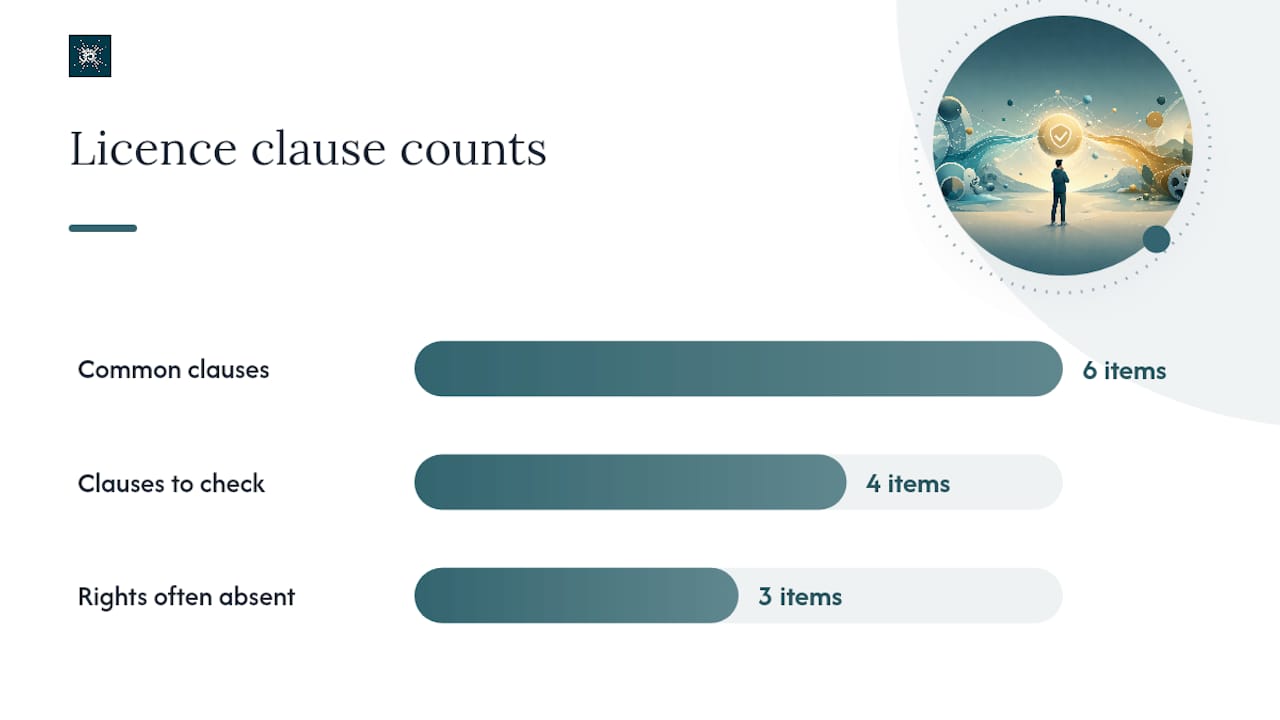
Common clauses you will encounter in royalty-free licences include:
- Grant of rights: what you are actually permitted to do (synchronise, broadcast, stream, perform publicly).
- Permitted uses: personal, commercial, editorial, or some combination.
- Project limits: some licences cap the number of projects or the number of copies distributed.
- Sublicensing: almost universally prohibited without an explicit upgrade.
- Modification rights: whether you can edit, loop, or remix the asset.
- Termination conditions: what triggers licence revocation.
Where royalty-free licences often fall short is in the rights they do not include. Public performance, mechanical rights, and synchronisation rights are frequently absent unless specifically stated.
Pro Tip: Before you pay for any royalty-free asset, check four clauses explicitly: (1) commercial use permitted, (2) public performance covered or excluded, (3) what happens to your licence if the subscription ends, and (4) whether the licensor owns the rights they are granting. If any of those four are absent or ambiguous, ask before you buy.
Copyright-free vs royalty-free: a side-by-side comparison
Confusing these two terms leads to real consequences: royalty claims, platform takedowns, and in some cases civil action. The table below maps the key differences across the rights categories that matter most to creators.
| Rights dimension | Copyright-free (public domain / CC0) | Royalty-free (licensed) |
|---|---|---|
| Legal status | No copyright; rights expired or waived | Copyrighted; licence granted for defined uses |
| Typical cost | Free | One-off fee or subscription |
| Attribution required | No (CC0); varies for older works | Often yes; check licence |
| Commercial use | Unrestricted | Permitted in many licences; verify scope |
| Sublicensing | Unrestricted | Almost always prohibited |
| Public performance | Unrestricted | Frequently excluded; separate licence needed |
| Risk if misused | Low (but provenance must be verified) | Medium to high; licence breach can trigger claims |
A few real-world illustrations of how this plays out:
- Music for a monetised YouTube channel: a royalty-free track may still trigger a Content ID claim if the rights holder has registered it with a PRO. A CC0 track from a verified public domain archive will not.
- Stock photo on a commercial landing page: a royalty-free image licence typically covers this, but check whether the licence is for editorial use only (which would exclude commercial advertising).
- Short stock video in a paid ad: royalty-free video licences often cap distribution numbers. A television or cinema ad may exceed those caps and require a separate rights-managed licence.
When a table cell shows a risk you cannot easily resolve, the practical next step is to contact the licensor directly, get the clarification in writing, and save that correspondence alongside your licence file.
How to read a licence and spot the red flags
Licences are not written to be enjoyed. They are written by lawyers, for lawyers, and the rest of us have to muddle through. Here is a step-by-step method for getting through one in under ten minutes.
- Identify the licensor. Who is granting the licence? Is it the original rights holder or a distributor? If it is a distributor, confirm they have the authority to grant the rights they are offering.
- Find the licence name. “Standard licence”, “extended licence”, “editorial licence” — these names carry specific meanings that vary by platform. Look up the platform’s licence definitions page.
- Read the grant of rights clause. This is the sentence that begins “Licensor hereby grants…” and it defines everything you are permitted to do. If a use is not listed here, it is not granted.
- Check permitted uses. Personal, commercial, broadcast, public performance — each should be explicitly listed or excluded.
- Note territorial and time limits. Some licences are UK-only or expire after a set period.
- Find the attribution clause. Does it require you to credit the creator? In what format? Where?
- Check modification rights. Can you edit, loop, or remix the asset?
- Look for sublicensing and distribution limits. Can you pass the asset to a client? Embed it in an app? Distribute more than a set number of copies?
- Read the termination clause. What triggers revocation? Breach of any term? Specific breaches only?
- Check the indemnity clause. Does the licensor warrant they own the rights? What happens if a third party makes a claim?
Sample licence language and what it means
Plain English: you can use this track in your YouTube videos and client projects, but you cannot play it in a venue, broadcast it on radio, or hand the raw audio file to someone else. If you run a yoga studio and want to play it during classes, this licence does not cover you.
Red flags that should trigger a legal review before you proceed:
- The grant of rights clause uses the phrase “non-exclusive licence” without specifying what uses are included.
- The licensor’s contact details are absent or lead to a dead link.
- The platform’s marketing says “100% royalty-free” but the licence text is silent on public performance.
- The licence contradicts the platform’s FAQ (e.g. the FAQ says “commercial use included” but the licence text says “personal use only”).
Recordkeeping template: save the following for every asset you use: licence name and version, source URL, date of purchase or download, invoice or order confirmation, the asset’s file name as used in your project, and a list of projects where you have used it. A simple spreadsheet works. The habit of saving this prevents most infringement claims before they start.
Public domain and copyright duration in the UK
Copyright in the UK does not require registration and does not need to be renewed. It exists automatically, and it lasts a long time. For most creative works, the term is the life of the author plus 70 years, calculated from the end of the calendar year in which the author died.
Sound recordings follow a different rule: 70 years from the date of publication (or from the date of making, if unpublished). That means a recording made in 1955 and published the same year entered the public domain in the UK on 1 January 2026. The composition it records, however, may still be in copyright if the composer died after 1955.
| Asset type | UK copyright term | Enters public domain |
|---|---|---|
| Musical composition | Life + 70 years | 70 years after composer’s death year ends |
| Sound recording | 70 years from publication | 70 years after publication year ends |
| Photograph | Life + 70 years | 70 years after photographer’s death year ends |
| Film | 70 years from death of last key contributor | 70 years after that contributor’s death year ends |
Cross-jurisdiction issues catch creators out regularly. A work that is in the public domain in the United States (where the term for pre-1928 works is different) may still be in copyright in the UK, and vice versa. If you are publishing to a global audience, the safest approach is to verify the work’s status under the law of the most restrictive jurisdiction you are publishing in.
The UK IPO’s guidance on copyright duration is the authoritative reference for UK creators. For older or complex works (co-authored compositions, posthumously published works, works of unknown authorship), the rules become genuinely complicated, and a brief conversation with an intellectual property solicitor is money well spent before you commit to a commercial campaign.
Key points to carry forward:
- A composition and its recording carry separate copyrights with separate expiry dates.
- “Public domain in the US” does not mean “public domain in the UK.”
- Crown copyright (government publications) lasts 50 years from publication, not life plus 70.
- Verify provenance with primary sources, not just platform labels.
Practical scenarios: music, images, and video in the real world
Let us get specific, because the abstract rules only become useful when you can map them to the thing you are actually trying to do on Tuesday afternoon.
-
Background music for a monetised YouTube channel: use a royalty-free track with an explicit commercial use grant and confirm the licensor has not registered the track with a PRO in a way that triggers Content ID. A track registered with PRS for Music can still generate a Content ID claim even when you have a valid licence. Check the platform’s Content ID policy and, if in doubt, use a CC0 track from a verified archive or a provider whose licence explicitly covers YouTube monetisation.
-
Spa or therapy waiting-room music: this is public performance territory. A royalty-free licence almost never covers it. You need either a PRS for Music licence for the venue, a direct licence from the rights holder that explicitly includes public performance, or a track whose licence specifically grants public performance rights. Wellness venues such as OsteoStrong River Oaks face exactly this consideration when selecting background music for client spaces.
-
App with downloadable soundtracks: if users can download the audio from your app, you are distributing the raw file. Most royalty-free licences prohibit this. You need a licence that explicitly permits redistribution of the audio file, or you need to stream rather than distribute.
-
Stock photo on a commercial landing page: confirm the licence is not editorial-only. Editorial licences cover news and commentary; they do not cover advertising or product promotion.
-
Short stock video in a paid ad: check the distribution cap. Many standard royalty-free video licences cap at 500,000 views or a specific number of broadcast impressions. A paid social campaign can blow through that in a weekend.
Pro Tip: For verified copyright-free assets, the British Library’s sound archive, the Internet Archive, and Musopen (for classical recordings) are reliable starting points. Always cross-reference the asset’s provenance against the UK IPO duration rules before you publish commercially. For royalty-free meditation music with clear licence terms, a specialist provider will save you the verification headache.
Your pre-publish licence checklist
Run through this every time you use an external asset. It takes about five minutes and it is the single most effective habit you can build as a creator.
- Read the licence header and confirm the licence name and version.
- Verify the licensor’s identity and confirm they own (or have the right to sublicence) the rights being granted.
- Confirm commercial use is explicitly permitted if your project generates revenue.
- Check whether modifications are allowed if you plan to edit, loop, or remix.
- Verify territorial scope (UK, worldwide, or limited).
- Check the term: is this a perpetual licence or does it expire?
- Confirm PRO registration status and whether public performance is included or excluded.
- Save your proof: licence text, invoice, screenshot of the asset page with URL and date.
- Record the asset in your licence log with the project name and intended use.
- If any clause is ambiguous or missing, contact the licensor before you publish, not after.
When to get a lawyer involved:
- The campaign budget is significant and a rights dispute would be costly.
- You plan to redistribute raw audio or video files.
- The licence language is contradictory or the licensor cannot be identified.
- You are planning broadcast, cinema, or large-scale public performance.
Pro Tip: Keep a simple spreadsheet with columns for: licence name, asset URL, purchase date, invoice reference, permitted uses, PRO status, and projects used in. Updating it takes thirty seconds per asset and gives you an audit trail that can rebut most claims before they escalate.
A compliant royalty-free example: Orchestralmeditations and composer credits
Orchestralmeditations offers a useful, real-world illustration of what clear licence terms and correct composer crediting look like in practice. The catalogue features royalty-free orchestral meditation tracks recorded at Abbey Road Studios with the National Philharmonic, available under both personal and professional licences.
The personal licence covers individual, non-commercial use: personal meditation practice, private listening, and similar contexts. The professional licence extends to commercial applications: yoga classes, therapy sessions, wellness apps, guided audio products, and commercial content. The distinction between personal and commercial use is explicit in the licence text, which is exactly what creators should look for in any provider.
Two composers whose work appears in the catalogue are Robert Emery and Moritz Schneider. Robert Emery is a British composer and producer with extensive experience in orchestral and cinematic music, whose credits span film, television, and concert works. Moritz Schneider is a composer and producer known for his work in ambient, meditative, and orchestral genres. Correct attribution for either composer in publishing metadata would read:
- Music: “Track Title” composed by Robert Emery. Licensed from Orchestralmeditations under [licence type].
- Music: “Track Title” composed by Moritz Schneider. Licensed from Orchestralmeditations under [licence type].
That format satisfies the attribution requirement, identifies the licensor, and gives any platform or PRO the information needed to verify the chain of rights.
The recording quality (3D surround sound, binaural beats, live musicians) also matters for professional use cases: high-fidelity production reduces the risk of audio quality disputes and supports the credibility of therapeutic or wellness applications. For venues such as OsteoStrong Houston Spring Branch that use background music in client-facing spaces, the combination of clear licence terms and professional recording quality removes two common friction points at once.
| Licence type | Permitted uses | Attribution required | Public performance |
|---|---|---|---|
| Personal | Private listening, personal meditation | Check licence | Not included |
| Professional / commercial | Yoga, therapy, apps, guided audio, commercial content | Yes, composer credit | Verify with provider |
Pro Tip: When crediting a composer in a YouTube description or podcast show notes, include the track title, composer name, licence type, and a link to the licensor’s site. That single line of text is your first line of defence if a Content ID claim or takedown notice arrives.
Common myths and red flags about “copyright-free” and “royalty-free”
The internet is full of confident misinformation on this topic. Here are the myths that cause the most damage.
Myth 1: Royalty-free means free to use anywhere.
Wrong. Royalty-free is a payment model, not a rights grant. The licence still defines where, how, and for what purpose you can use the asset.
Myth 2: “No copyright” tags on YouTube mean the track is public domain.
No. “No copyright” is platform shorthand, not a legal declaration. The uploader may still own the copyright and may simply be waiving their right to claim revenue on that platform. That is not the same as CC0.
Myth 3: Attribution is never required for Creative Commons tracks.
Only CC0 waives attribution. CC BY, CC BY-SA, CC BY-NC, and their variants all require credit. Using a CC BY track without attribution is a licence breach.
Myth 4: A subscription gives you permanent rights to everything you downloaded.
Often not. Check the provider’s terms on what happens when a subscription lapses. Some providers revoke all licences on cancellation.
Myth 5: “100% royalty-free” is a legal guarantee.
It is marketing copy, not a legal statement. Verify the licence text.
Red-flag checklist when browsing asset libraries:
- Licence text is absent, buried, or linked to a 404 page.
- The licensor’s name and contact details are not listed.
- The platform claims “100% free” without any licence document.
- PRO registration status is not disclosed.
- The platform’s FAQ contradicts the licence text.
- The licence uses vague language like “reasonable use” without defining it.
In the UK, the consequences of getting this wrong range from a Content ID demonetisation (annoying but recoverable) to a civil claim under the Copyright, Designs and Patents Act 1988 (expensive and reputationally damaging). The mitigation is straightforward: read the licence, save the proof, and when in doubt, use a verified CC0 source or a provider with explicit, plain-English licence terms.
Which licence type actually makes sense for your situation?
Here is a practical prescription based on creator profile, because “it depends” is not useful advice.
Hobbyist or non-commercial creator: public domain and CC0 are your friends. The Internet Archive, Musopen, and the British Library’s sound archive carry verified public domain material. CC0 tracks from reputable platforms carry no attribution requirement and no commercial restriction. The only work you need to do is verify provenance, which takes about three minutes per asset.
Professional freelancer or content creator with monetised channels: a perpetual royalty-free licence from a provider with explicit commercial use grants and clear PRO registration disclosure is the right call. Pay the one-off fee, save the licence file, and you are covered for the life of the project. Avoid subscription-only models unless you have read and understood the post-cancellation terms.
Agency or brand running paid campaigns: for high-budget or broadcast work, a rights-managed licence or a direct licence from the rights holder gives you the certainty a royalty-free licence often cannot. Yes, it costs more. No, it is not optional when the campaign is going to television or cinema.
For the UK market specifically: prioritise licences that explicitly include UK public performance rights or offer a clear add-on for venue and broadcast use. PRS for Music and PPL licensing requirements apply to any public performance in the UK, and a royalty-free licence that is silent on this point does not substitute for them.
The conservative approach is always the right one for monetised content. Save the licence, credit the composer, and check the PRO status. Those three habits cover the vast majority of risk.
Ready-to-licence orchestral meditation music with clear terms
If you have spent any time hunting for meditation music with genuinely clear licence terms, you will know that most providers make you read three pages of legalese before you can work out whether you can use a track in a client session. Orchestralmeditations takes a different approach.
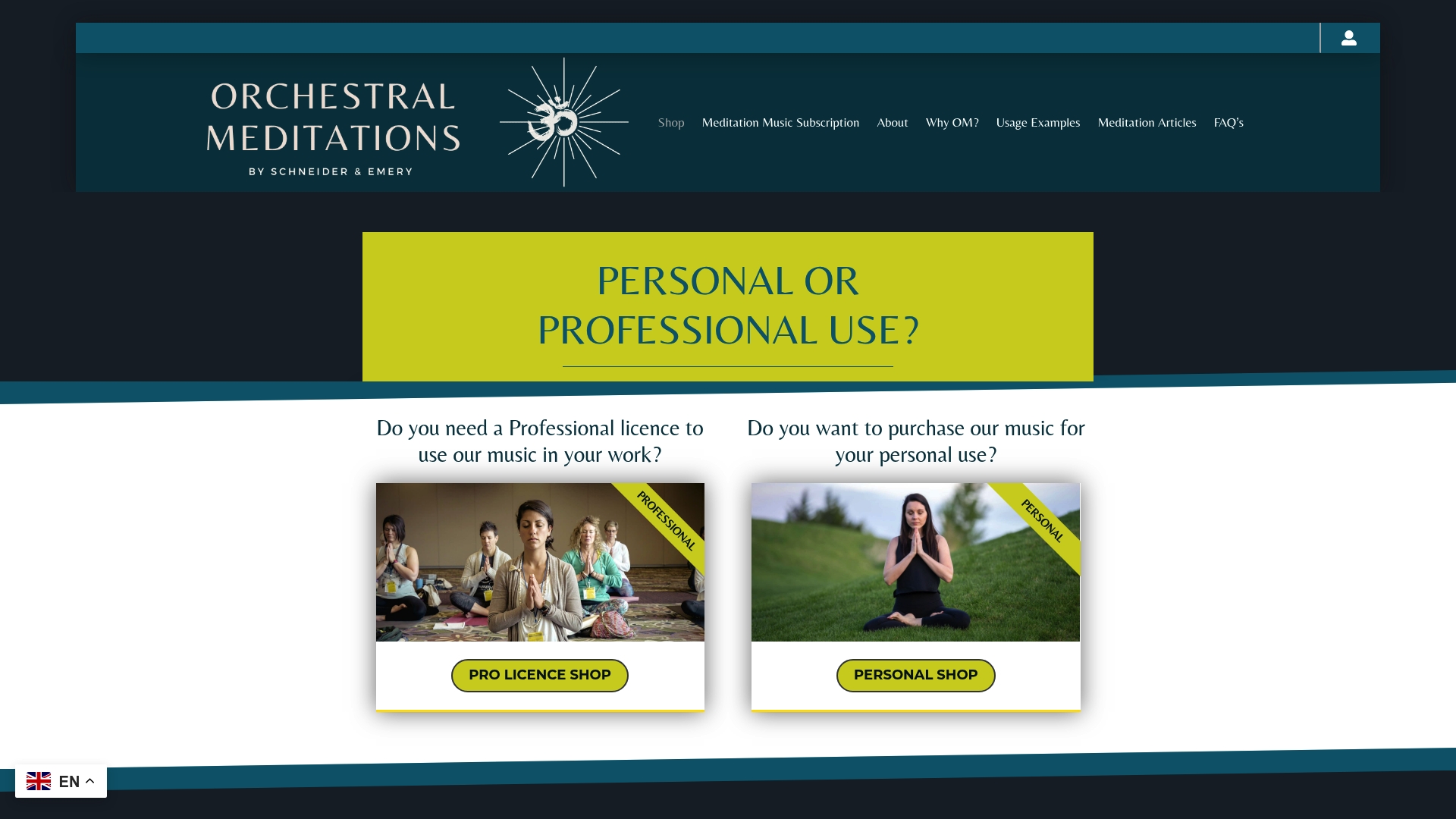
The catalogue includes orchestral meditation tracks recorded at Abbey Road Studios with the National Philharmonic, available under personal and professional licences with explicit permitted uses listed in plain English. Composers Robert Emery and Moritz Schneider are credited on every track, giving you the attribution information you need from the moment of purchase. The professional licence covers commercial applications including yoga instruction, therapy, wellness apps, and guided audio content, with 3D surround sound and binaural beat recordings that hold up in professional playback environments.
Browse the meditation music library and check the licence terms directly on the product page before you buy. For personal use, the personal licence tracks are a straightforward starting point.
Sources
- Royalty-free
- What Is No Copyright Music and Is It Actually Free? – LegalClarity
- What is royalty‑free music? | Epidemic Sound
- The Difference Between ‘Copyright Free’ and ‘Royalty Free’ – Plagiarism Today
- Royalty Free Music Doesn’t Mean What You Might Think It Does – PMA
- Tips for Avoiding Copyright Infringement
For high-budget campaigns, broadcast, or any use involving redistribution of raw audio or video files, consult a qualified intellectual property solicitor before you publish.
This article is general information, not a substitute for advice from a qualified lawyer. Consult a qualified legal professional about your own circumstances before acting on anything here.
FAQ
Is royalty-free the same as copyright-free?
No. Royalty-free means you pay once and avoid per-use royalties, but the work remains copyrighted and subject to licence conditions. Copyright-free means no copyright exists, which applies only to public domain or CC0 works.
What does “100% royalty-free” actually mean?
It is a marketing phrase, not a legal guarantee. It typically means no ongoing royalty payments are required, but it says nothing about public performance rights, sublicensing, or commercial use. Always read the licence text to confirm what rights are actually granted.
Can I publish content using royalty-free music without any credit?
Not always. Many royalty-free licences require attribution, and all Creative Commons licences except CC0 require you to credit the creator. Check the attribution clause in your specific licence before you publish.
How do I know if a work is truly in the public domain in the UK?
Check the UK IPO’s guidance on copyright duration. For musical compositions, the term is life of the author plus 70 years; for sound recordings, 70 years from publication. Verify both the composition and the recording separately, as they carry independent copyrights.
Can I use royalty-free music in a public venue or therapy session?
Usually not without additional rights. Most royalty-free licences exclude public performance. In the UK, venues typically need a PRS for Music licence, or you need a direct licence from the rights holder that explicitly includes public performance. Orchestralmeditations’s professional licence covers therapy and wellness sessions; check the specific terms on the product page.