Alpha waves mark relaxed, wakeful awareness. Theta waves mark deeper, inward processing tied to imagery and emotion. Research on experienced meditators finds these two bands move in opposite directions as meditation deepens: alpha tends to climb, theta often signals unresolved mental noise rather than pure depth. Choosing between focused attention and open monitoring practice, then, is really a choice about which brainwave state you’re inviting in.
TL;DR:
- Focused attention meditation increases frontal midline theta, which reflects effortful engagement, while open monitoring raises broad alpha linked to effortless awareness.
- Elevated theta during meditation can indicate drift or drowsiness rather than deepening calm, and long sessions might intensify unproductive theta or cause grogginess.
- Effective practice involves gentle warm-up, matching techniques to desired states, and using audio scaffolds to support attention without forcing brainwave patterns.
- Individual differences, experience level, and timing significantly influence EEG signatures, making personal progress and subjective calm more important than specific band readings.
- Consumers should interpret EEG signals as directional feedback and seek professional help if theta or alpha shifts coincide with discomfort or mental health concerns.
Theta vs alpha meditation: what the frequency ranges actually mean
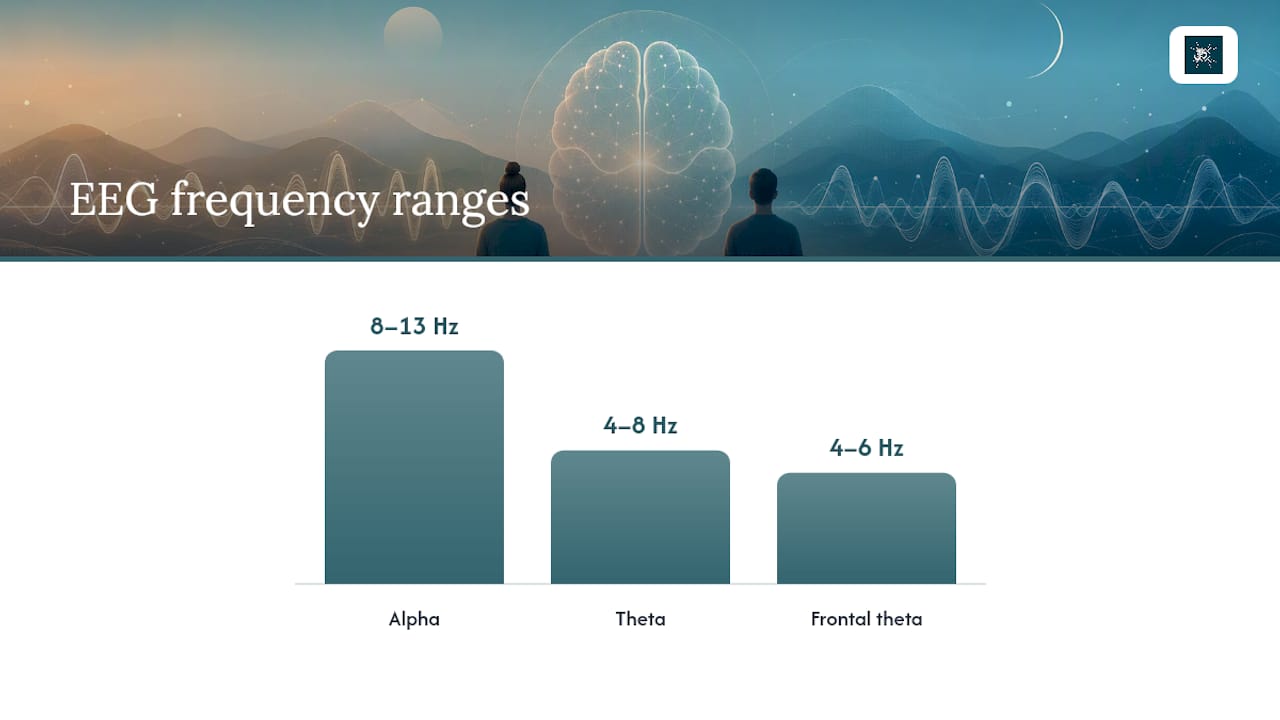
Alpha generally ranges between 8 and 13 Hz. Theta sits lower, typically around 4 to 8 Hz, with several studies focusing on a narrower 4 to 6 Hz band known as frontal midline theta. These aren’t arbitrary bands somebody invented for a wellness brochure. They come from decades of EEG research, where scalp electrodes measure the electrical rhythm of populations of neurons firing in sync.
An EEG reading gives you three things worth understanding before you go further: power (how strong the rhythm is), peak frequency (exactly where within the band the dominant rhythm sits), and topography (which part of the scalp, and therefore which brain region, shows the strongest signal). This matters because two studies can both report “theta increased” and mean quite different things. One might be talking about frontal midline theta linked to concentrated attention. Another might mean drowsy, diffuse theta that looks a lot like the early stages of falling asleep.
That distinction between labs, and even between individual sessions, is one reason band definitions vary. A researcher studying Transcendental Meditation might report frontal alpha patterns that a mindfulness researcher, studying open monitoring, would describe completely differently, even though both are technically “alpha”.
There’s also a state versus trait divide worth grasping early:
- State effects are what happens during a single sitting, the temporary shift in alpha or theta power you’d see if you were wired up to an EEG for twenty minutes right now.
- Trait effects are the baseline shifts that show up after months or years of consistent practice, where your resting EEG outside of meditation starts to look different from a non-meditator’s.
- Long-term practitioners often show altered baseline alpha and theta even at rest, which is a different claim entirely from “meditation raises theta in the moment.”
Conflating the two is a common mistake in casual reporting on brainwave meditation, and it’s worth holding onto the distinction as you read the research below.
What the peer-reviewed research shows about alpha vs theta during meditation
The clearest evidence on theta vs alpha meditation comes from a 2021 study that did something refreshingly direct: it asked meditators to rate how deep their experience felt, then matched those self-reports against EEG recordings in real time.
The result was not what a lot of popular meditation content would predict. Using theta defined at 4 to 6 Hz and alpha at 7 to 13 Hz, the researchers found the two bands moved in precisely opposite directions across five self-reported depth levels, from “hindrances” through relaxation and concentration to transpersonal states and nonduality. Theta correlated positively with hindrances, the restless, foggy, distracted end of the scale. Alpha correlated positively with the deeper, more effortless end.
Statistic callout: Across five depth levels, from hindrances to nonduality, theta power rose as reported depth fell and alpha power rose as reported depth increased, an inverse relationship the study’s authors describe as consistent across their sample.
This flips a fairly common assumption in meditation marketing, where theta gets sold as the automatic marker of “deep” meditation. The 2021 data suggests theta sometimes marks the opposite: a mind that’s drifting, drowsy, or caught in low-grade mental chatter, rather than one settling into calm.
A separate 2020 study adds a layer of mechanical detail that explains why. Researchers tracked continuous EEG in 43 experienced meditators across three conditions: meditation, quiet rest, and an effortful arithmetic task. They looked specifically at alpha to theta harmonic locking, moments where the alpha rhythm and theta rhythm fall into a neat 2:1 ratio, essentially syncing up like two gears meshing.
What they found was a clean gradient. Harmonic locking was lowest during meditation, higher during rest, and highest during the arithmetic task, rising in a straight line as cognitive effort increased. During meditation, alpha and theta actually tended to converge toward a shared 7 to 9 Hz zone rather than locking into that rigid ratio. The practical read: meditative states loosen the usual coupling between these two rhythms, and that loosening seems to track with what practitioners describe as thoughtless, effortless awareness rather than active problem solving.
A 2018 review in Frontiers in Neuroscience ties both findings together by looking across traditions rather than single studies. Its conclusion, drawn from a wide sweep of EEG meditation research, is that focused attention practices reliably produce frontal midline theta, while open monitoring more consistently produces broad alpha increases. Experience level changes the picture further; long-term practitioners show different baseline signatures than beginners in both bands.
Put the three together and a coherent picture emerges:
- Alpha rising during meditation generally tracks with deeper, more effortless awareness.
- Theta rising can mean either useful, focused inward processing or unhelpful drift, depending on where in the session and where on the scalp it appears.
- Trying to force your way into theta by sheer will can backfire, generating the very restlessness the 2021 study links to low meditation depth.
That last point matters practically. If you’ve ever pushed hard for a “deep” meditative state and come out feeling more scattered than when you started, this research offers a plausible explanation: you were chasing theta, and theta under effort often means struggle, not stillness.
How meditation styles map onto alpha and theta
Different techniques nudge your brain toward different bands, and knowing which is which helps you pick a practice that matches what you’re actually after that day.
-
Focused attention (breath counting, mantra repetition). These techniques train sustained attention on a single object, and the Frontiers 2018 review notes they reliably increase frontal midline theta. This is the “useful” theta, tied to working memory and executive control rather than drowsiness. If you want to sharpen concentration, focused attention is the more direct route.
-
Open monitoring (mindfulness, choiceless awareness). Rather than narrowing attention, you widen it, letting sensations, thoughts, and sounds pass without grabbing any of them. This style tends to raise alpha power broadly across the scalp, particularly posterior alpha during eyes-closed practice, which is one of the most replicable findings in mindfulness EEG research.
-
Transcendental Meditation and self-transcending techniques. These often produce distinctive frontal alpha patterns that differ from the posterior alpha seen in open monitoring, reflecting a more effortless, self-transcending quality some practitioners describe as thoughtless awareness.
-
Novice vs experienced readings. A beginner who sits down and immediately sees rising theta on a consumer headband isn’t necessarily meditating “wrong”. Experience reshapes baseline signatures over time, so what a two-year practitioner’s brain does at rest can look meaningfully different from a first-timer’s, even during an identical technique.
The honest takeaway is that no single band is the goal. Alpha and theta serve different functions, and your best practice depends on whether you’re after calm, focus, or something closer to introspective processing.
How to cultivate alpha or theta safely
Both states respond better to gentle cueing than to force, and the sequence you follow matters as much as the technique itself.
-
Warm up for two to three minutes. Settle your posture, soften your breath, and let your attention centre before attempting anything more targeted. Skipping this step is the single most common reason people report frustration with either protocol.
-
For alpha: open-monitoring cues. Sit for 10 to 20 minutes letting attention rest lightly on the breath, then widen it to include ambient sound and body sensation without following any one thread. Success feels like alert calm, not blankness. If your mind keeps snapping tightly onto one object, you’re drifting toward theta-style focus rather than alpha-style openness.
-
For theta: guided imagery, graduated length. Start shorter, around 10 minutes, and build up gradually. Picture a scene rather than chasing a “state”. Watch for the line between useful theta and drowsy drift: if you’re losing track of time in a foggy way rather than an immersive way, shorten the session next time rather than pushing through.
-
Use audio scaffolds sparingly. A steady, well-produced soundscape, including binaural beats or engineered theta tracks, can give your attention something stable to rest on without requiring effortful control. Treat it as scaffolding, not a shortcut. Leaning on audio every single session without ever practising unaided can make you dependent on the cue rather than the skill.
Pro Tip: If a theta-focused session leaves you groggy rather than settled, that’s usually a pacing problem, not a personal failing. Trim five minutes off the session and add a slightly longer alpha-style warm-up before you try again.
Recognising alpha or theta in yourself
You don’t need a lab to notice the difference, though the signals take a bit of practice to read accurately.
- Alpha tends to feel like relaxed alertness: eyes closed, body soft, mind present but not gripping anything.
- Theta feels more internally vivid, closer to dreaming while still nominally awake, with imagery or emotional material surfacing.
- Genuine theta and simple sleepiness can look almost identical from the inside, which is the trap most people fall into. The corrective is attention to what happens next: theta-linked imagery usually has some coherence or narrative thread, while sleepiness dissolves into blankness or a jerk back to full alertness.
- Entry-level biofeedback headbands can indicate broad shifts in relative band power, which is genuinely useful feedback for building a home practice. But consumer devices generally lack the electrode density and signal processing to make precise topography or peak-frequency claims, so treat their readings as directional rather than diagnostic.
- If you have a specific clinical question, disrupted sleep, suspected attention issues, or unusual EEG readings from a consumer device, a qualified EEG technician or neurologist is the right next step, not another app.
Individual differences and variability in alpha and theta responses
No two meditators produce identical EEG signatures, even doing the same technique side by side. Age, baseline anxiety, prior meditation experience, and even genetics all shape how readily someone’s brain shifts into alpha or theta.
Some people show strong alpha increases within their first few sessions of open monitoring; others take months to see a comparable shift. The Frontiers 2018 review notes that long-term practice reshapes baseline signatures, which implies the trajectory itself varies as much as the endpoint.
This variability cuts both ways. It means a session that produces little visible theta or alpha shift for you isn’t automatically a failed session, your particular nervous system might simply take longer to register change on an EEG than someone else’s, while still delivering subjective calm. It also means comparing your readings to a friend’s, or to a number quoted in a wellness article, is rarely a fair test.
Sex differences, sleep debt on the day, caffeine intake, and even the specific meditation posture you’re using can all nudge band power in one session versus the next. Treat any single reading as a snapshot influenced by dozens of variables, not a fixed verdict on your practice.
The neurophysiological mechanisms behind alpha and theta generation
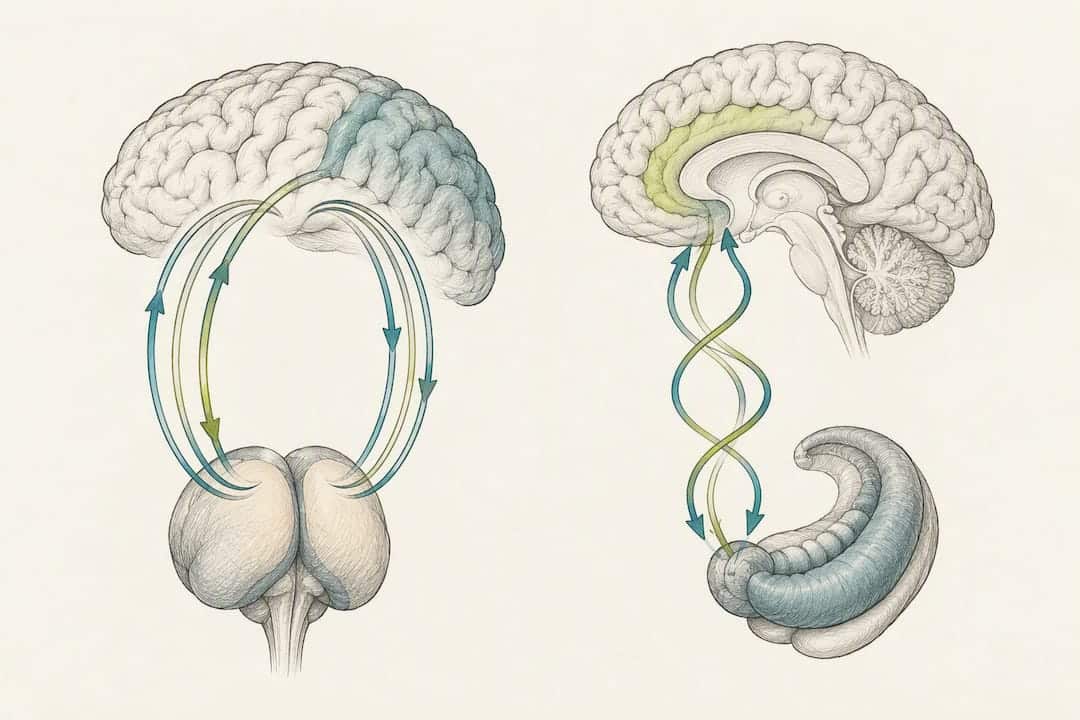
Alpha rhythms are generally understood to arise from thalamocortical loops, circuits linking the thalamus and cortex that produce synchronised oscillations when the visual and sensory systems are in a state of relaxed disengagement, which is part of why alpha spikes so reliably the moment you close your eyes.
Theta, particularly the frontal midline variety picked up in meditation research, is more closely tied to circuits involving the anterior cingulate cortex and hippocampus, structures heavily implicated in memory formation and sustained attention. The Frontiers 2018 review notes that frontal midline theta supports executive control and working memory during effortful tasks, which is a useful reminder that theta showing up during meditation isn’t automatically mystical, it can simply reflect your attention system working hard to stay on task.
The 2020 cross-frequency study adds a further mechanical detail: during meditation, alpha and theta rhythms tend to converge toward a shared 7 to 9 Hz zone rather than maintaining a strict 2:1 harmonic relationship. That convergence, described as reduced harmonic locking, appears to track with the loosely structured, non-effortful quality meditators describe as thoughtless awareness. Outside meditation, under cognitive load, that harmonic locking tightens back up.
None of this requires you to memorise circuit diagrams to meditate well. But understanding that alpha and theta come from at least partly distinct neural machinery explains why the two states feel so different from the inside, and why one doesn’t simply convert into the other with more effort.
Alpha and theta’s impact on memory, attention, and learning
Theta has one of the better-established links to memory in the wider neuroscience literature, particularly around encoding and consolidation. The Neurosity explainer on theta brainwaves notes theta’s association with dreaming, hypnagogia, and creative reverie, all states where the brain seems to be doing background work on recently formed memories and loosely associating ideas that wouldn’t connect during focused wakefulness.
Alpha’s cognitive signature is different. Rather than supporting memory formation directly, alpha appears more closely tied to attentional gating, essentially the brain’s ability to filter out irrelevant sensory input so it can focus resources where they matter. This is part of why open monitoring practices, which raise alpha, tend to produce reports of calmer, less reactive attention rather than sharper recall.
Frontal midline theta occupies a slightly different role again. Because it rises during focused attention tasks that demand working memory, in ordinary problem solving, coding, or complex conversation, as well as during meditation, it seems to index engaged executive control rather than passive dreaminess. That’s a useful distinction if you’re using meditation partly to support cognitive performance: focused attention training aimed at frontal theta may transfer more directly to working memory tasks, while open monitoring’s alpha gains may transfer more to emotional regulation and reduced reactivity.
Neither state is a straightforward performance enhancer on its own. They support different cognitive functions, and matching your practice goal to the right band saves a lot of wasted effort chasing the wrong outcome.
Duration and sustainability of alpha vs theta states
Alpha states tend to be more stable and sustainable across a typical meditation session. Once open monitoring settles in, many practitioners can maintain elevated alpha for the bulk of a 20 to 40 minute sitting without much conscious effort, which tracks with the “effortless awareness” quality the research associates with it.
Theta, particularly the useful, focused variety, tends to be less continuously sustainable. Frontal midline theta linked to concentrated attention often appears in shorter bursts rather than as a stable plateau, rising during moments of deep engagement and dipping when attention naturally cycles. This matches ordinary experience: intense focus is rarely a flat line, it ebbs and surges even within a single sitting.
This has a practical implication for session length. If your goal is alpha-dominant relaxation, longer sessions of 20 minutes or more tend to work well because the state, once reached, doesn’t require constant renewal. If you’re working with theta through focused attention or imagery, shorter, more frequent sessions often serve better than one long push, since trying to force an unstable state to persist for 30 or 40 minutes is where the drowsy, unproductive theta from the 2021 depth study tends to creep in.
There’s no fixed “correct” session length here. It depends on which state you’re cultivating and how your particular nervous system handles sustained effort versus sustained ease.
Contraindications and risks of prolonged theta meditation
Theta meditation is not risk-free for everyone, and the caution matters more than most wellness content admits. Because theta states involve a loosening of ordinary waking cognition and can surface vivid imagery or emotional material, people with a history of dissociation, unprocessed trauma, or certain psychiatric conditions may find prolonged theta work destabilising rather than restorative.
The 2021 study’s finding that theta correlates with “hindrances” also carries a practical safety implication: pushing to stay in a theta-heavy state despite rising restlessness or discomfort isn’t a sign you’re nearly through to something deeper. It’s frequently a sign to stop, shorten the session, or shift back toward an alpha-style open monitoring approach instead.
There’s a subtler risk too, around sleep. Theta sits close enough to the hypnagogic zone that long, poorly paced theta sessions late in the day can blur into unplanned napping, which may disrupt night-time sleep for people who already struggle with insomnia. If you’re using theta-oriented audio or imagery work as part of an evening routine, keep an eye on whether it’s helping you wind down or simply displacing your main sleep window.
None of this means theta meditation is dangerous for the average healthy adult in the doses discussed in this article. It means graduated pacing, self-awareness about your own history, and professional guidance where trauma or a diagnosed condition is involved should sit alongside any prolonged theta practice, not as an afterthought.
How orchestral soundscapes support alpha and theta practice
A stable, well-engineered listening environment does something for meditation that willpower alone often can’t: it gives your attention a consistent, non-distracting anchor, which the 2020 cross-frequency research suggests matters because meditative states favour loosened, effortless attention over active control. Orchestral Meditations builds its library around exactly that principle, featuring high-quality orchestral recordings mixed to create an immersive listening experience.
The catalogue includes binaural and theta-frequency tracks engineered to specific band ranges, alongside broader orchestral compositions better suited to alpha-style open monitoring. That range matters given everything covered above: a track built for deep theta work isn’t the right choice for a relaxed alpha session, and vice versa.
- Choose broader, sustained orchestral pieces for alpha-oriented open monitoring sessions of 20 minutes or more.
- Choose tracks specifically labelled as theta or binaural for shorter, focused-attention or imagery-based sessions.
- Keep volume low enough that the music sits in the background of attention rather than becoming the object of it.
Composer and producer Robert Emery, whose work spans large-scale orchestral and choral projects performed at major concert venues, brings a classically trained ear for pacing and dynamics to recordings designed to hold attention without straining it. Moritz Schneider’s production work on the technical side, particularly around spatial and frequency-based sound design, reflects the same underlying principle the neuroscience points to: the audio should support the state, not demand attention of its own.
An honest reflection on using alpha and theta in practice
I’ve noticed the same pattern the 2021 research describes: the sessions where I’ve chased theta hardest are usually the ones that left me restless rather than settled, while the calmest sittings came from simply widening attention and letting alpha rise on its own. That’s not an argument against theta work. Focused imagery and frontal theta have real value for creative and emotional processing. It’s an argument against treating theta as a trophy.
The most useful shift I’d suggest trying in your next session is small: stop asking “which brainwave am I in” mid-sit. Use audio, posture, and breath as scaffolds, then let the state emerge rather than monitoring for it. Curiosity about what shows up beats forcing a particular readout every time.
— ROBERT
Finding the right soundscape for your practice
If the protocols above have you wanting somewhere consistent to return to for both alpha and theta sessions, Orchestral Meditations gives you a library engineered specifically for that, rather than generic ambient playlists never designed with EEG research in mind.
The Personal subscription suits individual daily practice, giving you ongoing access to the orchestral, binaural, and theta-frequency tracks referenced throughout this guide, recorded with the National Philharmonic at Abbey Road Studios. If you teach, run sessions, or produce guided audio for clients, the Professional subscription adds the commercial licensing you need to use those same recordings in paid work. Therapists, yoga instructors, and app developers building on top of licensed tracks will find the Royalty Free Meditation Music product line covers that use case directly.
Start by matching your next session, alpha-style open monitoring or theta-style focused imagery, to a track built for that exact band, and see how the difference feels.
Sources
- Alpha and theta oscillations are inversely related to progressive levels of meditation depth
- From thoughtless awareness to effortful cognition: alpha–theta cross-frequency dynamics in experienced meditators during meditation, rest and arithmetic
- Neurophysiological correlates of meditation practices: a review
- What Are Theta Brainwaves? Creativity, Dreaming, and Deep Relaxation | Neurosity
FAQ
What is the difference between theta and alpha brainwaves?
Alpha waves (roughly 8 to 13 Hz) reflect relaxed, wakeful awareness and rise during effortless, open attention. Theta waves (roughly 4 to 8 Hz) reflect deeper, internally focused processing tied to imagery and memory, though research shows theta can also mark restlessness rather than depth, depending on context.
Are theta waves linked to ADHD?
Some EEG research has associated altered theta patterns, particularly frontal theta, with attention regulation differences seen in ADHD, though this is a distinct clinical research area from meditation studies. The theta findings discussed in this article concern meditative states in typically developing adults, not a diagnostic marker, so any personal concern about attention difficulties is best raised with a qualified clinician.
Is alpha or theta better for sleep?
Neither band is “better” outright, but theta sits closer to the hypnagogic, pre-sleep zone, which is why theta-oriented practice can support winding down in the evening. Alpha-dominant relaxation is generally more sustainable across a full session without tipping into drowsiness, making it a steadier choice earlier in the day.
How do I know if I am in theta state?
Subjectively, theta often feels dreamlike, with vivid imagery or emotional material surfacing while you remain loosely aware. Consumer biofeedback devices can suggest a broad shift toward theta, but they lack the precision of clinical EEG, so treat any reading as a general indicator rather than a diagnosis.