Try 50 to 60 BPM if deep rest or sleep is the goal, and 60 to 80 BPM for relaxed, wakeful mindfulness. Match the beat to your breath rather than the other way round, and let it slow you down gradually. Recordings composed by Robert Emery and Moritz Schneider are often built specifically within these bands, which makes them a sensible starting point if you’d rather not hunt for the right BPM yourself.
TL;DR:
- Slow tempos between 40 and 60 BPM closely match resting heart rates and are ideal for inducing deep relaxation and sleep states.
- Music above roughly 80 BPM tends to activate the body, making it unsuitable for calm or seated meditation practices.
- Syncing music to your breathing involves measuring your resting breath rate and aligning the track’s pulse with a four-beat inhale-exhale cycle.
- Individual physiological responses vary, so adjusting tempo based on personal relaxation or alertness cues can enhance meditation effectiveness.
- Tracks composed specifically within these tempo ranges, such as those by Robert Emery and Moritz Schneider, support consistent, scientifically-backed meditative states.
What tempo range is best for meditation?
There isn’t one correct answer, because “meditation” covers wildly different states of mind, from nodding off to a droning cello line to sitting bolt upright chasing laser focus. What matters is matching the band to the job.
40 to 55 BPM is the deep rest and slow theta induction zone. This is the tempo of a resting heartbeat slowed almost to a crawl, and it’s where you’ll find the most sparse, drone-like compositions. Solo cello, low string pads, and single sustained piano notes all live comfortably here. Nothing rushes. Nothing resolves quickly. That’s the point.
50 to 60 BPM is the sleep and deep relaxation band, and it overlaps deliberately with the range above. Practical guides on relaxation music consistently point to this bracket as the sweet spot for winding down, roughly matching a calm resting pulse. Slow piano, ambient synth washes, and orchestral pads with long decay times all sit naturally here.
60 to 80 BPM covers relaxed, wakeful mindfulness. This is the band you want if you’re meditating to stay present and alert rather than to fall asleep, and it tracks close to an average resting heart rate. Gentle orchestral movements, softly bowed strings, and unhurried woodwind lines fit well, since there’s enough rhythmic movement to hold attention without pulling you into an active, energised state.
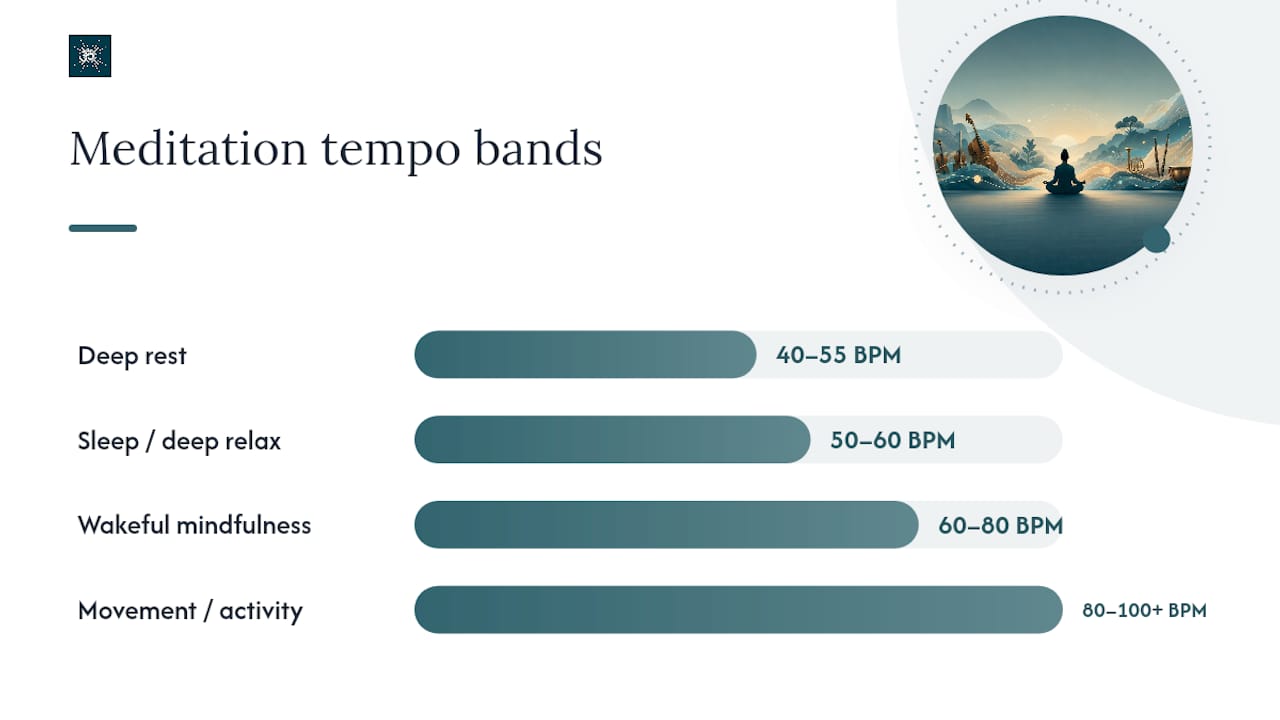
80 to 100+ BPM is for movement, not stillness. Walking meditation, some yoga flow sequences, and light physical practice can use this range, but it works against you if the goal is calm. Anything faster starts nudging the body towards alertness rather than away from it, which is exactly the opposite of what most seated meditation is trying to achieve.
Choosing a starting tempo is simpler than it sounds. Sit for a minute, breathe naturally, and notice your pace. If you’re tense or wired, start at the slower end, around 50 BPM, and let the music pull your physiology down with it. If you’re already fairly settled, 65 to 70 BPM gives you enough movement to stay engaged without drifting into sleep.
A few reliable starting points by style:
- Ambient drone — best for 40 to 55 BPM, ideal when the aim is stillness rather than engagement.
- Solo cello or low strings — versatile across 45 to 65 BPM, works for both rest and gentle mindfulness.
- Slow piano — sits naturally around 55 to 65 BPM, a good middle-ground choice for beginners.
- Low-frequency orchestral pads — effective from 40 to 60 BPM, particularly for sleep-focused sessions.
How do you sync music tempo to your breathing?
Breath entrainment is simpler than most guides make it sound, and you don’t need any special equipment beyond a watch and a bit of patience.
Start by measuring your own resting breath rate. Sit quietly for sixty seconds and count full breath cycles, one inhale plus one exhale counts as one. Most adults land somewhere between 12 and 20 breaths per minute at rest, though meditators often settle lower once they relax into a session.
Once you know your baseline, here’s a straightforward way to line music up with it:
- Pick a track tempo in the range appropriate to your goal, say 60 BPM for relaxed mindfulness.
- Decide beats per breath. A common starting pattern is four beats in, four beats out, giving you a breath every two seconds at 60 BPM, or roughly 15 breaths a minute.
- Practise the pattern without music first, using a metronome app or clock, until the rhythm feels natural rather than forced.
- Apply it to the track, letting the music’s pulse (not necessarily its melody) guide the count. Orchestral pieces without a hard percussive beat still carry a felt pulse through the phrasing, which works just as well as a click.
- Adjust gradually. If four and four feels rushed, try five in and five out, which slows your rate further without you consciously forcing it.
Movement-based practices need a slightly different approach. Walking meditation often uses a 4:4 or 6:6 breath-to-step ratio rather than a fixed beat count, since your stride naturally sets the pace. Guided breathwork sessions, meanwhile, usually work better with a vocal cue leading the breath and music sitting underneath at a low, unobtrusive volume, rather than the track dictating the rhythm outright.
Pro Tip: Use a free tap-tempo app and tap along to a track’s felt pulse for ten seconds. Most apps will average your taps into an accurate BPM reading, which is far quicker than trying to count beats manually against a stopwatch.
What does the research say about tempo, heart rate and brainwaves?
The physiological case for slow tempos isn’t just wellness folklore. It has some solid grounding.
Peer-reviewed work on music and physiology shows that tempo tracks changes in heart rate and can entrain physiological rhythms, with slower tempos producing measurable relaxation and faster ones increasing arousal. That’s a direct mechanism, not a correlation dressed up as one: your cardiovascular system responds to the pace of what you’re hearing.
Music near 60 beats per minute tends to synchronise with resting physiological rhythms, and reviews of the physiological effects of music associate that tempo with increased alpha brainwave activity, the 8 to 13 Hz range linked to relaxed wakefulness.
In practical terms, that gives you a rough map. Around 60 BPM tends to nudge the brain towards alpha, the state you’re in when you’re calm but still alert, similar to the drift just before daydreaming takes hold. Drop into the 40 to 60 BPM range and combine it with ambient or binaural textures, and you’re more likely to move towards theta, the 4 to 8 Hz band associated with deeper meditative states and the edge of sleep. Ambient, drone and binaural approaches are commonly cited as practical routes into that theta territory when paired with very slow tempos.
A quick physiological snapshot:
- ~60 BPM music → associated with alpha activity (8 to 13 Hz) → relaxed wakefulness
- 40 to 60 BPM + ambient or binaural texture → associated with theta activity (4 to 8 Hz) → deeper meditative states
It’s worth being honest about the limits here. Individual variability is real. Someone with a naturally fast resting heart rate might find 55 BPM oddly sluggish rather than soothing, while another person finds it exactly right. Music also works best as an adjunct to meditation practice, not a replacement for the skill of sitting with your own attention. No track does the meditating for you.
How do you find or create tracks at the right tempo?
Identifying BPM used to require a trained ear or a music production degree. It doesn’t anymore.
Streaming platforms and video descriptions increasingly list BPM directly in the title or metadata, particularly for meditation-specific content, since practitioners actively search for labelled tracks to keep their breath-sync practice consistent. Tap-tempo apps offer a quicker manual option: tap along to the felt pulse for ten seconds and most will average out an accurate reading. If you’re working in a digital audio workstation, built-in BPM detection tools will read a track’s tempo automatically, usually within a beat or two of accuracy.
Adjusting an existing track’s tempo is possible too, using time-stretch tools that preserve pitch while changing speed. Push much further than that and you’ll start hearing artefacts, a slightly warbled or smeared quality that undercuts the calming effect you’re going for.
Building a tempo-aware playlist for a full session follows a simple arc:
- Opening phase (5 to 10 minutes): tracks around 65 to 70 BPM to settle attention into an alpha-friendly state without dragging you towards sleep immediately.
- Deep phase (10 to 20 minutes): drop to 45 to 55 BPM, layering in drone or ambient textures to support theta.
- Return phase (5 minutes): ease back up slightly, around 55 to 60 BPM, to bring you gently back to alert wakefulness rather than jolting you out of the session.
Loopable tracks help here, since a seamless loop avoids the small jolt of a track restarting mid-session, and fades at the start and end of each phase smooth the transition between tempos instead of leaving an abrupt cut.
Does instrumentation matter as much as tempo?
Tempo sets the pace, but timbre decides whether that pace actually feels restful.
Sparse textures work better at slow tempos because empty space gives the brain room to settle rather than tracking busy melodic detail. Warm low frequencies, cellos, double bass, low piano registers, tend to feel grounding rather than stimulating, and slow harmonic motion, chords that change gradually rather than every bar, keeps the ear from working to predict what’s coming next.
Binaural beats and Solfeggio-frequency material can support theta induction when layered under a slow orchestral or ambient base, but they come with a practical catch: binaural effects only work properly with stereo headphones, since the effect relies on each ear receiving a slightly different frequency. Play it through speakers and the effect simply doesn’t happen.
A few practical notes worth keeping in mind:
- Keep volume moderate. Loud low-frequency content can feel physically overwhelming rather than calming.
- Binaural material isn’t recommended for anyone with epilepsy, and anyone with a serious neurological or cardiac condition should check with a clinician before using pulsed audio formats.
- Guided sessions (with a voice) generally suit beginners better than silent instrumental practice, since the voice anchors attention when the mind wanders.
- Silent, unguided practice suits more experienced meditators who don’t need external structure to stay present.
When is faster tempo, or no music at all, the better option?
Not every tempo band belongs in a meditation session, and pushing too fast is a genuine risk, not just a matter of taste.
Anything above roughly 100 BPM tends to activate rather than calm. A brisk, rhythmically busy track will nudge heart rate and breathing upward, which works directly against the physiological state most meditation is trying to reach. If you notice your shoulders tensing or your breath quickening while listening, the tempo is probably too fast for the goal, whatever the track’s label claims.
There’s also a middle-ground trap: tracks that sound gentle but sit at 90 to 100 BPM because of a persistent rhythmic pulse underneath the softer instrumentation. Melodic gentleness doesn’t guarantee a calming tempo. Check the pulse, not just the mood of the arrangement.
Silence has its place too, and it’s often underused. Advanced practitioners frequently drop music altogether once they’ve built the skill of settling attention without external cues, since a track (however slow) is still an external stimulus the mind has to process. Silence, or long unstructured pauses within a guided session, gives space for the mind to settle on its own terms rather than following a pace set from outside.
Guided voice or teacher-led chanting can also outperform continuous music in specific contexts, particularly for beginners who need a verbal anchor, or for practices rooted in vocal tradition where the chant’s own natural rhythm does the entraining work that a separate soundtrack would otherwise need to do.
Author perspective: experiment, notice and personalise
Here’s what I’d actually tell a friend rather than a wellness column reader: treat these tempo ranges as a starting hypothesis, not a prescription. Try each band for three to five sessions and pay attention to what your body does, not what you think it should do.
If you’re anxious, lean slower. But if a very slow track makes you drowsy and you’re trying to stay alert for daytime practice, that’s a signal to nudge the tempo up, not a failure on your part.
And sometimes the right answer is no music at all. A teacher’s voice, a chant, or plain silence can outperform anything on this list.
— ROBERT
Ready to try tempo-matched orchestral recordings?
Reading about the right BPM is one thing. Having a library already built around it saves you the trial and error. Some orchestral meditation music is recorded at famous studios with professional orchestras, and tracks are composed with these tempo bands in mind rather than assembled from generic stock loops, which provides a more tailored listening experience.
The Personal subscription at a moderate monthly cost suits individual practice, giving you access to tempo-appropriate tracks for sleep, relaxed mindfulness or deep rest sessions without hunting through mismatched playlists. Yoga teachers, therapists and wellness creators who need proper licensing for client-facing or public use should consider the Professional subscription, priced for professional users. If you need one-off commercial rights for a specific project, the Royalty Free Meditation Music line covers licensing for apps, guided audio and wellness content, with pricing available on request.
Start with a few sample tracks in the 50 to 60 BPM range and build your session arc from there.
Primary sources and further reading
The physiological groundwork behind these tempo recommendations comes from a small set of solid sources. The PMC review of music’s physiological effects explains the alpha-wave link to slower tempos in detail. The PLOS ONE study on tempo and heart rate provides the experimental basis for tempo-driven physiological change.
For practical technique, Verywell Mind’s guide to music meditation covers breath-sync basics well, and Orchestral Meditations’ own piece on mindfulness and sound expands on how musical structure affects mood and stress.
Sources
- Music and health: physiological effects and clinical applications (PMC)
- Tempo and physiological responses (PLOS ONE)
- How to practice music meditation | Verywell Mind
- What BPM is best for relaxation? The ideal tempo, explained | Calming Music
- Searchsound
FAQ
What BPM is most calming for meditation?
Most people find 50 to 60 BPM the most calming, since it sits close to a resting heart rate and supports the physiological shift towards relaxation. Slower still, down to 40 BPM, works well for sleep-focused sessions.
Is 200 BPM too fast for meditation music?
Yes, tempos far above 100 BPM are too fast for meditation and belong to genres built for energy and movement, not stillness. Anything above roughly 100 BPM tends to raise heart rate and breathing rather than calm them.
What frequency of music is good for meditation?
Slow tempos combined with low, warm frequencies work best, and some practitioners add binaural beats or Solfeggio tones to support theta-range states. Binaural effects only work through stereo headphones, so speaker listening won’t produce the same result.
What sound calms the brain most effectively?
Sparse, slow-moving orchestral or ambient textures around 40 to 60 BPM are widely cited as the most calming, particularly when paired with breath-synchronised listening. Orchestral Meditations builds its recordings, composed by Robert Emery and Moritz Schneider, specifically within this range for that reason.
How do I know if a track’s tempo is right for my session?
Check whether your breathing and shoulders relax within the first few minutes of listening; if you feel more alert or tense, the tempo is likely too fast for your goal. Tap-tempo apps can confirm the exact BPM if the track isn’t labelled.