
If you teach meditation, yoga or breathwork online and you want music under your lessons, you need two things: a basic grasp of how German music rights work, and a track you are actually allowed to use. The courses below cover the first. For the second, a licensed library with a professional licence is the shortest road, and ours was built for exactly that: live-orchestra meditation music recorded at Abbey Road Studios with the National Philharmonic.
I am Robert, and I am a conductor and composer, not a lawyer. I have, however, spent enough years around rights, recordings and the occasional baffled yoga teacher to know where people trip. This guide tells you what Germany’s online licensing courses teach, what they cost, who they are really built for, and how to decide whether you need one at all.
TL;DR
- Online music licensing courses in Germany run from a free self-paced course to one-day live seminars at around €490 to €495, and most are aimed at media professionals, not meditation teachers.
- Every course circles the same core idea: a song has two rights layers (the composition and the recording), and each must be cleared.
- Your online course counts as a commercial use of music, so “it was on a streaming service” is not a licence.
- The simplest route for a wellness teacher is music that arrives with a licence for your use. Our professional subscription costs €150 per month, our personal subscription €21 per month.
- A short course is worth your time if you will clear music from several sources, such as mainstream releases, collecting societies and publishers.
Why a meditation teacher needs to care about music rights at all
Picture it: you have recorded a lovely twelve-minute body scan, you have laid a gentle piano piece underneath it, and you have uploaded the lot to your course platform. Beautiful. Also, quite possibly, a problem.
Music is protected by copyright, and the right to make a title publicly available is reserved to the rights holder. Medien-Akademie frames its seminar around exactly this risk: third-party music in product and marketing videos on websites or on Facebook, TikTok and Instagram is protected. A paid online course is no different. If anything, because you charge for it, nobody will call it a private hobby.
The good news is that this is not rocket science. It is rights housekeeping. You need to know who owns what, what kind of permission you hold, and whether that permission covers selling a recording to students.
The two layers every course teaches first
Open any decent licensing course and you meet the same idea in the first hour. A piece of recorded music contains two separate things:
- The composition: the notes and, if there are any, the lyrics. Composers, lyricists and publishers hold rights here.
- The recording (the master): one specific performance captured on tape or disk. Record labels and performers hold rights here.
Wisstor’s course designers describe this distinction as the central concept of the whole programme. It matters to you because one permission rarely covers both. Buying a download of a pop song gives you a copy to listen to, not the right to put it under a paid lesson.
On top of that sit the terms you will meet in every syllabus:
- Synchronisation (sync) licence: permission to combine music with picture or video.
- Master licence: permission to use a specific recording.
- Mechanical licence: permission to reproduce music, for covers or physical and digital copies.
- Performance rights: permission for public playback, for instance in TV, radio or livestreams.
Wisstor’s syllabus lists all four, together with clearing rights across composers, lyricists, publishers, labels and collecting societies such as GEMA.
GEMA, GVL and who collects what
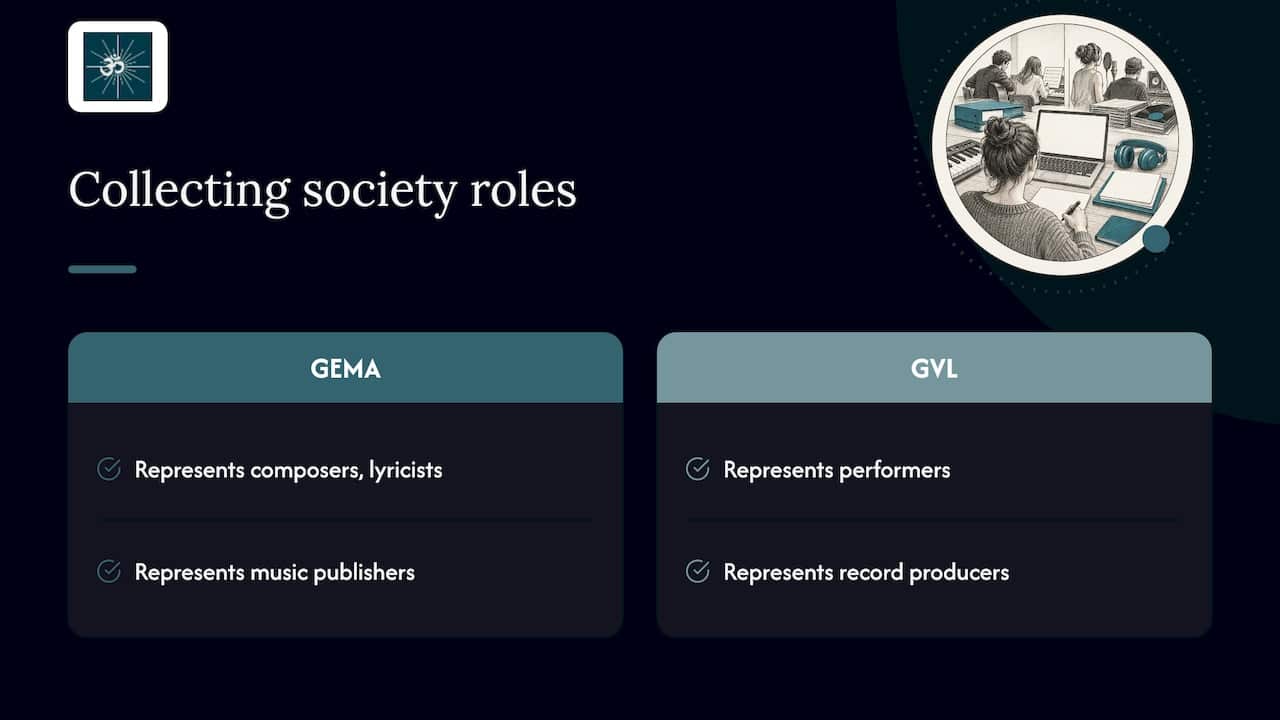
Germany leans on collecting societies. GEMA represents composers, lyricists and music publishers; GVL represents performers and record producers. Medien-Akademie’s seminar teaches the distinction between GEMA and music publishers, and between GVL and record labels, along with the framework of the Verwertungsgesellschaftsgesetz (VGG), the law governing collecting societies.
How far does GEMA’s reach go? Its model Berechtigungsvertrag of May 2025, the contract members sign, shows rights holders entrusting GEMA with their exploitation rights for all countries, including the production right (Herstellungsrecht) to use music in film works and picture-and-sound recordings. In plain words: for music by GEMA members, you often cannot just ask the composer. There is an organisation in the middle.
For physical products, GEMA’s official page says a new, simplified tariff structure for audio and audiovisual recordings entered into force in 2025, with licensing handled through the GEMA Online Portal. It also notes that, for film DVDs, users must first clear synchronisation rights and then register the production to obtain a GEMA AV number. That is the kind of detail a course walks you through, and also the kind of detail you would happily never meet if your music came pre-licensed.
The online courses available in Germany
Here is the landscape as it stood when this article was written in November 2026. Dates and prices change, so treat the figures as the published price for the year given and check each provider’s page for the current schedule.
Free and self-paced: the gentle starting point
Wisstor’s “Musik-Lizenzierung für Medienproduktionen” is free with all content included, with an optional certificate from $55. It has 12 units totalling 12 hours, is self-paced with unlimited access, works on mobile, and was last updated on 3 August 2026. It is designed for filmmakers, content creators, music producers and editors, and it needs no prerequisites. Of everything here, it is the closest fit for a teacher who produces video lessons.
One-day live seminars: fast, focused, pricey
Medien-Akademie’s “Musikrechte digital | rechtssicher handeln” is a one-day live session on Zoom, 09:00 to 16:00, at €495 per participant, with 15 places per session and a 4.8 out of 5 rating from 25 reviews. It covers GEMA and GVL responsibilities, the costs of music on digital platforms and social networks, music reporting, and AI-generated music: protectability, labelling duties and risk reduction. It targets staff at broadcasters, film companies, publishers and companies using music in digital marketing.
ARD.ZDF medienakademie’s “Musikurheberrecht: Digitale Verwertung und künstliche Intelligenz” is a one-day online webinar priced at €490 per person. It is aimed at staff in music editorial, rights management, central purchasing and licensing, and covers YouTube, media libraries, streaming-type distribution, the use of music libraries, AI-generated content, and dealings with GEMA and GVL. It is taught through lectures, discussion and case examples.
Both are excellent if you work inside a media organisation. If you are a solo yoga teacher with a laptop and a ring light, they are rather like hiring a concert hall to practise the triangle.
Specialist and music-business routes
EPI’s eLesson “Clearing Music Rights” is in English, with four chapters and 3 to 5 hours of learning time. It costs €150.00 including 19% VAT and comes with a certificate. Access is valid for one person on three devices for six months. It covers the clearance procedure, legal frameworks, errors and omissions insurance, and sync, master and composer agreements, taught by two German lawyers, Dr. Martin Diesbach and Kai May.
HOFA-College’s online “Music Business 2” module has a Music Law chapter covering copyright, sound-recording rights, performance rights organisations, public domain, Creative Commons, sampling and the legal side of generative AI, plus contracts. It suits people building a career in music more than people borrowing music for a class.
Side by side
| Course | Format | Published price | Best for |
|---|---|---|---|
| Wisstor, Musik-Lizenzierung für Medienproduktionen | Self-paced, 12 hours | Free (certificate from $55) | Content creators and video makers |
| Medien-Akademie, Musikrechte digital | Live online, one day | €495 | Marketing and media staff |
| ARD.ZDF medienakademie, Musikurheberrecht | Live online, one day | €490 | Broadcast and rights staff |
| EPI, Clearing Music Rights | Self-paced, 3 to 5 hours, English | €150.00 incl. 19% VAT | Anyone clearing music professionally |
| HOFA-College, Music Business 2 | Online module | See provider | Aspiring music professionals |
What you get for the money is mostly knowledge and, for some, a certificate. What you do not get is a single bar of music you may use. Keep that in mind, because it is the whole point of the next section.
What a course will not do for you
A licensing course teaches you to clear music: to find the rights holders, ask, negotiate and document. That is a real skill, and the lawyers teaching it are good at it. But clearing a popular recording for a paid online course can involve several parties, each with their own terms.
The ARD.ZDF medienakademie makes the point from the broadcasting side: when a programme is missing from an online media library, it is usually down to music rights, because performers’ and producers’ neighbouring rights are almost always involved. If a broadcaster with a legal department struggles, a solo teacher will too.
So ask yourself honestly which describes you:
- You want to understand music rights in depth, perhaps because you will publish, produce or manage music. A course is a sound investment.
- You want calm music under your lessons, this month. You need music that comes with a licence for your use, not a research project.
Most of the wellness teachers I meet are the second kind. That is who we made our library for.
A checklist: does a course cover your use of music?
If you do pick a course, match the syllabus to your situation before you pay. Here is the test I would apply:
- Where will the music play? Course platform, social media, livestream, app or physical product? Medien-Akademie’s seminar separates social networks and digital platforms; the GEMA tariffs separate physical carriers.
- Is the use commercial? Charging students, selling a download or running ads changes the picture.
- Does it explain sync and master licences? These are the two you will meet most often for video.
- Does it deal with AI music? Both big seminars now cover it, including protectability and labelling duties.
- Is the language right? Most are in German; EPI’s is in English.
- Does it cover what happens after a warning letter? A narrower social-media video course, Soundcheck, includes steps to take after an Abmahnung (a formal cease-and-desist letter) and checklists that are updated when rules change.
None of this requires you to become a rights lawyer. It just stops you assuming that “royalty-free” means “free of every obligation”, which is the misunderstanding I see most.
Music made for your use: how our library fits
Orchestral Meditations sells royalty-free orchestral meditation music with personal and professional licensing options, for use in meditation, therapy, yoga, apps, guided audio, massage and wellness content. The recordings feature live musicians, 3D surround sound, binaural beats, and theta and Solfeggio frequency tracks. Tracks are available individually or through a subscription.
If you teach online, this is the part that concerns you. Wellness practitioners, meditation and yoga instructors, therapists, content creators and app developers are exactly who our professional licensing is for. You pick a licence that matches how you use the music, rather than reconstructing one from several rights holders.
Perspective
I have been on both sides of this. As a conductor I have stood in front of an orchestra and thought about who owns every note. As someone who loves how music helps people sleep, relax and meditate, I have also watched teachers abandon beautiful ideas because the rights question seemed too fiddly.
Here is what we believe. Meditation music should be made for meditation from the first bar, not borrowed from somewhere else and hoped about. Together with Moritz Schneider, a producer who works with frequency-based and meditative orchestral sound, I wrote and recorded our library with the National Philharmonic at Abbey Road. On my own site I describe it as dedicated binaural theta meditation music recorded with the orchestra and choir, and as far as I know, we were the first composers to record meditation music with a full symphony orchestra.
That scale is not vanity. My biography notes a production with over 128 musicians and singers for this project. A live room of people playing together produces a depth of sound that is hard to fake, and our 3D surround sound and theta and Solfeggio tracks are designed to help listeners settle into a meditative state.
And because the music is ours, the licence conversation is short. You choose personal or professional, and you get on with teaching. Licensing courses are valuable for anyone who needs to clear other people’s music. For teaching meditation, we think the better question is: why clear a hundred songs when one library already speaks your language?
ROBERT
Which licence fits you
Think about how you use music, and choose accordingly.
For your own practice
If you listen for your own relaxation, sleep or meditation, the personal subscription is built for you, at €21 per month.
For teaching, therapy or content
If you use music with clients, in class recordings, apps or guided audio, the professional route fits. The professional subscription costs €150 per month. Our Royalty Free Meditation Music page covers the professional library and its licensing options.
Before you decide, put your own use in one sentence: “I play music in ___ for ___ people, and I charge for ___.” That sentence is the thing any licence, ours or anyone else’s, has to cover.
From a licensing course to a calm class: a simple routine
Whether or not you take a course, this routine keeps you tidy.
- List every place your music plays. Lessons, trailers, social clips, livestreams, the app.
- Note who made each track and what licence came with it.
- Keep the paperwork. Save the licence and receipt alongside the project. Courses call this due diligence; it is simply a folder.
- Check each use against the licence. Personal listening is not teaching, and teaching is not a resold product.
- Re-check when you change format. Moving from a private class to a public app is a new use.
- Revisit annually. Rules shift. GEMA’s 2025 tariff reform for sound carriers is one recent example, and AI music is moving quickly.
With music from our library, step 2 shrinks considerably: one source, one licence, one folder.
What is happening in German music licensing
You do not need the numbers to teach yoga, but they show the system is active. GEMA’s FAQ states that its general cost rate for business year 2025 is 18.408%, down from 21.993% in 2024, and that from 1 January 2026 it lowers its foreign remittance commission, with no commission for income from Austria, Switzerland, the USA and the UK. These figures concern what composers and publishers receive and are updated as GEMA publishes them, so check the FAQ for the latest.
The takeaway for you: the system keeps evolving, which is one more reason a ready-to-use licence saves headaches.
FAQ
Is there a free online course on music licensing in Germany?
Yes. Wisstor’s German course on music licensing for media productions is free with all content included, and a certificate costs from $55. It has 12 units over 12 hours, is self-paced and needs no prior knowledge.
How much do paid music licensing seminars cost?
The published prices of two one-day live-online seminars are €495 at Medien-Akademie and €490 at ARD.ZDF medienakademie. EPI’s self-paced English eLesson is €150.00 including 19% VAT. Prices change, so check each provider’s page.
Do I need a licensing course to use music in my online meditation course?
Not necessarily. A course helps if you will clear music from several rights holders. If you use music that comes with a licence covering your use, such as our personal or professional licences, you mainly need to follow that licence and keep your receipt.
What is the difference between a sync licence and a master licence?
A sync licence is permission to combine music with picture or video. A master licence is permission to use one specific recording. A recording of a song usually involves both the composition and the recording, so both layers must be cleared.
Does “royalty-free” mean I can use the music anywhere?
No. Royalty-free means you do not pay per play, but the licence still defines where and how you may use the music. Pick a licence that matches your use, personal or professional, and keep it with your project files.
Sources
- Musikrechte digital | rechtssicher handeln, Medien-Akademie
- Musikurheberrecht: Digitale Verwertung und künstliche Intelligenz, ARD.ZDF medienakademie
- Musik-Lizenzierung für Medienproduktionen, Wisstor
- Clearing Music Rights eLesson, EPI
- Music Business 2, HOFA-College Online Campus
- Soundcheck, Level Up Your Social Media
- GEMA Berechtigungsvertrag, model 2025-05
- GEMA: audio and audiovisual recordings for music users
- GEMA: Fragen & Antworten
- Backstage with Robert Emery
- Robert Emery (pianist), Wikipedia