
Stereo sends two fixed channels, left and right, to your speakers or headphones. 3D audio treats each sound as an object with metadata describing where it sits in space, letting one master render correctly across wildly different playback systems. Neither wins outright: stereo stays the reliable, universal choice, while 3D delivers real immersion when content is mixed for it and your gear supports it properly.
TL;DR:
- 3D audio relies on object-based rendering with metadata, which adapts sound placement across different playback systems, unlike stereo’s fixed channels.
- Genuine spatial sound requires native multitrack mixes, as upmixed stereo files often produce inconsistent or artificial effects on your gear.
- Content designed specifically for 3D audio, like film sound design or spatially mixed music, significantly benefits from immersive formats, unlike well-recorded stereo music.
- Compatibility varies widely, with high-end speaker arrays offering the best experience, while Bluetooth and phone speakers often default to standard stereo.
- For casual everyday listening, stereo remains preferable unless your device explicitly supports and is calibrated for native 3D audio formats.
3D audio vs stereo: the fundamental technical difference
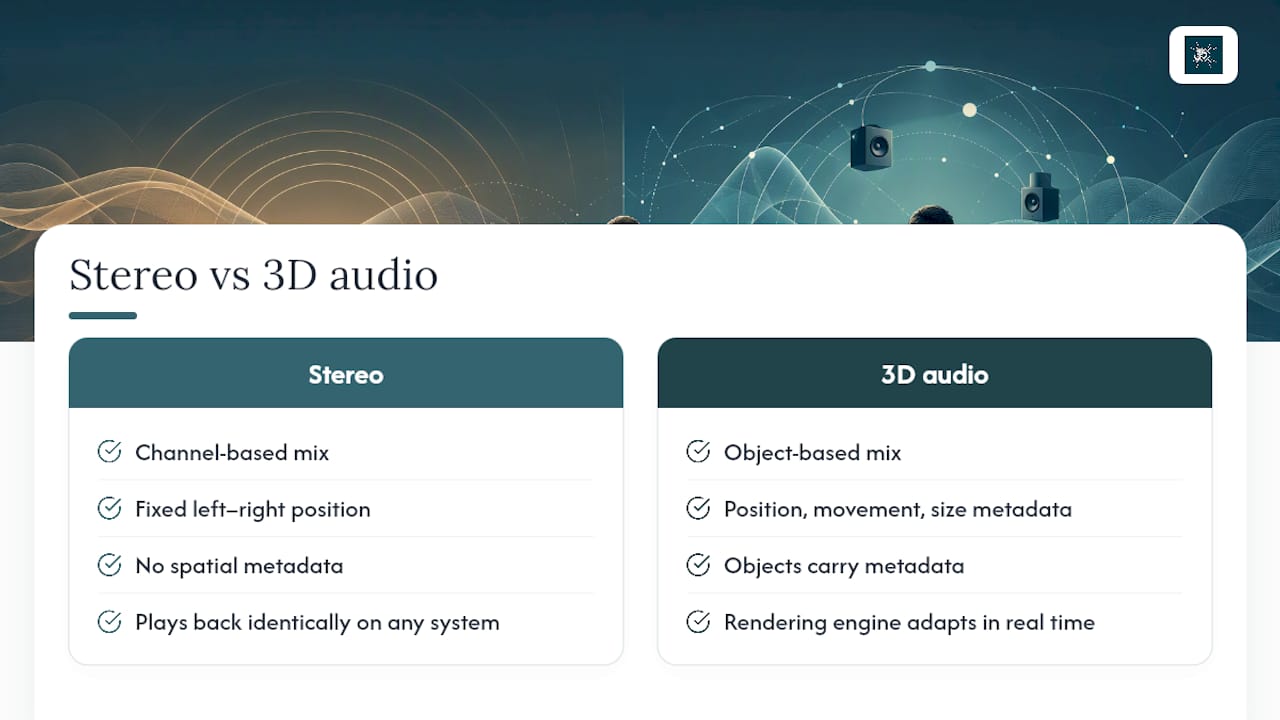
Stereo works on channel-based mixing. Every sound gets assigned a fixed position between the left and right channels during the mix, and that position never changes once it’s baked in. It’s simple, it’s been the industry backbone since the 1950s, and it plays back identically on a £15 earbud or a £15,000 hi-fi system.
3D audio flips that model entirely. Instead of channels, it works with audio objects: individual sounds carrying metadata that describes their position, movement, and size in three-dimensional space. A rendering engine then calculates, in real time, how each object should sound on whatever system is playing it back. Object-based audio means a single master file can adapt to a 7.1.4 cinema array, a soundbar, or a pair of headphones without anyone remixing a thing.
That’s the part people miss when they ask about the difference between 3D audio and stereo. It’s not really a comparison of “more speakers versus fewer speakers.” It’s a comparison of two entirely different philosophies: fixed channels versus dynamic, positional objects. One is a recording. The other is closer to a set of instructions.
How 3D audio actually gets rendered on your gear
Getting an object-based mix onto headphones requires a clever trick called binaural rendering. It uses a Head-Related Transfer Function (HRTF), a mathematical model of how your outer ear, head shape, and shoulders naturally filter sound before it hits your eardrum. Apply that filtering artificially to a stereo signal and your brain gets tricked into perceiving height and depth that headphones, by construction, cannot physically produce.
Head tracking adds another layer. Sensors in supported headphones detect when you turn your head, then adjust the soundfield so a sound that was in front of you stays in front of you rather than swivelling with your ears. Dolby’s own setup guidance stresses that binaural rendering quality and speaker calibration, particularly for height channels, make or break the illusion.
Here’s the catch worth knowing before you buy anything: converting a finished stereo mix into a spatial one after the fact, known as upmixing, produces inconsistent results. Genuine spatial audio needs native multitrack stems recorded and mixed for the object-based format from the start. Some distributors won’t even accept an upmixed stereo file as an Atmos master.
Does 3D audio actually sound better than stereo?
The honest answer, backed by measurement rather than marketing copy, is: sometimes, and it depends heavily on what you’re listening to.
Pro Tip: Envelopment and presence are not the same thing. Envelopment is the sense of being surrounded by sound. Presence is how “there” a performance feels. 3D formats reliably boost the first. The second is far more contested.
The evidence gap most guides skip: a peer-reviewed perceptual comparison testing 3D, surround, and stereo reproductions found that while spatial formats generally increase envelopment, listeners reported no statistically significant difference in perceived presence for certain classical recordings (p > 0.05). Listener envelopment correlated closely with overall listening experience across formats, but the gains varied sharply by recording technique and programme material.
Translation: a well-recorded orchestral stereo mix, captured in a genuinely resonant space with sensible microphone placement, can feel just as present as its 3D counterpart. The format matters less than how carefully the original recording captured the room. Where 3D audio pulls decisively ahead is with content designed around movement and directionality: film sound design, competitive gaming, and music mixed from the ground up with spatial placement in mind, rather than squeezed into it afterwards.
Which devices and services actually support 3D audio
Compatibility remains the single biggest gap between the promise of spatial audio and what most listeners actually experience. Playback quality varies enormously depending on the chain:
- Dedicated 7.1.4 speaker arrays deliver the highest spatial resolution but need a purpose-built room and calibration.
- Soundbars virtualise height channels using upward-firing drivers, with results ranging from convincing to underwhelming depending on ceiling height and room shape.
- Atmos-enabled and binaural headphones handle rendering per listener rather than per room, which SonusGearFlow’s comparison notes tends to give consistently good results regardless of where you’re sitting.
- Bluetooth compression, car stereo systems, and phone speakers frequently fall back to stereo even when the source file is spatial, because the decoder or bandwidth simply isn’t there.
- Streaming services vary in whether they serve a native spatial stream or an algorithmic approximation, so the same track can sound different depending on the app.
Firmware and renderer quality matter more than most buyers assume. Two headphones with identical drivers can render the same Atmos file quite differently depending on how their internal HRTF model is tuned.
When stereo is still the smarter choice
Stereo remains the sensible default for most everyday listening, and production studios generally agree that mastering in stereo first keeps a track compatible everywhere, with spatial versions reserved for content that genuinely benefits from the extra dimension.
Use this quick decision sequence before choosing a format:
- Check whether the content was natively mixed in 3D, not just upmixed.
- Confirm your playback device actually decodes spatial audio rather than faking it.
- Consider your environment: a noisy commute or a car cabin rarely rewards the investment.
- For focused listening at home, whether meditation, film, or a dedicated album, test both formats on the same track.
Pro Tip: If you’re mostly listening on a phone speaker or in a car, stereo will sound identical or better than a poorly rendered 3D fallback. Save the spatial listening for headphones or a proper speaker setup.
How to run a fair stereo vs 3D listening test
Most informal comparisons are rigged without anyone realising it, usually because the 3D version is louder or the listener knows which one is playing. A cleaner method:
- Match loudness levels precisely between both versions before you start; volume differences fool the ear into hearing “better,” not “different.”
- Disable any virtual surround or enhancement processing on the stereo playback so you’re comparing genuine formats, not a gimmick.
- Test on both headphones and speakers, since binaural rendering and physical speaker arrays behave very differently.
- Listen blind if you can, switching formats without knowing which is which, and note specific cues: does the soundfield feel wrapped around you, does imaging stay stable, do you hear artefacts like comb filtering or an unnaturally hollow ambience?
- Calibrate speaker height channels correctly. A practical audition protocol recommends checking for level and time-alignment issues, since a badly calibrated height channel can undo most of the benefit 3D is supposed to deliver.
How Orchestral Meditations approaches 3D audio in practice
Orchestralmeditations records live sessions that support a true spatial mix. Composers and producers including Robert Emery and Moritz Schneider shape those sessions, work that carries real weight given the precision object-based rendering demands from the original recording.
A listener’s honest take on choosing between the two
Format choice comes down to content and intent, not brand loyalty to one technology. Test with music you already know well, in the room or headphones you’ll actually use, rather than trusting a demo reel built to impress. For dedicated listeners chasing genuine immersion, studio-grade 3D mixes exist and reward the effort of proper playback.
— ROBERT
Meditation music built for genuine spatial listening
Orchestralmeditations offers wellness practitioners and individual listeners access to orchestral recordings mixed in 3D surround, rather than algorithmically upmixed from stereo, aiming for a more authentic spatial depth.

Whether you’re guiding a meditation session, running a yoga class, or licensing sound for an app, the difference between a native spatial mix and a fallback stereo file is audible the moment you put on headphones. The Personal subscription suits individual practice, while the Professional subscription covers practitioners and creators needing commercial licensing. For one-off projects, the Royalty Free Meditation Music catalogue offers tracks recorded with the same scientific sound design, including binaural and theta-frequency layers. Sample a few tracks on headphones first and hear what a genuinely native 3D mix does that a converted stereo file never quite manages.
Sources
- Working with object-based audio — Audiokinetic
- Perceptual comparisons of 3D, surround and stereo reproductions — (DOI)
- Dolby Atmos speaker setup — Dolby
- Spatial audio explained — Remasterify
- Spatial audio: beyond stereo — SonusGearFlow
FAQ
Is 3D audio better than stereo?
Not universally. 3D audio increases envelopment for content mixed natively for it, but peer-reviewed testing found no significant difference in perceived presence for some classical stereo recordings. It’s better for cinematic and gaming content; stereo often matches it for well-recorded music.
Does the PS5 have 3D audio or stereo audio?
The PS5 supports Sony’s own 3D audio processing (Tempest 3D AudioTech) alongside standard stereo output, and the option you get depends on your headphones or TV setup. Compatible headsets and TVs with the right decoders unlock the spatial effect; otherwise the console falls back to stereo or standard surround.
Should I turn off 3D audio on my PS5?
Turn it off if you’re using standard TV speakers, a soundbar without height channels, or headphones the console doesn’t specifically support, since the effect can sound thin or artificial on unsupported hardware. Leave it on for compatible headsets, where the positional cues genuinely help in games.
Should I turn on 3D surround sound?
Turn it on for headphones or a properly configured speaker array with height channels, and for content natively mixed for spatial formats like film and games. Leave it off for casual listening on phone speakers, car stereos, or Bluetooth connections that typically can’t decode it properly anyway.