
Short answer: 24-bit gives a far bigger theoretical dynamic range than 16-bit (about 144 dB against about 96 dB), and it matters most while music is being recorded, mixed and processed. For simply lying down and listening, 16-bit is a perfectly good delivery format, and the thing that decides whether a meditation feels alive is the quality of the performance and the recording behind the file, not the number on the spec sheet.
If you teach yoga, guide breathwork, run a sound bath or just fall asleep to a good cello, this is the version of the bit-depth debate you need. No engineering degree required. We will use the odd bit of maths, one worked example and (I promise) only a little complaining about forum arguments.
TL;DR
- Bit depth is loudness resolution, not pitch. It sets how many volume steps each sample can take: 65,536 at 16-bit, 16,777,216 at 24-bit.
- Theoretical dynamic range: roughly 96 dB for 16-bit and 144 dB for 24-bit. CD audio is 16-bit at 44.1 kHz.
- 24-bit is for making, 16-bit is fine for playing. Record and edit in 24-bit (or higher), and when you reduce to 16-bit, use dither.
- File size: 24-bit files are about 50% bigger than 16-bit files at the same sample rate, which adds up over a 45-minute meditation.
- For your practice, the performance, the room and the mix count for far more than the bit depth printed on the download.
What bit depth actually means (and what it does not)
Digital audio is a series of snapshots. Each snapshot is called a sample, and two numbers describe it. The sample rate says how many snapshots are taken every second (44.1 kHz means 44,100 of them). The bit depth says how finely each snapshot can measure the loudness of the sound at that instant.
Adobe’s guide to digitising audio puts it plainly: bit depth determines the amplitude values available, and with them quantization noise and the theoretical dynamic range. Sample rate, on the other hand, describes how the waveform is captured over time. So bit depth is not about how high the highest note can go. It is about how gently the quietest moment can be drawn compared with the loudest.
Think of it as a staircase. A 16-bit staircase has 65,536 steps between silence and the loudest possible sound. A 24-bit staircase has 16,777,216. Those figures come from the same Adobe guide. More steps mean each step is tiny, so the little rounding errors (quantization noise) sit much lower down.
Why should a meditator care? Because meditation music lives in the quiet end of the staircase. A long, soft string swell, a breath of reverb tail, a singing bowl decaying into the room: all of this is low-level detail, precisely where rounding errors would show up if they were going to show up anywhere.
The numbers: 96 dB versus 144 dB
Dynamic range is the distance between the quietest sound a format can hold (above its noise floor) and the loudest. Adobe gives the theoretical figures as about 96 dB for 16-bit and 144 dB for 24-bit. A rule of thumb: every extra bit adds roughly 6 dB, and 8 extra bits therefore add roughly 48 dB.
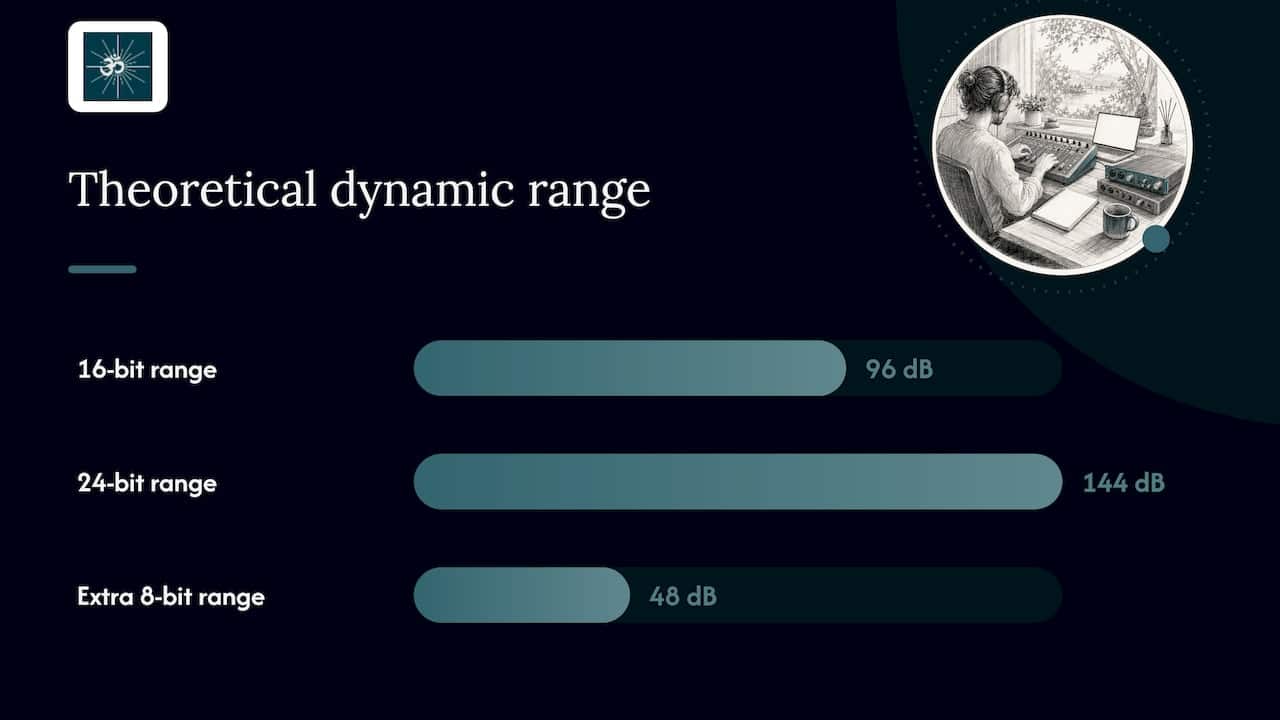
To keep this in proportion: 96 dB is already huge. The difference between a quiet room and a loud concert is in that territory. Real recording rooms and real microphones have their own noise, and no practical converter delivers the full 144 dB. So the 24-bit figure is best read as “a very comfortable amount of headroom” rather than “you will hear 144 dB of detail”.
Where does the extra space help in practice? One recording-forum answer put it neatly: 24-bit lets you set a more generous safety margin below the peak, for example 20 dB, than 16-bit does. I will not lean on that thread as an authority, but the logic is sound and it matches the manufacturer guidance below. With 24-bit you can record with plenty of space before clipping and still have loads of resolution left.
Is CD quality 16-bit or 24-bit?
CD audio is 16-bit, conventionally at 44.1 kHz. Sony’s German digital-audio guide states this and adds that a higher bit depth generally means larger files. So when someone says “CD quality”, they mean 16-bit/44.1 kHz. Anything above that, in bit depth or sample rate, is usually sold under the label “high-resolution audio”.
That label gets slapped on files with great enthusiasm. It is worth remembering that it describes a technical container. It says nothing about whether the cellist was inspired that morning.
Can you actually hear the difference?
Honest answer: sometimes, under controlled conditions, and rarely as dramatically as marketing suggests.
Academic work shows the question is subtle. A paper presented at the ICA 2019 congress by the German acoustics society (DEGA) tested a sound-localisation task with ten university students and found a correct-response rate of 44.38%, significantly above chance. That is a real effect in a specific experiment. The same paper also notes that listeners often find 16-bit and 24-bit versions hard to tell apart when the musical context is the same. It is a narrow experimental method, not a verdict on how you will experience your evening wind-down.
What does that mean for you? Three practical points:
- Your playback chain limits what you can perceive. Phone speakers, cheap earbuds and a noisy room mask differences long before bit depth does. Decent headphones in a quiet space let you hear far more.
- Quiet material is where a difference is most likely to appear, because low-level signals are where rounding noise would live. That is relevant to ambient and meditative music.
- Spatial and immersive formats ask more of the signal. Binaural and surround-style recordings rely on subtle level and timing cues between the ears, so clean low-level detail is a sensible thing to want.
None of this makes 16-bit “bad”. It means 24-bit gives the people who make and process the music a safer margin, which is the next point.
Recording, mixing and mastering: where 24-bit earns its keep
If you only ever press play, you can skim this section. If you produce guided meditations, record your own voice-overs or edit sound for classes, read on.
Recording. Apple’s Logic Pro documentation describes 24-bit as the commonly used recording depth, with files 50% larger than 16-bit files, and lists 16-bit as an option when you need smaller files or your device only works at 16-bit. In plain terms: record your voice in 24-bit and you do not have to ride the input level nervously. Leave a healthy gap below the loudest peak and the quiet parts will still be well captured.
Mixing. Modern software does its sums at high internal precision. Ableton’s German Live manual notes that Live processes internally at 32-bit precision and recommends rendering at 32-bit while you are not mastering or finalising. The idea is to avoid squeezing the audio down to a lower bit depth at every intermediate step. Save the reduction for the very last stage.
32-bit float versus 24-bit. Another reader question. Apple’s guidance is that for acoustic recording with sensible external gain staging, 24-bit is sufficient, while 32-bit float in Logic Pro can let you lower the gain of a clipped region to remove digital clipping or lift a quiet recording without raising the noise floor. Think of 32-bit float as an editing safety net rather than something a listener needs.
A worked example: file size for a 30-minute meditation
Bigger bit depth means bigger files, and for long meditations it adds up. Adobe calculates that mono audio at 44.1 kHz and 16-bit needs about 5 MB per minute, and stereo doubles that to about 10 MB per minute.
So a 30-minute stereo meditation at 44.1 kHz works out like this:
| Format | Approx. size per minute (stereo) | Approx. size for 30 minutes |
|---|---|---|
| 16-bit / 44.1 kHz | about 10 MB | about 300 MB |
| 24-bit / 44.1 kHz | about 15 MB | about 450 MB |
The 24-bit row is my own arithmetic from two sourced facts: the 16-bit figure from Adobe and the 50% increase from Apple. It is uncompressed audio, so compressed formats will be smaller. For a one-hour sleep session on a phone with limited storage, you can see why 16-bit is sensible for playback while 24-bit is what you want on the studio drive.
How to convert 24-bit to 16-bit without damaging the sound
If you make your own material, at some point you will need to reduce a 24-bit master to 16-bit, for a CD, for a platform that wants it, or for a smaller download. This is the step where care counts.
Reducing bit depth is called requantisation: the software has to round each sample to the nearest of far fewer steps. Left alone, that rounding error is correlated with the music, which on soft passages can sound like a faint grittiness rather than a clean hiss. The cure is dither, a tiny amount of deliberately added noise. The German Audio Engineering Society paper by Christian R. Helmrich explains that dither decorrelates the quantisation error by adding a signal before requantisation. In other words, you trade a whisper of steady noise for the removal of a nastier, music-dependent distortion.
The practical routine:
- Work in 24-bit or higher the whole way, and keep the intermediate renders at high resolution. Ableton’s guidance on this is to use dither whenever you render at a lower bit resolution.
- Reduce the bit depth once, as the very last step. Never convert down and then process again.
- Apply dither at that single conversion, particularly for pieces with long quiet passages, which is most meditation music.
- Do not dither twice. Add it once, at the final reduction.
- Listen to the quietest section with headphones (the fade-out and the opening bars are the usual suspects) before you export the final files.
One more thing: never convert 16-bit up to 24-bit and call it high-resolution. The extra bits are empty. You gain file size, not detail.
Should you pick 24-bit or 16-bit? A simple guide
| Your situation | Sensible choice |
|---|---|
| Recording voice-overs or live instruments | 24-bit (32-bit float if your setup supports it and you want recovery headroom) |
| Editing and mixing a guided meditation | Keep it at high internal precision until the final export |
| Final delivery to listeners on phones or in the car | 16-bit/44.1 kHz is a standard delivery format |
| Listening on good headphones, in a quiet room | 24-bit if you have it, 16-bit if you do not |
| Limited storage, long sleep sessions | 16-bit, to keep files manageable |
The table is a summary of the sources above, not a rulebook. The principle holds: capture and process generously, deliver sensibly.
Why the source matters more than the spec
Here is the bit that gets lost in the bit-depth debate. A bit depth is a ruler. It tells you how finely something is measured, not whether the thing being measured is any good. A beautifully played orchestral piece, captured in a great room with good microphones, will still move you through earbuds. A thin synthesised pad at 24-bit will still sound like a thin synthesised pad. If I may borrow an image: putting a thin sound into a bigger file is like pouring a thimble of tea into a bucket.
That is why live performance and the recording space are worth caring about. The pianist and conductor Robert Emery was named music director of the National Philharmonic Orchestra of Great Britain in 2023, and recorded the meditation music behind Orchestral Meditations at Abbey Road Studios with more than 128 musicians and singers, according to his biography. He writes and produces with the composer Moritz Schneider, his partner on albums and musicals going back well over a decade, including the 2017 album 4Colors for the Swiss singer SEVEN. Moritz has been writing for films, albums and musicals for over 20 years.
That background matters to a listener for a simple reason: a large live ensemble in a famous room produces the kind of rich, slowly changing low-level detail (bow noise, room air, the way a note blooms and fades) that a higher-resolution signal chain is designed to preserve. You hear it as depth and calm, not as a number.
Therapy and sound-healing contexts
If you work with clients, whether in a yoga studio, a clinic or a treatment room, the same logic applies. Quiet passages and gentle fade-outs are part of the experience, so clean playback of low-level detail is a sensible goal, along with reliable volume control and a speaker or headphone setup suited to the room. If you want a wider picture of how people use music in practice, this overview of sound healing therapy is a good place to read around the subject.
For the science of why sound and music affect attention and calm, our own article on science-backed sound and music for mindfulness goes into it in more detail.
Our perspective
When Moritz and I walked into Abbey Road with the National Philharmonic, nobody was talking about bit depth. We were talking about whether the strings could breathe together, whether the room would hold a note long enough, and whether the music would carry a listener somewhere quiet.
That is the order of priorities we believe in. Technical choices serve the music, and the music serves the meditator. Live musicians matter to us because, as Moritz likes to say, the power of the frequencies created by a live instrument played by a real heartbeat cannot be beaten.
We also care about the science side: binaural beats, theta frequencies, Solfeggio-based tracks and 3D surround sound are all part of how we design a listening experience. These are immersive formats, and immersive formats reward a clean, carefully handled signal from the first microphone to your headphones.
So our advice is simple. Do not agonise over 16 versus 24. Choose music that was recorded with care, in a real room, by people who love it, and give it a quiet space and decent headphones. Then close your eyes.
ROBERT
Where to find the music
If you want to hear what live orchestral recording brings to your practice, our library is built around exactly that: orchestral meditation music with live musicians, recorded at Abbey Road Studios, with binaural, theta and Solfeggio-frequency tracks and 3D surround sound. You can buy individual tracks for personal or professional use with licensing, or listen through a subscription.
The personal subscription costs 21 € per month and suits home practice, sleep and personal listening. If you teach, guide or create content, the professional subscription costs 150 € per month, and our royalty-free meditation music page covers licensing for use in classes, therapy, yoga, apps, guided audio and massage.
FAQ
How do I convert 24-bit audio to 16-bit?
Do it once, as the final step, from your highest-quality master. Apply dither when you reduce the bit depth, as Ableton’s guidance on rendering at a lower bit resolution recommends. Dither adds a very small amount of noise in return for avoiding music-dependent rounding distortion, which matters most on quiet passages.
What is the maximum dynamic range of 24-bit audio?
The theoretical figure is about 144 dB, against about 96 dB for 16-bit, according to Adobe’s digitising guide. Real converters, microphones and rooms have their own noise, so in practice you will not use the whole range. The point is generous headroom, not a number to chase.
Should I use 24-bit or 32-bit audio?
For ordinary acoustic recording with sensible gain levels, 24-bit is enough. 32-bit float is useful in editing because, as Apple’s Logic Pro documentation explains, it can let you recover clipped peaks or lift quiet recordings without raising the noise floor. It is a workflow safety net rather than something a listener needs.
Is CD quality 16-bit or 24-bit?
CD quality is 16-bit, normally at a sample rate of 44.1 kHz, as Sony’s German digital-audio guide describes. Files with a higher bit depth or sample rate are typically called high-resolution audio.
Sources
- Digitalisieren von Audiodaten (Adobe Audition)
- Digitale Audiotechnik im Überblick (Sony Deutschland)
- Recording settings in Logic Pro for Mac (Apple Support)
- Merkblatt zu Signalen in Live (Ableton Reference Manual)
- Discriminability of high-resolution audio (DEGA, ICA 2019)
- Improved Psychoacoustic Noise Shaping (AES 2007)
- Robert Emery (pianist), Wikipedia
- 24-bit recording discussion (KVR Audio forum)