For commercial or revenue-earning TikTok content, use TikTok’s Commercial Music Library, which is pre-cleared for the platform. For any externally sourced track, use only music with explicit commercial sync rights and platform coverage, and save the licence or invoice the moment you buy it. If your video is going on Instagram or YouTube too, get a track whose licence names every platform in writing before you post.
TL;DR:
- TikTok’s Commercial Music Library is free and easy but only covers use within TikTok, not other platforms like Instagram or YouTube.
- Licences claiming “royalty-free” do not guarantee cross-platform or commercial rights unless explicitly specified in writing.
- Always verify licence scope, territories, and platform coverage before using external tracks and keep documented proof with your project files.
- Automated audio matching and unverified “no copyright” labels do not guarantee safe use, as rights holders can still file claims regardless of labels.
- Using original, commissioned, or fully licensed orchestral meditation music with clear provenance is the safest way to avoid copyright issues.
What is safe to use for TikTok meditation music copyright compliance?
Three routes exist for creators who want meditation sounds without a copyright claim landing on their account. Each has a different trade-off between convenience and reach.
TikTok’s Commercial Music Library (CML) is the free, built-in option, and it does exactly one job well: it clears you to use a track on TikTok for commercial posts, including brand deals and monetised content. TikTok’s own Business team describes it as a curated catalogue built specifically for promotional use inside the app. The catch is scope. That clearance was never designed to travel with your video onto other platforms, so a CML track that’s perfectly fine on TikTok can still trigger a claim the moment you repost it to Reels.
- Pro: free, fast, built into the upload flow
- Con: TikTok-only licence, no cross-platform coverage
Externally licensed royalty-free libraries are the better fit once your meditation content starts earning money outside TikTok, or you’re producing for a client. Here, the licence wording matters more than the price tag. Royalty-free describes how you pay for a track, not what you’re allowed to do with it, and that distinction trips up a surprising number of wellness practitioners who assume “royalty-free” means “use anywhere, forever.” Look for licences that spell out commercial sync rights, who holds the master, and which territories and platforms are actually covered.
Original audio, whether commissioned or self-recorded, removes the guesswork entirely. If you own the master, nobody else can claim it. This is where a tool such as AmmarAI’s AI music generator earns its place, letting creators generate a bespoke ambient bed they fully own rather than gambling on someone else’s upload.
What you should never trust: a TikTok sound simply labelled “no copyright” by whoever uploaded it. That label is not a licence. TikTok’s automated matching checks the audio fingerprint, not the caption someone typed underneath it, so a popular “no copyright meditation music” sound can still belong to a rights holder who hasn’t reported it yet.
How to verify a licence and what documentation to keep
Before you trust any external track, read the licence itself. Not the marketing page. Not the FAQ. The actual document.
- Check the permitted placements. Does it explicitly mention TikTok, Reels, Shorts, or advertising use, or does it only say “digital media” in vague terms?
- Confirm the territory and duration. Some licences are region-locked or time-limited, which matters if you’re building a back-catalogue of evergreen meditation videos.
- Look for exclusivity clauses. A non-exclusive licence is normal and fine; an exclusive one restricts who else can use the track, which rarely applies to creator purchases but is worth ruling out.
- Confirm commercial use is named outright. Wording that only mentions “personal use” or “private listening” is a licence for your own headphones, not your monetised TikTok account.
Once you’ve confirmed the licence covers you, build what amounts to an evidence pack for that specific track: the licence PDF, the invoice or transaction ID, the exact track filename, and a way to contact the composer or producer if you ever need to prove the chain of rights. Melobleep’s guide for meditation teachers makes the same point to therapists and yoga instructors, who face this exact problem when licensing background audio for client sessions.
Pro Tip: Screenshot the licence terms and date them the day you download the track, not the day you eventually get a copyright strike. TikTok’s appeals process moves fast, and scrambling to find proof after the fact wastes the window you have to respond.
Red flags worth walking away from: licences that never mention “commercial,” bundles that only cover “streaming” without naming platforms, or sellers who can’t produce an invoice on request. If a track is genuinely valuable to your content but the licence is ambiguous, email the rights holder and ask for it in writing before you post. A five-minute email beats a removed video with 40,000 views.
Uploading licensed music so TikTok recognises it
The mechanics of how you add music matter almost as much as the licence itself.
- Embed the audio into the video file before upload. Don’t rely on TikTok’s in-app sound layering tool for externally licensed tracks. That feature is built around TikTok’s own sound library, not your separately purchased licence, and mixing the two invites confusion if a claim comes through.
- Complete the Music Usage Confirmation. TikTok’s upload flow asks creators to confirm they hold the rights to any external audio, and Soundstripe’s breakdown of TikTok’s licensing rules confirms this step exists precisely to catch unlicensed uploads early.
- Keep the licence inside your project folder, alongside the raw video file, so if a claim triggers an appeal, you can attach proof in minutes rather than digging through old email receipts.
- If you’re repurposing the video for other platforms, check whether the licence actually names them. If it only covers TikTok, swap the audio before you post to Instagram or YouTube rather than assuming the clearance travels with the file.
Business accounts and revenue-earning creators need to be more careful here, not less. Recent tightening of commercial licensing enforcement has raised scrutiny specifically on monetised and brand-affiliated content, meaning a personal account posting for fun faces a different risk profile to a business account running ads.
What happens when a sound gets muted or claimed
TikTok’s enforcement runs on two tracks at once: automated audio matching that scans every upload, and manual reports filed by rights holders. The outcomes vary even for near-identical videos, because the system weighs both signals differently depending on the claim.
- Mute: your video stays up, but the audio goes silent. Common for a first-time, low-severity match.
- Removal: the whole video comes down, usually for a stronger or repeated match.
- Claim with monetisation redirect: your video stays live, but ad revenue on that clip may go to the rights holder.
- Account strike: repeated violations escalate towards a ban, which is the outcome creators most want to avoid.
If you get hit, act fast. Check “view details” on the flagged post first, since it usually tells you exactly which track triggered the match. Gather your licence proof and file an appeal immediately if you genuinely hold the rights. If you don’t, or you’re not sure, the faster fix is often just swapping the audio and re-uploading rather than fighting a claim you can’t prove.
A myth worth killing outright: trimming a track to a few seconds or dropping the volume under your voice does not reliably dodge detection. TikTok’s matching system compares the underlying audio fingerprint, not how loud or long the clip is, so a quiet fifteen-second snippet can still get flagged exactly like the full track.
Orchestral Meditations: a licence-ready option worth knowing
If you want meditation music built for licensing from the start rather than repurposed from a streaming playlist, consider platforms offering royalty-free orchestral meditation tracks recorded with full orchestras and commercial licensing options, with downloadable licence proof available at purchase.
The production credits can be important. Named composers and producers on recordings provide provenance that can be useful if you ever need to appeal a mute. A licence tied to an anonymous stock file is harder to defend than one tied to a credited composer and a specific recording session at a named studio, because there’s a real, checkable production chain behind it.
- Recordings made at renowned studios with live orchestral players
- 3D surround and binaural elements layered into the mix for immersive listening
- Composer credits attached to individual tracks for provenance
- Licence certificate and invoice available at the point of purchase
| What to check before buying | Why it matters |
|---|---|
| Licence scope (platforms named) | Confirms TikTok, Reels, or Shorts coverage in writing |
| Composer/producer credit | Strengthens provenance if you need to appeal a claim |
| Commercial vs personal tier | Determines whether monetised content is covered |
| Licence certificate availability | Gives you the proof document you’ll need to keep |
This suits meditation teachers, yoga instructors, therapists, and wellness content creators who need a track they can defend, not just enjoy.
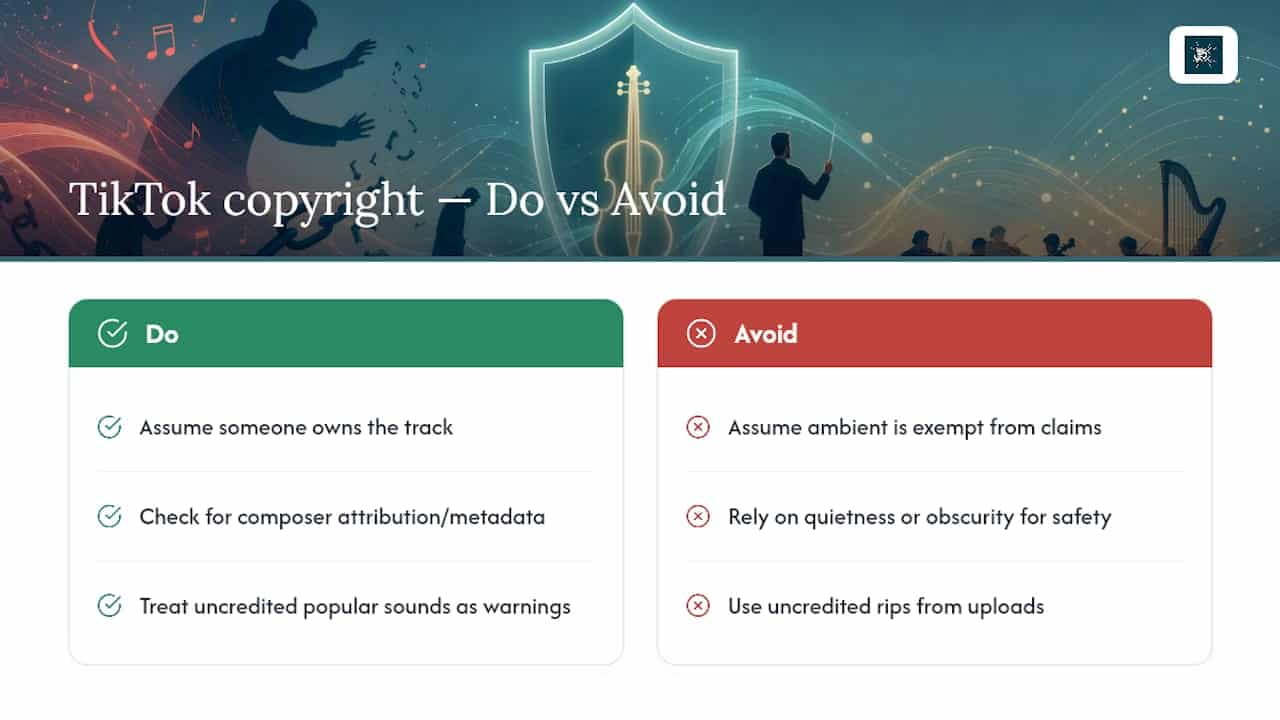
TikTok’s copyright rules don’t treat meditation music differently
There’s no separate rulebook for ambient or relaxation genres. TikTok’s audio matching system fingerprints the track itself, and it doesn’t care whether that track is a pop chorus or twelve minutes of theta-wave drone. The reason meditation creators feel a false sense of safety is structural, not legal: ambient tracks are quieter, less recognisable to a human ear, and rarely trend the way a viral pop hook does, so claims feel rarer.
That perception is misleading. Meditation and ambient sounds still get flagged, and analytics tools like Toklytics show some relaxation-focused sounds racking up genuinely high view counts on TikTok, which means they’re circulating widely enough to attract a rights holder’s attention eventually. Popularity is not a licence.
One genuine nuance for the genre: a lot of ambient and meditation audio floating around TikTok is uncredited, ripped from longer YouTube uploads or unofficial rips of commercial sound-healing albums. That makes it harder, not easier, to establish who owns it, because there’s no metadata trail pointing back to a composer. If a “calming meditation music” sound has thousands of uses and no visible attribution, treat that as a warning sign rather than reassurance.
The safest assumption for any wellness or ambient track is the same one that applies to a chart hit: someone owns it until proven otherwise.
Checking a track’s copyright status before you post
Run a short verification pass before any external track goes into a finished edit.
Search the track name and composer directly, ideally on the platform where you sourced it, and confirm the listing explicitly mentions commercial or TikTok use. If you bought it from a library, re-read the licence tier you purchased rather than assuming the cheapest tier matches the rights you need. If the track came from a “free meditation music downloads” site with no visible licensing terms, treat that as unverified rather than free, because a missing licence page usually means the terms are unfavourable, not absent.
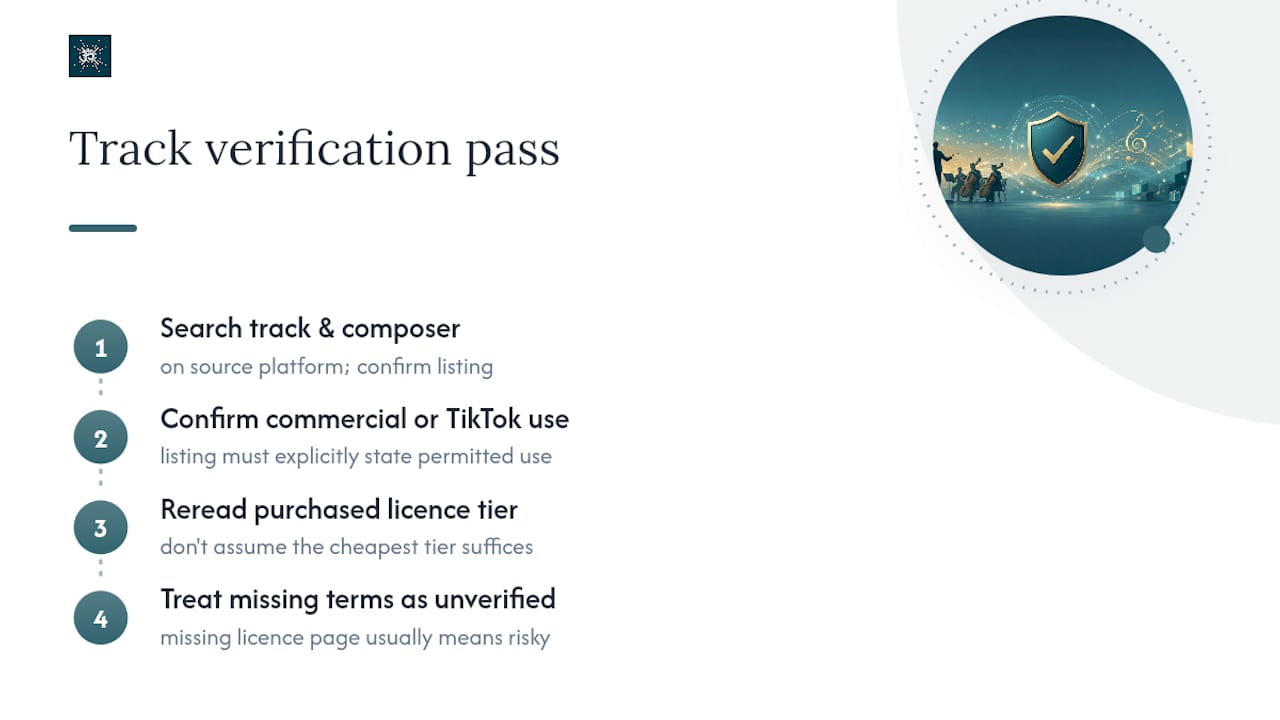
For tracks already circulating on TikTok as sounds, don’t assume high usage numbers mean safety. A sound with thousands of videos attached can still get pulled overnight if a rights holder finally files a claim, and everyone who used it gets hit at once. Checking a track’s actual licence status, not its popularity, is the only reliable signal.
Does fair use protect meditation music on TikTok?
Fair use is a narrow legal doctrine built around commentary, criticism, parody, and education, and it almost never covers using someone’s full meditation track as ambient background for your own content. Playing a track behind your video because it sounds nice is not transformation. It’s use, and platforms including TikTok don’t run fair use assessments before muting or removing audio; enforcement happens automatically, well before any legal argument gets made.
Meditation and relaxation music is particularly weak ground for a fair use claim because the whole point of using it is the original composition’s calming effect, not commentary on it. If you sampled a few seconds to critique or analyse a track, that’s a different conversation. Using it wholesale as a soundtrack is not.
The practical takeaway: don’t post unlicensed meditation music hoping fair use will protect you if flagged. It almost certainly won’t, and the appeal process gives far more weight to a licence document than to a fair use argument for background music.
A creator’s mental model: treat clearance like part of the edit
Clearance isn’t a legal chore bolted onto content creation. It’s project admin, the same as backing up your footage or exporting the right aspect ratio. Keep every licence with the project files it belongs to, and date-stamp it the day you buy it, not the day you need it.
When cross-platform reuse is frequent, lean towards named-composer tracks over anonymous stock. A credited composer and a specific recording session, the kind Orchestral Meditations builds its catalogue around with Robert Emery and Moritz Schneider named on the work, gives you something concrete to point to if TikTok’s system ever mutes your audio and you need to appeal. Anonymous licences leave you arguing from nothing.
— ROBERT
Where to find licensable orchestral meditation tracks
If you’d rather not gamble on ambiguous licences, Orchestral Meditations’ shop is built around exactly the problem this article covers: royalty-free orchestral tracks with commercial licensing built in, not bolted on as an afterthought.
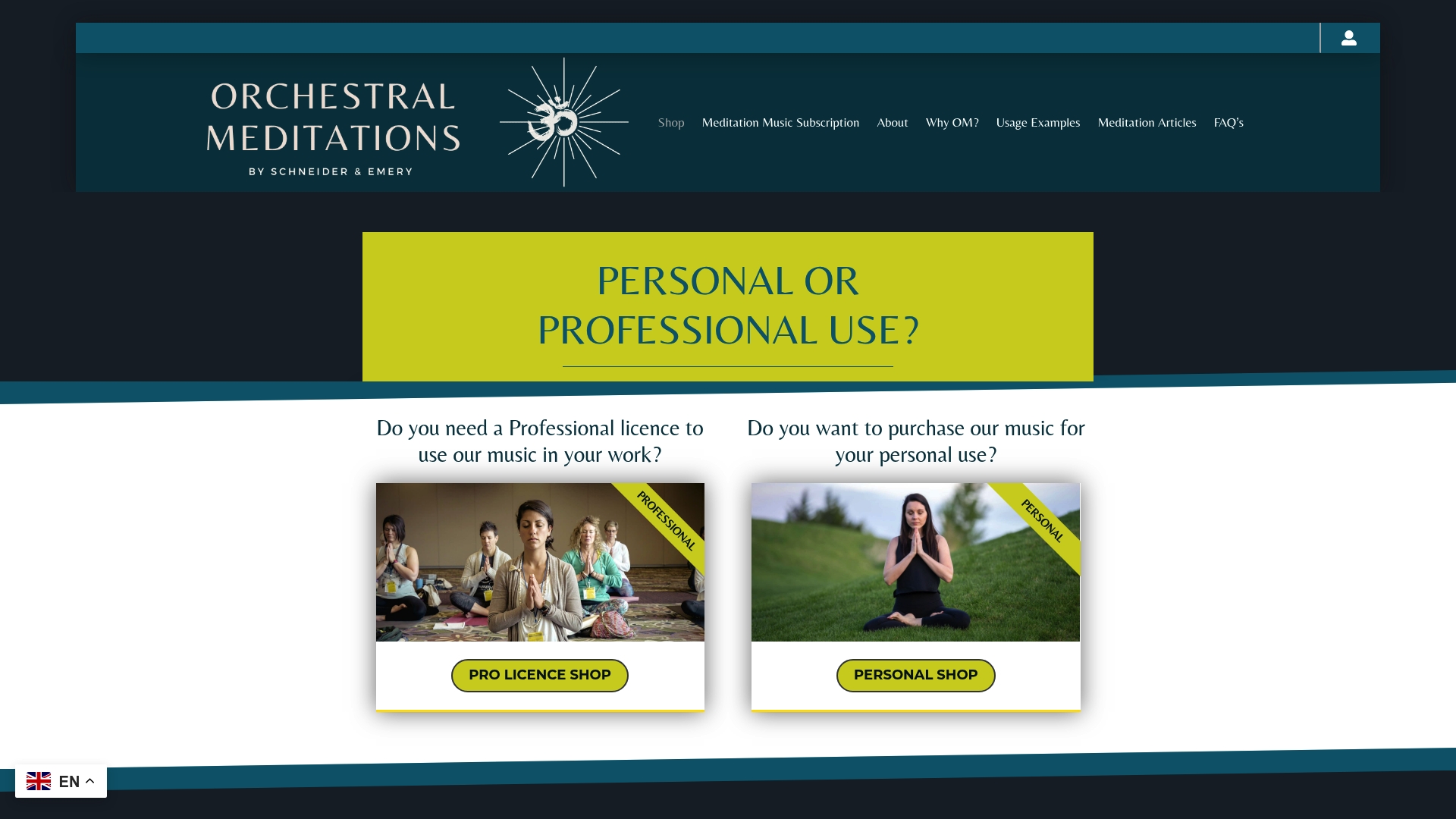
Browse the catalogue to find tracks recorded with live orchestral musicians, licence downloads available at the point of purchase, and composer credits attached to each recording rather than hidden behind a generic library tag. That last point matters: a track you can trace back to a named composer and recording session gives a solid reference for appeals, unlike a licence with no name attached.
Before buying anything, check the licence scope against your own use case: TikTok only, or cross-platform coverage for Reels and YouTube too. Once you’ve confirmed it fits, download the licence certificate and file it with your project the same day. If anything about the scope is unclear, get in touch with support before you post rather than after a claim lands. Visit the Orchestral Meditations shop to start browsing.
Key resources for platform rules and licensing basics
- TikTok’s Commercial Music Library explainer for the platform’s own scope and eligibility rules
- Melobleep’s licensing guide for meditation teachers for practical licence-reading advice
- Audiodrome’s breakdown of TikTok’s enforcement system for how matching and reporting actually work
- Soundstripe’s guide to TikTok’s Music Usage Confirmation for the upload-flow requirements
This article is general information, not a substitute for advice from a qualified lawyer. Consult a qualified legal professional about your own circumstances before acting on anything here.
Sources
Attribution won’t override a copyright claim, but it does two useful things: it protects you if a dispute arises, and it’s simply good practice for supporting composers.
- TikTok music rules for creators — Audiodrome
- Explore royalty-free music in our Commercial Music Library — TikTok for Business
- Music licensing for meditation teachers — Melobleep
- TikTok music licensing rules — Soundstripe
Attribution is good manners and useful evidence. It is not, on its own, permission.
FAQ
Can you get a copyright claim for using music on TikTok?
Yes. TikTok’s automated matching system checks every upload against a database of registered tracks, and a match can trigger a mute, removal, or claim regardless of whether the audio was labelled “copyright free” by the person who posted it.
Why does TikTok say my music is copyrighted when it’s labelled free?
Uploader labels like “no copyright” are not legal licences; they’re just text someone typed in. TikTok’s audio fingerprint matching checks the actual track, so a mislabelled sound can still belong to a rights holder.
How do I know if a song is copyrighted on TikTok?
Assume every track is copyrighted unless you have a licence proving otherwise, whether that’s a TikTok Commercial Music Library track, a paid royalty-free licence with commercial terms, or original audio you own outright.
Which songs are copyright-free on TikTok?
Nothing is universally “copyright-free.” TikTok’s Commercial Music Library offers pre-cleared tracks for use inside the app, and libraries such as Orchestral Meditations sell tracks with explicit commercial licences and licence certificates you can keep as proof.