Six things separate a meditation app that feels genuinely calming from one user delete after a week: musical characteristics, licence type, technical delivery, stems and loop markers, metadata, and safety constraints around binaural content. Get a composer or library to confirm all six before a single track ships. In practice, that means asking for 24-bit WAV masters, labelled stems, marked loop points, BPM and key data, no lyrics, and a stated LUFS target in every brief you send.
TL;DR:
- Tracks should have a tempo between 40 and 60 BPM for breath work and 30 to 50 BPM for body scans, with sleep music containing no fixed tempo.
- All meditation tracks must exclude lyrics, feature minimal melodic movement, and use gradual harmonic shifts to avoid activating verbal thinking or distraction.
- Deliverables must include a 24-bit WAV master, labelled stems, embedded loop markers, and metadata such as BPM, key, composer, and PRO information for licensing and technical purposes.
- Binaural content requires headphone playback and must include clear safety warnings for certain groups, with explicit communication about limitations and intended use.
- Proper licensing entails clear ownership metadata, including ISRC and PRO registration, with licenses preferably royalty-free, buyout, or well-defined sync agreements to avoid legal disputes later.
What are the meditation app music requirements for musical characteristics?
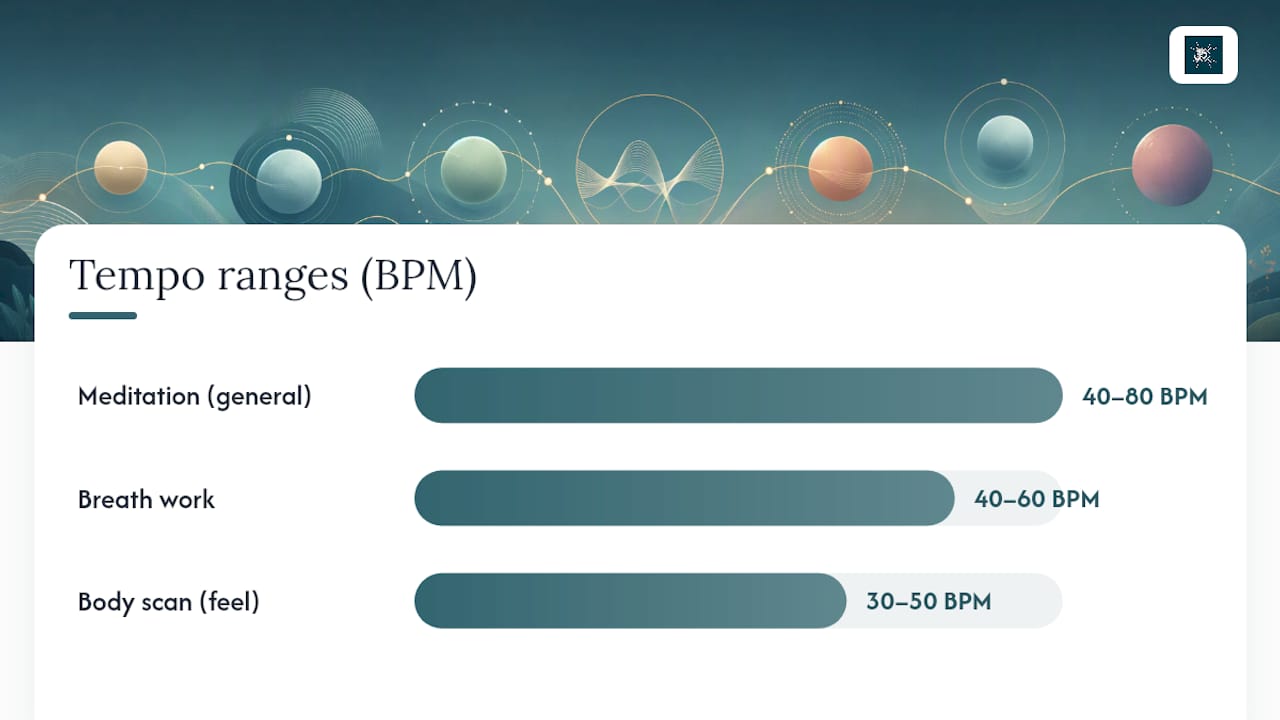
Tempo does most of the psychological work, and it’s the first thing to get wrong. Meditation music typically runs at 40 to 80 BPM, a range chosen because it sits below or near resting heart rate and nudges the body towards a slower rhythm rather than fighting it.
But “slow” isn’t one number, it’s a spectrum, and different modalities need different corners of it. Breath work tracks tend to sit at the upper end, around 40 to 60 BPM, because the music needs enough pulse to loosely guide inhale and exhale cycles without dictating them. Body scan sessions want something looser, more like 30 to 50 BPM in feel even if the literal tempo marking is ambiguous, because the priority is a sense of suspended time rather than any rhythmic anchor. Sleep content drops the concept of tempo altogether. Slow-moving drones and long sustained pads with no discernible pulse work better than anything you’d tap your foot to.
Lyrics are the second big variable, and here the guidance is unambiguous: leave them out. Language processing activates analytic, verbal thinking that pulls attention away from the body and breath, which is precisely the opposite of what a meditation track is meant to do. Even a wordless vocal line can be risky if it’s melodically busy enough to sound like it’s “saying” something. Minimal melody, sustained textures, and harmonic movement that shifts gradually rather than resolving in obvious phrases all work better than anything structured like a pop song.
Binaural beats and Solfeggio-frequency tracks deserve a specific callout in your brief, because they carry a technical requirement most composers won’t volunteer unprompted: binaural effects only work over headphones, since they rely on each ear receiving a slightly different frequency that the brain fuses into a perceived beat. Over speakers, the effect simply doesn’t happen. If your app markets binaural content, say so clearly in the UI, and add a note that these tracks are not recommended for anyone with a diagnosed seizure disorder or who is currently pregnant, given the lack of definitive safety research on prolonged frequency-based listening for these groups.
Length and looping round out the brief. A track should match or exceed the expected session duration, and any library aiming for volume should plan track length around the longest sessions the app supports, not the shortest. Anything shorter needs a genuinely loopable structure, not just a fade that repeats jarringly at the seam.
- Breath work: 40 to 60 BPM, rhythmic but gentle
- Body scan: 30 to 50 BPM feel, minimal pulse
- Sleep: no fixed tempo, continuous drone or pad
- Universal: no lyrics, minimal melodic movement, gradual harmonic shifts
Pro Tip: Ask composers for a “loop map” alongside the track, a simple note showing exactly where the seamless repeat point sits in the waveform. It saves your audio engineer hours of manual scrubbing later.
Which technical delivery standards should you require?
Specify the numbers, don’t leave them to interpretation. Sample rate should be 44.1 kHz or 48 kHz, the two standards nearly every DAW and mobile audio engine handles natively. Request 24-bit for anything going through further processing on your end, such as ducking, adaptive layering, or binaural encoding, since the extra bit depth gives more headroom before quantisation noise becomes audible. Sixteen-bit is fine only for a final, untouched distribution file that won’t be manipulated again.
Master and distribution formats are not the same thing, and conflating them causes avoidable rework. The master should always arrive as WAV, uncompressed and unprocessed beyond the composer’s own final mix. What you actually embed in the app is a different question: high-bitrate MP3 or AAC (256 to 320kbps) works for most standard playback, while Opus is worth considering for adaptive-bitrate streaming scenarios where bandwidth varies, since it holds up better at lower bitrates than MP3.
Loudness is where most briefs fall short, because developers assume “make it sound good” is enough guidance. It isn’t. Meditation mixes should sit quieter than commercial music, and specialist guidance points to a target loudness with defined true-peak limits rather than the aggressive levels used in pop or film trailers. As a working rule, meditation beds should sit meaningfully below broadcast loudness, leaving generous headroom so a guided voice track can duck underneath without either element clipping or fighting for space.
| Deliverable | Format | Purpose |
|---|---|---|
| Full mix master | WAV, 24-bit, 44.1/48 kHz | Archival and further processing |
| Distribution mix | MP3/AAC 256 to 320kbps or Opus | In-app playback |
| Labelled stems | WAV, 24-bit | Adaptive layering, ducking |
| Mix without master bus | WAV, 24-bit | Custom loudness/EQ handling in-app |
| Loop markers | Text or embedded cue points | Seamless repeat automation |
| Cue sheet | PDF or spreadsheet | Sync licensing, PRO reporting |
Deliverables matter as much as specs. Ask for the full mix, individual labelled stems (pads, strings, drone, percussion where present), at least one alternate mix with no mastering processing applied so your team can shape loudness in-app, embedded or documented loop markers, and a cue sheet if the track will ever be used in sync contexts. Composers who supply this as standard, rather than only on request, tend to be the ones already working with app clients regularly.
- WAV master, 24-bit, at 44.1 kHz or 48 kHz
- Distribution copy in MP3, AAC, or Opus
- Labelled stems for every major instrumental layer
- A mix with no master-bus processing for flexible in-app loudness control
How does meditation music licensing work for app developers?
Licence type shapes almost everything downstream, from your budget to your legal exposure, so treat it as a design decision, not paperwork to sort out after the music’s chosen.
- Royalty-free licences let you pay once (or per track) and use the music indefinitely under agreed terms, without ongoing per-play fees. Most app developers gravitate here because it’s predictable at scale.
- Sync licences are negotiated for specific placements, usually higher cost, and used when a track needs guaranteed exclusivity or a bespoke usage grant, such as a flagship app trailer or a paid ad campaign.
- Buyout licences transfer broad, often perpetual rights for a single upfront fee, useful when you want to avoid any future renewal conversation entirely.
- Subscription licences grant access to a rotating catalogue for as long as you keep paying, which suits apps still experimenting with their sound library and unwilling to commit to permanent ownership of specific tracks.
Whichever model you choose, the licence document itself needs to answer several questions explicitly, and a surprising number of vendor contracts leave at least one vague. Confirm the territory (worldwide, or restricted to specific countries), the term (perpetual or time-limited), whether the grant is exclusive to your app or shared with other licensees, and the exact permitted use, meaning whether offline caching, streaming, and any advertising use are all covered or only some of them. Ask too about derivative works rights, since adaptive layering, pitch-shifting, or remixing a track inside your app may count as creating a derivative depending on the contract’s wording, and confirm whether attribution is required anywhere in your app’s credits or settings screen.
Royalty structures vary by the same logic. A one-time buyout means no further payment regardless of how many users stream the track. Per-stream models tie cost directly to usage, which can get expensive fast at scale but keeps upfront costs low during early development. Subscription-share arrangements split ongoing platform revenue with the rights holder, more common when a library partners directly with an app rather than simply selling assets to it.
Red flags are where legal risk actually lives, and they’re rarely obvious from a first listen. Watch for uncleared samples buried inside a track (a vocal chop, a found-sound recording, a sampled instrument loop) where the composer may not hold full rights to the underlying source. Watch for unlicensed session performers, meaning musicians who played on the recording without a signed release covering commercial app use. And watch for tracks arriving with no PRO (Performing Rights Organisation) registration or ISRC (International Standard Recording Code) attached, since missing metadata here makes it far harder to prove clean provenance if a rights dispute ever surfaces.
Pro Tip: Request the composer’s PRO membership number and the track’s ISRC before you sign anything, not after. A library that can’t produce these instantly usually can’t produce a clean chain of title either.
What production rules keep meditation tracks reliable inside an app?
Structure decides whether a track survives real-world use or breaks immersion the first time someone loops it. Long-form composition with a gradual intro, meaning the track builds in volume and texture over the first 10 to 30 seconds rather than starting at full level, gives your app room to fade in without a jarring first impression. Endings need the same care: either a gentle fade-out or, for anything designed to loop, a genuinely seamless edit point rather than a fade that gets cut off mid-decay.
Mixing decisions made in the studio directly affect what your engineers can do later. Composers should avoid abrupt dynamic shifts and heavy limiting, both of which crush the headroom your ducking system needs to pull the music down cleanly when a guided voice track starts speaking. A heavily limited stem has nowhere left to duck to; it either stays too loud under the voice or disappears entirely.
Stem hygiene sounds like a small detail until you’re three weeks into integration and half your stems are unlabelled WAV files named “Audio 3” and “Audio 3_final_v2.” Insist on consistent, descriptive naming for every stem (pad_low, drone_theta, strings_sustained) and matching sample rates and start points across the full set, so your playback engine can layer them without manual realignment.
Metadata hygiene deserves the same discipline as the audio itself:
- BPM and key, even for drone-based tracks with no obvious tonal centre
- Composer and writer credit, spelled correctly and consistently
- ISRC and PRO registration details
- A one-sheet summarising mood, instrumentation, and intended use case
- Loop markers documented in writing, not just implied by the waveform
Before anything goes into your library, run a quality control pass specifically for artefacts (clicks, pops, digital noise at loop seams), stereo balance across the full track length, and what audio engineers call frequency fatigue, meaning a narrow band of frequencies (often low-mid drones) that becomes tiring over a 30 or 45-minute session even though it sounds fine in a 30-second preview.
How should music integrate with app playback and UX?
Ducking is the single most important integration behaviour to get right, because it’s the mechanism that decides whether a guided voice sits clearly above the music or gets buried under it. Sidechaining, where the voice track automatically triggers a volume reduction in the music bed, needs headroom to work smoothly, which is exactly why the mixing notes above matter so much. A track mastered too hot simply can’t duck cleanly.
Gapless loops and crossfades matter most for sleep content, where a listener drifting off is the worst possible moment for a sudden silence or an audible seam. Fade strategies should aim for continuity: a quiet background bed that keeps playing after the spoken guidance ends prevents the kind of jarring silence that can actually wake someone back up.
Adaptive layering, using separate stems to intensify or simplify a track in real time, lets your app respond to session length or user preference without needing dozens of near-identical variations in the library. Alternate mixes without master-bus processing make this dramatically easier, since your engineers can shape loudness and EQ per layer rather than fighting a pre-mastered file.
- Duck music under voice using sidechain triggers with adequate headroom
- Use gapless loops for anything longer than a single session
- Layer stems adaptively rather than switching between separate full mixes
- Cache high-value tracks offline; use Opus or AAC to manage mobile bandwidth
Bandwidth and offline caching decisions belong in this conversation too, particularly for users meditating on flights or in low-signal environments, where a format that streams beautifully on Wi-Fi but stutters offline defeats the purpose entirely; for more on this see Audio Mitschnitte und Podcasts – Rubin Institut. For related thinking on how audio quality supports voice-led sessions specifically, the step-by-step guided meditation approach shows how timing and pacing decisions ripple through the whole listening experience.
What should a platform submission checklist include?
Rejections at the submission stage are almost always avoidable, and almost always come down to missing one small thing rather than a fundamental problem with the track.
- Assemble the full asset set before you submit anything: the master WAV, every labelled stem, a one-sheet, and complete metadata. Submitting a bare MP3 with no supporting documentation is the fastest route to a rejection email.
- Fill in every searchable metadata field the platform offers, including mood tags, BPM, instrumentation, and any usage notes. Wellness platforms and app marketplaces both rely heavily on these fields for internal search and curation, so a track with blank fields effectively becomes invisible even after approval.
- Check the platform’s specific submission rules, since these vary but common ones include no silence at the very start of the file, a minimum duration threshold, and a clear, explicit copyright statement. Insight Timer’s submission guidance is a useful real-world example of how granular these rules get, right down to distinguishing free tracks from premium ones in the metadata itself.
- Run your own pre-submission testing pass: loop the track end to end and listen for the seam, confirm loudness sits within your stated LUFS target, and play it back across at least two device types, since phone speakers and headphones reveal different problems in the low end.
Pro Tip: Keep a running spreadsheet of every platform’s specific quirks (Insight Timer’s silence rule, another platform’s minimum duration). Submission teams change these requirements more often than composers expect, and a spreadsheet catches drift before it causes a rejection.
How does a curated orchestral library meet these requirements in practice?
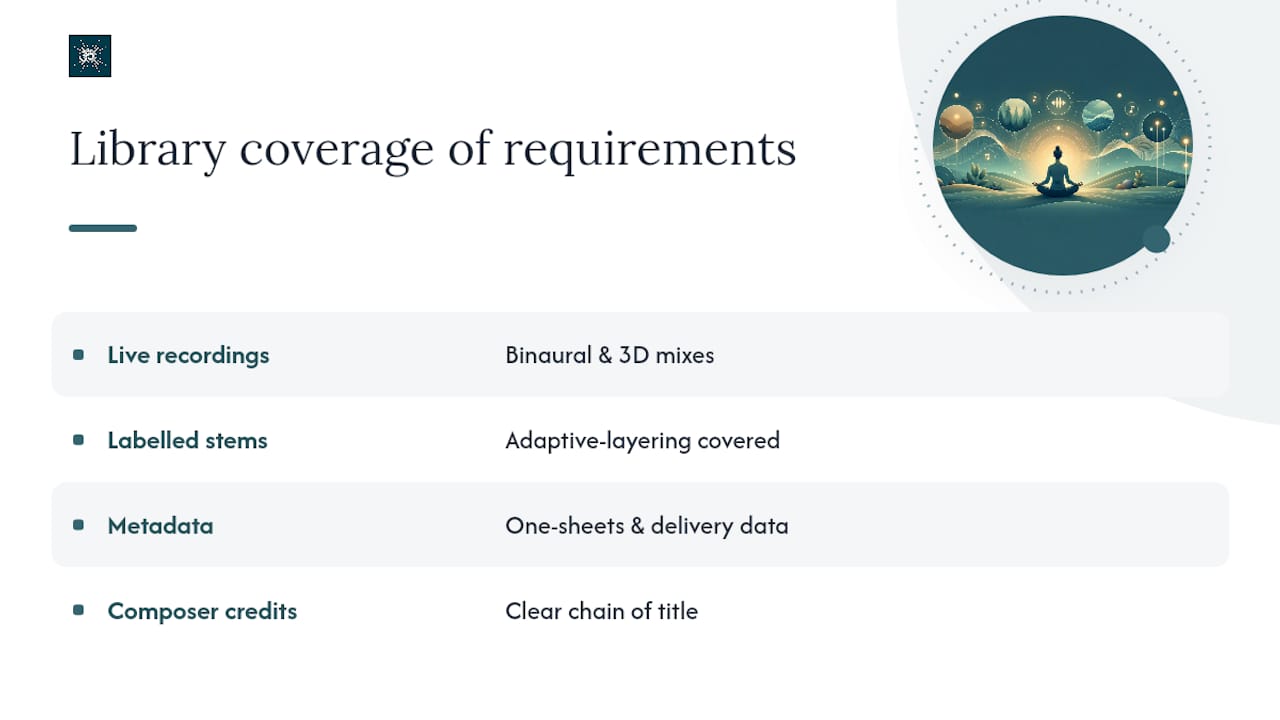
A studio-recorded orchestral catalogue answers most of this checklist before a developer even opens a brief. Orchestral Meditations supplies tracks recorded with live musicians, including binaural and 3D surround mixes, alongside the stems, one-sheets, and metadata that the technical delivery section above treats as non-negotiable. That’s the difference between hunting down assets track by track and receiving a package that already matches an integration spec.
Provenance matters more than it sounds like it should. Tracks associated with named composers and producers such as Robert Emery and Moritz Schneider carry a clean, traceable chain of title, exactly the kind of paperwork trail the licensing section above flags as essential for avoiding uncleared-sample and missing-PRO-data problems down the line. When a licence dispute surfaces years later, a track with clear composer credit and registration data resolves in a phone call. One without it can stall an entire product release.
Mapped against the earlier checklist, a labelled stem set with binaural variants covers both the technical delivery and adaptive-layering requirements in one deliverable, while documented composer and PRO metadata satisfies the licensing red-flag checks outright.
What developers wish they’d known earlier about meditation app music
Three lessons surface repeatedly once a build ships: test loop points with real users before launch, not just in a DAW; demand metadata discipline from day one, because retrofitting it across a growing library is miserable; and give composers a checklist upfront rather than a vague mood brief.
Pro Tip: Run a five-person test specifically on ducking and loop behaviour, headphones and speakers both, before wider release. It surfaces problems no waveform view ever will.
— ROBERT
How Orchestral Meditations supplies production-ready assets
Orchestral Meditations is the practical shortcut through everything this article has just walked through: a royalty-free orchestral library recorded with live musicians, complete with binaural and 3D surround mixes, stems, one-sheets, and both personal and professional licensing options, so a development team isn’t assembling a compliant asset from four different vendors.
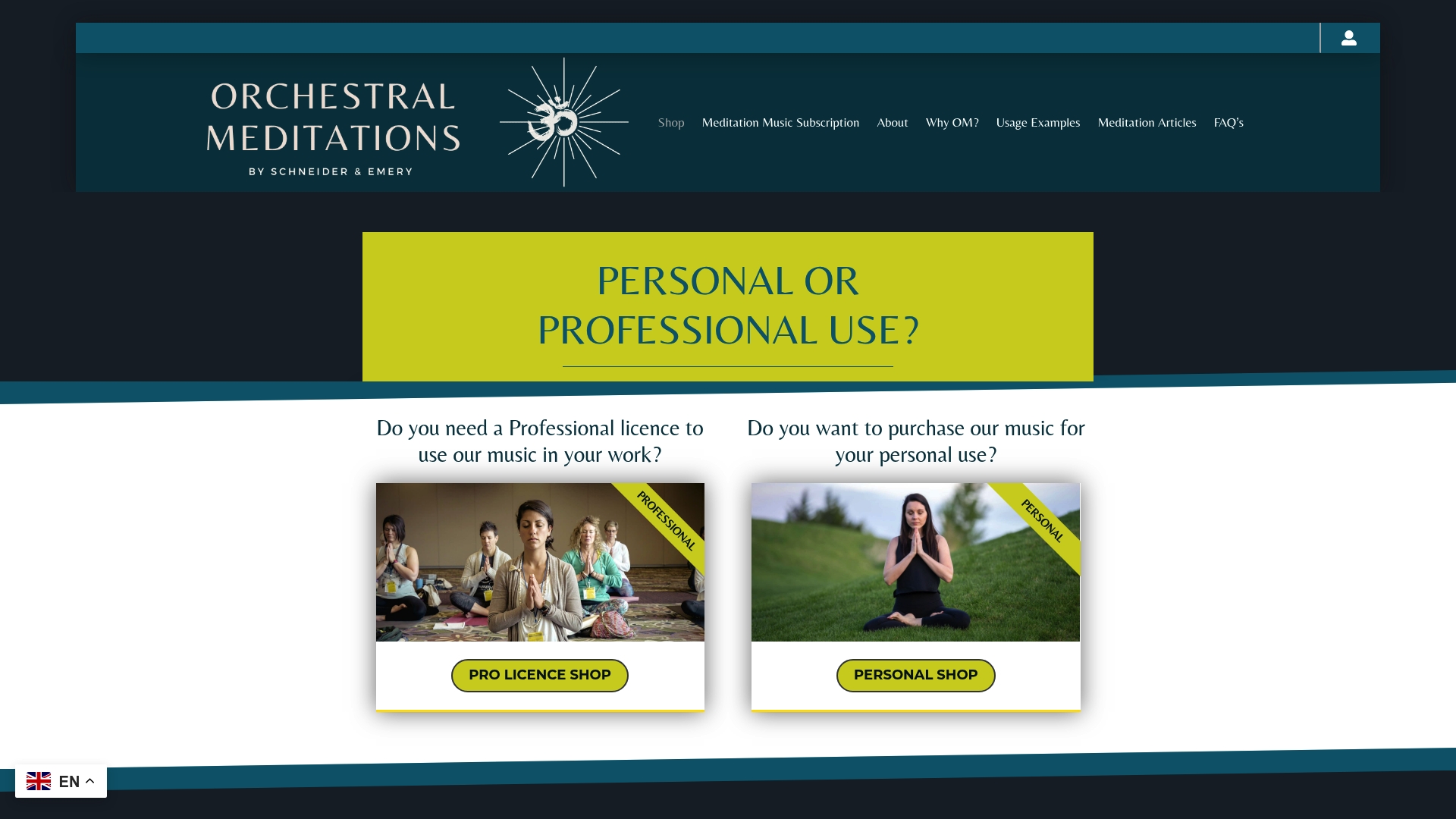
What makes it worth building into a serious app brief is provenance. Tracks tied to named composer and producer credits, including Robert Emery and Moritz Schneider, arrive with the kind of clean metadata and registration trail that this article’s licensing checklist treats as essential, not optional. That’s fewer red flags to chase down before launch, and a clear answer if a rights question ever surfaces later. Browse the sample tracks and licensing tiers on the Orchestral Meditations shop to see how a fully specified deliverable actually looks before your next composer brief goes out.
Sources
- Music for meditation and wellness apps – Orphiq resources
- How to practice music meditation – Verywell Mind
- Meditation App Music Guidelines 2027 – Plugg Supply
- Royalty-Free Music for Meditation App – Royalty Free Music Hub
FAQ
Can I meditate with music playing in the background?
Yes, and it’s one of the most common ways people practise. The key is choosing music with slow tempo, no lyrics, and minimal dynamic shifts, since anything busier tends to pull attention away from breath and body rather than supporting it.
What is the best free meditation app with music?
Several wellness platforms offer free meditation tracks alongside paid tiers, and most apply the same core rules covered here: no lyrics, slow tempo, and clean loop points. The specific “best” option depends on which library’s licensing and catalogue depth suits your use case, and Orchestral Meditations offers sample tracks worth comparing against other free options.
Is 20 minutes of meditation equivalent to four hours of sleep?
No credible evidence supports that claim, and it isn’t something this article’s sources address. Meditation offers genuine relaxation and stress-reduction benefits, but it isn’t a substitute for sleep.
What frequency of music is good for meditation?
Solfeggio frequencies and theta-range binaural beats are commonly used in meditation music, though binaural effects only work correctly over headphones since they rely on each ear receiving a distinct tone. Track choice should still prioritise slow tempo and minimal melodic movement over any specific frequency claim.