Start with ten minutes. Lie down, close your eyes, and press play on a genuine 432 Hz recording. Breathe slowly through your nose and notice whether your shoulders drop within the first two minutes. That single, low-stakes experiment is how to use 432Hz music spiritually in its most honest form: not a grand ritual, but a quiet test of your own nervous system.
Before you go any further, here are the two things worth knowing upfront:
- Session length: 10–20 minutes is enough for a first test; 30–60 minutes for a deeper meditative or sound-bath session. Sleep use can run the full night at low volume.
- What to listen for: a slight slowing of your breath, a sense of warmth in the chest, or a drop in mental chatter within the first five minutes. These are the signals that matter, not the numbers on the label.
A small clinical study found that 432 Hz music reduced systolic blood pressure more than its 440 Hz equivalent in participants, according to authors, though blood pressure reductions did not reach statistical significance in a separate peer-reviewed pilot study. When you are choosing a recording for this kind of practice, producer and composer credits matter enormously. Names like Robert Emery and Moritz Schneider, both of whom have worked on orchestral meditation recordings with documented studio provenance, are the sort of credits that tell you someone cared about the audio quality before you pressed play.
Pro Tip: Set a timer for five minutes and check in with your breath rate before you start. Do the same check at the end. That simple before-and-after comparison is more useful than any theory.
What exactly is 432 Hz, and how does it differ from standard tuning?
Every instrument in a modern orchestra tunes to a shared reference pitch: A above middle C, set at 440 Hz. That standard was formalised internationally in 1975. A 432 Hz tuning simply lowers that same reference note by approximately 8 Hz, which shifts every other note in the piece downward by the same proportion.
In practical terms, the pitch difference is less than a third of a semitone. Music psychologists describe the gap as subtle but perceptible: many listeners report 432 Hz as “warmer” and slightly more enveloping than the same piece at 440 Hz. Whether that warmth is a genuine acoustic phenomenon or a perceptual one is a fair question, and one the science section below addresses honestly.
Here is what the difference looks like in concrete terms:
- Reference pitch: A4 = 440 Hz (standard) vs A4 = 432 Hz (alternative tuning)
- Pitch shift: approximately 32 cents flatter (roughly a third of a semitone)
- Perceived character: often described as warmer, rounder, and less bright
- How it is achieved: either re-recording every instrument at the new pitch, or digitally pitch-shifting an existing recording (which changes absolute pitch but not the musical arrangement)
The distinction between re-recorded and digitally shifted matters if you care about audio quality. A recording made from scratch at 432 Hz, with live musicians tuning to that reference, will sound different from a 440 Hz track run through pitch-shifting software. Both are technically “432 Hz,” but only one was conceived and performed at that frequency.
Statistic callout: The double-blind crossover pilot study published in a peer-reviewed journal found a mean heart rate reduction of 4.79 bpm (p = 0.05) when participants listened to 432 Hz music versus 440 Hz, alongside a slight decrease in respiratory rate.
What does the science actually say about 432 Hz?
The honest answer is: promising but preliminary. The most-cited clinical study, a double-blind crossover pilot involving 33 healthy volunteers, found that 432 Hz music was associated with a marked decrease in mean heart rate (4.79 bpm, p = 0.05) and a slight decrease in respiratory rate compared to 440 Hz. Participants also reported higher satisfaction and focus during the 432 Hz sessions. Blood pressure reductions were observed but did not reach statistical significance in that study.
A separate small study found 432 Hz reduced salivary cortisol levels more than 440 Hz in patients before a dental procedure, which is a genuinely interesting finding in a high-anxiety context. Again, small sample, but the direction of effect is consistent.
What the evidence does not support is the more extravagant claim: that 432 Hz is cosmically aligned, that it vibrates with the Earth’s frequency, or that it has any magical property beyond being a slightly lower pitch. Music psychologists are clear that the likely mechanism is perceptual: lower-pitched sounds tend to be interpreted by the brain as calmer, because in human communication, a lower voice pitch signals relaxation rather than agitation. The body follows the cue.
Plausible mechanisms worth understanding:
- Pitch-arousal link: lower pitch reduces perceived arousal, which can slow breathing and heart rate
- Entrainment: physiological systems like breathing and heart rate tend to synchronise with an external beat or rhythm
- Expectation and context: the ritual of intentional listening, in a quiet space, with eyes closed, contributes meaningfully to any relaxation response
- Binaural layering: when 432 Hz tracks include theta-wave binaural beats, there is some evidence of altered brain activity, though effects are not exclusive to binaural formats
The practical implication: test it yourself with simple measures. Note your resting breath rate before and after a 20-minute session. If it drops, something is working, whether the frequency, the ritual, or both. For more on the science of healing frequencies, the evidence base is broader than 432 Hz alone.
The spiritual history and chakra associations of 432 Hz
The idea that specific frequencies carry spiritual meaning is old. The ancient Greek concept of “music of the spheres” proposed that planetary orbits produced a kind of cosmic harmony, and various tuning systems across history have tried to align musical pitch with natural or divine ratios. Giuseppe Verdi, the Italian opera composer, famously advocated for A=432 Hz tuning in the nineteenth century, arguing it was more natural for the voice.
In modern practice, 432 Hz reappeared through New Age and neo-esoteric communities in the late twentieth century, gaining significant momentum online. The Independent notes that its popularity is driven largely by personal reports of calm and grounding rather than conclusive science, which is not a dismissal so much as an honest description of how spiritual practices often spread.
Spiritual traditions and contexts where 432 Hz is commonly used:
- Sound baths: participants lie in a room while a practitioner plays instruments tuned to 432 Hz, often combined with singing bowls
- Chakra work: 432 Hz is most commonly associated with the heart chakra (Anahata), linked to compassion, emotional release, and connection
- Mantra practice: chanting at a lower pitch that aligns with 432 Hz is said to deepen resonance in the chest cavity
- Neo-esoteric and Solfeggio frameworks: 432 Hz is sometimes grouped with Solfeggio frequencies as part of a broader healing-frequency system
A simple frequency-to-intention map that you will encounter in spiritual communities:
| Frequency | Chakra association | Common intention |
|---|---|---|
| 432 Hz | Heart (Anahata) | Compassion, emotional release, connection |
| 528 Hz | Solar plexus | Transformation, clarity, DNA repair (claimed) |
| — | Root (Muladhara) | Releasing fear and guilt |
For a deeper look at 432 Hz and its Solfeggio context, the heart-chakra association is the most consistently cited across traditions, and it is the one most worth working with if emotional release or compassion practice is your aim.
Step-by-step spiritual uses: five session templates you can try today
These are reproducible templates, not vague suggestions. Each one has a clear purpose, a time frame, and a simple instruction set.
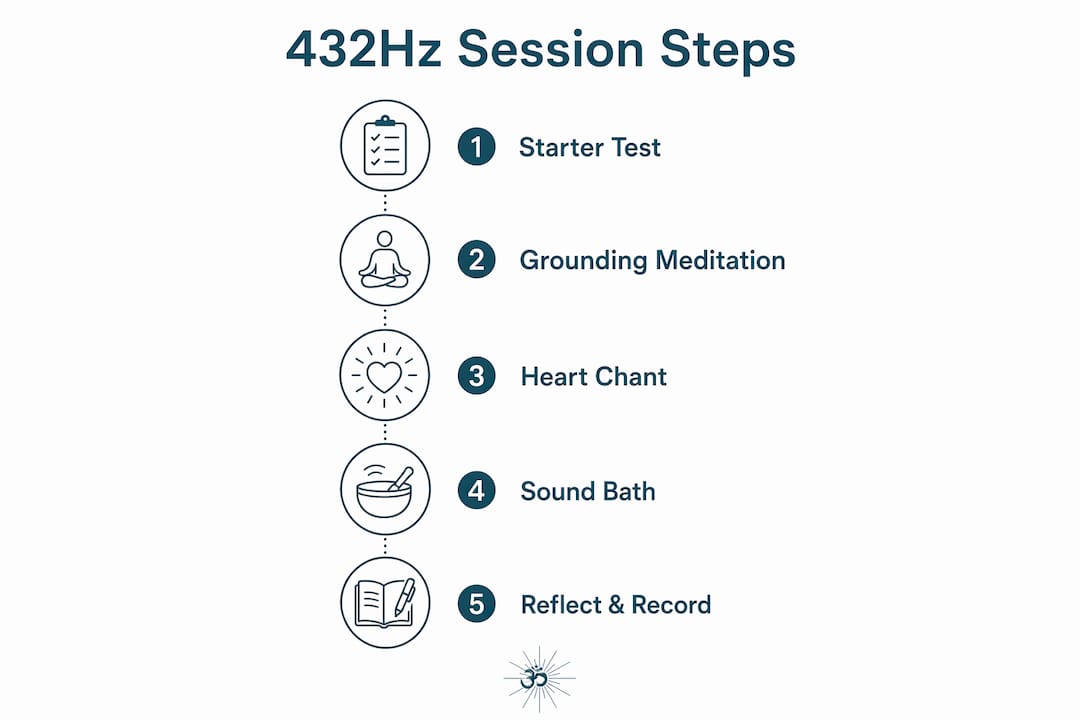
Session timing table
| Session | Purpose | Length | Position | Key instruction |
|---|---|---|---|---|
| Starter test | Gauge personal response | 10–15 min | Seated or lying | Breathe through nose; note shoulder tension |
| Grounding meditation | Calm the nervous system | 20–30 min | Seated, feet flat | Focus on the exhale; let sound fill the room |
| Heart-opening chant | Emotional release, compassion | 20–30 min | Seated, upright | Chant “Yam” (heart-chakra seed mantra) on the exhale |
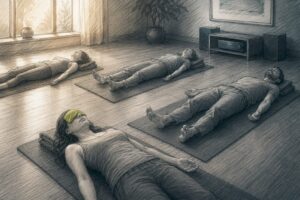
| Sound bath | Deep meditative immersion | 45–60 min | Lying flat | No agenda; observe what arises without analysis |
| Sleep wind-down | Transition to sleep | 30–60 min | Lying in bed | Low volume; no headphones; let it fade as you drift |
1. The starter test (10–15 minutes)
Sit or lie comfortably. Note your breath rate. Press play on a 432 Hz track with no binaural layer for your first session — you want to isolate the frequency effect. Breathe through your nose. At the end, note your breath rate again and write one sentence about how your body feels.
2. Grounding meditation (20–30 minutes)
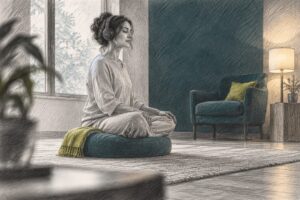
Sit with your feet flat on the floor. Choose a track with a slow tempo and minimal melodic variation. Focus entirely on the exhale, letting each out-breath be slightly longer than the in-breath. This is a simple parasympathetic activation technique that pairs naturally with the lower pitch of 432 Hz.
3. Heart-opening chant (20–30 minutes)
Sit upright. On each exhale, chant the syllable “Yam” (the seed mantra for Anahata, the heart chakra) at a comfortable low pitch. The 432 Hz music acts as a tonal anchor. You are not trying to match the frequency precisely; you are using the music as a resonant backdrop for your own voice.
4. Sound bath (45–60 minutes)
Lie flat. Use speakers rather than headphones so the sound fills the room. Set no agenda. If thoughts arise, treat them like clouds passing. This is the format most commonly used in professional sound-healing contexts, and it is the one where holistic healing approaches integrating body, breath, and sound tend to produce the most consistent reports of deep release.
5. Sleep wind-down (30–60 minutes)
Play a 432 Hz track at low volume through a speaker on the far side of the room. No headphones for sleep use. Let the music fade into the background as you drift. The goal is not active listening but a gentle acoustic environment that supports the transition to sleep.
Pairing with breathwork (numbered steps):
- Inhale for four counts through the nose.
- Hold for four counts.
- Exhale for six counts through the mouth.
- Repeat for five cycles before the music begins.
- Once the music starts, release the count and breathe naturally.
Pro Tip: After each session, write three things in a notebook: your breath rate before and after, one word for your emotional state, and one physical sensation you noticed. After two weeks, patterns become visible.
How to confirm a genuine 432 Hz track and set up your listening space
Not every track labelled “432 Hz” on a streaming platform is what it claims. Some are simply 440 Hz recordings with the label applied for marketing purposes. Here is how to check.
Verification checklist:
- Producer notes: look for explicit documentation that the recording was made at 432 Hz, not pitch-shifted post-production
- Metadata: some audio files embed tuning information in their metadata; use a tool like Sonic Visualiser (free, available on Windows and Mac) to inspect this
- Tuner apps: apps such as GuitarTuna or a chromatic tuner app can confirm the reference pitch if you play a sustained note from the track and check where A lands
- Spectrogram check: a spectrogram view in Sonic Visualiser or Audacity will show the fundamental frequency of a sustained note; A should sit at approximately 432 Hz rather than 440 Hz
Playback recommendations:
- Headphones vs speakers: headphones give more precise binaural separation and are better for focused meditation; speakers fill the room and are better for sound baths and sleep use
- Volume: keep it at a conversational level or below, roughly 50–60 dB. Louder is not more healing, and prolonged exposure above 70 dB carries hearing risk
- File format: lossless formats (FLAC, WAV, AIFF) preserve the full frequency range; compressed MP3s at low bitrates can degrade the subtler harmonic content
- Room acoustics: soft furnishings absorb harsh reflections; a carpeted room with curtains is naturally better for meditation listening than a bare, tiled space
Pairing with binaural beats or theta layers:
If a track includes a binaural layer, you must use headphones for the binaural effect to work (it requires separate signals in each ear). Theta waves (4–8 Hz) are associated with the drowsy, pre-sleep state and pair well with 432 Hz for deep meditation. Keep the binaural layer at a low mix level; it should be felt rather than heard. If you experience headaches, dizziness, or agitation, reduce the volume or switch to a non-binaural track. People with a history of seizures should avoid binaural beats entirely and consult a GP first.
For mindfulness-based tension release, pairing gentle 432 Hz music with a body-scan practice can be particularly effective for releasing held tension in the neck and shoulders.
How long and how often should you listen?
The honest answer is: start shorter than you think you need to, and build from there.
- Week one: one session per day, 10–15 minutes, at the same time each day (morning or evening works best for most people). The consistency matters more than the duration.
- Week two: extend to 20–30 minutes. Add the breathwork pairing from the session templates above. Begin your three-item journal note after each session.
- Week three: introduce one longer session of 45–60 minutes mid-week, keeping the shorter daily sessions on other days. Note whether sleep quality or morning mood has shifted.
Practical rules of thumb:
- 10–20 minutes: adequate for a relaxation or mindfulness test
- 30–60 minutes: appropriate for deeper meditative or spiritual work
- Sleep use: low volume, no time limit, but use speakers rather than headphones to avoid ear pressure overnight
If you are neurodivergent or particularly sensitive to sound, start with five minutes and a very low volume. Some people find sustained frequency-based music overstimulating rather than calming, and that is useful information about your nervous system, not a failure. Adapt the duration downward rather than pushing through discomfort.
For guidance on choosing frequencies for specific meditative aims, the comparison between 432 Hz and 528 Hz is worth reading if you find one frequency more resonant than the other.
How to choose high-quality 432 Hz music: what to look for
Production quality matters as much as the nominal tuning. A poorly recorded track at 432 Hz will not serve your practice as well as a beautifully produced one at 440 Hz. That is not a controversial claim; it is what music psychologists consistently emphasise.
Selection checklist:
- Re-recorded vs pitch-shifted: prefer recordings made from scratch at 432 Hz with live musicians; pitch-shifted tracks can introduce artefacts
- Producer and composer credits: named credits are a signal of accountability. Look for producers like Robert Emery, whose orchestral work spans film, television, and meditation music, bringing a compositional rigour that purely synthetic productions rarely match. Moritz Schneider is another name worth knowing: a composer and producer whose work in the meditation and wellness audio space is characterised by careful frequency layering and live instrumental recording, rather than the MIDI-and-plugin approach that dominates cheaper releases
- Recording location: studio provenance matters. Orchestralmeditations, for instance, documents recordings made at Abbey Road Studios with the National Philharmonic, which is a verifiable, specific claim rather than vague “professional quality” marketing language
- Binaural and 3D surround notes: if a track claims to include binaural beats or 3D surround processing, the producer notes should specify the beat frequency and the processing method
- Licensing clarity: for personal use, a standard download licence is sufficient; for professional use in yoga classes, therapy sessions, apps, or wellness content, you need an explicit commercial licence
Orchestralmeditations’ healing frequency library is a practical example of what documented provenance looks like: composer credits, studio information, and frequency specifications are all stated rather than implied. That transparency is what you are looking for when evaluating any 432 Hz recording.
Safety, contraindications and realistic expectations
A few things worth saying plainly before you build a daily practice around this.
When to be cautious:
- Seizure history: binaural beats and certain frequency-based audio can trigger seizures in susceptible individuals. Consult your GP before using any binaural or frequency-layered tracks
- Auditory hypersensitivity: conditions like hyperacusis or misophonia can make sustained frequency-based listening uncomfortable or distressing. Start with very short sessions at low volume
- Acute mental health episodes: if you are currently experiencing a psychotic episode, severe dissociation, or acute mania, immersive audio practices are not appropriate. Speak to your mental health team first
- Volume limits: keep sessions below 70 dB for extended listening. Prolonged exposure above this level carries genuine hearing risk, regardless of the frequency
Realistic expectations:
The evidence for 432 Hz supports modest physiological effects: slight reductions in heart rate, respiratory rate, and blood pressure in some studies. It does not support claims of cellular repair, DNA activation, or cosmic alignment. If a product or practitioner promises those outcomes, that is a red flag, not a feature.
What 432 Hz music can genuinely offer is a well-designed acoustic environment for meditation, relaxation, and intentional spiritual practice. That is actually quite a lot. Measure your results with simple, personal metrics: breath rate, sleep quality, emotional tone after sessions. If those improve over two to three weeks, the practice is working for you.
This article is general information, not medical or psychiatric advice. If you have a health condition, confirm the suitability of sound-based practices with a qualified professional.
Key takeaways
432 Hz music offers a practical, low-risk acoustic tool for meditation and spiritual practice, with modest physiological evidence and strong anecdotal support, provided you verify the recording’s authenticity and match session length to your personal sensitivity.
| Point | Details |
|---|---|
| Start with a short test | A 10–15 minute session with a verified 432 Hz track is enough to gauge your personal response. |
| Verify the recording | Check producer credits, studio provenance, and use a tuner app to confirm the reference pitch is genuinely 432 Hz. |
| Match duration to purpose | Use 10–20 minutes for relaxation tests, 30–60 minutes for deeper spiritual work, and low-volume speakers for sleep. |
| Measure your own response | Note breath rate, mood, and sleep quality before and after sessions; personal data beats theory. |
| Orchestralmeditations | Offers live-orchestra 432 Hz recordings with named composer credits (Robert Emery, Moritz Schneider) and documented Abbey Road provenance. |
The quiet shift you might not expect
There is a particular moment in a well-produced 432 Hz session that nobody really warns you about. It is not a dramatic revelation. It is more like the moment you realise you have stopped thinking about your to-do list, and you cannot quite remember when that happened. The music did not announce itself; it just quietly lowered the temperature of your mind.
What I find most interesting about this practice is that the people who get the most from it are rarely the ones who believe most fervently in the frequency’s cosmic properties. They are the ones who treat it like a daily habit: same time, same space, same short check-in before and after. The ritual container matters as much as the sound inside it.
One practical note from experience: resist the urge to layer every session with binaural beats, theta waves, and guided narration simultaneously. A single, clean 432 Hz orchestral recording, played at a sensible volume in a quiet room, is often more effective than a maximalist audio stack. Simplicity is underrated in sound practice, as it is in most things.
Orchestralmeditations: live-orchestra recordings built for this kind of practice
If you have read this far and you want to skip the guesswork of verifying random YouTube uploads, Orchestralmeditations is the practical alternative. Rather than digitally pitch-shifted tracks of uncertain origin, the library features live orchestral meditation music recorded at Abbey Road Studios with the National Philharmonic, with composer and producer credits you can actually look up.
Composers including Robert Emery and Moritz Schneider bring a level of musical craft to these recordings that makes a genuine difference to the listening experience. Emery’s background in orchestral composition for film and television means the music moves with intention; Schneider’s production work in the wellness audio space means the frequency layering is deliberate rather than decorative. The library includes binaural beats, theta frequency tracks, and 3D surround recordings, all available with clear personal and professional licensing options.
If you are a yoga teacher, therapist, or content creator, the professional licence covers commercial use in classes, sessions, and apps. For personal practice, a single-track purchase or subscription gives you access to the full catalogue. You can audition tracks and view the full catalogue before committing to anything.
Useful sources
- Music Tuned to 440 Hz Versus 432 Hz and the Health Effects: A Double-blind Cross-over Pilot Study — the primary peer-reviewed clinical study on physiological effects
- Does 432 Hz Tuning Improve Well-being? A Music Psychologist Unpacks the Evidence — balanced expert commentary on mechanisms and limits
- Why 432 Hertz Music Is Soaring in Popularity Despite Being Labelled ‘Nonsense’ — The Independent’s journalistic overview of the cultural phenomenon
- SSRN empirical study comparing 432 Hz and 440 Hz effects — additional physiological findings including cortisol and blood pressure data
- The Healing Power of 432 Hz Solfeggio Frequency — Orchestralmeditations’ in-depth article on spiritual and physiological context
- 432 Hz vs 528 Hz: Which Feels Better for Deep Relaxation? — practical frequency comparison for choosing between meditative aims
- Your Orchestral Sound Healing Guide for 2026 — production techniques and listening recommendations from Orchestralmeditations
FAQ
What does 432 Hz do to the human body?
A double-blind pilot study found that 432 Hz music reduced mean heart rate by 4.79 bpm and slightly decreased respiratory rate compared to 440 Hz, with participants also reporting greater focus and satisfaction. Blood pressure reductions were observed but did not reach statistical significance in that study.
What chakra does 432 Hz resonate with?
432 Hz is most commonly associated with the heart chakra (Anahata) in sound-healing traditions, linked to intentions of compassion, emotional release, and interpersonal connection.
Does 432 Hz music really work?
The evidence supports modest physiological effects, particularly on heart rate and respiratory rate, but music psychologists caution that the benefits are likely perceptual rather than mystical, driven by the calming effect of lower pitch rather than any special cosmic property.
How long should you listen to 432 Hz for spiritual practice?
Ten to twenty minutes is sufficient for a relaxation or mindfulness test; 30–60 minutes suits deeper meditative or spiritual sessions. For sleep support, low-volume playback through speakers can run longer, but start shorter if you are new to frequency-based listening.
Where can I find verified, high-quality 432 Hz recordings?
Look for recordings with named composer credits, documented studio provenance, and explicit licensing terms. Orchestralmeditations offers live-orchestra 432 Hz tracks recorded at Abbey Road Studios, with composer credits including Robert Emery and Moritz Schneider, available for both personal and professional use.