
For most healthy adults, binaural beats are low risk — but they carry real contraindications that are worth knowing before you put your headphones on. The single most important precaution: if you experience anything resembling a seizure, severe dissociation, or a sudden psychiatric shift while listening, stop immediately and contact your GP or a neurologist.
A few quick safety reminders before we go any further:
- Keep volume below 85 dB — the threshold at which prolonged exposure risks irreversible hearing damage
- Limit sessions, especially when you are new to this; a sensible starting point is to keep volume moderate and session duration reasonable
- Stereo headphones are non-negotiable for the binaural effect to work at all
- Never listen while driving or operating machinery
The binaural beats danger conversation is often muddied by hype on both sides: breathless wellness marketing on one end and panicked forum posts on the other. The reality is somewhere more measured, and that is exactly what this guide covers.
What are binaural beats and how do they actually work?
The mechanism is elegantly simple, even if the science around its effects is not. You play a tone of, say, 200 Hz into your left ear and 210 Hz into your right. Your brain perceives a third tone pulsing at the difference between the two: 10 Hz. That phantom tone is the binaural beat.
The binaural beat is not in the audio file — it exists only inside your auditory cortex. Your brain constructs it by reconciling two slightly mismatched signals, one from each ear. This is why speakers cannot replicate the effect: the moment both tones reach both ears simultaneously, the percept collapses.
This has a practical implication that many people miss. A track labelled “binaural beats” played through a Bluetooth speaker is just two tones. You need stereo headphones for the binaural phenomenon to exist at all. Earbuds work, but over-ear headphones with good channel separation tend to deliver a cleaner experience.
Common delivery formats include standalone frequency tracks, guided meditations layered over ambient music, and orchestral compositions with embedded binaural tones. There are also isochronic tones, which pulse a single tone on and off rhythmically and do not require headphones — a useful alternative to binaural beats for listeners who find headphones uncomfortable.
How binaural beats affect the brain — and what the science actually says
The core hypothesis is brainwave entrainment: the idea that the perceived beat frequency nudges your dominant brainwave activity towards a matching state. The five frequency bands most commonly referenced are:
- Delta (0.5–4 Hz): associated with deep sleep and restoration
- Theta (4–8 Hz): linked to drowsiness, creativity and meditative states
- Alpha (8–13 Hz): relaxed alertness, often targeted for stress reduction
- Beta (13–30 Hz): active concentration and problem-solving
- Gamma (30+ Hz): higher cognitive processing and sensory binding
Sounds tidy, doesn’t it? The trouble is that the evidence for entrainment is genuinely inconsistent. A systematic review examining 14 basic research studies found that five reported entrainment effects while eight did not — and methodological heterogeneity across studies makes direct comparison almost impossible. Different studies use different frequencies, different session lengths, different EEG analysis methods, and wildly different participant populations.
Some neuroscientific studies do show measurable entrainment under specific controlled conditions. Others find no effect at all. The honest summary is that the entrainment hypothesis is plausible but not proven, and the binaural beats Hz guide from Orchestralmeditations offers a useful lay explanation of what each frequency band is thought to target, with appropriate caveats.
What studies report as potential benefits — and the caveats you should know
Small and mixed studies have reported benefits in three main areas: anxiety reduction, relaxation, and sleep onset. A 2020 study found that adding binaural beats to traditional therapy reduced trait anxiety significantly compared to therapy alone, though the sample size was limited. Some sleep research supports the idea that ambient sound environments, including certain low-frequency audio, can improve sleep onset.
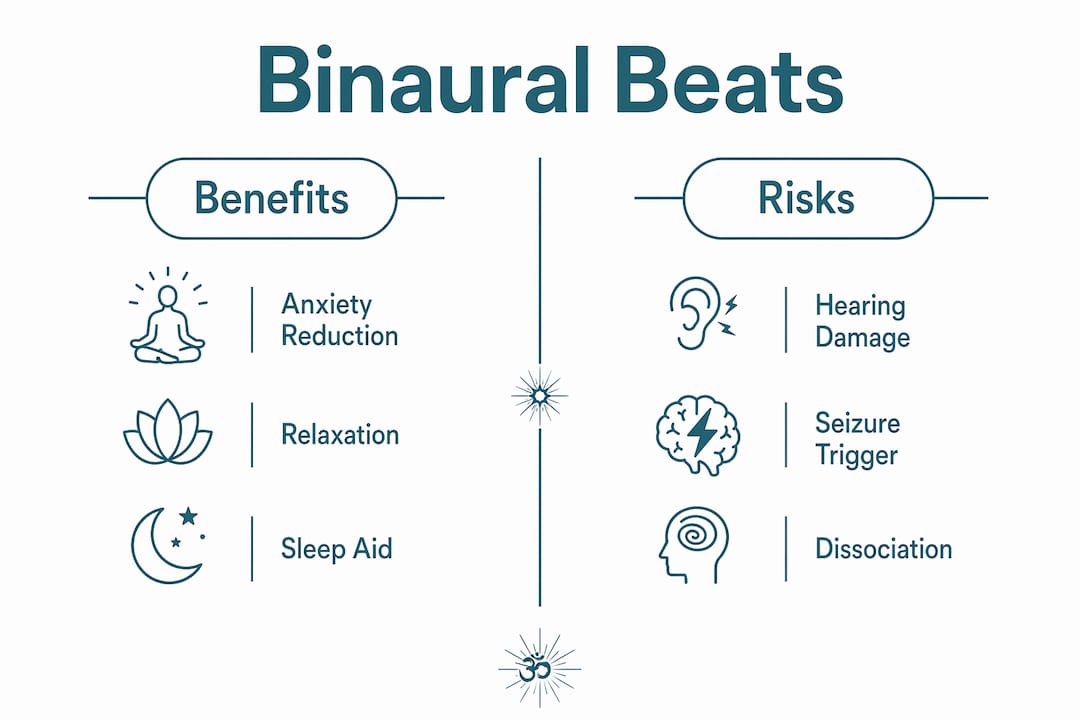
The caveats matter as much as the findings, though. Placebo effects are notoriously difficult to control for in audio research — participants who believe they are receiving a therapeutic intervention often report improvements regardless of the actual stimulus. Lab conditions also rarely replicate home listening, where distractions, inconsistent equipment, and variable listening habits all dilute any effect.
A large 2023 home-use study involving 1,000 participants found something genuinely surprising: binaural beats used at home actually impaired cognitive test performance compared to silence or neutral sounds. That is not a reason to panic, but it is a reason to treat the “focus booster” marketing claims with healthy scepticism. Benefits, where they exist, tend to be modest and context-dependent — not a substitute for clinical treatment of anxiety, insomnia, or any other condition.
Documented side effects of binaural beats: what gets reported
The adverse effects associated with binaural beats range from mild and transient to, in rare cases, genuinely concerning. Here is what the literature and clinical reports document:
- Headache and nausea: among the most commonly reported complaints, particularly after longer sessions or at higher volumes
- Irritability and agitation: some listeners report feeling more unsettled after listening, especially with beta or gamma frequency tracks
- Dissociation: a sense of detachment from one’s surroundings or self, which can be alarming if unexpected
- Vivid hallucinations: documented in anecdotal reports, particularly with tracks marketed as “digital drugs” or consciousness-altering experiences
- Seizure-like activity: rare, but reported in vulnerable individuals, particularly those with pre-existing neurological conditions
- Noise-induced hearing loss: not from the binaural effect itself, but from listening at excessive volumes — prolonged exposure above 85 dB risks permanent hearing damage
An important nuance: many of the more dramatic adverse reports come from unregulated commercial tracks marketed as “digital drugs” or extreme consciousness-altering experiences. These are poorly studied and often use aggressive stimulation parameters. Clinical recognition of binaural-beat-related adverse events remains limited, but caution is clearly warranted — particularly for the groups covered in the next section.

Who should avoid binaural beats, or consult a clinician first
Some people should not experiment with auditory entrainment without professional guidance. This is not scaremongering; it is the same common sense that applies to any intervention that affects neurological activity.

| Group | Risk | Recommended action |
|---|---|---|
| People with epilepsy or seizure disorders | Rhythmic auditory stimulation may trigger seizure activity in susceptible individuals | Consult a neurologist before any use |
| Active psychosis or recent psychiatric crisis | Dissociative or hallucinatory effects could worsen symptoms | Avoid; seek clinical support |
| Severe PTSD or dissociative disorders | Altered states of consciousness may destabilise | Avoid unsupervised use; discuss with a mental health professional |
| Migraine with aura | Rhythmic stimulation may precipitate an episode | Approach with caution; start with very short, low-volume sessions |
| Children and adolescents | Developing nervous systems; limited safety data | Parental supervision; consult a GP |
| Pregnant women | Insufficient safety data | Consult a midwife or GP before use |
Clinical guidance treats auditory entrainment with caution comparable to visual rhythmic stimulation for people with seizure disorders. The absence of a definitive “binaural beats caused this seizure” case study in the literature does not mean the risk is zero — it largely reflects how poorly adverse events from consumer audio products are tracked and reported.
Practical steps to reduce risk when trying binaural beats
The good news is that most of the risk associated with binaural beats is behavioural, not inherent to the phenomenon itself. Sensible listening habits address the majority of it.
Volume and duration:
- Keep volume at a moderate level for reasonable session durations; if you cannot hold a normal conversation over your audio, it is too loud
- Start with sessions of 15–20 minutes and build up gradually
Equipment and environment:
- Use stereo headphones — over-ear models with good channel separation are preferable
- Verify the track is genuinely binaural (the producer should state the frequency differential clearly)
- Never listen while driving, cycling, or operating any machinery
- Choose a safe, comfortable environment where you can sit or lie down without risk if you feel drowsy
Monitoring your response:
- Keep a brief log of how you feel during and after sessions — this is especially useful in the first few weeks
- Stop immediately if you experience headache, dissociation, nausea, or anything resembling seizure activity
- Do not push through discomfort; the wellness benefits of binaural sound are only accessible when you are listening safely
Pro Tip: Choose tracks from producers who publish their frequency parameters, mixing levels, and session guidance openly. Anonymous uploads with no production credits are a red flag — not because the binaural effect is inherently dangerous, but because you have no way to know what else is in the mix or at what levels.
Fitting short binaural sessions into a broader wellness routine is entirely reasonable for healthy adults; the key is treating it as a complementary tool rather than a primary intervention.
What the research does — and does not — show
The honest state of the evidence is one of genuine uncertainty rather than established harm or proven benefit. Here is a summary of where things stand:
| Research area | Current status | Key gap |
|---|---|---|
| Brainwave entrainment | Inconsistent across studies; 5 of 14 studies showed effects | No standardised stimulus parameters |
| Anxiety reduction | Some positive findings in small trials | Small samples; placebo controls difficult |
| Cognitive performance | Home-use study showed impairment vs silence | Needs replication; lab vs home gap |
| Long-term safety | Virtually no data | No large-scale longitudinal studies |
| Adverse event reporting | Poorly systematised; mostly anecdotal | No formal pharmacovigilance equivalent |
The scientific role of sound technology in wellness is a genuinely developing field, and the research gaps are not a reason to dismiss binaural beats entirely. They are a reason to approach them with calibrated expectations and to prioritise well-produced tracks over anonymous internet uploads. Standardisation of protocols and better adverse-event reporting would transform this field considerably — but that work has not yet been done at scale.
Why professional production matters for safety: Orchestralmeditations, Robert Emery, and Moritz Schneider
Here is something that does not get said often enough in binaural beats discussions: the quality of the production is a genuine safety variable, not just an aesthetic one.
Consider what separates a professionally produced binaural track from an anonymous upload. Accurate frequency placement means the beat frequency you are told you are receiving is the one actually embedded in the audio. Careful mixing ensures that neither channel is clipping, that levels are conservative, and that no unintended artefacts have crept in during mastering. Session guidance tells you how long to listen, at what volume, and what to do if you feel unwell.
Orchestralmeditations records at Abbey Road Studios with the National Philharmonic, and its catalogue features compositions by producers and composers including Robert Emery and Moritz Schneider. Emery is a British composer and producer with extensive credits in orchestral and cinematic music, bringing a rigorous approach to arrangement and sonic architecture that translates directly into how a track sits in the listener’s auditory field. Schneider brings a similarly disciplined production sensibility, with experience spanning orchestral composition and studio production. When either of them is involved in a binaural recording, you are getting frequency placement that has been considered, not guessed at.
That matters for safety-conscious listeners. The complete binaural beats guide on the Orchestralmeditations site reflects this production philosophy: detailed, transparent, and grounded in the actual science rather than the marketing version of it.
Key takeaways
Binaural beats are generally considered low risk for healthy adults; however, safety depends on volume, session length, production quality, and individual health conditions.
| Point | Details |
|---|---|
| Low risk, not no risk | Healthy adults can typically use binaural beats safely; those with certain medical conditions should seek clinical advice first. |
| Contraindications are real | Epilepsy, active psychosis, severe PTSD, and migraine with aura all warrant caution or avoidance. |
| Volume is the main hazard | Listening above 85 dB for extended periods risks permanent hearing damage. |
| Evidence is genuinely mixed | Systematic reviews show inconsistent entrainment results; home-use studies can show cognitive impairment. |
| Orchestralmeditations | Professionally produced tracks with named composers (Robert Emery, Moritz Schneider) and Abbey Road credits offer safer, better-labelled options than anonymous uploads. |
A note on safety and what we actually believe
There is a tendency in wellness content to either oversell binaural beats as a neurological miracle or dismiss them as pure pseudoscience. Neither position is honest, and neither serves you particularly well.
The evidence is genuinely mixed. Some people find real value in structured listening sessions — better sleep onset, a quieter mind before meditation, a useful anchor for focus work. Others notice nothing, or feel mildly worse. A small number of people, particularly those with certain neurological or psychiatric histories, face real risks. The responsible position is to acknowledge all of that without either breathless enthusiasm or reflexive scepticism.
What we are committed to at Orchestralmeditations is producing audio that is honest about what it is, transparent about how it was made, and accompanied by clear guidance on safe use. That means named composers, verifiable studio credits, and session notes that actually tell you something useful. It also means saying plainly: this content is general information, not medical advice. If you have any of the conditions listed in this article, please speak to your GP or a neurologist before experimenting with auditory entrainment.
Professionally produced binaural tracks for safety-conscious listeners
If you have read this far and you are thinking “right, I want to try this properly,” the Orchestralmeditations library is built precisely for that kind of listener. Every track in the catalogue is recorded at Abbey Road Studios with live musicians from the National Philharmonic, produced under the oversight of composers including Robert Emery and Moritz Schneider, and comes with clear frequency labelling and session guidance.
That is a meaningful contrast to the anonymous uploads that generate most of the adverse-event reports in the literature. You know exactly what frequencies are embedded, at what levels, and who made the decisions about how the track was mixed. Personal and professional licensing options are available, making the library suitable for individual listeners, therapists, yoga instructors, and app developers alike.
Browse the meditation music library to find professionally produced binaural, theta, and orchestral meditation tracks with full production credits and safe-use guidance included.
Useful sources
For readers who want to go deeper into the primary research or seek clinical guidance:
- Systematic review: binaural beats and brain oscillatory activity (PMC) — the most rigorous review of entrainment evidence currently available
- Large 2023 home-use study on cognitive performance (Nature) — important counterweight to optimistic marketing claims
- The Hearing Journal: dangers of high-volume binaural listening — the key source on hearing risk and the 85 dB threshold
- American Academy of Audiology: what are binaural beats? — clear, clinically grounded explainer from an authoritative professional body
- Clinical safety guidance on brainwave entrainment audio — practical contraindication guidance including seizure risk
- OSF preprint: risks from unregulated commercial tracks — documents adverse events linked to “digital drug” culture
- Orchestralmeditations: binaural beats complete guide — production-informed guidance from a professional recording context
- NHS GP or neurologist: for personal medical advice on any of the contraindicated conditions listed in this article
FAQ
Are binaural beats actually dangerous for most people?
For healthy adults without neurological or psychiatric contraindications, binaural beats are generally low risk — provided volume is kept safe and sessions are not excessively long. The main hazards are hearing damage from loud listening and adverse reactions in people with specific conditions such as epilepsy or active psychosis.
Why do I feel strange or dissociated after listening to binaural beats?
Altered states, mild dissociation, and vivid mental imagery are reported by some listeners, particularly with theta and delta frequency tracks designed to induce drowsy or meditative states. If the feeling is distressing or persists after the session ends, stop using the tracks and speak to a GP.
What is the dark side of binaural beats?
The most documented concerns are hearing damage from excessive volume, adverse reactions in people with seizure disorders or psychiatric conditions, and the unregulated “digital drug” market where tracks make extravagant claims and use aggressive stimulation parameters without safety guidance. Unregulated commercial tracks account for the majority of serious adverse reports in the literature.
What happens if you fall asleep listening to binaural beats?
Falling asleep during a delta or theta session is common and generally harmless for healthy adults. The main practical concern is that you may leave audio playing at volume for an extended period, which increases cumulative hearing exposure. Using a sleep timer on your device is a sensible precaution.
Should I consult a doctor before using binaural beats?
If you have epilepsy, a history of seizures, active psychosis, severe PTSD, a dissociative disorder, or migraine with aura, yes — speak to your GP or neurologist before trying any form of auditory entrainment. For healthy adults with no relevant history, a brief trial at safe volumes is generally considered low risk.