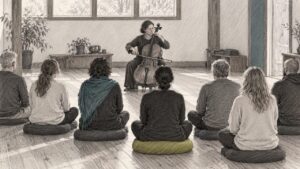
The 432 frequency is not a scientifically proven universal healing tool. That is the honest, evidence-aware answer. What it is — and this matters just as much — is a tuning choice that many listeners find genuinely calming, and one that sits within a growing body of small, promising studies worth knowing about. The modern concert pitch standard, ISO 16, sets A4 at 440 Hz. Choosing 432 Hz instead is a deliberate step away from that norm, and for a lot of people, it feels like a step toward something quieter. Orchestralmeditations produces professionally recorded 432 Hz music at Abbey Road Studios precisely because the listening experience, when done properly, is worth taking seriously.
Here is what the current evidence actually supports:
- Small peer-reviewed studies report modest physiological changes (heart rate, heart rate variability) in some settings, but sample sizes are limited and results are mixed.
- No broad scientific consensus exists that 432 Hz is uniquely healing compared to any other calming music.
- Subjective benefits — relaxation, focus, reduced anxiety — are consistently reported by listeners and are real, even if the mechanism is not fully understood.
- Production quality and accurate tuning matter enormously; a poorly mastered upload labelled “432 Hz” may deliver none of the intended experience.
What does 432 Hz actually mean, and where did it come from?
Think of concert pitch as the anchor note every instrument in an ensemble tunes to. The modern international standard, A4 = 440 Hz, became widespread through the mid-20th century and is now baked into virtually every piano, synthesiser, and orchestral tuning fork you will encounter. Choosing A4 = 432 Hz instead shifts every pitch in the piece downward by approximately 31.8 cents — roughly one-third of a semitone. That is a small but perceptible difference, particularly for trained musicians and attentive listeners.
| Feature | A4 = 440 Hz (Standard) | A4 = 432 Hz |
|---|---|---|
| Pitch reference | ISO 16 international standard | Alternative concert pitch |
| Pitch difference | Baseline | ~31.8 cents lower |
| Perceptibility | N/A | Noticeable to many listeners |
| Common description | Bright, modern | Warmer, softer |
| Retuning method | N/A | Digital pitch-shift or physical retuning |
The historical claims around 432 Hz are colourful, if not always watertight. Advocates often cite Giuseppe Verdi, who preferred a lower concert pitch in the 19th century (linked to a philosophical preference for C = 256 Hz, which places A at approximately 432 Hz). The idea that 432 Hz is somehow more “natural” or mathematically aligned with the universe gained momentum in the late 20th century through wellness communities. None of those cosmological claims have been verified scientifically, but the historical preference for lower tuning among some composers is real.
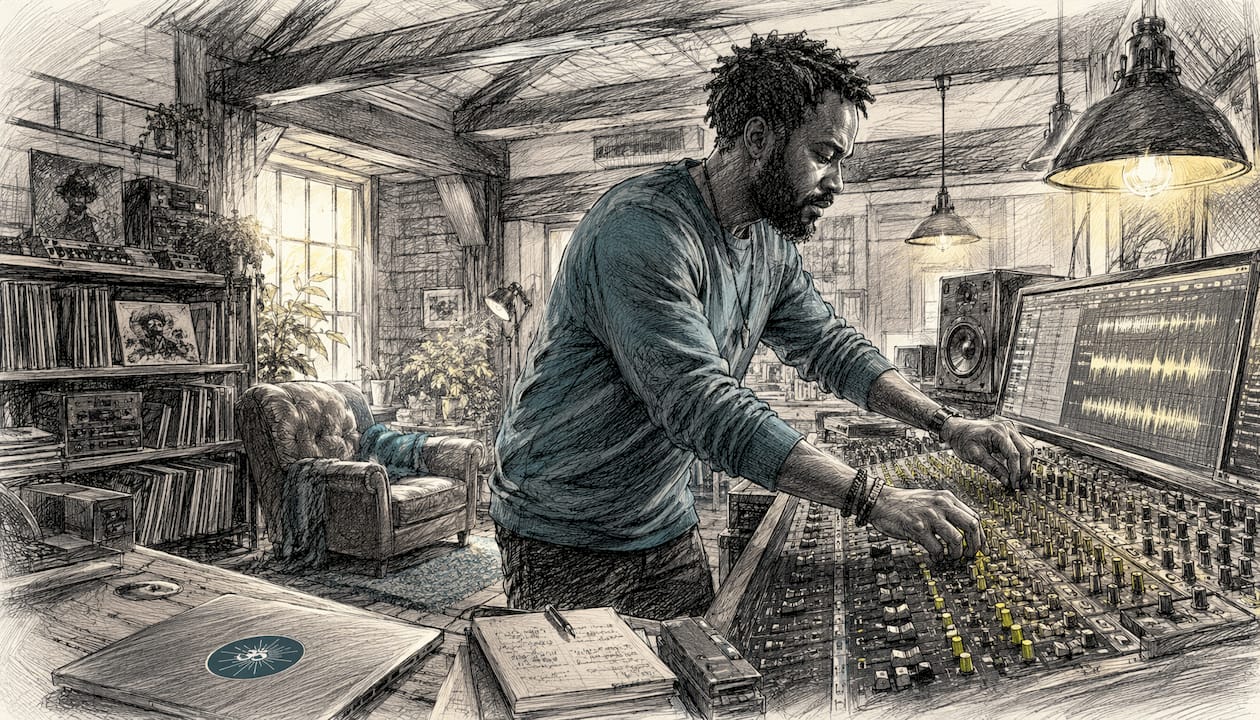
Practically speaking, there are two ways to create 432 Hz music. The first is digital pitch-shifting: take an existing recording at 440 Hz and transpose it down. Quick, but it can introduce subtle artefacts, especially in complex orchestral textures. The second is physically tuning instruments to 432 Hz before recording. This produces a cleaner, more natural result. For casual listeners, the difference between the two methods may be imperceptible. For anyone with musical training, it often is not.
Why do people use 432 Hz? Common claims and what to believe
The wellness world has built quite a mythology around this tuning. Some of it is grounded in genuine subjective experience. Some of it is, let us say, enthusiastically speculative.
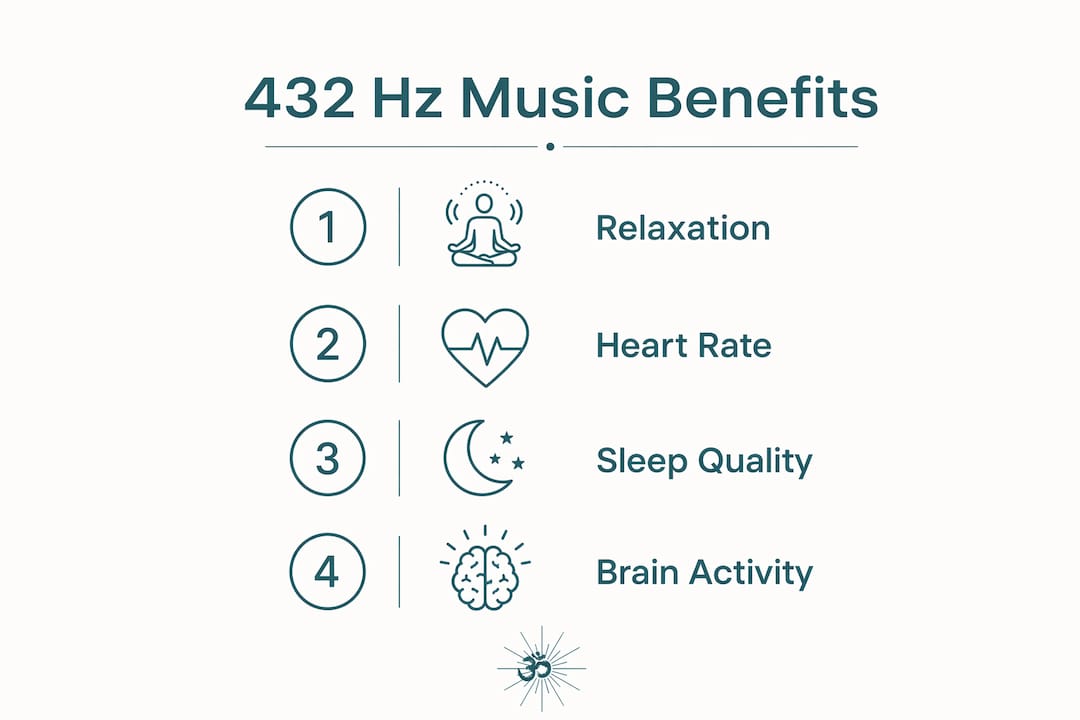
Commonly reported benefits that listeners describe include:
- Deeper relaxation during meditation or before sleep
- Reduced anxiety and a general sense of calm
- Improved focus for work, study, or creative tasks
- A sense of “raised vibration” or positive energy (subjective and culturally framed)
- Better sleep quality, particularly when used as a pre-sleep wind-down
Then there are the claims that venture into less evidenced territory. You will see references to Schumann resonance alignment, DNA repair, and cellular healing. These are not supported by peer-reviewed science. The 528 frequency carries similar claims in wellness circles, as do other Solfeggio frequencies like the 741 frequency, each assigned symbolic meanings within sound-healing traditions. Those traditions are culturally rich and personally meaningful to many people. They are not clinical diagnoses.
The honest distinction to hold onto: subjective experience (feeling calmer, sleeping better, enjoying the music) is real and worth pursuing. Objective, replicable physiological healing from 432 Hz alone has not been demonstrated at scale. Both things can be true simultaneously, and neither cancels the other out.
What does the research actually say?
There is no scientific consensus that 432 Hz is a universally healing frequency. That sentence should appear on every wellness site that discusses this topic, and it rarely does. But “no consensus” does not mean “no evidence,” and the distinction matters.
A double-blind cross-over pilot study found a marked heart rate decrease when participants listened to music at 432 Hz versus 440 Hz, with a reduction in heart rate compared to 440 Hz. The authors themselves called for larger trials before drawing firm conclusions. A separate randomised cross-over trial in cancer patients found that both 432 Hz and 443 Hz interventions improved psychological outcomes, with some cardiovascular measures showing greater change at 432 Hz, though differences were not uniformly significant across all outcomes. Research into brain electrical activity has shown frequency-related differences in power spectral density and coherence between musicians and non-musicians, suggesting that training and perception both shape how the brain responds.
“The popularity of 432 Hz is largely driven by subjective experience rather than standardised clinical proof; production quality matters as much as the tuning itself.” — AP News
Small pilot studies on sleep — including trials with spinal cord injury patients and dental procedure contexts — have shown mixed but sometimes positive results for 432 Hz, though sample sizes were very small and expectancy effects cannot be ruled out. The stronger, more consistent evidence in music therapy research points to preferred calming music as the active ingredient, not a specific tuning. If 432 Hz is the music you find calming, that preference itself is doing meaningful work.
One practical note that gets buried in the frequency conversation: WHO and NIOSH safe-listening guidance recommends keeping volume low and sessions bounded. Volume and duration pose a greater risk to hearing health than any tuning choice. Worth remembering before you reach for the headphone volume dial.
How to use 432 Hz music for meditation, sleep, and relaxation
Treat 432 Hz as a preference tool within a consistent relaxation routine, not a magic switch. The ritual around listening — the intention, the environment, the regularity — consistently predicts benefit more reliably than the specific Hz value. Here is a practical session guide:
- Set your environment. Dim the lights, close unnecessary tabs, and give yourself a clear signal that this time is different from the rest of your day.
- Choose your listening method. Headphones give you a more immersive experience, particularly with binaural or 3D-mixed recordings. Speakers work well for ambient background use during yoga or reading.
- Set volume conservatively. Aim for a level where you can hear the music clearly but could still hold a quiet conversation. This protects your hearing and, counterintuitively, often deepens relaxation.
- Start with 10–20 minutes. Especially in your first few sessions, shorter is smarter. Note how you feel before and after.
- Pair with a breathing practice or body scan. Slow, diaphragmatic breathing synchronised with the music’s tempo amplifies the calming effect. A simple 4-7-8 breath pattern works well.
- Repeat consistently. Three to four sessions per week over two to three weeks gives you enough data to judge whether this tuning genuinely suits you.
Pro Tip: Want to verify whether a track is actually tuned to 432 Hz? Use a chromatic tuner app (GuitarTuna or similar) and play a sustained note from the recording through your device’s microphone. If A reads as approximately 432 Hz rather than 440 Hz, the tuning is genuine. Many uploads labelled “432 Hz” on social platforms are simply pitch-shifted or mislabelled.
Where to find quality 432 Hz music in the UK
Spotify, YouTube, and Apple Music all carry 432 Hz playlists and are fully accessible in the UK. The challenge is quality control. Many uploads are pitch-shifted from 440 Hz recordings, poorly mastered, or simply mislabelled. Production quality is often the decisive factor for whether a listener actually benefits, not the number in the title.
| Platform | UK Accessible | Quality Control | Best For |
|---|---|---|---|
| Spotify | Yes | Variable (user uploads and label releases) | Playlist discovery |
| YouTube | Yes | Low (many mislabelled uploads) | Free exploration |
| Apple Music | Yes | Moderate | Curated listening |
| Orchestralmeditations | Yes | High (studio-recorded, verified tuning) | Deep meditation sessions |
A short checklist for spotting a high-quality recording:
- Named composer or producer with verifiable credits
- Studio or orchestra listed in the release notes
- No pitch warbling or digital artefacts in sustained notes
- Professional mastering (consistent dynamic range, no clipping)
- Tuning method specified (physically tuned instruments vs. digital shift)
Solfeggio-frequency tracks, including 432 Hz and the 528 frequency, appear widely across these platforms. The label signals a wellness tradition rather than a guarantee of accurate tuning. When in doubt, verify with a tuner app or choose releases from producers with a documented track record. Wellness and sound healing communities have increasingly recognised that the recording process itself shapes the experience as much as the frequency choice.
Why production quality matters: Orchestralmeditations’ approach
Here is something the frequency conversation often skips: a beautifully conceived 432 Hz composition, recorded badly, is just a bad recording at an unusual pitch. The tuning is the starting point, not the finish line.

Orchestralmeditations records with live musicians, including sessions at Abbey Road Studios with the National Philharmonic. That is not a marketing flourish. It means the instruments are physically tuned to 432 Hz before the microphones go live, which eliminates the digital artefacts that plague pitch-shifted uploads. The recordings use 3D surround sound and professional mastering, which means the spatial and dynamic qualities of the music are preserved in a way that genuinely supports deep listening.
Two composers central to this work are worth knowing about. Robert Emery is a British composer and producer with extensive experience in orchestral and cinematic music, whose approach to frequency-based composition prioritises technical accuracy alongside emotional resonance. Moritz Schneider brings a background in both classical composition and contemporary sound design, with a particular focus on how orchestral textures interact with meditative states. Industry observers, including AP News coverage of the 432 Hz scene, have cited composers and producers of this calibre as the benchmark for what the format can achieve when taken seriously.
Key production features that distinguish professionally made 432 Hz recordings:
- Physical instrument tuning to 432 Hz (not post-production pitch-shifting)
- Live orchestral performance captured in a world-class acoustic environment
- Binaural and 3D mixing for headphone and speaker optimisation
- Consistent mastering that preserves dynamic range across the full session length
- Transparent production notes so listeners know exactly what they are hearing
This matters practically. If you are using 432 Hz music to support a meditation practice, you want the recording to hold up for 20 minutes without fatigue-inducing artefacts or inconsistent dynamics. Professional production is what makes that possible.
Key takeaways
The strongest case for 432 Hz is not that it heals everything — it is that, for many listeners, it is the calming music they actually want to sit with, and that preference itself carries real benefit.
| Point | Details |
|---|---|
| No universal healing proof | Small studies show modest physiological effects; no scientific consensus exists for 432 Hz as a universal healing frequency. |
| Pitch shift is small but perceptible | Retuning from 440 Hz to 432 Hz shifts pitch by ~31.8 cents; many listeners describe the result as warmer or softer. |
| Ritual and preference drive benefit | Consistent listening routine and personal music preference predict relaxation outcomes more reliably than tuning alone. |
| Verify before you trust | Many online uploads labelled “432 Hz” are mislabelled; use a tuner app or choose releases with named producers and studio credits. |
| Orchestralmeditations for fidelity | Orchestralmeditations records with live musicians at Abbey Road, physically tuned to 432 Hz, for a high-fidelity meditative experience. |
The frequency that actually changed my listening habits
Honestly? I came to 432 Hz sceptically. The cosmological claims felt like a lot of weight for eight Hz to carry. But I tried a properly produced orchestral track at 432 Hz for a 15-minute body scan, kept a simple note in my phone about how I felt before and after, and did it four times over two weeks. The result was not a revelation. It was quieter than that. I slept better on those nights. My shoulders dropped a little faster. Whether that was the tuning, the ritual, the music itself, or some combination of all three, I genuinely cannot say. What I can say is that the healing frequency conversation becomes a lot more useful when you stop asking “does it work?” and start asking “does it work for me, in this context, with this recording?”
Keep a simple listening journal. Three words before, three words after. Do it for two weeks. The data you collect on yourself will tell you more than any study with 20 participants.
Orchestralmeditations: professionally produced 432 Hz for serious listeners
If you have spent any time wading through YouTube uploads labelled “432 Hz miracle frequency,” you will know the experience can range from genuinely lovely to mildly headache-inducing. The difference is almost always production. Orchestralmeditations’ meditation music library offers a different starting point: live orchestral recordings, physically tuned to 432 Hz, captured at Abbey Road Studios with the National Philharmonic.
The library includes both single-track purchases and subscription access, so you can start with one session before committing to more. Composers Robert Emery and Moritz Schneider have built these recordings specifically for meditative listening, which means the dynamic arc, the spatial mixing, and the session length are all designed with your practice in mind rather than streaming metrics. For anyone integrating 432 Hz into a wellness routine that also touches on broader cannabis wellness trends or yoga and mindfulness practices, the production quality here removes one significant variable from the equation.
Preview a track at low volume for your first session. Keep it to 15 minutes. See how you feel.
Browse the full meditation music collection and find the track that fits your practice.
Useful sources and further reading
| Source | What it covers | Why it is useful |
|---|---|---|
| PubMed: 432 vs 440 Hz double-blind pilot | Heart rate changes in controlled listening trial | Primary study; cites heart rate decrease |
| Springer Nature: cancer patient trial | Cardiovascular and psychological outcomes at 432 Hz vs 443 Hz | Clinical population; nuanced results |
| This Week in Science: 432 Hz review | History, health claims, and evidence summary | Best single overview; covers safe-listening guidance |
| AP News: 432 Hz at work | User experiences and expert cautions | Real-world context; names production quality as key factor |
| Brain activity study (Dergipark) | EEG differences between musicians and non-musicians | Neurophysiological angle; perceptual training effects |
| Orchestralmeditations: 432 Hz vs 528 Hz | Side-by-side comparison of two popular tunings | Useful for listeners exploring alternatives |
| Orchestralmeditations: frequency healing sounds | Evidence summary for healing frequencies | Science-focused; good companion read |
This article is general information, not medical or therapeutic advice. For personal health concerns, consult a qualified professional and check current guidance from relevant health authorities.
FAQ
What does 432 Hz actually do?
Listening to music at 432 Hz may produce modest relaxation effects, including small reductions in heart rate, though evidence from small trials is mixed and no large-scale consensus exists. Most benefits listeners report — calmer mood, better focus, easier sleep — are real subjective experiences, likely driven by a combination of music preference, expectancy, and consistent listening ritual.
What does 432 Hz do to the brain?
Research has found differences in brain electrical activity between listeners hearing music at 432 Hz versus 440 Hz, with variations in power spectral density and coherence that differ between musicians and non-musicians. These findings suggest the brain responds differently to the two tunings, though what that means for everyday listeners is still being studied.
Is 432 Hz the same as God’s healing frequency?
The label “God’s frequency” is a cultural and spiritual framing, not a scientific classification. Some wellness traditions assign 432 Hz special cosmological significance, but no peer-reviewed research supports the idea that it is uniquely sacred or universally healing compared to other calming music.
Is The Dark Side of the Moon recorded at 432 Hz?
No. Pink Floyd’s The Dark Side of the Moon was recorded at the standard A4 = 440 Hz concert pitch. Versions circulating online labelled as “432 Hz” are fan-made pitch-shifted edits, not original releases. Always check production notes or use a tuner app to verify a recording’s actual pitch.
How is 432 Hz different from 528 Hz or 741 Hz?
All three are tuning or frequency references used in wellness and sound-healing contexts. The 528 frequency is associated with the Solfeggio tradition and claims around emotional healing, while the 741 frequency is linked in that same tradition to clarity and expression. None of the three has a stronger scientific evidence base than the others; the choice between them is largely a matter of personal preference and intended use.