
A multi-seat meditation licence lets several people in one organisation, such as instructors, therapists, coaches or colleagues, use the same meditation music legally, under one agreement instead of a pile of individual ones. The catch: “multi-seat” has no fixed meaning. One provider counts people, another counts devices, a third counts addresses. So the first job is to read what your licence actually counts, and the second is to check that it covers what you do with the music.
We make orchestral meditation music, so we have sat on both sides of this conversation. Below is a plain guide for anyone in Germany who runs a studio, a team of practitioners or a corporate wellness programme and needs to get the licensing right without hiring a lawyer for the first draft.
TL;DR
- “Multi-seat” can mean per person, per device, per stream or per location. Ask which one your provider means before you pay.
- A royalty-free licence and a public performance fee are two separate things. In Germany, playing music on business premises can also involve GEMA, the collection society.
- Private streaming accounts are meant for private listening. They are the wrong tool for a team, a class or a waiting room.
- Get the licence in writing, with a certificate or document you can show if anyone asks.
- Our professional subscription costs €150 per month and our personal subscription costs €21 per month. Pick by how you use the music, not by team size alone.
What “multi-seat” really means for meditation music
The term comes from software. A “seat” was one person at one computer. Music licensing borrowed the word, and then, as borrowed words do, wandered off and changed its meaning.
In practice you will meet four models:
| Model | What is counted | Typical trap |
|---|---|---|
| Per person | Each instructor or therapist who uses the music | A freelancer who covers a shift is not on the list |
| Per device or stream | Each phone, speaker or player running at the same time | Two treatment rooms at once means two streams |
| Per location | Each physical address | Home-office sessions and online classes may sit outside it |
| Per organisation | The whole company, often with a fair-use cap | The cap is buried in the small print |
None of these is wrong. They simply fit different businesses. A yoga studio with three teachers who each run one class at a time is a per-person story. A clinic with five treatment rooms playing music at once is a per-stream story. A company rolling out a mindfulness programme across offices in Munich, Hamburg and Berlin is a per-location or per-organisation story.
So before you compare prices, write down three facts about your own set-up:
- How many people will press play, and are they employees or freelancers?
- How many rooms, devices or online sessions run at the same time?
- Where does the music play: on premises, in recorded content, in an app, or all three?
Those three answers decide which model suits you. Without them, any quote you get is a guess dressed up in a nice PDF.
Two licences people confuse: the music licence and the performance fee
Here is the misunderstanding we hear most. Someone buys a royalty-free track, feels thoroughly legal, and plays it to a room of paying clients. Then a letter arrives.
Royalty-free means you pay for the right to use a recording without paying a royalty each time it is used, for example in a video, a guided audio or an app. It does not automatically settle every separate right that can attach to playing music in public. As one guide on music for yoga content points out, a licence for your own synchronised content is not the same as clearance for broadcasting music in a venue.
In Germany, the collection society GEMA is the body that handles public performance of the music in its repertoire. Whether it applies to you depends on whose music you play. Music from composers who are not GEMA members, licensed by a provider who is able to confirm this, may fall outside GEMA. Music from GEMA members generally does not. That is why “GEMA-free” is a claim you should ask the provider to put in writing, rather than something you assume from a product page.
We are a music maker, not your lawyer, and German licensing practice has real detail in it. If you run a studio, clinic or company programme, check the specifics with GEMA directly or with a lawyer who handles media or copyright law. That is the person to see before you invest in a library for a whole team.
Why a private streaming account will not do
It is tempting. You already pay for a streaming service, the meditation playlists are lovely, and you have a Bluetooth speaker. What could go wrong?
Quite a lot, as it happens. Consumer streaming subscriptions are sold for private listening. Playing them to clients or colleagues in a professional setting is the situation their terms are not built for. A German guide to yoga studio music makes the same point from the studio owner’s side: public playback on business premises is subject to a licence, and yoga studios are no exception.
There is also a practical problem that has nothing to do with law. A streaming playlist is a lucky dip. It can serve an advert, a loud track or an algorithmic leap into something peppy, just as your class settles into stillness. We have heard the stories. One cheerful pop chorus arriving mid-body-scan has a way of ending a session faster than any gong.
What a good multi-seat licence should spell out
When you read a licence, or a quote for one, look for these points. If any of them is missing, ask.
Who is covered
Is it named individuals, job roles, or the organisation as a whole? Can you swap a person out when someone leaves? Are freelancers and substitute teachers included? A licence that covers “employees” may leave your self-employed therapists out in the cold.
Where and how the music may be used
List your actual uses: live classes, one-to-one sessions, recorded videos, a members’ app, guided audio you sell, a podcast, a corporate intranet. Then check each against the licence wording. Personal use and professional use are usually separate permissions, and commercial products that you resell or distribute are often a third.
Simultaneous use and locations
Can two instructors play the same track at the same time in different rooms? Does the licence follow you if you teach at a client’s office, or is it tied to a single address? Industry guidance on workplace licensing makes the same point: check whether use across locations is allowed or whether the licence is strictly tied to one site.
Term and what happens when you stop
If you pay monthly, what happens to content you already published when you cancel? A good answer is clear and unsurprising. A vague answer is a reason to pause.
Proof
Ask for a licence certificate or a written confirmation naming your business. If anyone ever questions your use of a track, a document beats a memory every time. Keep it with your tax papers. It is boring, which is exactly why it works.
A worked example: a small practice with three practitioners
Let us make this concrete with an invented but typical case. Say you run a small therapy practice in Cologne with three practitioners and two treatment rooms. On a busy day both rooms are in use, and once a week one practitioner records a guided relaxation for clients to use at home.
- Counting people: three practitioners, possibly one of them freelance.
- Counting streams: two at the busiest moment.
- Counting uses: in-room playback, plus a recorded audio that leaves the building.
A per-person licence that excludes freelancers fails you on the first line. A per-device licence with a single stream fails you on the second. A personal-use licence fails you on the third, because the recording is distributed to clients. The licence that fits is the one that handles all three, and you only find that out by listing them first.
Now a different case: a company with an in-house wellbeing programme, offering a lunchtime meditation in three offices. Here the interesting question is not headcount but location and audience. Is the music played on company premises to staff? Is it embedded in an internal video? Does an external instructor bring it? Each answer shifts the paperwork. Workplace wellness buyers often prefer one central arrangement over a separate licence per office, because compliance reporting becomes simpler and the experience stays consistent.
Corporate wellness: what HR and wellbeing leads should ask
Corporate wellness is where multi-seat questions get loud, because the numbers are bigger and the people buying are rarely music specialists. If that is you, here is a short list to take into a supplier call.
- Who is the licensee? Your company, a subsidiary, or the external trainer you hire?
- Is playback internal only? Staff in a meditation room is different from content sent to customers.
- Are recordings included? If you make an internal course video, is the music cleared for it, and for how long?
- Is there a performance-fee question? Ask in writing whether the provider’s catalogue falls under GEMA or not.
- What is the audit trail? A certificate, an invoice naming the company, and the licence text itself.
- Can it scale? Adding an office or a trainer should be a clear step, not a fresh negotiation.
Notice what is not on the list: the length of the sales deck. A supplier who answers these six crisply is usually one you can work with.
Choosing the right kind of music for a group
Licensing is the legal half. The other half is whether the music works for a room of people who did not choose it. A track you adore while alone at 6 a.m. may do something odd to a team of twelve in a meeting room.
Some things worth weighing:
- Dynamic range. Very dramatic swells can startle a group. Gentle, slow-moving orchestral writing keeps attention soft.
- Length. Sessions vary. Short pieces suit a breathing break; long ones suit a full practice.
- Purpose. Sleep, relaxation, focus and deeper meditative states want different textures.
- Sound technology. Binaural beats need headphones to work as intended, which makes them a fit for individual listening, less so for speakers in a shared room. Our own library includes binaural, theta and Solfeggio-frequency tracks as well as orchestral compositions, so we always say: match the format to how people will listen.
We would also say, with the humility of people who have tested this the hard way, that nobody has ever regretted choosing calmer over clever.
Our perspective: why live orchestras, and why it matters for licensing
We will be upfront. We have a stake in this, and we also have a view.
Orchestral Meditations is built around live musicians. Our meditation music is recorded at Abbey Road Studios with the National Philharmonic, and the library is written and produced by a small team of composers, including Robert Emery, who works as composer and producer. The point of recording real players in a great room is simple: a living orchestra breathes. The little irregularities in a bowed string are the sort of thing your body notices even when your mind does not. Many of our listeners tell us the effect is deeper relaxation than they get from synthesised pads. We can’t promise that for everyone, and we would not try to.
The licensing consequence is one we care about. Because the tracks are exclusive to our library rather than pulled from a giant anonymous catalogue, we can speak plainly about what our licences cover and for whom. We offer personal and professional licensing, and we sell tracks individually or through subscription. If a question about your set-up is not answered on our pages, we would rather you ask than guess.
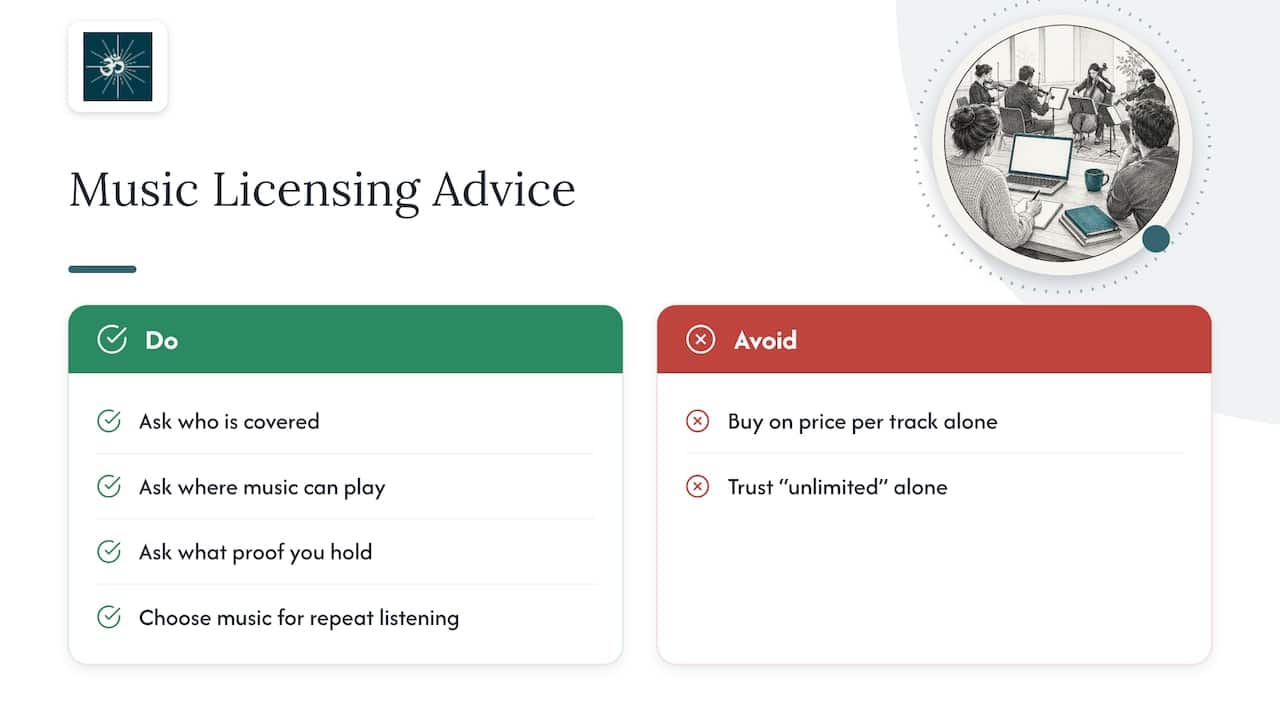
Our advice to any practitioner or wellbeing lead is this. Do not buy on price per track alone, and do not buy on the word “unlimited” alone. Ask three questions: who is covered, where can it play, and what do I hold in my hand as proof? Then choose music you would be happy to hear on a Monday morning for the fourth week running. If you would not, your clients will not either.
— ROBERT
Subscription or single tracks: which fits a team?
This is a question about rhythm of use more than team size.

Single purchases suit a fixed need: one guided meditation, one course, one video. You pick the music once, license it for that use, and move on.
A subscription suits ongoing work: a teacher who changes the playlist every week, a therapist who likes variety, or a wellbeing programme that refreshes content monthly. You get access to a library instead of a handful of pieces.
We offer two subscriptions:
| Plan | Price | Best suited to |
|---|---|---|
| Personal subscription | €21 per month | Your own practice and personal listening |
| Professional subscription | €150 per month | Practitioners and businesses using the music in their work |
If you are a team, the personal plan is not the one to rely on for client work. It is made for personal use. For professional use, look at the professional plan, and read its licence terms against your list of uses before subscribing. For content you plan to build into products, our royalty-free meditation music page is where to start. It has no published price, so get in touch about the details for your project.
A checklist before you sign anything
Print this, or paste it into your notes.
- List every use: live, recorded, online, app, resale.
- Count people, simultaneous streams and locations.
- Decide who the licensee is: you, your company, or your trainer.
- Ask whether the music falls under GEMA, and get the answer in writing.
- Confirm what happens to published content if you cancel.
- Request a licence certificate or written confirmation naming your business.
- Check whether freelancers, substitutes and new hires are included.
- Test the music with a real group before you roll it out.
- Keep all documents together, with dates.
- Review the licence once a year, or when your team changes.
Nothing on that list is glamorous. It is, however, the difference between a calm session and an awkward email.
Common mistakes we see
Assuming “royalty-free” means “free of every fee”. It means you do not pay per use of the recording. Separate performance questions can remain, as covered above.
Buying a personal licence for professional work. It feels like a bargain until the first paying client walks in.
Forgetting freelancers. Self-employed practitioners are often the people who use the music most, and the ones least often named in the licence.
Ignoring online delivery. Teaching over video or posting recordings is a different use from playing in a room. Check it separately.
Not keeping proof. If your only evidence is a vague memory of a checkout page, you are relying on luck.
Where our offer fits
If you are a practitioner, teacher or wellbeing lead who wants orchestral, live-recorded meditation music with clear personal and professional options, start with our professional subscription at €150 per month, or browse the full library from our home page. Tell us how many people, rooms and locations are involved, and we will point you to the right option rather than the most expensive one.
FAQ
Is a multi-seat licence the same as a team licence?
Often, yes, but the words are not standardised. Some providers count named people, others count simultaneous streams or locations. Ask what is counted and request the answer in writing.
Does royalty-free music mean I never pay GEMA?
No. Royalty-free describes how you pay for using a recording, not whether a collection society has a claim on public performance. In Germany, whether GEMA applies depends on whose music is played, so ask your provider to confirm the status of the catalogue and, if unsure, speak to GEMA or a copyright lawyer.
Can I use my personal streaming account for classes or treatments?
It is not advisable. Consumer accounts are sold for private listening, and public or business playback is a different situation that usually requires its own licence. A music provider that offers professional licensing is the safer route.
Which of your plans suits a small practice?
For client-facing work, the professional subscription at €150 per month is the plan designed for professional use. The personal subscription at €21 per month is for your own listening. If your plans involve resale or building music into a product, contact us about royalty-free licensing first.