
Short answer: the research is encouraging, but it is narrower than the marketing suggests. Music therapy has solid evidence for reducing anxiety and stress. Pairing music with mindfulness appears to help some people, especially beginners, more than mindfulness alone. And in Germany, music therapy is a clinical profession, which is a different thing from pressing play on a relaxing playlist.
We make orchestral meditation music for a living, so we have an obvious interest here. That is exactly why we want to be careful with what we claim. Below you will find what the studies found, where they stop, and how to use music in your own practice without expecting it to do a doctor’s job.
TL;DR
- A 2024 meta-analysis of 51 studies found music therapy reduces anxiety with a medium effect size (g = 0.357), and listening-based (receptive) approaches showed significant benefit.
- An eight-week trial found mindfulness combined with music therapy improved emotional regulation more than mindfulness alone, though the sample was small and specific.
- In Germany, music therapy is a recognised healthcare profession with its own standards and a place in medical guidelines. Meditation music, however good, is not that.
- Music apps and recordings are best treated as a supplement to care, not a replacement for it.
Music therapy is not the same as meditation music
Let us clear up the vocabulary first, because it trips up almost every search on this topic. (I once confidently told a dinner guest that my playlist was “basically music therapy”. A music therapist was sitting across the table. It went about as well as you would expect.)
The Deutsche Musiktherapeutische Gesellschaft defines music therapy as the targeted use of music within a therapeutic relationship, aimed at restoring, maintaining and promoting mental, physical and spiritual health. The key phrase is the therapeutic relationship. A qualified therapist assesses you, chooses methods, adapts in real time and evaluates the outcome.
The German professional description of the field, the Berufsbild of the BAG Musiktherapie, states that music therapy rests on the bio-psycho-social model of health and illness. It uses the interplay of music, creative activity and relationship in a therapeutic process. The European Music Therapy Confederation’s country page for Germany describes the same foundation.
So we have three different things that often get blurred together:
- Music therapy: delivered by a trained therapist, with a clinical goal. Active (making music) or receptive (listening) methods.
- Music listening for wellbeing: you choosing music to relax, focus or sleep. Useful, but self-directed.
- Music-supported meditation: a meditation practice, guided or silent, where music provides atmosphere, rhythm or an anchor for attention.
Most of what we make sits in the third category. Most of the research people cite sits in the first two. Keeping that distinction in mind will save you from a lot of overblown claims, ours included.
What the strongest evidence shows
Anxiety: the clearest result
The most robust finding comes from a systematic review with multilevel meta-analyses of music therapy for anxiety, published in eClinicalMedicine. It pooled 51 studies and reported a medium effect size (g = 0.357) for reducing anxiety symptoms. Receptive interventions, meaning listening, showed significant benefits.
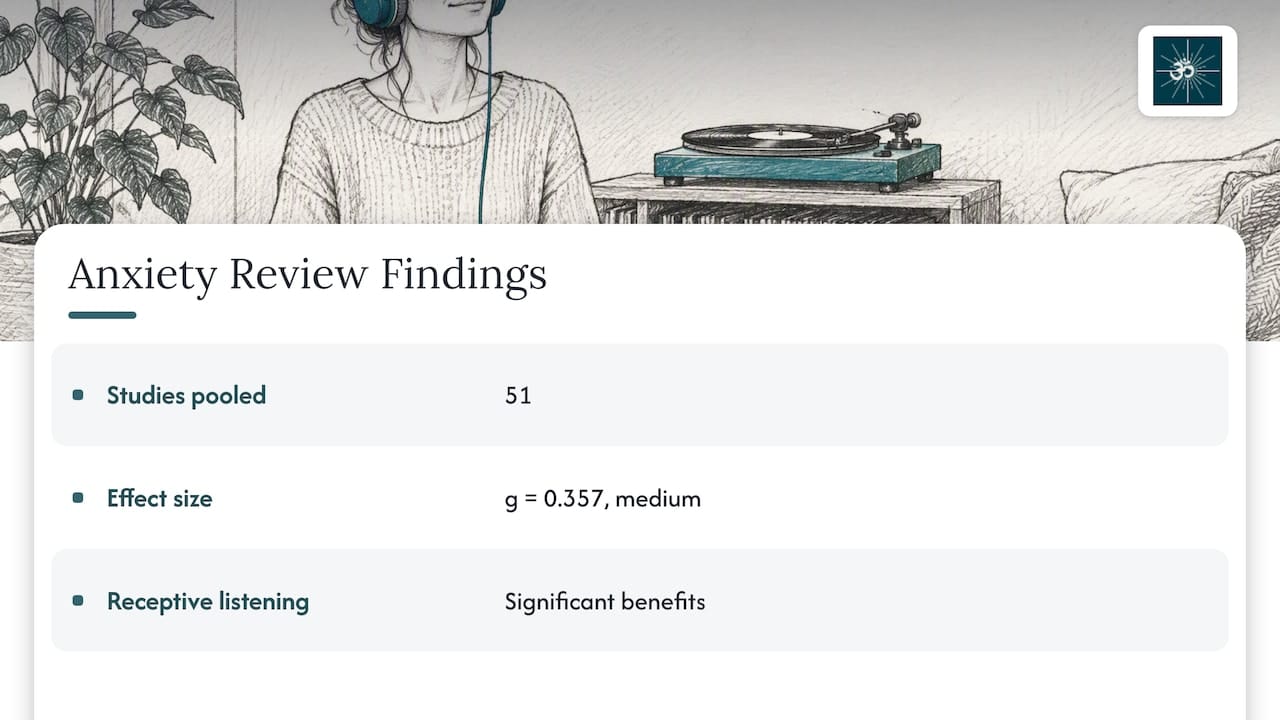
A medium effect is meaningful but not miraculous. It tells you that, on average, people who received music therapy felt less anxious than those who did not. It does not tell you that any individual will feel calm after any individual track.
If your anxiety spikes in the moment, music is only one tool. Slow breathing is another, and a practical guide on breathing techniques for acute anxiety is worth reading alongside any listening practice. If anxiety is persistent and interferes with daily life, speak to your GP or a psychotherapist rather than relying on audio.
Emotion regulation
A systematic review and meta-analysis on musicking and emotion regulation, published in Psychology of Music in 2024, examined how music-making and music use affect our ability to manage emotions. It is a useful reminder that how we engage with music matters, not only that we do.
The mindfulness crossover is where it gets interesting. A randomised controlled trial of mindfulness-based music therapy, published in 2023, ran an eight-week structured programme with 92 older women who were blind. The group receiving mindfulness-based music therapy improved significantly more on emotional regulation measures than the mindfulness-only control group. On the DERS scale, the difference in improvement reached 12.1 points.
We should be honest about the limits. The participants were a specific population, the programme was therapist-led and structured, and one trial is one trial. It supports the idea that music adds something to mindfulness. It does not prove that any album does the same for any listener.
Sleep and attention
Sleep is where many meditation-music listeners start. A 2024 study in Frontiers in Psychology looked at mindfulness-based music listening in young adults with insomnia disorder, using behavioural measures and event-related potentials to examine conflict control. It is early, small-scale work, but it shows researchers taking the combination seriously with brain-level measurements rather than just questionnaires.
The studies that tend to top the search results for this topic point the same way. Work by Innes and colleagues in 2016 compared meditation with music listening for perceived stress and related outcomes, and a 2021 online study by Hernandez-Ruiz examined whether music distracts from a mindfulness session. A 2025 paper by Cote looked at music and mindfulness for anxiety, suggesting music may give novice meditators some attentional and emotional support while they learn the skill. These are worth reading in full if you want the detail; we are summarising direction, not numbers.
Why music might help meditation (and when it might not)
Here is the honest picture, as I see it from years of watching people try to meditate.
The single biggest obstacle for beginners is not stillness. It is the internal commentary. You sit down, close your eyes and your brain announces that you forgot to reply to an email in 2019. Music gives that restless attention somewhere gentle to land.
That fits the research direction on novices. Sound can lower the barrier to starting, and starting is most of the battle.
But music is not always the answer. Some experienced practitioners prefer silence because the aim is to observe the mind with as little scaffolding as possible. Some people find any melody pulls them into thought or emotion they did not choose. And a track that is too busy, too bright or too loud will do the opposite of calming you.
A few practical rules we give people:
- Match the music to the intention. Sleep, breathwork, body scan and open awareness each ask for different pacing.
- Prefer slow, unhurried, low-surprise music. Sudden dynamic jumps drag attention outward.
- Keep the volume low enough that you could still hear a quiet room.
- Try both. Do one week with music and one week without, and note which sessions you actually finish.
Mindfulness plus music versus mindfulness alone
A question we hear often is whether adding music makes mindfulness stronger or just more pleasant. The honest answer is: probably both, depending on the person and the programme.
For an overview of how mindfulness is being used and evidenced in clinical work, this piece on mindfulness in psychotherapy is a good companion read. It is written for a Polish audience, but the clinical framing travels well.
The table below summarises how the options compare in practice.
| Approach | Who guides it | Best suited to | Main limitation |
|---|---|---|---|
| Music therapy | Qualified music therapist | Clinical goals, diagnosed conditions | Needs access to a therapist; often limited availability |
| Mindfulness alone | Teacher, course or self-led | Building attention skills | Hard for beginners to stay with |
| Music-supported meditation | You, or a teacher | Relaxation, sleep, habit-building | Not a clinical treatment |
| Mindfulness-based music therapy | Trained therapist | Structured emotional regulation work | Evidence still limited to specific groups |
What German medical guidelines say
This is the part most English-language articles skip, and it matters if you live in Germany or work with clients here.
A systematic review of AWMF guidelines, published in the Musiktherapeutische Umschau, found that as of 2021, 29 German medical guidelines mention music therapy. In three major areas it earns a “should” recommendation (Sollte), the second-highest level: schizophrenia, psychosomatic treatment of severe mental illness, and pain and delirium management in intensive care.
The AWMF (Arbeitsgemeinschaft der Wissenschaftlichen Medizinischen Fachgesellschaften) is the umbrella body of German scientific medical societies. Its guidelines are the evidence-based framework doctors use for decisions, and they influence how institutions adopt a treatment. The BAG Musiktherapie keeps a collection of professional documents, including a competence-based framework for qualified and ethical practice.
Two things follow for you:
- If you need treatment for a diagnosed condition, look for a qualified music therapist through your doctor or the professional associations. Our recordings are not a substitute.
- If you are a practitioner, such as a yoga teacher, coach or masseur, know where your role ends. Using calming music in a session is fine. Calling it music therapy is not.
If you are exploring technology-based sound tools beyond music, such as vibration or vibroacoustic devices, check the safety side before you start. This overview of vibroacoustic contraindications is written for patients in the United States, so apply it with that context in mind and ask your own doctor first.
Apps and recordings: a supplement, not a cure
A 2024 systematic review of music therapy mobile applications asked what level of evidence such apps actually have in psychiatric care. Its conclusion is cautious: apps show potential for reducing anxiety and supporting care, but they are best used as supplements to clinical practice, and the field still needs long-term, high-quality trials.
We agree, and we say so on our own pages. A recording can be a helpful daily companion. It cannot diagnose, treat or replace a therapist.
Our perspective: why live musicians, and why the details matter
We record orchestral meditation music at Abbey Road Studios with the National Philharmonic. People sometimes ask whether that is just a very expensive way of making something sound nice. Fair question.
Our view is that human-played music carries something a synthesised track struggles to. Our composer and producer Robert Emery puts it as a matter of heartbeat: when professional players pour themselves into acoustic instruments, the result is a different kind of sound from computer-generated frequency tracks. We cannot hand you a study that proves this exact claim, and we would not pretend to. It is a craft conviction, shaped by years of making and listening.
What we can say plainly:
- We design for a purpose. Our library includes orchestral pieces, binaural beats, theta music and Solfeggio-frequency tracks, with 3D surround sound for immersive listening. These are tools for meditation, relaxation and sleep, not medical treatments.
- We separate the claims. The research above supports music for anxiety and stress in clinical settings. It does not test our catalogue specifically.
- We respect the profession. Music therapists in Germany train for years. We make music they, and you, may choose to use, and we will never ask you to confuse the two.
If you want to read more about how we think about sound and mindfulness, our article on enhancing mindfulness with science-backed sound and music goes further.
And the practical advice from someone who has sat through a great many badly chosen soundtracks: pick music you can forget about. The best meditation track is the one you stop noticing five minutes in.
— ROBERT
How to use this research in your own practice
Research gives you direction, not a prescription. Here is a simple way to turn it into something usable.
If you are a beginner
Start with ten minutes. Choose a slow instrumental piece without lyrics, sit comfortably and follow your breath. When your mind wanders, which it will, return to the sound. The music is a rope, not a cage.
If you struggle with sleep
Use a longer, steady track at low volume, ideally with a timer. Keep screens out of it. If sleeplessness lasts weeks or affects your daytime functioning, see your GP. Insomnia disorder is a medical condition, and music is a support, not a treatment plan.
If you teach yoga, meditation or bodywork
Music can set the tone for a class, but licensing matters. Playing a streaming playlist in a paid class usually breaches personal-use terms. Royalty-free music with a professional licence solves that, and it is worth checking before you build a business on borrowed tracks.
If you work in a therapeutic setting
Music therapists choose and adapt music within the therapeutic relationship. If you are a psychotherapist or clinician who uses background music, document why you chose it and keep it in line with your professional body’s standards.
Using our music: personal and professional options
If you want to try orchestral meditation music for your own practice, our personal subscription costs €21 per month and gives you access to the library for personal listening.
If you teach, treat or create content for others, the professional subscription costs €150 per month and is built for professional use. You can also browse our royalty-free meditation music for use in guided audio, yoga, massage, apps and wellness content. For an overview of everything, start at orchestralmeditations.com.
What the research cannot tell us yet
Good articles name their gaps, so here are ours.
- Dose and duration. How many minutes, how many weeks, which tempo? Studies vary too much to give a firm recipe.
- Specific frequencies. Claims around binaural beats, theta and Solfeggio tones are popular, but the evidence is thinner and more mixed than for music therapy in general. Treat them as an option you can try, not a guaranteed mechanism.
- Long-term outcomes. The app review above calls for longer trials. We second that.
- Individual taste. Music you dislike will not relax you, whatever a meta-analysis says.
That last point is not trivial. Every effect size in this article is an average across many people with many preferences. You are not an average. Test, notice, adjust.
FAQ
Is meditation music the same as music therapy?
No. In Germany, music therapy is a clinical discipline delivered by trained therapists within a therapeutic relationship. Meditation music is a recording you choose yourself. It can support relaxation, but it is not a treatment.
Does music really reduce anxiety?
The best current evidence says yes, on average. A 2024 meta-analysis of 51 studies found a medium effect (g = 0.357), with listening-based approaches showing significant benefits. Results vary between people, and persistent anxiety should be discussed with a doctor or psychotherapist.
Is music with mindfulness better than mindfulness alone?
Some evidence says so. A 2023 randomised trial found a mindfulness-based music therapy programme improved emotional regulation more than mindfulness alone in a group of 92 older women. It was a specific population, so it is a promising signal rather than a universal rule.
Can I use meditation music in my yoga or therapy sessions?
Yes, provided the licence covers it. Personal-use tracks are not meant for paid classes or client work, so choose music with a professional licence. Do not describe it as music therapy unless a qualified music therapist is delivering the session.
Sources
- Music therapy for the treatment of anxiety: a systematic review with multilevel meta-analyses, eClinicalMedicine
- Clinical effectiveness of mindfulness-based music therapy on emotional regulation in blind older women
- Musiktherapie in Medizinischen Leitlinien, Musiktherapeutische Umschau
- Musicotherapy mobile applications: a systematic review, PMC
- The impact of musicking on emotion regulation: a systematic review and meta-analysis
- Mindfulness-based music listening and conflict control in young adults with insomnia disorder, Frontiers in Psychology
- Was ist Musiktherapie?, Deutsche Musiktherapeutische Gesellschaft
- Berufsbild Musiktherapie, BAG Musiktherapie
- BAG Musiktherapie, Dokumente
- Germany, European Music Therapy Confederation