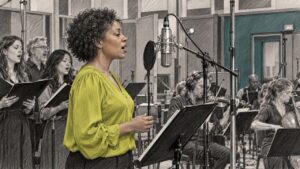
The best flow state music is wordless, steady and gently structured: a clear pulse, simple harmony, moderate dynamics and nothing that asks for your attention. It is there for your task, not the other way round. Live orchestral recordings suit that brief well, and that is the idea behind our meditation music library, recorded with live musicians, including sessions at Abbey Road Studios with the National Philharmonic. Below: what flow actually is, what the studies say music can do for it, and how to build a listening routine that doesn’t go stale.
TL;DR
- Flow is deep, effortless absorption in an active task where challenge and skill are matched. Music can support it, but it cannot create it on its own.
- In a 2025 study, music with strong rhythm, simple tonality and moderate dynamics improved mood and reaction speed. Loud, high-arousal music did the opposite in another trial.
- Choose instrumental, predictable, unobtrusive tracks, and rotate them: one study found the flow boost faded by 53% after 30 days of daily use.
- Match the sound to the task. Demanding reading or writing wants a calmer texture than repetitive work.
- Orchestral, theta-based and loopable tracks are easy to rotate. Our personal subscription is 21 € per month.
What flow state actually is (and isn’t)
Let’s start with the word itself, because “flow” gets used for everything from a good yoga class to a decent afternoon with a spreadsheet.
The University of Ulm’s psychology group describes flow as a deep absorption in an activity, free of self-reflection, with high engagement, strong concentration and a feeling of control. Time perception shifts, so you tend to underestimate how long you’ve been at it. The central condition is a perceived match between what the task demands and what you can do.
The American Psychological Association’s dictionary adds the same ingredients: skills fully used and matched to demands, high intrinsic motivation, loss of self- and time-awareness, and a sense of effortlessness. The term was proposed by Mihaly Csikszentmihalyi, and the APA dates its formal proposal to 1990.
Two points matter for anyone choosing music.
First, flow is not the same as plain concentration. Concentration is one ingredient. Flow adds the loss of self-consciousness, the sense of control and the merging with the activity.
Second, Ulm stresses that flow needs an active task with a skill element. Watching a sunset can be lovely but isn’t flow. So “flow state music” is really music for something you are doing: writing, coding, painting, practising an instrument, a vinyasa sequence, a focused sketching session. If you are lying down with your eyes closed, that is meditation or relaxation, and the sound brief is different (more on that below).
Can music really help you reach flow?
A fair amount of evidence says it can help, with some useful caveats about which music.
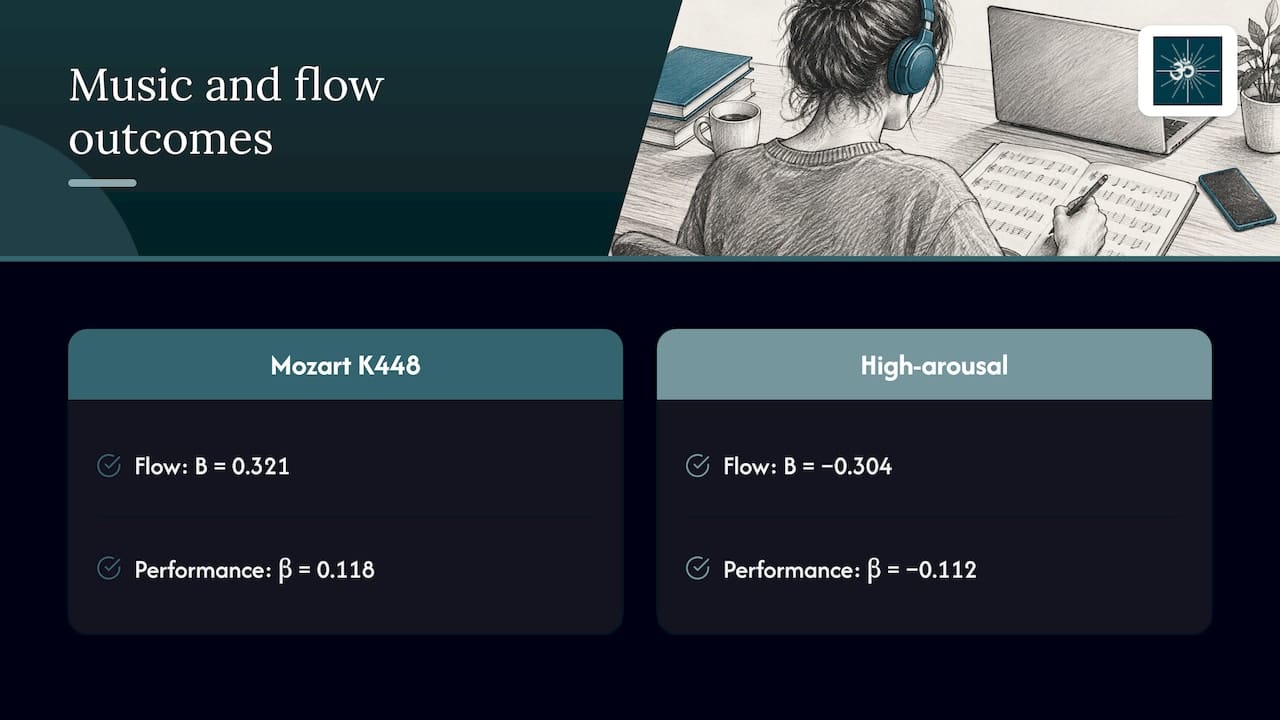
In a randomised study of 428 Chinese university students, Mozart’s Sonata K448 raised flow (B = 0.321), while high-arousal music lowered it (B = −0.304). The indirect effect on performance followed the same direction: positive for Mozart (β = 0.118), negative for the high-arousal music (β = −0.112). In the same study, flow fully mediated the effect on work engagement.
That is a nice little reminder that “energetic” is not the same as “flow-friendly”. A track that makes you want to leap off the sofa can keep you from sinking into the task.
A different line of research asked how people experience flow in music itself. Loepthien and Leipold’s studies (N = 207 and N = 383) found that participants reported more intense flow when listening than when playing. Flow was significantly associated with subjective well-being and listening experience. Listening is not a lesser pleasure than playing; it can be an absorbing activity in its own right.
There is also the humbler benefit of keeping the mind from wandering. In a UK study of 40 students, self-chosen background music increased task-focused states by reducing mind wandering. It did not change external distraction, and reaction times were not significantly faster than in silence. The authors read this as consistent with an arousal model: preferred music helps most on low-demand tasks, by pulling attention back from drifting.
So a sensible summary: music will not hand you flow, but the right kind lifts mood, steadies arousal and keeps your attention from slipping away, which are the conditions flow grows in.
What the music should sound like
The most useful study for picking tracks comes from Orpella, Liu Bowling, Tomaino and Ripollés (PLOS ONE, 2025). They compared music advertised for focus in several categories with pop hits and office noise, using a flanker task (a quick test of selective attention). Only the music promoted for “work flow” improved mood and speed together, with accuracy unchanged. It was lyric-free, with a strong rhythm, simple tonality, energy spread broadly across the frequency range and moderate dynamics.
The mood effect was clear: in the work-flow condition, 76% of participants reported a better mood, against fewer than half in each of the other conditions (44%, 36.7% and 36.17%).
Translate that into a checklist you can use at your desk:
-
No lyrics. Words compete with your own inner language, especially when you read or write.
-
A steady pulse. Rhythm gives the brain something to lock on to, without demanding a response.
-
Simple harmony. Familiar, consonant chord movement is easy to ignore in the best sense.
-
Moderate dynamics. No sudden crescendos, no cymbal crashes at minute eleven.
-
Warm, full sound. Energy spread across low, middle and high registers feels less thin than a lone synth line.
That last point is where live orchestral recording earns its keep. A string section, woodwind and soft percussion naturally spread energy across the spectrum, and live players breathe in a way that a loop of samples rarely does. I’ll admit I’m biased: I have spent years in rooms with orchestras, and I’ve yet to hear a laptop plug-in sneeze.
Match the music to the task
Not every task wants the same soundtrack. A simple guide:
| Task | What tends to work | What to avoid |
|---|---|---|
| Repetitive or routine work (admin, data entry, sorting photos) | Steady pulse, a little more movement, familiar tracks | Anything so slow it makes you drowsy |
| Creative work (design, composing, sketching) | Warm orchestral textures, slow-evolving harmony | Lyrics, tracks you know word for word |
| Demanding reading or writing | Very quiet, sparse, low-contrast instrumental | Busy melodies and sudden changes |
| Movement practice (yoga flow, tai chi, stretching) | Gentle, even tempo with a clear but soft pulse | Abrupt shifts in volume or mood |
| Stressful, high-stakes decisions | Lower the volume or pause the track | Fast, dense, high-arousal music |
The cautions come from the research. In a classic UCL experiment with 38 introverts and 38 extraverts, Furnham and Strbac found that background music and noise both worsened reading comprehension and prose recall compared with silence, and introverts were hit harder. That study used pop-style music with lyrics, which is exactly what the guidance above steers away from, but it shows why a demanding text deserves the quietest, plainest track you own.
On stressful decisions, a Psychology of Music experiment (Arboleda and colleagues) found that participants under music conditions showed strong cognitive effort during a stressful decision-making task, and the authors suggest turning the music off for those moments. It is a small, practical habit: when a task turns tense, lower the volume and bring the sound back once you’re settled.
Theta, binaural beats and frequencies: what the studies show
If you work with meditation sound, you will have met theta music, binaural beats and Solfeggio tones. Here’s what the recent studies say, in plain terms.
A binaural beat is what you perceive when each ear hears a slightly different tone through headphones; the brain perceives a slow “beat” at the difference between them. Theta is the 4 to 8 Hz range often linked with deep relaxation and inward attention.
In two studies by Amd (PLOS ONE, 2026, N = 101 and N = 118), people listened to five-minute self-administered beats. Only the theta beats (6 Hz) significantly improved calm and focus ratings (Hedge’s g > 0.84), while 9 and 12 Hz beats increased calm only. Beats embedded in pink noise were subjectively preferred over isolated beats, pink noise alone or silence.
A 2026 pilot in npj Digital Medicine (Cone and colleagues, n = 74) tested 11.5 minutes of alpha (9 to 11 Hz) or theta (4 to 7 Hz) audiovisual stimulation with binaural beats. Flow measures improved significantly on absorption, fluency and the total score, with no difference between the two frequency protocols. It was an uncontrolled pilot, so treat it as a promising early result.
An Italian pilot with 13 healthy participants found that binaural beats adapted in real time within the theta range lowered stress index and heart rate during stressful arithmetic, compared with constant beats.
What does this mean for you? Theta-based tracks make sense as a gentle backdrop for the settling in phase of a session, and as a bridge between meditation and active work. If you want to go deeper on how sound and mindfulness work together, our article on science-backed sound and music for mindfulness covers it in more detail.
Keeping it fresh: why rotation matters
Here is the part nobody puts on a playlist cover. The same study that found the Mozart effect also tracked what happened over time. After 30 days of 20 minutes daily, the flow-boosting effect had dropped by 53% (B = 0.150 against a baseline of 0.321), although a residual effect remained (β = 0.072).
The author proposes a hybrid explanation: music first works through novelty-driven dopamine release, then shifts to schema-based cognitive priming, as your brain learns what the track “means”. The practical recommendation is to rotate your music and use structured tracks in phases.
A routine that follows from this:
-
Build a small rotation. Five to eight tracks you like, in a similar mood, is enough.
-
Assign roles. One for starting a session, one or two for the long middle stretch, one for winding down.
-
Keep one “anchor” track. A familiar piece that cues the brain it’s time to begin is useful. Just don’t play it every hour of every day.
-
Refresh monthly. Swap two or three tracks so novelty stays in the mix.
-
Loop with care. If you need a long stretch, a well-edited loop beats a track that ends abruptly. We explain how in our guide to choosing and looping meditation music.
This is why a library beats a single “perfect” track. The perfect track lasts about a fortnight, and then you start hearing it in your sleep.
Meditation versus flow: two different sound jobs
Meditation practitioners often ask whether the same track can do both. Usually it can’t, and that’s fine.
Meditation music is meant to help you let go of tasks and rest attention. Flow music is meant to support an active task. The first can be slower, more spacious, with long drones, deep theta textures and little rhythm. The second wants a pulse and a touch more forward motion.
A practical way to use both: begin a session with a short meditation (five to ten minutes) using a theta or orchestral meditation track, then switch to a steadier, rhythmic piece as you start your work or movement. The transition itself is a ritual your brain learns to read.
Choosing a soundtrack: a short buying guide
When you’re selecting tracks, whether for yourself or for clients, these questions keep you honest:
-
Is it instrumental throughout? Check the whole running time, not just the first minute.
-
Does the energy stay moderate? Look for even dynamics and no sudden peaks.
-
Is it recorded with live musicians? Natural performance variation gives long listens a living quality.
-
Do you have the right licence? Personal listening and professional use (classes, therapy sessions, apps, videos) are licensed differently.
-
Can you build a rotation? A library with many tracks in a consistent style lets you refresh without changing mood entirely.
On that last point, our personal subscription costs 21 € per month and our professional subscription 150 € per month. The first is for your own listening; the second covers professional use such as classes, therapy sessions, guided audio and apps.
Who made this music, and why it matters
Music for deep states depends heavily on the people shaping it. Our tracks are composed and produced by Robert Emery, working alongside fellow composer and producer Moritz Schneider, and recorded with live musicians, including sessions at Abbey Road Studios with the National Philharmonic. The aim is orchestral writing that is built for listening states, with scientific sound design such as binaural, theta and Solfeggio frequencies and 3D surround sound layered into the production.
You can read more about the composers on our site. The short version: a session musician’s ear for what a string section can do quietly is, in our view, what separates a track that lets you forget it’s playing from one you notice every thirty seconds.
Our perspective
I’ve spent a good part of my life around orchestras, and the honest truth is that the best compliment a piece of focus music can receive is silence. Nobody says “what was that cello line at 14 minutes?” That means it did its job.
When we record for Orchestral Meditations, we think about that all the time. We write for live musicians, record them in rooms like Abbey Road, and shape the sound so it holds a steady, warm space rather than demanding a reaction. Then we layer in the sound design: theta and Solfeggio frequencies, binaural elements and 3D surround, so the listening experience feels wide and unhurried instead of flat.
The research on flow keeps pointing the same way: rhythm that’s steady, harmony that’s simple, dynamics that stay moderate, and enough variety that your brain doesn’t switch off. That’s a brief a composer can write to, and it’s one reason we prefer a library of exclusive, carefully made tracks to a single endlessly repeated one.
My advice? Pick a handful of pieces, give each a job, and let the music disappear into the work. If you find yourself humming along, swap it out. (I say this as someone who has hummed along to his own mixes at 2 a.m. It happens.)
ROBERT
Put it into practice
If you want a rotation of orchestral meditation and focus-friendly tracks that you can refresh month by month, our personal subscription is 21 € per month. Practitioners, teachers and therapists who play music in sessions, or creators who use it in audio and apps, can look at the professional subscription at 150 € per month, or browse the royalty-free meditation music collection for licensing options.
FAQ
What does flow mean in music?
In psychology, flow is a state of deep, effortless absorption in an activity where your skills match the challenge. In music it can happen when you play, and, according to one pair of studies, often more intensely when you listen. For work, flow music is simply sound that supports that absorption instead of interrupting it.
Which music is best for getting into flow?
Wordless music with a steady rhythm, simple harmony and moderate dynamics. A 2025 study found exactly this profile improved mood and reaction speed, while high-arousal music lowered flow in another trial. Orchestral and theta-based instrumental tracks fit this description well.
Does music stimulate dopamine?
One 2025 study proposes that music first works through novelty-driven dopamine release and later through learned expectations. That is a hypothesis from the author, not a measurement, but it explains why the effect faded by 53% over 30 days of the same track. Rotating your music keeps the novelty alive.
Should I use the same track every day?
A small anchor track for starting a session works well, but the rest of your playlist benefits from rotation. Swapping two or three pieces a month is an easy rhythm. A library or subscription makes that painless.
Can I use flow music in classes or sessions with clients?
Personal and professional uses are licensed separately. If you play music in yoga classes, therapy sessions, massage, guided audio or apps, the professional licence is the one designed for that, with the professional subscription at 150 € per month.
Sources
-
The Impact of Background Music on Flow, Work Engagement and Performance (PMC, 2025)
-
Flow in music performance and music listening (Psychology of Music, 2022)
-
The effect of preferred background music on task-focus (PMC)
-
Effects of music advertised to support focus on mood and cognition (PMC, 2025)
-
Effects of music advertised to support focus, PLOS ONE full text
-
A stressful task is when to turn off the music (Psychology of Music)
-
Effects of self-administered binaural beats on meditative states (PLOS ONE, 2026)
-
Alpha and theta audiovisual interventions (npj Digital Medicine, 2026)
-
Adaptive binaural beats for acute mental stress (Applied Sciences, 2025)