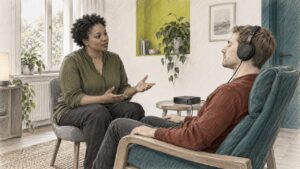
Theta music for creativity is slow, spacious audio built around the 4–8 Hz range, the band of brain activity linked to drifting, daydreaming and meditative states. You use it on headphones, before or during a creative session, to settle into the loose, inward attention where ideas tend to turn up. Our theta orchestral meditations are recorded with live musicians at Abbey Road Studios, so the sound you settle into is played, not synthesised.
I will be honest about one thing at the start. A music track is not a magic idea machine (I have tried, and my unfinished symphonies are a tidy monument to that). What it can do is give you a reliable, pleasant doorway into a quieter state of mind, and the research gives us some interesting reasons to take that doorway seriously.
TL;DR
- Theta is usually defined as brain activity of roughly 4–8 Hz, associated with meditative states, daydreaming and the drowsy edge of sleep.
- Theta binaural beats work by playing two slightly different tones, one in each ear, so you need headphones.
- A 2017 EEG study reported more theta activity during a 30-minute 6 Hz binaural beat, with a pattern resembling a meditative state.
- A small 2023–2024 Portuguese pilot with 26 students reported better creativity scores after 20 minutes of daily theta binaural beats.
- Keep the volume moderate: German occupational-medicine guidance puts the start of inner-ear risk at 85 dB(A) daily exposure.
What theta music actually is
Your brain’s electrical activity, which doctors record with an EEG (electroencephalogram, a set of sensors on the scalp), rises and falls in rhythms. Those rhythms are sorted into bands by speed. Theta is one of the slower ones. A 2017 study on a 6 Hz binaural beat describes theta as 4–8 Hz and associates it with alertness, attention, working memory, concentration and meditative states. The APA Dictionary of Psychology gives 4–7 Hz and notes that theta turns up in the drowsy state before sleep, and also in trances, hypnosis and daydreams.
So “theta music” is a loose label for audio made to sit in or point towards that slow territory. It comes in a few flavours:
- Theta binaural beats. Two pure tones with a small gap in pitch, one per ear. Your brain perceives a pulse at the difference between them.
- Ambient or orchestral theta music. Slow, sustained instrumental writing, often with a binaural layer underneath.
- Isochronic or pulsed tones. A single tone switched on and off at a steady rate. This works without the stereo split.
The binaural version has the neatest arithmetic. The 2017 study gives the example of 250 Hz in one ear and 256 Hz in the other, which produces a perceived 6 Hz beat, squarely in the theta range. The 2023 PLOS ONE systematic review describes binaural beats as slightly different tones presented separately to each ear, with a perceived fluctuation at the frequency difference. It also notes that headphones are normally used so that each tone reaches only one ear.
Note that the beat is not a sound anyone plays. It is something your auditory system constructs from the gap. That is a rather lovely little fact, and it is why a pair of decent headphones matters more than anything else in your setup.
How theta music is meant to support creativity
The idea is not that theta makes you cleverer. It is that creative work needs two different modes of mind, and most of us are very good at only one of them.
The first mode is the busy one: judging, editing, answering messages, counting. The second is the loose one: letting thoughts wander, linking things that do not obviously belong together, noticing a half-formed image before it vanishes. Theta activity is associated with the second kind of state, the meditative, drifting, daydreaming end of the range. Theta-style audio is an attempt to give you a gentle, repeatable cue to step from the first mode into the second.
In practice, listeners and practitioners use it in three ways:
- Before a session. Ten to twenty minutes of listening to let the day’s noise settle, then you start to write, paint, compose or plan.
- During a session. Quiet theta music as a stable background, without lyrics to pull your attention.
- As an incubation break. You stop working on a stuck problem, lie back with headphones, and let your mind wander on purpose.
If you are a yoga teacher sequencing a class, a therapist planning a guided imagery session or a content creator scoring a visualisation, the same logic applies: a slow, sustained, unobtrusive sound bed supports the inward state you are inviting people into. We cover the relaxation side of this, and why sound is such a direct route into it, in our piece on science-backed sound and music for mindfulness.
There is also a plain, human link between relaxation and ideas. Most people have had their best thought in the shower or on a long walk, which is to say, when they stopped trying. Gentle approaches to winding down, such as the effective relaxation techniques for mental health described by a healthcare provider, make the same point from a clinical angle: a calmer body makes a freer mind. Theta music is one way to build that calm into a routine.
What the research reports
Here is what individual studies actually did and found, because the details matter more than the headlines.
Theta activity during listening
The 2017 study played a 6 Hz binaural beat on a 250 Hz carrier tone for 30 minutes. Participants sat upright, and the volume was set at 65 dB SPL, which is a moderate level (comparable to ordinary conversation). The researchers reported increased theta activity during listening, in a pattern they described as similar to a meditative state. That is the closest research match to what theta meditation music sets out to do.
Creativity scores after daily listening
A quasi-experimental pilot study from a Portuguese university followed 26 students. It reported improvements in creativity, psychological wellbeing and mood disturbance after 20 minutes of daily theta binaural beats, again using a 6 Hz beat on a 250 Hz carrier. It is a small pilot, so it is best read as an encouraging first signal and a sensible protocol to borrow for your own routine: short, daily and consistent.
Binaural beats and creative thinking more broadly
The best-known experiment on binaural beats and creativity, published in Frontiers in Human Neuroscience in 2013, used 10 Hz alpha and 40 Hz gamma beats rather than theta. It measured divergent thinking (coming up with many different ideas) and convergent thinking (finding the one right answer). Binaural beats affected divergent thinking but not convergent thinking. People with lower spontaneous eye-blink rates generally benefited from the alpha stimulation. A 2015 review of auditory beat stimulation reports the same creativity finding, with 3 minutes of beats before and during the tasks.
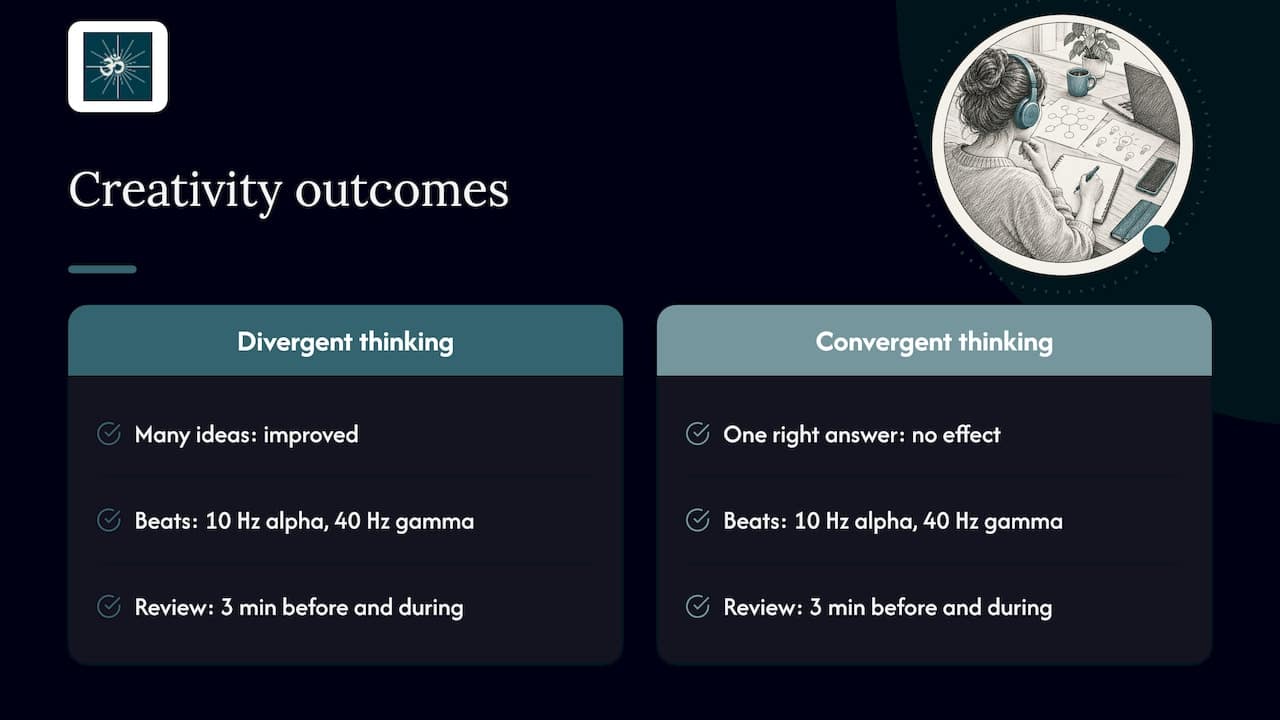
Two things are worth taking from this. First, the creative benefit that has been measured sits on the idea-generating side of creativity, which is exactly the side where you want a loose, wandering mind. Second, individual differences are real: the same track may suit one listener more than another, so a few weeks of your own notes will tell you more than any study.
Stress, mood and the wider picture
A 2026 systematic review of music and binaural beat interventions in young adults reported generally promising effects for anxiety, sleep, stress physiology, mood and cognition. One included study of theta-frequency beats reported an effect size of d = 0.59 for physiological stress reduction. Since stress is the great enemy of loose, playful thinking, that matters for anyone who creates under pressure. The reviewers also noted that samples were small and protocols varied, which is why we describe the studies one by one rather than promising a fixed outcome.
Why live orchestral theta feels different
Most theta tracks you will find online are a synth pad and a binaural tone. They do the job of delivering a frequency. Ours set out to do something a little more ambitious: wrap the frequency in real music.
Orchestral Meditations was created by the composers and producers Robert Emery and Moritz Schneider, who have worked together for thirteen years. Robert is an English pianist and conductor who, according to his Wikipedia entry, became known for performing with artists including Russell Watson, Meat Loaf and Stewart Copeland, and was named music director of the National Philharmonic Orchestra of Great Britain in 2023. The same entry notes a recording session at Abbey Road Studios with over 128 musicians and singers for the Orchestral Meditations project. Moritz has been writing music for feature films, album productions and musicals for over 20 years, and has had several No. 1 albums in the UK classical charts.
Why does that matter to a creative listener? Three reasons.
- Tone you can sink into. Strings, brass, choir and piano played by humans carry small variations in timing and breath. For a long listen, that organic movement holds attention gently without grabbing it.
- Space. Our tracks use 3D surround sound alongside binaural and theta frequencies, which gives the music a sense of room around you, handy when you want an inner landscape rather than a flat background.
- Music first, frequency second. Our approach is to treat the theta layer as part of a composition, not a replacement for one. Moritz puts it this way on our site: the power of frequencies created by recording a live instrument, played by a talented heartbeat, cannot be beaten.
Our library also includes Solfeggio-frequency tracks, for listeners who like those tunings in their practice. They sit alongside the theta recordings, so you can build a small personal rotation.
A theta session for creative work, step by step
Here is a routine you can try tomorrow morning. It borrows the shape of the studies above (headphones, upright seat, moderate volume, a fixed daily slot) and adds the practical bits that tend to go wrong.
- Pick a clear intention. Write one line: “I want to find three directions for the chorus” or “I want to see the next scene.” A vague session drifts into a nap. A session with an open question drifts somewhere useful. Where it goes wrong: choosing a deadline-sized task. Keep the question small and curious.
- Put on stereo headphones. Binaural beats rely on each ear receiving its own tone, which is why headphones are the norm in the research. Speakers blend the tones and the effect is lost. Where it goes wrong: one earbud in, one out, or a mono setting on your phone.
- Set the volume low to moderate. Aim for a level where you could still hear someone talking softly next to you. The 2017 EEG study used 65 dB SPL, around that level. Louder does not mean deeper.
- Sit upright or recline comfortably, eyes closed or soft. The 2017 study had participants seated upright. If you tend to fall asleep, sit; if you are wired, lie back. Where it goes wrong: working from a sofa with a laptop on your knees and calling it meditation.
- Listen for 20 minutes. That is the daily duration used in the Portuguese pilot. The 2017 study used 30 minutes. Both are short enough to fit before a work block. For your first week, pick one and stick to it.
- Let thoughts come, and catch them. Keep a notebook within reach. Do not analyse; jot a word or a sketch and go back to listening.
- Move straight into the work. Take the notebook, take your instrument, and start for ten minutes before checking messages. The state is fragile, and email is the cat that knocks the vase off the shelf.
- Repeat daily for two weeks and keep short notes. Rate your session from 1 to 5 for ease of ideas. Patterns show up faster than you expect.
If you want the library to do the choosing, our personal subscription is built for this kind of daily habit: you rotate through recordings rather than looping one track until you can hum it in your sleep.
Listening safely
The beat frequency is not the main thing to watch. Volume is. German occupational-medicine guidance on noise-induced hearing loss identifies 85 dB(A) daily exposure as the level at which the risk of damage to the inner ear’s hair cells begins, with the risk depending on both loudness and duration. Meditation listening should sit comfortably below that, and a long session at a low level is exactly what we want.
One more point on who the studies covered. A 2021–2022 Taiwanese study of binaural beat therapy excluded people with mental illness, acute illness, epilepsy, eye problems, vertigo or hearing impairment. If any of those apply to you, talk to your doctor before starting a binaural beat routine, and stop listening if you feel dizzy or unwell. Do not listen while driving, cycling or operating machinery: closed-eyes, headphones-on music belongs in a safe, stationary place.
Our perspective: why we record theta music with a live orchestra
When Moritz and I started Orchestral Meditations, the question we kept asking each other was simple: why does so much meditation music sound like a screensaver? We are musicians. We have spent our lives in rooms where a hundred people breathe and play together, and we know what that does to the air.
So we took the theta idea, slow frequencies that sit in the meditative range, and gave it to the National Philharmonic at Abbey Road. Real strings, real choir, real room. Then we layered binaural beats and theta frequencies into 3D surround sound, so the music is not just something you hear but something you sit inside.
For creative people, that matters in a very practical way. A creative session needs a sound that you can forget about and still feel held by. Synthetic loops tend to tell the ear exactly what is coming next. Live orchestral writing keeps a quiet sense of life going, which is what we have designed our tracks to give you.
The science of beats and brainwaves is a young and fascinating field, and we follow it with real curiosity. Our job is to make the listening experience worth coming back to every day, because a routine you enjoy is a routine you keep. That is where creative momentum comes from, and it is why we have made quality, not quantity, the heart of our library.
ROBERT
Using the music in your practice or product
If you teach yoga, run guided meditations, work as a therapist or build apps, you will need more than a good track: you need the right licence. Our music is royalty-free, with personal and professional licensing options for meditation, therapy, yoga, apps, guided audio, massage and wellness content.
For personal listening, the personal subscription costs €21 per month. For professional use, the professional subscription costs €150 per month. If you want to browse the catalogue for a class, a series or an app, start at our royalty-free meditation music page.
Whichever route you take, pick two or three tracks and give them a fortnight before judging them. A track needs a few listens to become a cue, and a cue is what turns a lovely recording into a working creative tool.
FAQ
What frequency is best for creativity?
Theta, at roughly 4–8 Hz, is the band most associated with meditative, daydreaming states, and the pilot study that reported creativity gains used a 6 Hz beat. The best-known creativity experiment used 10 Hz alpha and 40 Hz gamma beats and found effects on idea generation. Many creators rotate between a slower theta session for incubation and a lighter one for working.
Do I need headphones for theta binaural beats?
Yes. Binaural beats depend on each ear receiving a slightly different tone, and research protocols use headphones for exactly that reason. Stereo headphones or earbuds worn properly in both ears are enough. Speakers mix the tones in the room and the beat is not produced in the same way.
How long should a theta session last?
Studies have used 20 to 30 minutes: the Portuguese pilot had 20 minutes daily, and the 2017 EEG study had a single 30-minute listen. Starting with 20 minutes before a creative block is a sensible routine. Keep the volume low to moderate throughout.
Can I use theta music in my classes, videos or app?
Yes, with the right licence. Our tracks are royalty-free and come with personal and professional licensing options for meditation, therapy, yoga, apps, guided audio, massage and wellness content. The professional subscription is €150 per month.
Is theta music safe for everyone?
For most listeners, a moderate volume in a safe, stationary setting is the key. If you have epilepsy, vertigo, hearing impairment or a mental health condition, speak to your doctor before starting binaural beats. Never listen while driving or operating machinery.
Sources
- Brain Responses to a 6-Hz Binaural Beat (PMC, 2017)
- Binaural beats to entrain the brain? A systematic review (PLOS ONE, 2023)
- APA Dictionary of Psychology: theta wave
- The impact of binaural beats on creativity (Frontiers in Human Neuroscience, 2013)
- Auditory Beat Stimulation and its Effects on Cognition and Emotion (PMC, 2015)
- Effects of theta-binaural beats auditory stimulation (Universidade Católica Portuguesa)
- Music and binaural beat interventions for young adults (PMC, 2026)
- Effects of binaural beat therapy with different frequencies (PMC)
- Berufskrankheit Lärmschwerhörigkeit (ASU Arbeitsmedizin, 2024)
- Robert Emery (pianist), Wikipedia