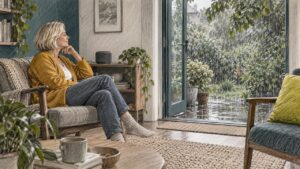
A 3D nature meditation puts you inside a natural place using spatial sound, and sometimes 360° video, so that birdsong seems to come from above, water from your left and wind from behind you. You don’t need a headset to do it. Good headphones and a well-made, spatially recorded piece of music are enough, and the best research we found suggests that the audio carries most of the relaxation.
I’ll be honest: when I first heard the phrase, I pictured a man in a clunky headset standing in his living room, politely waving at a virtual waterfall. The reality is calmer, cheaper and far more musical. Below you’ll find what the term means, what studies say, how to practise step by step, and how to choose between audio, video and VR.
TL;DR
- 3D nature meditation means a nature scene built from spatial (3D) sound, with or without 360° visuals, used as the anchor for your attention.
- In a 2026 German randomised trial, 360° VR felt more immersive, yet gave no extra physiological relaxation compared with audio-only breathing meditation.
- Nature-based imagery has beaten non-nature imagery for anxiety in research, and multisensory digital nature shows promise for stress.
- Headphones, a quiet 15 to 20 minutes and a spatially recorded orchestral track are all you need to begin.
- Our library of orchestral meditations, recorded at Abbey Road Studios with the National Philharmonic, includes 3D surround, binaural, theta and Solfeggio-based tracks, from €21 per month.
What 3D nature meditation actually is
Three things get muddled under this keyword, so let’s separate them.
Guided nature visualisation. A voice asks you to picture a forest or a beach. Guided imagery is a relaxation technique in which you deliberately imagine a peaceful scene, often led by a counsellor or a recording, to trigger the body’s natural relaxation response: slower breathing, lower blood pressure, a calmer heart rate. The scene lives entirely in your imagination.
Nature sounds. A recording of rain, a stream or a woodland dawn. Often it is a stereo loop, so everything sits in a flat line between your ears.
3D nature meditation. The scene is placed around you. Sounds are positioned in space, so a stream can sit at your left shoulder while leaves move overhead. Some versions add 360° video or a VR headset. Others, the ones I’d start with, keep your eyes closed and let spatial audio do the work, which is closer to how meditation is traditionally practised anyway.
So the difference is not that one is “real” and the other imaginary. It is how much of the scene is handed to you by the sound, and how little your mind has to build alone. For a restless mind, that matters.

How a session works
A typical 3D nature session has four parts, whatever the format.
- Arrival. You settle, close your eyes or soften your gaze, and let the first soundscape establish the place: a clearing, a shoreline, a mountain valley.
- Anchoring. Your attention rests on a breath, a sound or a bodily sensation. The nature scene gives the mind something gentle to hold.
- Deepening. Sounds drift slowly through the space, and music or a steady tone supports the feeling of depth. This is where binaural or theta-oriented design comes in, if the track uses it.
- Return. The scene thins out and you come back to the room, to the weight of the chair and the temperature of the air.
The natural environments people use most are forests, water (streams, waterfalls, sea), open landscapes and gardens. In audio and video formats you can find all of them, from Tasmanian shores to the Grand Canyon in VR experiences.
What the research says
It is worth being precise here, because this is a young field and the headlines run ahead of the data. What follows is what we’d happily repeat to a friend.
Nature helps, even when it is digital
In a study of 48 people with moderate anxiety, nature-based guided imagery (waves on a beach, trees rustling in a forest) reduced anxiety more than non-nature imagery. A 2024 systematic review of multisensory digital nature, which combines sound, vision and sometimes smell, found promise for reducing stress and anxiety, with outcomes often comparable to time in real natural environments.
A 2022 study by Reese, Stahlberg and Menzel found that immersive VR nature can be restorative in a way similar to being outdoors, a useful option when you can’t get to a wood. And a proof-of-concept study with 63 participants found that 360° nature videos increased calmness and feelings of connection with nature, with positive mood rising afterwards.
Sound alone is a heavyweight
A study commissioned by the UK National Trust, reported in German by Deutschlandfunk Nova, found that 600 people who listened to forest sounds such as birdsong and rustling leaves felt 30 percent less stressed than before. Guided meditation was somewhat more effective still, which is a good argument for combining the two: a natural soundscape with a calm, structured practice.
Does the video part add anything?
This is the most interesting finding for anyone shopping for gear. In a 2026 randomised controlled trial from Germany, 100 healthy adults did a breathing meditation with a 360° VR nature scene, a 2D display or audio only. Everyone relaxed as expected: lower heart rate, lower skin conductance, more parasympathetic activity. The VR group felt more immersed, but the extra physiological benefit was not significant compared with audio only.
Read that the way a musician would: the sound did the heavy lifting. You can leave the headset in the cupboard and still get the relaxation response. A 2021 review likewise noted that vocal guided meditation in nature-inspired VR hadn’t shown clear differences in mindfulness levels compared with practice without the technology. Presence still seems to matter, though: a 2019 study linked presence, meditation depth and restorativeness in nature-inspired scenes for guided mindfulness training.
Why spatial sound in particular
A 2024 PLOS study by Sudre and colleagues tested sounds that move through space, including binaural beats and panning, at 6 Hz and 40 Hz. These had a stronger effect on EEG activity than a control and improved relaxation. The authors read this as support for the idea that the spatial qualities of the sound matter, not just the sensation of beating. That is exactly the territory 3D nature meditation lives in. Sound that is felt as well as heard is also studied elsewhere, for instance in vibroacoustic therapy research.
A fair summary: nature plus spatial sound has good evidence behind it for calming the body, and none of it requires expensive hardware.
How to practise 3D nature meditation, step by step
Here is the routine I’d give a friend. At each step I’ll say what it takes and where it usually goes wrong.
Step 1: Choose your scene and your sound
Pick one place and stay with it for a week. Hopping between a rainforest on Monday and an ocean on Tuesday keeps your mind curious, which is the opposite of what you want.
Where it goes wrong: choosing a thin, looped stereo recording and wondering why nothing feels three-dimensional. Spatial depth comes from how the sound was recorded and mixed. Our tracks are recorded with live musicians at Abbey Road Studios with the National Philharmonic and use 3D surround sound, which is what gives the music its sense of space around you.
Step 2: Use headphones
Binaural and 3D effects rely on each ear receiving a slightly different signal, so closed or good over-ear headphones are the single most useful upgrade. Speakers blur the effect.
Where it goes wrong: tiny volume mistakes. Set it so the quietest sound, a distant bird, is only just audible. If you are straining, you are not meditating.
Step 3: Prepare the room, not just the playlist
Dim the lights, silence your phone and sit or lie where you will not be tempted to fall asleep unless sleep is the goal. Ten minutes of preparation beats an hour of fidgeting.
Step 4: Anchor on your breath first
Spend the first two minutes simply noticing your breathing. In the German trial above, the task was a breathing meditation, and that is a sensible template: scene as backdrop, breath as anchor. If you want a clear walkthrough of the technique itself, our step-by-step guided meditation guide covers it.
Step 5: Let the soundscape move you
When a sound travels from left to right, follow it with your attention, then let it go. When your mind wanders (and it will, mine once drafted a shopping list during a flawless oboe passage), gently return to the breath or the nearest sound. No scolding required.
Step 6: Come back slowly
When the track ends, stay still for a minute. Notice the room. Then stretch. Rushing out of the scene is like slamming the door on a good conversation.
Step 7: Repeat, briefly and regularly
Fifteen to twenty minutes most days beats a heroic hour once a month. Keep a one-line note of how you feel afterwards. After two weeks the notes tell you more than any study can.
Audio, video or VR: which format suits you?
| Format | What it gives you | Practical points |
|---|---|---|
| Spatial audio with eyes closed | Depth, direction and music; the focus of traditional meditation | Needs good headphones only; works for sleep and travel |
| 360° or 4K video on a screen | A visual anchor and a sense of place | Needs a screen and some light in the room |
| VR headset | Highest sense of presence | Headset comfort, glasses and Wi-Fi can interfere |
In the New Zealand study of 360° VR nature, prior VR experience affected ratings, and participants mentioned headset discomfort, Wi-Fi problems and difficulty wearing glasses. Audio avoids all of that. It also suits people with limited mobility, visual fatigue or little space.
A note on comfort with VR
VR can cause simulator sickness in some people. In the 2026 trial, high visual fidelity and smooth playback were used to reduce it. If you feel dizzy or nauseous, stop, take the headset off and rest. If symptoms keep returning, speak to your doctor. Eyes-closed spatial audio sidesteps the issue entirely.
Our view on nature, music and space
I’ve spent a good part of my life around orchestras, and one thing never changes: a room full of live musicians sounds like a place, not a file. A cello has a position. A flute has air around it. When we record at Abbey Road Studios with the National Philharmonic, that sense of place is what we are chasing.
Nature meditation has always worked on a simple principle: give the mind somewhere safe to be. Spatial sound does that without asking you to strap anything to your face. The research is encouraging on this point: in the 2026 German trial, relaxation happened with audio alone, and the sound did the work.
That is why we put so much into 3D surround recording, binaural beats, theta frequencies and Solfeggio-based tuning. Together with Moritz Schneider, I compose every piece to guide a listener gently through a state, from arrival to depth to return, rather than to fill a silence.
Mass-produced meditation tracks tend to be a loop and a hope. We would rather give you music written by composers, played by musicians, and built for headphones. Close your eyes, and let the room open up.
ROBERT
The people behind the music
You’ll want to know who is writing the music you let into your head for twenty minutes a day. Our recordings are composed by Robert Emery and Moritz Schneider, whose work is recorded at Abbey Road Studios with the National Philharmonic and shaped around binaural beats, theta frequencies and Solfeggio-based tuning. Their approach is to treat orchestral composition as a practice with a purpose: guiding a listener through a particular emotional state rather than simply providing background pleasantness.
That matters for nature meditation because a landscape needs a soundtrack that behaves like the landscape: unhurried, spacious, never demanding your attention. Writing for live strings and winds, then capturing them in 3D, is a very different craft from looping a stock sample.
Using our music for your own 3D nature practice
If you’d like to try this with music built for it, our library offers orchestral meditations in 3D surround, binaural, theta and Solfeggio-based versions. Listen with headphones, pick the scene in your mind (a forest edge, a shoreline), and let the orchestra supply the space around it.
The personal subscription costs €21 per month and gives you access to the meditation music library for your own practice.
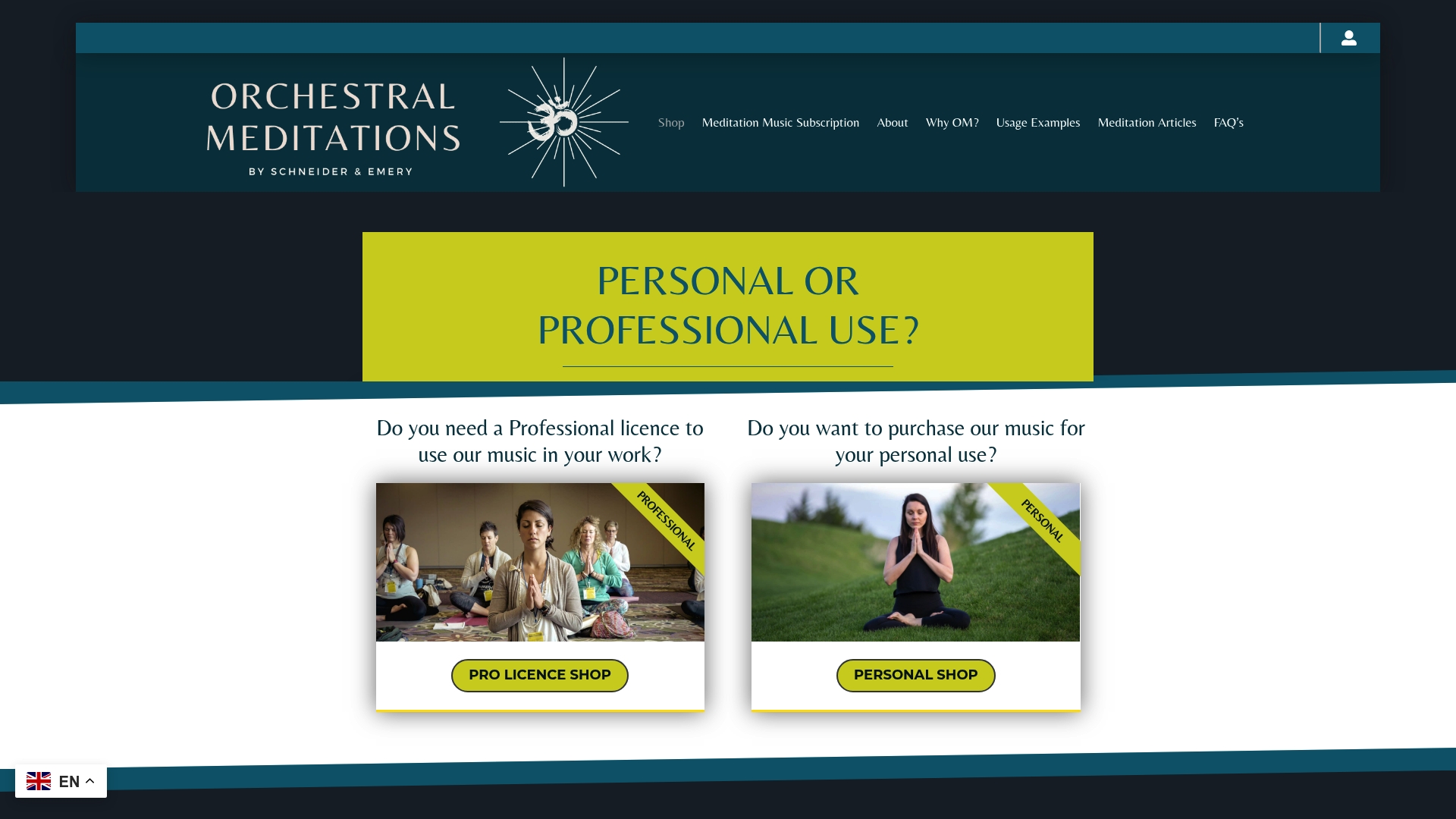
Teaching yoga or meditation, working with clients, or building an app or guided audio? The professional subscription is €150 per month and comes with professional licensing, and our royalty-free meditation music is licensed for use in therapy, yoga, apps, guided audio, massage and wellness content.
Making it stick: small habits that help
- Same time, same place. Your nervous system learns the cue.
- One scene per week. Familiarity deepens the effect.
- Pair sound with a structured practice. The National Trust study found guided meditation was a little more effective than forest sound alone, so a gentle structure helps. Our piece on science-backed sound and music for mindfulness goes deeper.
- Keep the volume low. Quiet detail is what makes space audible.
- Add real nature when you can. A walk and a recording complement each other nicely.
If you’re dealing with persistent anxiety, low mood or trouble sleeping, meditation music is a supportive practice, and your GP or a licensed therapist is the right person to talk to about how it fits with your care.
FAQ
Do I need a VR headset for 3D nature meditation?
No. In a 2026 German trial, 360° VR felt more immersive, but it added no significant physiological relaxation over audio-only breathing meditation. Good headphones and a spatially recorded track are a complete setup.
Is 3D nature meditation the same as binaural beats?
Not quite. Binaural beats use slightly different tones in each ear, while 3D nature meditation places sounds around you. They combine well, and a 2024 PLOS study found that spatially moving sounds had a stronger effect on brain activity and relaxation than a control.
How long should a session last?
Fifteen to twenty minutes is a comfortable starting point for most people, and ten minutes is perfectly respectable on a busy day. Regular short sessions are easier to keep up than occasional long ones.
Can I use nature meditation music in my classes or app?
Yes, with the right licence. Our professional subscription and royalty-free music are licensed for yoga, therapy, apps, guided audio, massage and wellness content, while the personal subscription is for your own listening.
Sources
- Guided imagery: Techniques, benefits, and more (Medical News Today, 2022)
- Audio-visual-olfactory immersive digital nature (Frontiers in Virtual Reality, 2024)
- Digital shinrin-yoku: nature experiences in virtual reality (Virtual Reality, 2022)
- Virtual nature and well-being (PMC)
- Umweltpsychologie: Waldgeräusche entspannender als Meditation (Deutschlandfunk Nova, 2019)
- Does a 360° VR nature environment augment relaxation during MBSR (Virtual Reality, 2026)
- Challenges and Opportunities of Immersive Technologies for Mindfulness (Frontiers in Virtual Reality, 2021)
- Nature Inspired Scenes for Guided Mindfulness Training (Springer, 2019)
- A new perspective on binaural beats (PLOS, 2024)